

Rin-se, Repeat: Unheralded Miyaji Downs Matsuyuki Twice for 68kg Title, Ticket to Worlds
Saturday, May 29, 2021 - 17:10 By Ken Marantz
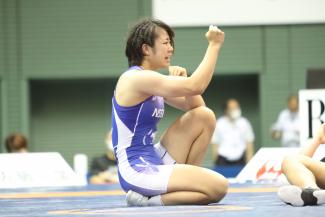
TOKYO (May 29) --- After coming up short at 62kg, Rin MIYAJI decided she needed to go back to the drawing board and restructure her training to up her game. She also moved all the way up to 68kg, and it paid off.
The unheralded Miyaji pulled off one of the surprises of the Meiji Cup All-Japan Invitational Championships on Saturday, defeating world junior champion Naruha MATSUYUKI for the women's 68kg title, then beating her again for a place on Japan's team to this year's World Championships.
"First of all, I'm relieved," the 20-year-old Miyaji said. "It's the first time to make a final and win at an All-Japan, so I'm really happy."
In the gold-medal match, Miyaji trailed early in the second period before storming to an 8-2 victory over Matsuyuki. The two then returned to the mat about an hour later for a playoff for the world team spot, and Miyaji was never in danger as she handily won 7-2.
"In the final, no matter how matter points I gave up, I kept imagining my hand being raised in the end," Miyaji said. "And in the end I won, so it was alright."
Miyaji had finished third at 62kg in December at the Emperor's Cup All-Japan Championships, where Matsuyuki won the 68kg gold. That tournament and the Meiji Cup serve as domestic qualifiers for the World Championships to be held in October in Oslo, with a playoff to decide the entry in weight classes in which the titlists are different.
None of the 12 wrestlers who have qualified for the Tokyo Olympics, including Risako KAWAI and Kenichiro FUMITA, entered the tournament at Tokyo's Komazawa Gym, opening the door for others to fill the places in Oslo.
That was the case for Miyaji, who knew that changing weight classes for the Meiji Cup doubled the difficultly of the task facing her. But she had a plan and it entailed being as well prepared as possible by changing her training regimen.
"I'm not the dextrous type and my movement is not very accomplished, so for this tournament, I changed everything in the basics of my training, and today this was the result," Miyaji said.
Asked to be more specific, she replied, "My defense against tackles has always been a problem. To overcome that, I practiced defensive wrestling every day. Also, I am underweight, so I've been working on filling out my body. I believe that I have gotten stronger physically."
Chikara TANABE, the head coach at Nippon Sports Science University and a former Olympic medalist, said the loss at the Emperor's Cup spurred the change in direction. It also helped that one of the coaches at the university is four-time Olympic gold medalist Kaori ICHO.
"She's the type who always goes all out in practice," Tanabe said. "This time, she cut back on running and worked on building strength.
"She worked all the time with Icho, and under her she sharpened her style. Her best point is that she never stops moving. I think her style will be effective in facing the world, no matter who the opponent is."
Miyaji said working with Icho has really made a difference.
"On days off, Kaori or one of my friends will practice with me" Miyaji said. "That extra practice paid off, and it gave me confidence. I really appreciate it."
Miyaji had come into the tournament with a relatively thin international resume among Japanese women, who are the dominant force globally. An Asian cadet champion in 2017, she finished second at both the 2019 Asian juniors and the 2020 Ivan Yarygin Grand Prix, both at 68kg.
But the prospect of a first-ever appearance at a senior World Championships hardly intimidates her.
"I will be appearing in my first World Championships, but it's not enough just to take part," she said. "I will give again everything in practice starting today to be able to come home with the gold medal."
For a Japanese woman to move to a different weight class, particularly an Olympic one, also means encountering new but equally strong rivals. In Miyaji's case, that could mean eventually battling NSSU teammate Miwa MORIKAWA, who won the 65kg title here and will accompany her on the plane to Oslo.
"Having such a strong rival so close by really motivates me," Miyaji said. "For example, whether it's running or lifting weights, I don't want to lose. I will do what it takes to get to the Paris Olympics."

Ayana GEMPEI defeated Rin TERAMOTO in their opening-round meeting. (Photo: Japan Wrestling Federation)
Gempei returns from injury with 3rd-place finish
Miyaji's title run overshadowed the return from a lengthy injury absence of Ayana GEMPEI, a 2018 world bronze medalist at 65kg and a two-time world U-23 champion.
Gempei, wrestling pain-free for the first time in 2 1/2 years, saw her bid for a first Meiji Cup crown and possible return to the World Championships end with a dramatic loss to Matsuyuki in the semifinals.
Gempei took a 2-2 lead on criteria with a stepout late in the match, only to have Matsuyuki, a junior teammate during her days at Shigakkan University, hit a 4-point move in the closing seconds for a 6-2 win.
"I'm still far from my ideal wrestling," Gempei said. "I still need to make my movement sharper so I can take the gold the next time."
The sky seemed to be the limit when Gempei won her first Emperor's Cup title in 2017, then defeated longtime rival Ayaka ITO in a playoff for the 2018 World Championships in Budapest, where she took home a bronze medal after suffering a nail-biting 6-6 loss to Petra OLLI (FIN) in the semifinals.
A month later, she picked up her second world U-23 title in Bucharest. But two weeks before that year's Emperor's Cup in December, tragedy struck when she snapped three ligaments in her right knee during practice.
She opted to forego surgery, having been advised that with three ligaments the chances of recurrence were high, and made a long, slow recovery. She attempted a comeback at the 2019 Meiji Cup, as it was serving as an Olympic qualifier, but she was nowhere near her old self and lost in the first round. That would be her last match before Saturday.
"I entered the tournament even though the injury had not healed, and I lost bad," Gempei said. "I didn't qualify for the All-Japan, then with coronavirus, there were no tournaments. I finally got to appear here. Right now I'm back to normal."
Having finished graduate school at Shigakkan, Gempei, who will turn 25 on Tuesday, started a sponsorship deal in April with technology and energy company Aisin that allows her to train full-time.
"A big company took me in and I feel a great sense of responsibility," Gempei said. "And then I lost. They give me a lot of support and I feel I have to win for them."
In the other women's title decided Saturday, Tsugumi SAKURAI repeated her victory from the Emperor's Cup, this time beating 2018 world junior champion Umi IMAI 4-2 in the final by scoring a takedown in each period.
Sakurai, the 2020 Klippan Lady Open champion where she beat veteran Sofia MATTSON (SWE) in the final, has set her sites firmly on winning the gold in Oslo and bringing more glory to her young university.
Her victory at last December's Emperor's Cup made Sakurai the first-ever national champion from Ikuei University, which was founded in 2018 and is aiming to challenge the women's collegiate powerhouses of Shigakkan and NSSU.

Kaiki YAMAGUCHI took down Kei YONEZAWA, 6-2, to earn his spot in Oslo at 65kg. (Photo: Japan Wrestling Federation)
Junior champs Yamaguchi, Abe nab tickets to Oslo
In freestyle action, Kaiki YAMAGUCHI and Toshiya ABE, who won world junior gold medals together in 2019, both earned chances to repeat their success on the senior level.
Yamaguchi, the Emperor's Cup champion at 65kg, scored all of his points in the second period to defeat Kei YONEZAWA 6-2 in the final and clinch his ticket to Oslo.
"It got a little dicey in the beginning, but I managed to turn it around," Yamaguchi said. "At this point, I don't think I am competitive on a global level, so I need to improve both physically and technically."
Yamaguchi, who won the world junior title at 61kg in Tallin, will be making his second trip to the senior worlds. In 2019, he lost 3-2 in the qualification round to Tuvshintulga TUMENBILEG (MGL).
Moving up to the Olympic weight of 65kg, he knows he will have to contend with former world champion Takuto OTOGURO, one of the Olympic-bound wrestlers who skipped this tournament.
"For now, I plan to stay at 65kg," Yamaguchi said. "If I can't beat Takuto Otoguro, I can't win a world medal, so I will aim to beat him."
Abe captured the 57kg gold with a 3-1 victory in the final over Yudai FUJITA, a 2019 Asian bronze medalist at 61kg, to earn his first trip to the senior worlds in the absence of Emperor's Cup champion Yuki TAKAHASHI.
"This is the first time to make the podium at an All-Japan tournament, so everything is the first for me," said Abe, a student at Kokushikan University. "I had thought about the World Championships, but first I had to focus on winning each and every match."
Abe overcame a scare in the semifinals, when he needed a decisive stepout with :03 left to defeat Yuto TAKESHITA, a bronze medalist at this year's Asian Championships. An unsuccessful challenge gave Abe a 3-2 win.
Takahashi, a former world champion, did not enter the Meiji Cup after he secured an Olympic place for Japan at the final world qualifying tournament in April. He will instead by preparing for a playoff for the Olympic spot with Rio Olympic silver medalist Rei HIGUCHI, to be held June 12.
There was one other world team playoff on Saturday, and it was won by Emperor's Cup champion Ryuki YOSHIDA, who denied Yudai TAKAHASHI a second straight trip to the senior worlds with a dramatic 3-2 victory.
Yoshida's bid to win the world place outright went off the rails at the first stage, as he was dealt a stunning loss by fall in the quarterfinals by Yuta ABE. Yoshida had led 6-0, only to see Abe storm back with 10 straight points before ending the match with :29 left.
Takahashi, who was still a high schooler when he competed at the 2019 World Championships in Nur-Sultan, crushed Abe in the final with a 10-0 technical fall to set up the playoff with Yoshida, a first-round loser at this year's Asian Championships.
Takahashi scored with a stepout and an activity clock point in the first period, and the gap was closed to one when Yoshida gained an activity point in the second. With the clock ticking down, Yoshida scored a stepout off a single leg with :04 left to take the lead on criteria. An unsuccessful challenge added the final point.
Asian bronze medalist Ayata SUZUKI captured the Greco-Roman 60kg title, giving him the ticket to Oslo because world champion Fumita, who won the Emperor's Cup title, was not entered.
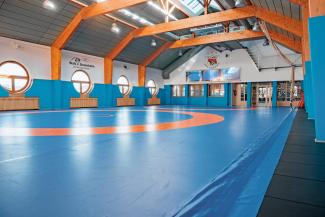
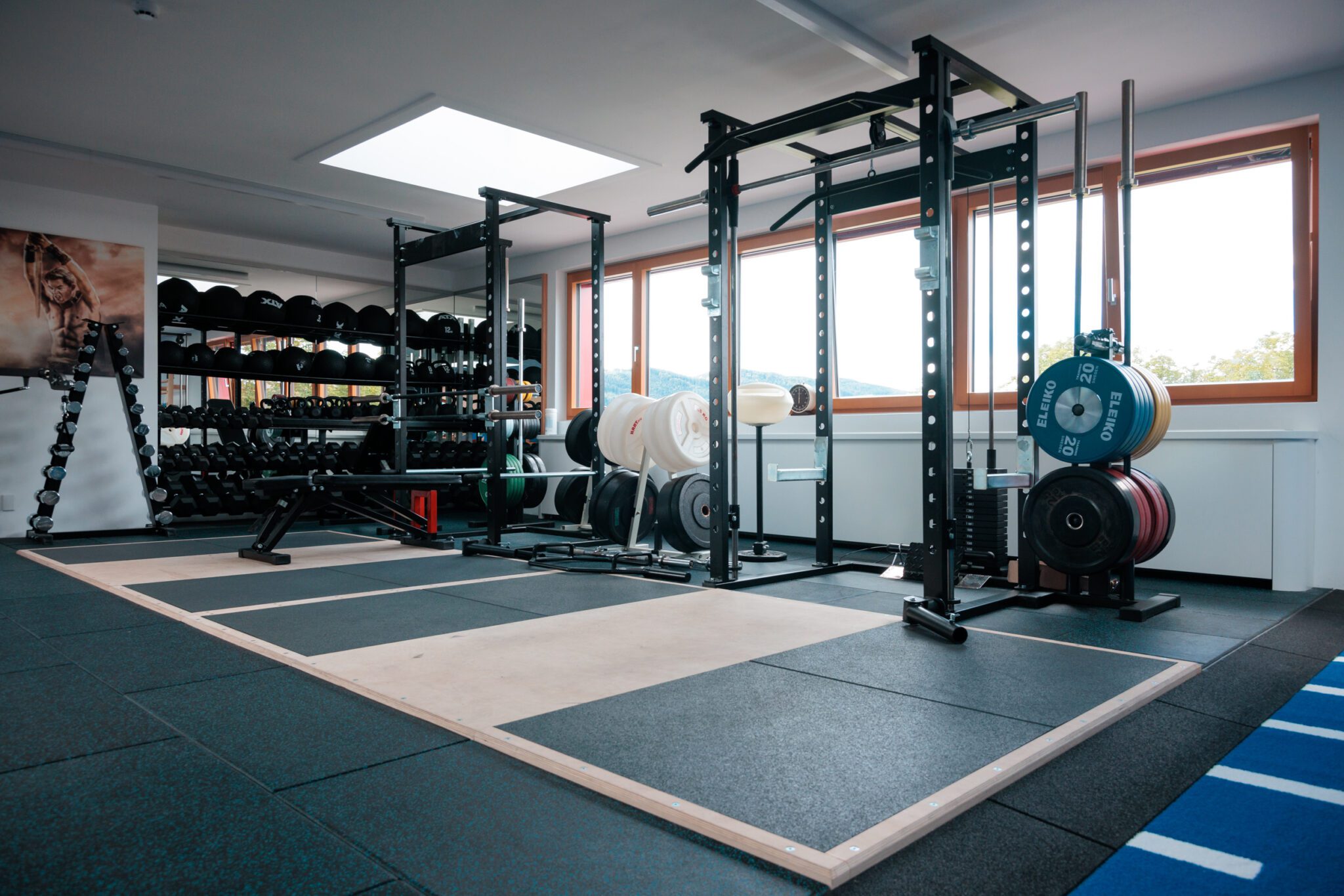 Fitness centre at A.C. Wals. (Photo: Austrian National Wrestling Centre)
 A.C. Wals
Share your thoughts.
Comments