

Asian Games

Rio Champ Dosho to Miss Asian Games Due to Shoulder Injury

By Ken Marantz

World and Olympic champion Sara DOSHO (JPN) will miss the Asian Games in Jakarta this summer due to a left shoulder injury suffered at the recent Women's World Cup, the Japan Wrestling Federation has announced on its website.

Dosho's reign as a world champion is also in doubt, as she will almost surely to be forced to skip the Japan Invitational Championships (Meiji Cup) in June, which is serving as the final domestic qualifying tournament for Japan's team to the world championships in Budapest in October.

Sara DOSHO (JPN) df. Aline FOCKEN (GER) by 3-0 to win the gold medal at the 2017 World Championship. Photo by Martin Gabor.

Dosho suffered the injury, which has necessitated surgery, during her 68kg match against Danielle LAPPAGE (CAN) on the opening day of the World Cup in Takasaki, Japan. Dosho took a 2-1 lead early, then held on to win by that score as Japan beat Canada 8-2.

The four-time world medalist skipped the gold-medal match the following day against China, which Japan won 6-4 for its fourth straight title. As team captain, she joined the celebrations on the mat.

Dosho, a product of powerhouse Shigakkan University who won a seventh consecutive national title last December, captured gold medals at 69kg at the 2016 Rio Olympics and 2017 Paris world championships.

Dosho has not lost since the 2015 world championships in Las Vegas, where she fell in the third round 11-7 to FENG Zhou (CHN). She came back to win the bronze medal.

Ironically, Dosho and Feng were in line for a rematch in the final at the Women's World Cup, but Dosho's injury scuttled the clash.
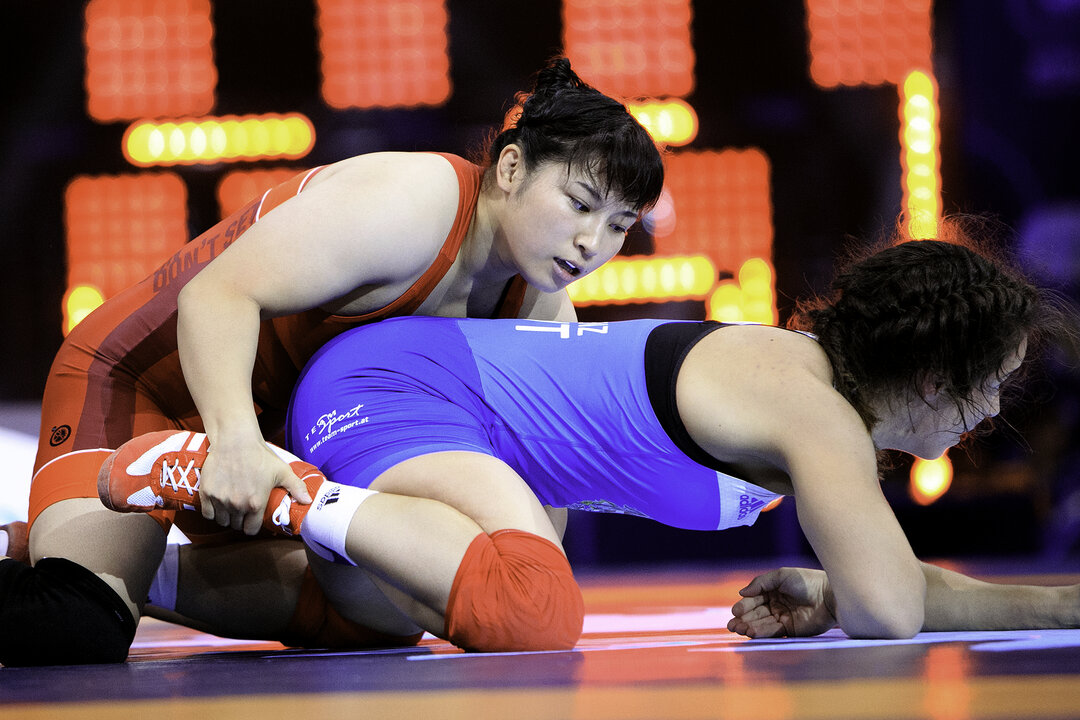

Sara DOSHO (JPN) df. Martina KUENZ (AUT), 6-0 to seal her spot in the 2017 world finals. Photo by Martin Gabor. 

Dosho's place at the Asian Games will be taken in a three-way wrestle-off between Ayana GEMPEI, Miwa MORIKAWA, and Naruha MATSUYUKI on April 22 at the Ajinomoto National Training Center in Tokyo.

Gempei and Morikawa finished 1-2 at 65kg at the national championships, while Matsuyuki was the 72kg champion. All three were members of the Japan team in Takasaki.

At the Asian Games, wrestling will be held Aug. 19-22, with six weight classes in each style.

As entries must be finalized by the end of May, the Japan federation cannot use the results of the Meiji Cup to determine its team. As such, in principle, the winners of the respective weight classes at the national championships will fill the team spots, according to the website.

Development

Argentina become first country in the Americas to host a Level 3 Coaches Course

By United World Wrestling Press

BUENOS AIRES, Argentina (December 2) —Argentina has become the first country in the Americas to host a Level 3 Coaches Course, organized by United World Wrestling (UWW) and Olympic Solidarity (OS), with the organizational support of the Federación Argentina de Luchas Asociadas (FALA) and the Argentine Olympic Committee (COA). This historic course, held from November 25-29, also stands out as the first-ever Level 3 course conducted in Spanish globally, marking a significant milestone in the development of wrestling coaches in the region.

The course brought together 40 Argentine coaches--including seven women--to enhance their technical and pedagogical skills while embracing a high-performance vision. In addition, Ignacio D'Alessandro (ARG), an international 1S referee and UWW educator, conducted a refereeing clinic, which the participants highly appreciated.

CUBWorld champion and Olympic silver medalist Arsen JULFALAKYAN (ARG) walks through par terre strategy at the Level 3 Coaches Course in Argentina. (Photo: United World Wrestling)

One of the course's highlights was a technical and practical masterclass delivered by Arsen JULFALAKYAN (ARG), UWW Bureau member and Olympic medalist. Julfalakyan shared advanced strategies and innovative exercises that inspired participants to raise their training standards and adopt new perspectives in their daily coaching routines.

The program covered essential topics such as the profile of an excellent coach, tactical strategies, periodization theory and training methodology, and pedagogy for both grassroots and high-performance levels. This comprehensive approach not only strengthened the attendees' theoretical and practical knowledge but also fostered a sense of community and collaboration.

Raúl Trujillo and Filiberto Delgado, renowned Cuban coaches with a distinguished track record of training Pan-American, World, and Olympic champions, led the main sessions.

CUBLegendary coach Raúl TRUJILLO (CUB) walks through technique during a training session at the Level 3 Coaches Course in Argentina. (Photo: United World Wrestling)

"Argentina has tremendous potential. During this course, we focused on technical aspects and strategies to evolve and enhance the sport’s development in the country," said Trujillo, the celebrated coach of Mijaín López, a five-time Olympic champion. "The Americas are growing significantly; while Cuba, the United States, and Canada used to dominate, other nations are now achieving remarkable results at World Championships and the Olympic Games."

David Ochoa, Argentina's National Coach and newly accredited UWW Educator, supported the Cuban experts. Ochoa earned this distinction at the most recent Educators’ Course held in Guatemala just weeks prior, and his involvement exemplified Argentina’s commitment to nurturing local talent in wrestling education.

The course opened with an inauguration ceremony at the Argentine Olympic Committee, attended by key figures such as Fernando Rittner, president of FALA; Sebastián Pérez, Secretary General of FALA; Yuri Maier, UWW Sports and Development Officer; Arsen Julfalakyan, UWW Bureau member; and Cristian Roldán, head of administration and responsible for Olympic Solidarity. The practical and theoretical sessions took place at the National Center for High Performance Sports (CENARD), providing a professional and motivating environment for the coaches.

This course marks a significant step in the growth of wrestling across the continent, underscoring the importance of educational programs to elevate coaches’ technical and pedagogical levels. The certificates awarded, endorsed by UWW and Olympic Solidarity, symbolize not only recognition for the participants' efforts but also a commitment to developing the sport in Argentina and Latin America.

The success of this event opens the door to replicating this model in other countries across the continent, contributing to the global advancement of wrestling.