

Rivals Japan, China Split Head-To-Head Finals on Final Day of Tokyo 2020 Test Event
Saturday, October 5, 2019 - 13:25 By Ken Marantz

CHIBA, Japan (Oct. 5)—Host Japan and rival China each came up with a victory in head-to-head duels as the last three gold medals were awarded to bring a close to the three-day Tokyo 2020 Olympic test event in women’s wrestling at Makuhari Messe in neighboring Chiba city.
LEI Chun (CHN) defeated teenager Miu SHIMIZU (JPN) 5-2 in the 50kg final, before 2018 world junior champion Umi IMAI (JPN) struck back for the host nation by edging LUO Lannuan (CHN) 3-2 for the 53kg gold.
In an all-Japan final at 57kg, Yumeka TANABE (JPN) gained the winning points on a late challenge to top Sena NAGAMOTO (JPN) 6-4.
With no spectator seating and only the set-up of the mats offering a glimpse of what the actual venue will look like during the Tokyo Games, the tournament served mostly to test the newly developed integrated scoring system and to give volunteers and staff experience with the flow of matches.
“It was definitely good to organize such an event, to see the small problems and to coordinate before the Olympic Games,” UWW technical delegate Peter BACSA said after the tournament in the six Olympic weight classes.
“It’s hard to imagine that in this hall it’s going to be an Olympic tournament, but I think when they put in the stands and podium and nice equipment, it’s going to be much different. So we’re looking forward to that.”
The tournament used just one hall in Makuhari Messe’s expansive International Convention Center. During the Olympics, the dividers to the two adjacent halls will be taken down, tripling the space to accommodate stands at the mat ends for a seating capacity of 8,000 to 10,000.
The final day of competition was delayed slightly by a malfunction in the scoreboard, but that was soon fixed and the medal matches got underway in the final three weight classes.
“In the Olympic Games, we will use the Omega system, which is different than Athena, so it has to be implemented together and matched together, and the two systems have to be parallel, so that was the first task,” Basca said.
In the day’s first final, Lei, the 2018 Asian champion, scored a first-period takedown, then added an activity point and a takedown off a slick ankle pick in the second to lead 5-0.
Shimizu, a 2017 Asian cadet champion, gained 2 points with a front headlock roll, but that’s all she could muster as the Chinese clinched the victory.
“I feel so-so,” Lei said of winning the gold. “I understand the opponent from Japan is not on the top level.”
To Shimizu’s credit, she boldly fought off Lei’s gut wrench attempts to limit the damage from the takedowns. Lei, however, chalked that up to fatigue from her semifinal match the previous day, in which she trailed Remina YOSHIMOTO (JPN) before a spree of lace-lock rolls gave her a 14-4 technical fall.
“The semifinal was the most difficult one,” Lei said. “I still tried my best to perform, but after that match, my condition was not very well. Although the opponent was weaker than in the semifinal, I understand it was the final match and I didn’t want to take a risk.”
Yoshimoto bounced back in her bronze-medal match to defeat Daria LEKSINA (RUS) by fall after building up a 10-4 lead, while Mariia VYNNYK (UKR) scored a late takedown against Chihiro SAWADA (JPN) for a 4-4 win on last-point criteria.
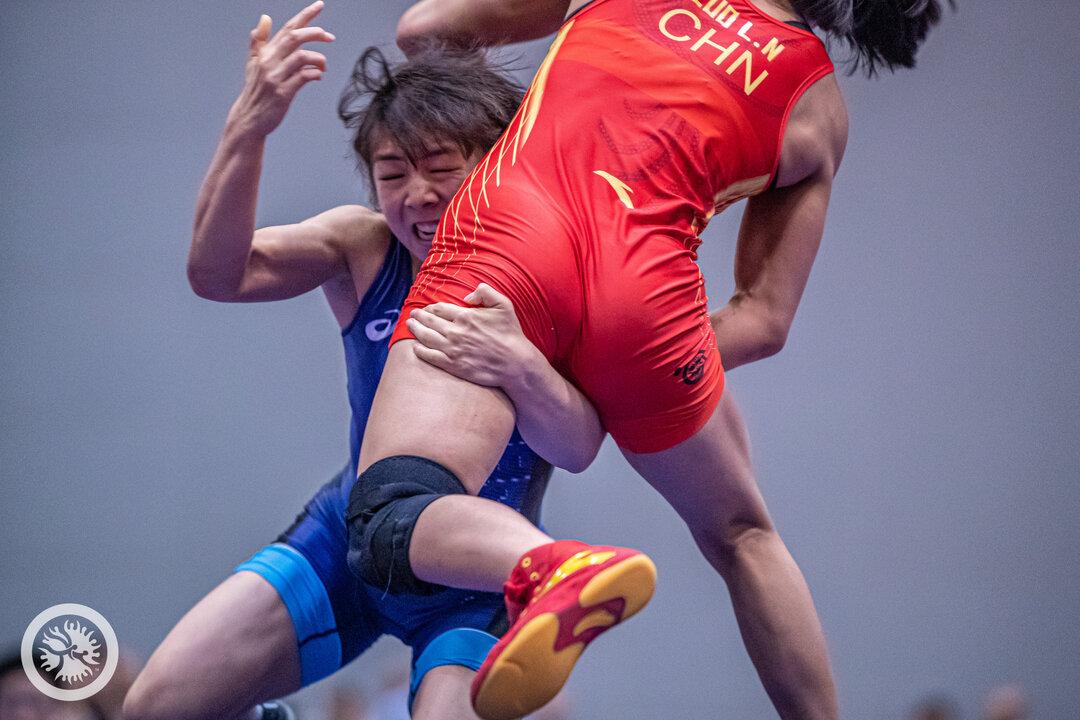 Umi IMAI (JPN) escaped the 53kg finals with a 3-2 win over LUO Lannuan (CHN) (Photo: Sachiko Hotaka)
In the 53kg final, Imai trailed Luo 2-1 going into the second period, but scored a takedown midway through the period and held on for a 3-2 victory over the 2018 Asian champion at 55kg.
Imai said she was determined to uphold Japanese pride against the Asian rival.
“China has recently become strong so I thought I have to win, and I fought hard,” Imai said. “I myself won’t be going to the Olympics, but to be given the chance to compete in this arena, I thought I want to go home with the title.”
The match ended with Imai clinging to a single leg and Luo desperately trying to lever her over. “I wanted to win by more points, but my opponent didn’t let me score that easily,” Imai said.
In the bronze-medal matches, Saki IGARASHI (JPN) received a victory by default from world bronze medalist PANG Qianyu (CHN), who was one of several top Chinese wrestlers from the recent World Championships in Kazakhstan who were entered in the tournament but did not compete.
Ibuki TAMURA (JPN) scored three takedowns in the second period, fighting off counter-lift attempts by lanky Katherine SHAI (USA) to win 7-3 and take home the other bronze.
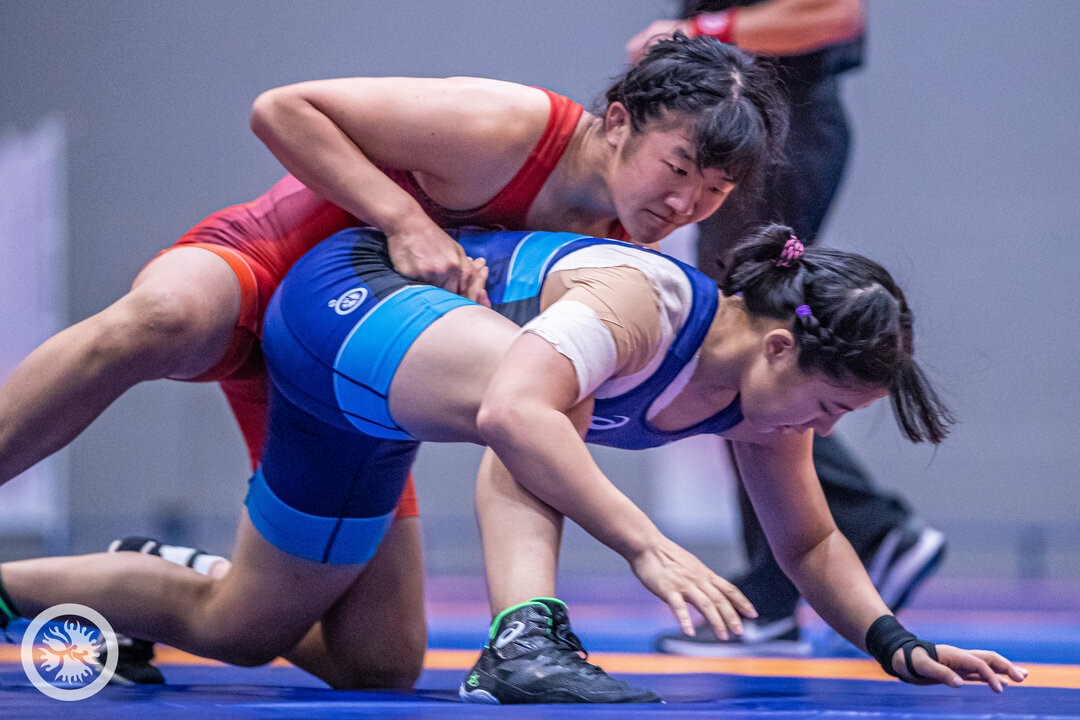 Yumeka TANABE (JPN) used a late challege to gain the 6-4 advantage over Sena NAGAMOTO (JPN) in the 57kg finals. (Photo: Sachiko Hotaka)
Capping the event was Tanabe’s knife-edge victory over 2018 Asian junior champion Nagamoto for the 57kg gold.
Tanabe, the daughter of Athens 2004 Olympic freestyle bronze medalist Chikara TANABE and a two-time world cadet champion, took a 4-2 lead into the second period, and seemed on the verge of padding it when she got behind Nagamoto in the standing position.
But in her haste to pull Nagamoto backward to the mat in the final 20 seconds, she allowed Nagamoto to grab onto a leg and stop her motion, momentarily putting her on her back. The original call was 2 points for Nagamoto, which would have put her ahead on criteria. But a successful challenge by Tanabe’s side gave 2 points to each wrestler, and Tanabe held on for the win.
“She’s an opponent I had faced before, but this time she pushed me harder,” Tanabe said. “She prepared a strategy against me. In the end, it’s good that I came away with the win, but I thought I had lost by the one challenge.
“The way I wrestled, I feel like I was the loser. But I’ll be ready for the world U23 and World Cup and will go in with the feeling that I am the challenger,” she added.
Hanako SAWA (JPN) added to the host country’s medal haul by gaining a takedown and stepout in the second period for a 3-2 win in the bronze-medal match over Khadizhat MURTUZALIEVA (RUS), while ZHANG Qi (CHN) took the other bronze by default.
Wrapping things up, the UWW’s other technical delegate on site, Theodoros HAMAKOS, commented, “I am sure that next year everything will be be OK.”
Basca added he expects Japan’s well-known organizational skills to ensure a successful Olympics.
“They are taking care of all small details—even too much care—but that’s how they do it,” he said, “so I’m sure that at the Games everything will be in the right place.”
Day 3 Results
Women’s Wrestling
50kg (8 entries)
Gold – LEI Chun (CHN) df. Miu SHIMIZU (JPN), 5-2
Bronze – Remina YOSHIMOTO (JPN) df. Daria LEKSINA (RUS) by Fall, 4:10 (10-4)
Bronze – Mariia VYNNYK (UKR) df. Chihiro SAWADA (JPN), 4-4
53kg (9 entries)
Gold – Umi IMAI (JPN) df. LUO Lannuan (CHN), 3-2
Bronze – Saki IGARASHI (JPN) df. PANG Qianyu (CHN) by Def.
Bronze – Ibuki TAMURA (JPN) df. Katherine SHAI (USA), 7-3
57kg (8 entries)
Gold – Yumeka TANABE (JPN) df. Sena NAGAMOTO (JPN) 6-4
Bronze – ZHANG Qi (CHN) df. RONG Ningning (CHN) by Def.
Bronze – Hanako SAWA (JPN) df. Khadizhat MURTUZALIEVA (RUS), 3-2

Share your thoughts.
Comments