

Russia Reels in Trio of Greco-Roman Golds on Third Day of Euro C’Ships
Wednesday, May 2, 2018 - 19:30 By Eric Olanowski
KASPIISK, Russia (May 2) - The Russian national anthem was on replay during the final day of Greco-Roman action at the Palace of Sport and Youth as the host nation claimed three of the five possible gold medals, bringing their tournament gold medal count to four.
“If you're comparing this year's performance to last years, we were better all around. We were much more prepared, which is why we have three champions. Hopefully one more is coming” said 67kg champion, Artem SURKOV (RUS). That “one more” Surkov mentioned came from Adam KURAK (RUS) in the 72kg gold-medal bout.
In addition to Kurak and Surkov, Sergey EMELIN (RUS) won a gold medal for the Russian Federation on the third day of wrestling in Kaspiisk, Russia.
At 60kg, 2017 U23 world runner-up Sergey Eemelin faced a 5-0 deficit against the U23 world champion, Murad MAMMADOV (AZE). Mammadov, the 23-year-old held an early 5-0 lead after a four-point throw and a lost challenge from the Russian corner. Emelin rebounded with a takedown and two guts, closing out the match on a 6-0 run. Emelin, who was competing in his first senior-level European Championship defeated Mammadov, 6-5.
When asked if there was any hesitation while facing the five-point deficit, Emelin said “No, because of my mental preparation. I was ready when I stepped on the mat…We’ve wrestled three times, so I knew coming into that match that he was a strong opponent.”
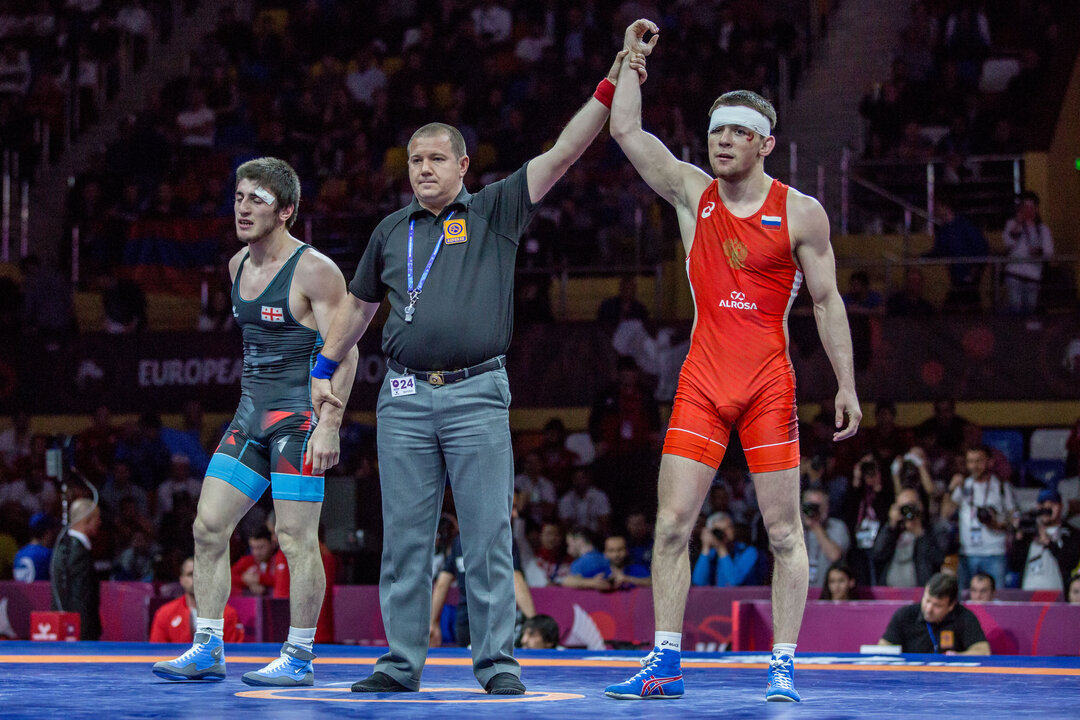 df. Shmagi BOLKVADZE (GEO) -by VFA, 8 - 0--4.jpg) Artem SURKOV (RUS) gets his hand raised after sticking Olympic bronze medalist, Shmagi BOLKVADZE (GEO). (Photo: Max Rose-Fyne)
Artem SURKOV (RUS) gets his hand raised after sticking Olympic bronze medalist, Shmagi BOLKVADZE (GEO). (Photo: Max Rose-Fyne)
In the 67kg finals, Surkov, who was already up 8-0 stuck 2016 Olympic bronze medalist, Shmagi BOLKVADZE (GEO) in the opening period. After the match, Surkov added, “I dedicate this win to the President of the Russian Wrestling Federation, my country, all my coaches, my family and especially to my twin brother who has spent every single minute training with me.”
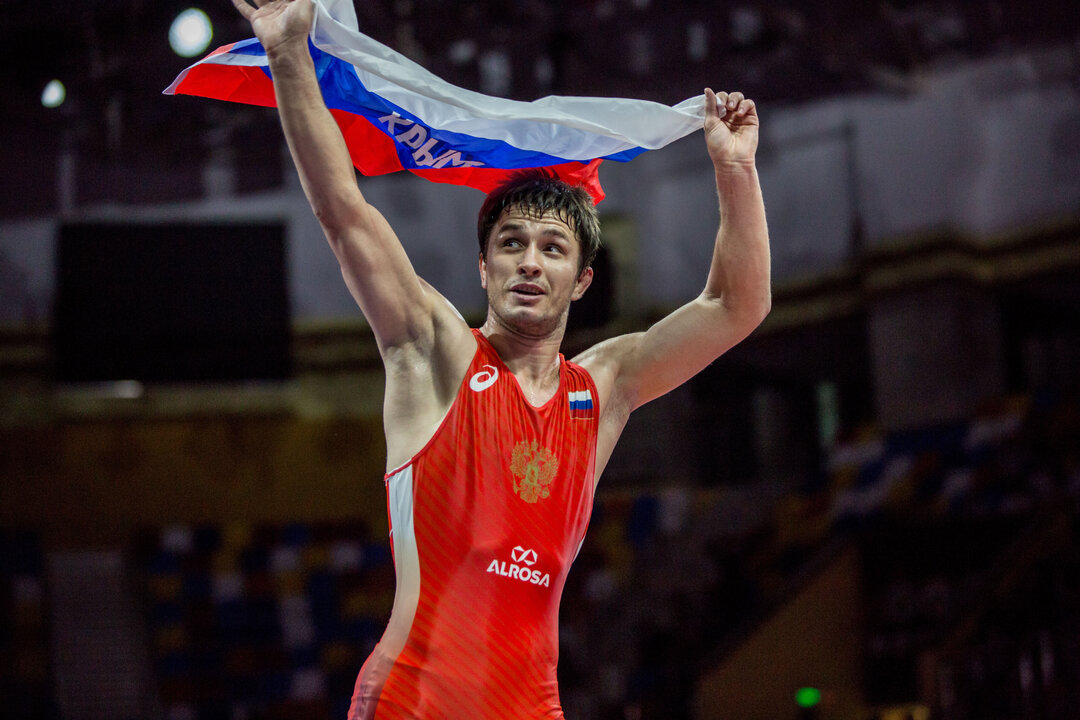 df. Rasul CHUNAYEV (AZE) -by VPO1, 9 - 5--5.jpg) Adam KURAK (RUS) celebrates after defeating Olympic bronze medalist, Rasul CHUNAYEV (AZE) to win the 72kg gold medal.
Adam KURAK (RUS) celebrates after defeating Olympic bronze medalist, Rasul CHUNAYEV (AZE) to win the 72kg gold medal.
Adam Kurak was the third Russian to capture gold on final day of Greco-Roman wrestling. The 2014 European champion found himself down 5-1 to 2015 world champion and clear crowd favorite, Rasul CHUNAYEV (AZE).
“I knew that Chunayev was the favorite, but I was sure that I had a chance to win. If you’re on the mat and not sitting in the stands or in front of the television, you have a chance to win.”
Midway through the match, Kurak cracked Chunayev’s puzzle and scored the remaining eight points of the bout, winning the 72kg gold-medal bout, 9-5.
“I wish I could divide my gold medal into pieces and give a piece to everyone who has supported me. If I did that, I’d only have a tiny piece of the medal because so many people have been there for me….But, these European Championships gave me a taste of victory. My next step is hopefully world and Olympic gold medals.”
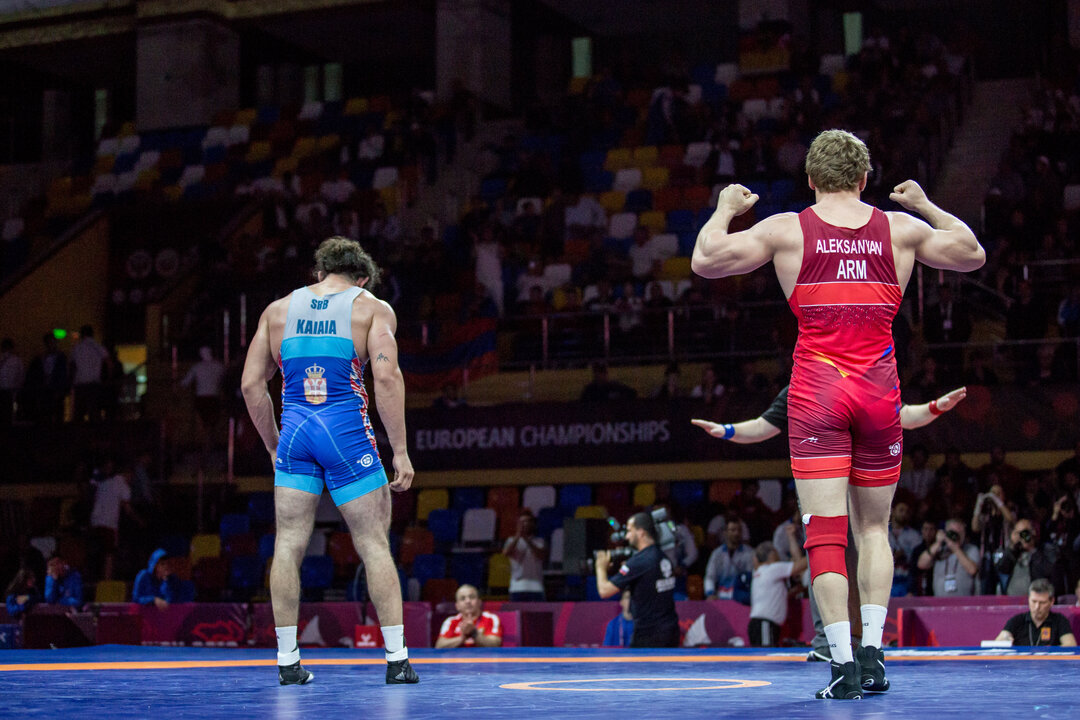 df. Mikheil KAJAIA (SRB) -by VPO, 7 - 0--3.jpg) Artur ALEKSANYAN (ARM) defeated Mikheil KAJAIA (SRB), 7-0 to win his fourth European Championship.
Artur ALEKSANYAN (ARM) defeated Mikheil KAJAIA (SRB), 7-0 to win his fourth European Championship.
Armenia’s Artur ALEKSANYAN (ARM) and Maksim MANUKYAN (ARM) closed out the Greco-Roman portion of the tournament, claiming the remaining two gold medals.
Artur “The White Bear,” Aleksanyan reclaimed European gold for the first time since 2014 by routing Mikheil KAJAIA (SRB), 7-0 in the 97kg gold-medal match.
“I feel very proud that I could become a European champion for the fourth time, and that I could bring one more gold medal to our country.”
Maksim MANUKYAN (ARM), the 2017 world champion claimed his first gold medal by earning the 9-0 technical superiority victory over Viktar SASUNOUSKI (BLR). The 2018 European gold medal was the Armenian’s first continental championship.
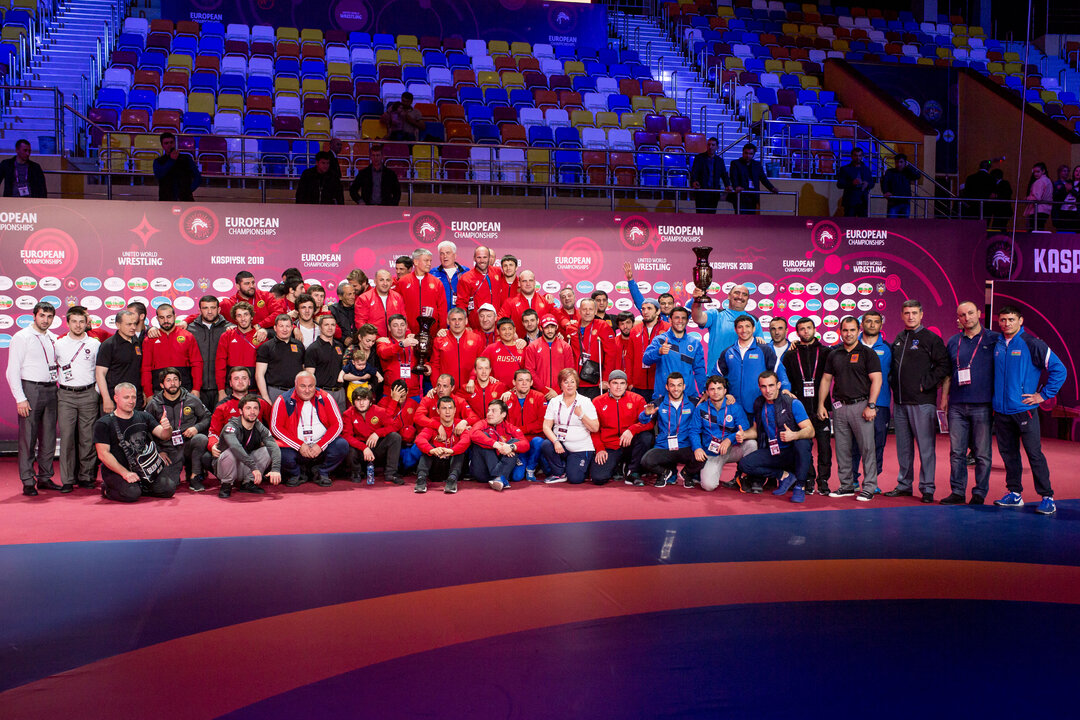 Russia, Georgia, and Azerbaijan are the top-three finishers in Greco-Roman at the 2018 European Championships. (Photo by Max Rose-Fyne)
Team Results
GOLD - Russia (169 points)
SILVER - Georgia (127 points)
BRONZE - Azerbaijan (113 points)
Fourth Place - Armenia (97 points)
Fifth Place - Hungary (71 points)
Sixth Place - Turkey (65 points)
Seventh Place - Germany (57 points)
Eighth Place - Serbia (56 points)
Ninth Place - Bulgaria (49 points)
Tenth Place - Belarus (46 points)
RESULTS
60kg
GOLD - Sergey EMELIN (RUS) df. Murad MAMMADOV (AZE), 6-5
BRONZE - Dato CHKHARTISHVILI (GEO) df. Etienne KINSINGER (GER), 1-1
BRONZE - Jacopo SANDRON (ITA) df. Maksim KAZHARSKI (BLR), 8-1
67kg
GOLD - Artem SURKOV (RUS) df. Shmagi BOLKVADZE (GEO), 8-0
BRONZE - Enes BASAR (TUR) df. Fredrik Holmquist BJERREHUUS (DEN), 5-4
BRONZE - Karen ASLANYAN (ARM) df. Dawid KARECINSKI (POL), 7-2
72kg
GOLD - Adam KURAK (RUS) df. Rasul CHUNAYEV (AZE), 9-5
BRONZE - Luri LOMADZE (GEO) df. Daniel CATARAGA (MDA), 15-6
BRONZE - Balint KORPASI (HUN) df. Gevorg SAHAKYAN (POL), 10-0
82kg
GOLD - Maksim MANUKYAN (ARM) df. Viktar SASUNOUSKI (BLR), 9-0
BRONZE - Rafig HUSEYNOV (AZE) df. Roland SCHWARZ (GER), 4-3
BRONZE - Daniel Tihomirov ALEKSANDROV (BUL) df Laszlo SZABO (HUN), 3-2
97kg
GOLD: Artur ALEKSANYAN (ARM) vs. Mikheil KAJAIA (SRB), 7-0
BRONZE - Balazs KISS (HUN) vs. Ramsin AZIZSIR (GER), 4-1
BRONZE - Matti Elias KUOSMANEN (FIN) df. Laokratis KESIDIS (GRE), 10-7

 Women's Wrestling at the 2004 Athens Olympic Games. (Photo: United World Wrestling / Martin Gabor)
 Tayla FORD (NZL) is the first wrestler from New Zealand who will compete at the Olympics. (Photo: United World Wrestling / Amirreza Aliasgari)
Share your thoughts.
Comments