

Ryu Makes Final in Move up to 72kg as 2 Iranian Defending Champions Dethroned
Wednesday, April 14, 2021 - 09:59 By Ken Marantz

ALMATY, Kazakhstan (April 15) --- As if qualifying for the Olympics six days earlier wasn't enough, Korean star Hansu RYU (KOR) made his bid for a third straight gold medal and fourth overall at the Asian Championships a bit more challenging.
Ryu, the reigning champion at 67kg, moved up to 72kg and used his speed and skill to overcome a disadvantage in girth and advance to the final, while two Iranian defending champions were dethroned on Wednesday, the second day of the tournament in Almaty.
"I didn't participate in any competitions due to COVID, so I decided to participate in all competitions now, hence the Asian Championships," said Ryu, a two-time world champion. "I was trying to stay in the bouts till the end and that was my way to win today."
Ryu held off a gutsy Muslihiddin UROQOV (TJK) in a 6-5 semifinal victory to make the final, where he will face 2020 bronze medalist Ruslan TSAREV (KGZ) in the night session at the spectator-less Baluan Sholak Palace of Culture and Sports.
"I don't know his strategy in the final but I am confident of winning because we have a lot of difference in weight, so I can use that to my advantage," said Ryu, who secured a spot at 67kg in the Tokyo Olympics at the Asian qualifying tournament held at the same venue April 9-11.
Unlike in his opening match, when he scored all of his points in the second period of a 10-1 technical fall victory over Taishi HORI (JPN), Ryu built up a 6-0 lead in the semifinal. But Uroqov caught the Korean with a pancake as he tried to spin behind for 4 points with 1:30 left. An unsuccessful challenge gave Uroqov another point, but Ryu hung on for the win.
Tsarev assured himself a move up the medal podium by avenging a loss from last year to defending champion Amin KAVIYANINEJAD (IRI), beating him 3-1 in the semis with the decisive points coming on a 2-point penalty for leg-grabbing with :50 left.
Before that, Tsarev knocked off Makhmud BAKHSHILLOEV (UZB) -- the runner-up to Ryu last year at 67kg -- by 8-0 technical fall in the quarterfinals.
"The Iran wrestler was tougher than the Uzbek because he is coming from 67kg so he had less power," Tsarev said. "And I have trained with Bakhshilloev before, so I also know his strategy.
"I have already had the goal to medal before in 2014. I lost to the Iran wrestler at the Asian Championships in Delhi last year 1-2. This is our top competition and it's was good to avenge that loss.
"I don't fight in an Olympic weight, so my focus is always on Asian Championships and World Championships, and the Olympics is not really my thing right now."
Iran's other defending champion to lose his crown was Mahdi EBRAHIMI (IRI), who lost both of his Nordic group matches at 82kg and failed to make the semifinals. Proof that their group was the dominant came when both of Ebrahimi's conquerors made the final.
In the semifinals, 2020 bronze medalist Jalgasbay BERDIMURATOV (UZB) edged Satoki MUKAI 3-2, while Kalidin ASYKEEV (KGZ) rode a big 4-point throw from the par terre position to a 7-3 win over Yevgeniy POLIVADOV (KAZ). Berdimuratov won the group-stage clash between them, 3-0.
"The toughest wrestler today was Asykeev, but if you see, the Iran wrestler was not easy as well," Berdimuratov said. "I had to fight very hard against both of them. I want to bring glory to Uzbekistan by winning the gold medal here."
Berdimuratov's 6-0 victory earlier over Ebrahimi, which consisted of nifty 2-point and 4-point arm throws, was pay back for a 6-5 loss to the Iranian in last year's semifinals.
The other group was somewhat diluted by the absence of 2019 Asian champion and Rio 2016 Olympic bronze medalist Hyeonwoo KIM (KOR), who defaulted his three matches for unspecified reasons. Kim had tried but failed to qualify for the Tokyo Olympics at 77kg last week.
Revenge was also sweet for Tsuchika SHIMOYAMADA (JPN), who will get a chance for more when he faces Almat KEBISPAYEV (KAZ) in the final at 67kg. The two met for the gold three years ago in Bishkek, with Kebispayev coming out on top 5-1.
In the semifinals, Shimoyamada defeated Hossein ASSADI KOLMATI (IRI) 3-2 by scoring a 2-point reverse lift with :40 left. That avenged a 5-3 loss to the Iranian in their bronze-medal match last year.
"He's a difficult opponent," Shimoyamada said. "At last year's Asian Championship in New Dehli, I lost to him. I'm happy I won."
Asked about coming back from a 2-point deficit to win, Shimoyamada said, "When I couldn't get points I thought I wouldn't win. But miracles happen, sometimes."
Kebispayev, a 2019 world bronze medalist at 63kg, scored a takedown and a front headlock exposure in the first period en route to a 4-1 victory over Amantur ISMAILOV (KGZ).
At 60kg, Mehdi MOHSEN NEJAD (IRI) will get a chance to improve on his bronze medal from a year ago after rolling to a 9-1 technical fall in the semifinal over Ayata SUZUKI (JPN) -- a repeat of the result between them at the 2019 world U-23, where the Iranian took a bronze medal.
Opposing him in the final will be Aidos SULTANGALI (KAZ), who chalked up a solid 7-2 win over Karrar Abbas ALBEEDHAN (IRQ) in the other semifinal.
"I came here with a fixed target of winning the gold medal at the Asian Championships," Mohsen Nejad said. "I am lucky enough to reach the final and I am now ready for it."
Suzuki produced a surprise in the quarterfinals when he stormed to a 9-0 technical fall over Islomojon BAKHRAMOV (UZB), the 2019 champion and the other bronze medalist last year, with a pair of 4-point throws.
"The level of competition has been very good and all wrestlers are tough," Mohsen Nejad said. "The Japanese and Uzbek had a tough bout, and then I was with Japan, which was tough as well."
Iran, which won three of five golds on Tuesday, will get another chance to add to the tally when 2017 Asian junior champion Mehdi BALIHAMZEHDEH (IRI) takes on 2017 Asian silver medalist Seungjun KIM (KOR) for the 130kg title.
In the semifinals, Balihamzehdeh emerged victorious from one of the day's most convoluted but exciting bouts, beating Yerulan ISKAKOV (KAZ) 11-9 on a takedown with one minute to go after having squadered a 9-4 lead. Just before the takedown, Iskakov had hit a second 4-point throw that put him ahead on criteria.
Kim's 2-1 victory over Beksultan MAKHMUDOV (KGZ) was decided on an unsuccessful challenge with Kim holding the criteria advantage after each had received a passivity point.
Day 2 Greco-Roman Results
Semifinals
60kg (10 entries)
Aidos SULTANGALI (KAZ) df. Karrar Abbas ALBEEDHAN (IRQ), 7-2
Mehdi MOHSEN NEJAD (IRI) df. Ayata SUZUKI (JPN) by TF, 9-1, 5:03
67kg (10 entries)
Tsuchika SHIMOYAMADA (JPN) df. Hossein ASSADI KOLMATI (IRI), 3-2
Almat KEBISPAYEV (KAZ) df. Amantur ISMAILOV (KGZ), 4-1
72kg (9 entries)
Hansu RYU (KOR) df. Muslihiddin UROQOV (TJK), 6-5
Ruslan TSAREV (KGZ) df. Amin KAVIYANINEJAD (IRI), 3-1
82kg (7 entries)
Jalgasbay BERDIMURATOV (UZB) df. Satoki MUKAI (JPN), 3-2
Kalidin ASYKEEV (KGZ) df. Yevgeniy POLIVADOV (KAZ), 7-3
97kg (9 entries)
Mehdi BALIHAMZEHDEH (IRI) df. Yerulan ISKAKOV (KAZ), 11-9
Seungjun KIM (KOR) df. Beksultan MAKHMUDOV (KGZ), 2-1
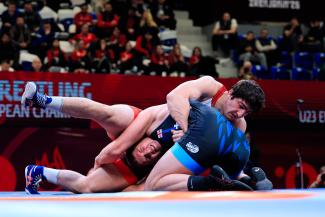
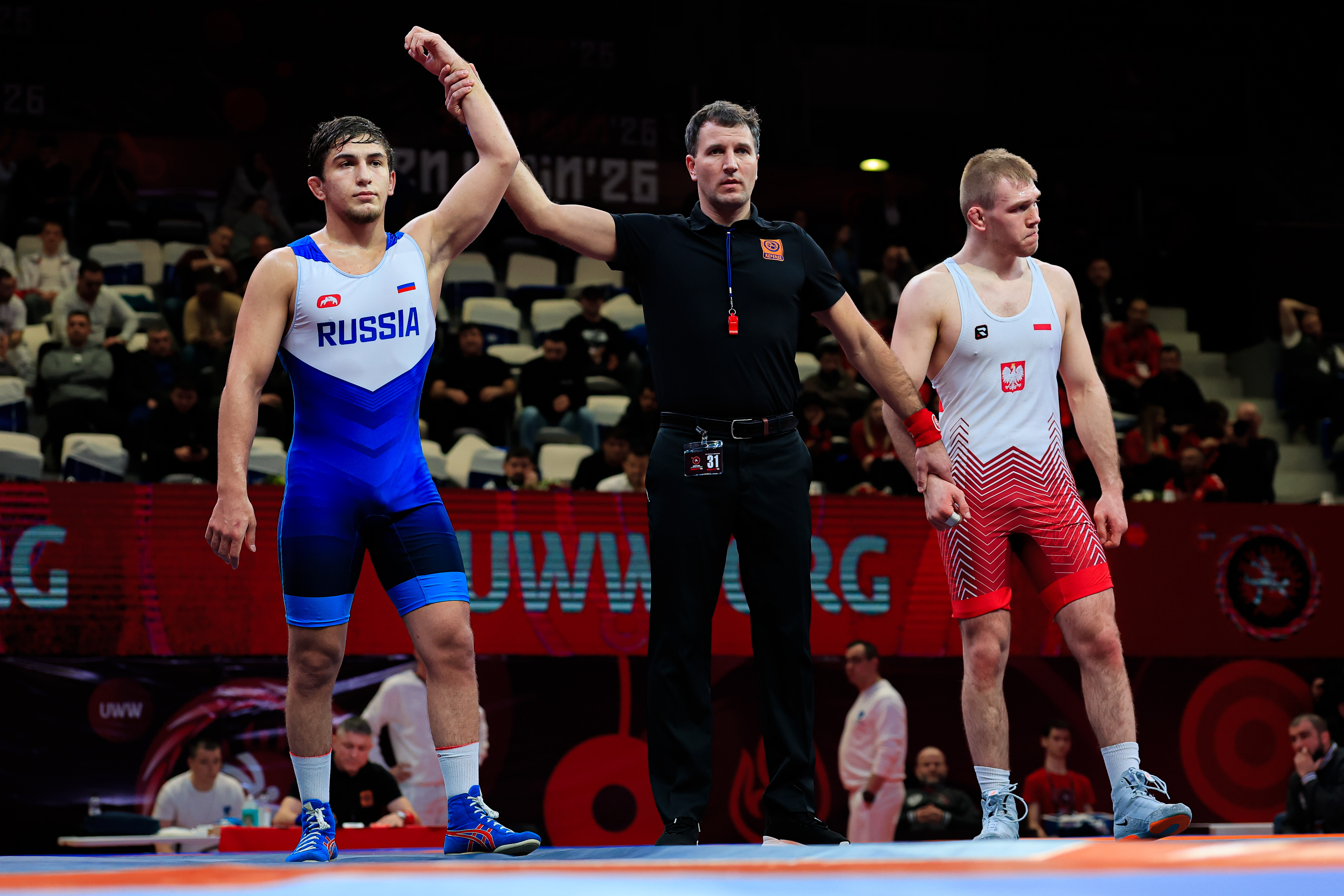 Ismail KHANIEV (RUS) will wrestle for the 79kg gold medal. (Photo: United World Wrestling / Kostadin Andonov)
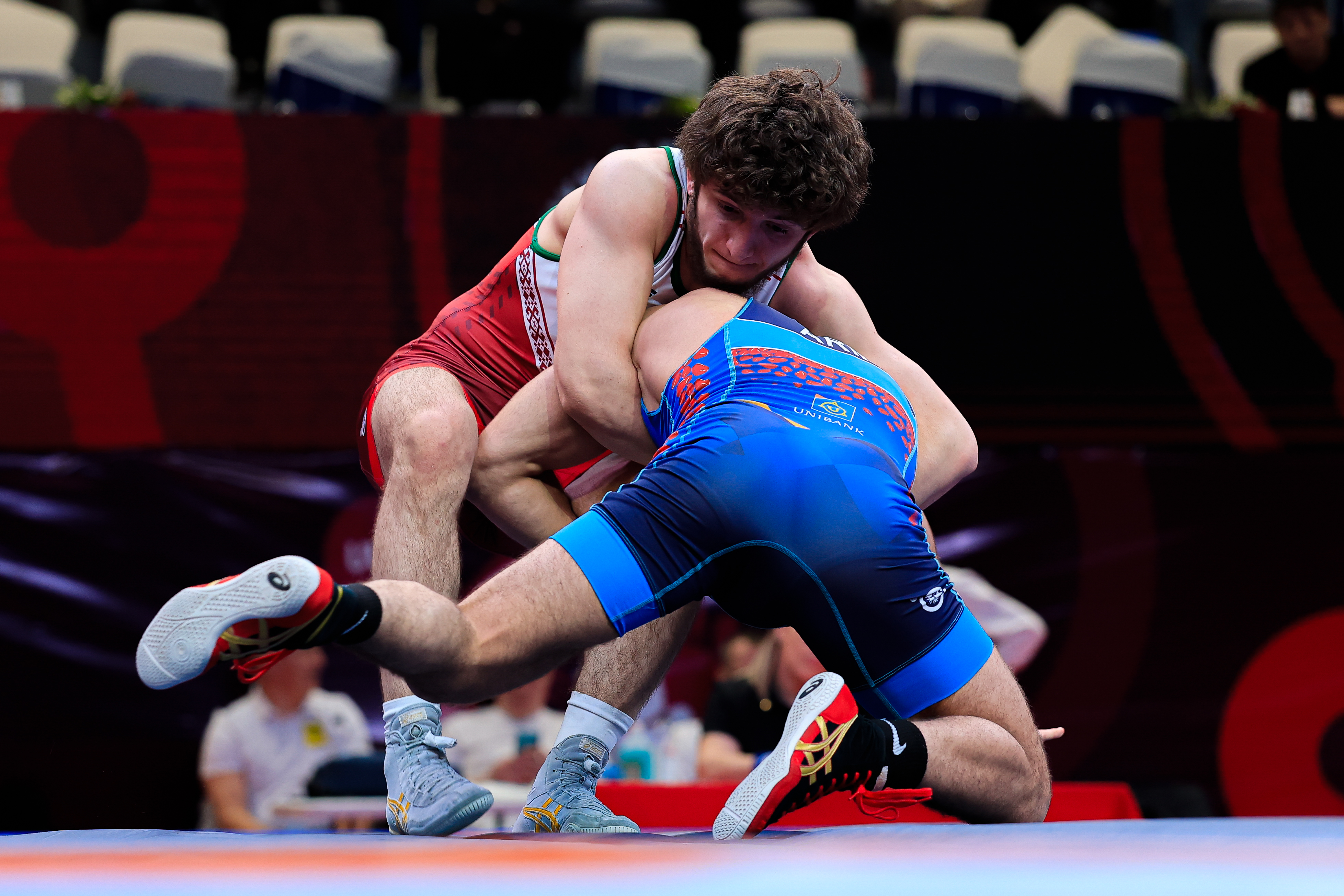 Magomedkhan MAGAMEDKHANOV (BLR) squares off against Arman MUSIKYAN (ARM) in the 65kg semifinals. (Photo: United World Wrestling / Kostadin Andonov)
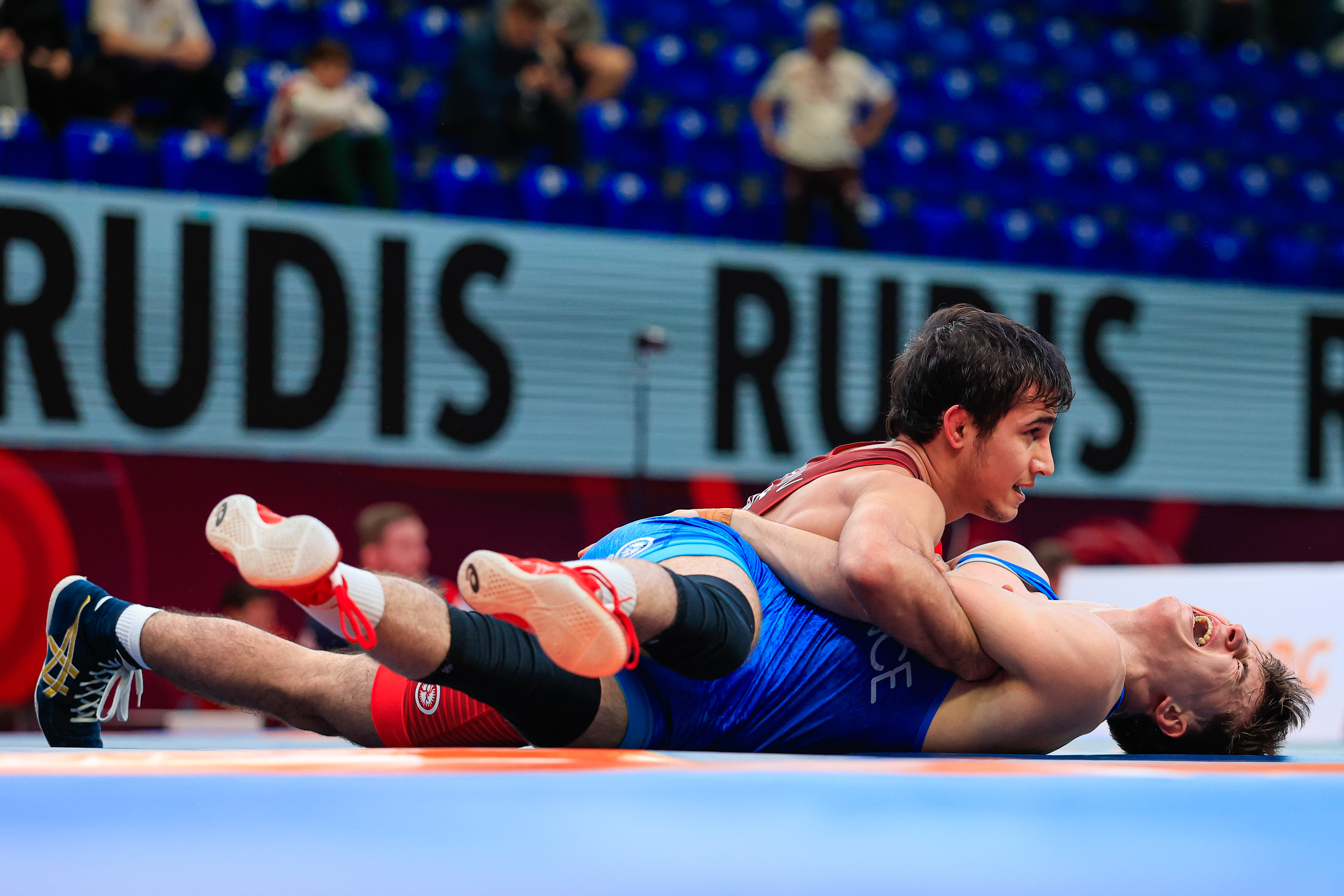 Vasif BAGHIROV (AZE) will wrestle for the 57kg gold medal. (Photo: United World Wrestling / Kostadin Andonov)
Share your thoughts.
Comments