

Rzazade, Aliyev lead Azerbaijan charge at European Championships
Tuesday, April 18, 2023 - 21:52 By Vinay Siwach

ZAGREB, Croatia (April 18) -- Since the turn of the century, Azerbaijan has been struggling to find a world-beating lightweight.
Barring Olympic champion Namik ABDULLAEV (AZE), no wrestler has been able to stamp his authority in the 55kg-57kg weight class. Giorgi EDISHERASHVILI (AZE) did win the European Championships twice in 2017 and 2018, but he was well past his prime by then and never looked threatening at the world level. Haji ALIYEV (AZE) won a bronze medal in the 2016 Rio Olympics but has spent most of his career at 61kg or above.
Aliabbas RZAZADE (AZE) may change that now. Having won the U23 world title in 2021, the 25-year-old reached the final of the European Championships last year and taking a step further, became the champion on Tuesday, beating two-time European champion Suleyman ATLI (TUR).
Rzazade led Azerbaijan's charge on day two of the European Championships in Zagreb as the nation took a comfortable seat at the top of the team rankings. Aliyev added a fourth European title and his first since 2019 to make it two golds for the night for his country.
For day two semifinal results, click here: Akgul vs Petriashvili, Round 11
Vasyl MYKHAILOV (UKR) ended the country's 10-year wait for a European champion as he defeated Georgios KOUGIOUMTISDIS (GRE) to capture the 79kg gold medal while Givi MATCHARASHVILI (GEO) scored a late takedown to deny Magomedkhan MAGOMED (AZE) a repeat at 97kg.
Vazgen TEVANYAN (ARM) added a senior European title to his U17, U20 and U23 titles as he defeated Mikyay NAIM (BUL) in the 65kg final.
 Aliabbas RZAZADE (AZE) throws Suleyman ATLI (TUR) in the final move of the bout. (Photo: UWW / Kadir Caliskan)
But it was Rzazade who came out all guns blazing and etched his name in history as he won the 25th gold medal for Azerbaijan at the European Championships.
Atli was looking for his third after suffering three losses in the finals in the last five years but little did he know that Rzazade will hit an arm throw five seconds into the final.
And as Atli was settling down after that throw, Rzazade dropped to his knees to which Atli reacted by throwing himself backward. Rzazade made it look like he was going for a leg attack but hit another arm throw, this time earning himself two points.
A 6-0 was always difficult to cover. Atli did try and cut it to 6-2 at the break but Rzazade came out even more aggressive in the second period. Atli tried tipping him but Rzazade was solid and threw Atli to his back for four and turned for a 12-2 win. Rzazade was off for the celebrations.
Turkiye challenged the call claiming it was only two points on the throw and won. The wrestlers had to restart with the score at 10-2. But it just delaying the inevitable.
Rzazade and Atli body-locked each other but it was the former who managed to get the throw. This time, there was no one stopping the Azerbaijan wrestler from celebrating his first European title.
"I came here to be a champion," Rzazade said. "I was very ambitious coming here. It's a great feeling and I am proud that I was able to raise the Azerbaijan flag. This is one of the best days of my life."
For the 17 years he has been wrestling, beginning in the town of Astara in south Azerbaijan, walking distance from the border of Iran which also has an Astara bordering Azerbaijan, the first senior title could feel that way.
Tuesday's final was in contrast to the one he had last year when Vladimir EGOROV (MKD) defeated him 8-6. Rzazade fell behind 8-0 but rallied to score six points and as he was about to get a turn for the win, the time ran out. He did not leave anything to chance this year and captured the gold medal.
"Last year in the final, I lost a very close bout," he said. "Today I was able to win gold and it's a very different feeling than the previous one. I am very happy that I was able to win the gold.”
That loss allowed Rzazade to put things into perspective and grow as a wrestler moving forward.
"Now I am an ambitious athlete," he said. "This is my year and this is my day. I think I am not that weak and everyone sees me as a tough opponent. It won't be easy as good and strong opponents are waiting for me.”
His opponents too will have to work hard to beat the newly minted European champion. A lethal underhook and strong gut wrench make him a threat. Add to that a solid defense, both in par terre and standing.
“I am looking forward to the next championships -- the World Championships in Serbia,” he said. “As we can obtain the license for the Olympic Games, I will like to get one in Serbia. I want to be an Olympic champion.”
 Haji ALIYEV (AZE) became the first male wrestler from Azerbaijan to win four European gold medals. (Photo: UWW / Kostadin Andonov)
Aliyev made it two for Azerbaijan as he won the 70kg gold after beating Ramazan RAMAZANOV (BUL) in the gold medal bout. With him turning 32 years old on April 21, Aliyev gifted him an early birthday present.
The Tokyo Olympics silver medalist became the first male from Azerbaijan to win four European titles as he went past Abdullaev who had three titles. Greco-Roman star Rafiq HUSEYNOV (AZE) has three titles as well and will get a chance to make it four in the coming days. Mariya STADNIK (AZE) still leads the way with seven titles.
“This is a very important win for me,” Aliyev said. “In the history of Azerbaijan, I am the first [male] one to win four European golds. This is very good for me.”
On Monday Aliyev had said that he is wrestling at 70kg which has stronger wrestlers than him. But he outsmarts them to win.
Against Ramazanov, he did use various tricks to capture the gold medal. Instead of waning himself out, Aliyev decided to rack up stepouts instead of indulging in scrambles.
He got three stepouts and a takedown to lead 5-1 at the break. He continued to put the pressure on Ramazanov and scored another stepout. Ramazanov scored a stepout and got an extra caution point to cut the lead to 8-3. Aliyev added a late takedown to win 10-3.
“We’ve been preparing a lot,” he said. “We had a lot of training camps this year. We are on the right way. That’s why we are winning.”
For his future plans, Aliyev said he is still chasing that elusive Olympic gold, a medal the 31-year-old missed by a whisker in Tokyo.
“I already have an Olympic bronze and silver, but I need the gold,” he said. “I will try hard. I do my best for this gold. I think it doesn’t matter if I am 32 or 34 years old, it only matters to work hard and become a champion.”
But Aliyev also knows that winning a medal in 65kg will be a herculean task as it is the deepest category in the world.
“This weight class is the toughest,” he said. “There are many good opponents and there are usually around 4-5 world champions. I think I know their wrestling styles. This is my last chance and I have to win the Olympic gold and then retire.”
 Givi MATCHARASHVILI (GEO) scoring a takedown on Magomedkhan MAGOMEDOV (AZE) in the final. (Photo: UWW / Kostadin Andonov)
Azerbaijan could have won three gold medals but world bronze medalist Matcharashvili pulled off a late takedown to beat fellow world bronze medalist Magomedov 4-3 in the final at 97kg.
Magomedov, the defending champion, began with a stepout and always looked to attack even as Matcharashvili continued to stall in the first period. He got a takedown on the edge to lead 3-0 at the break.
After five minutes of no action from Matcharashvili, he got going in the final minute, scoring a takedown via single-leg. In the final 20 seconds, Magomedov managed to go behind but slipped, giving Matcharashvili the opportunity to score another takedown as he won 4-3.
It was the first European gold medal for the former U23 world champion who also has a silver medal from European Games.
 Vazgen TEVANYAN (ARM) celebrates after winning the 65kg gold medal in Zagreb. (Photo: UWW / Kadir Caliskan)
Tevanyan, Mykhailov win first titles
Tevanyan waited four years to be back at the European Championships and he made it memorable by winning the gold medal at 65kg.
In 2019, Tevanyan finished 11th but won the U23 world title, wrestled at the Olympics and World Championships and has wins over Aliyev and Izsmail MUSZUKAJEV (HUN) since.
Though he got the first point of the final, Naim, hoping to become his country's first freestyle European champion in 18 years, failed to challenge a strong Tevanyan.
In the gold medal bout, it was in the second period that Tevanyan scored the first takedown using an arm drag but he failed to get any turns.
Naim kept coming back at Tevanyan who countered one of those attempts and got a roll to make it 6-1. He added another takedown to extend the lead before a slip-by takedown and gut got him the gold 12-1.
“I am very happy because this is a very long-awaited medal,” he said. “Since 2018 [2019], I could not participate in the European Championships, which is why I am very happy, I have a lot of emotions and I am in an amazing mood.”
Though he has U17, U20 and U23 European titles, his resume lacked the senior title that Tevanyan believes is the most important.
“The senior is very different from other age categories because for me this is the real sport. My plans are to get to the Olympic Games and become the champion of the world. There will be training camps and we will get back in shape. I will do everything to achieve the best physical shape.”
The first opportunity to win a ticket to Paris will be the World Championships in Belgrade in September and Tevanyan will be one of the favorites to win a medal, perhaps a gold. And if he reaches the final, which opponent will he like to wrestle?
“No difference [to me],” he said. “If I'm in the final, it doesn't matter.”
 Vasyl MYKHAILOV (UKR) won the gold medal at 79kg. (Photo: UWW / Kadir Caliskan)
Mykhailov ended a decade-long wait for Ukraine to have a freestyle European champion as he extended his unbeaten record against Georgis KOUGIOUMTSIDIS (GRE) who was the defending champion.
Pavlo OLIYNYK (UKR), who later represented Hungary, was the last European champion as he won the 96kg gold in 2013 in Tbilisi.
Kougioumtsidis, who became Grecee's first-ever champion last year, was hoping to repeat but Mykhailov shut him out completely.
The Ukrainian defeated Kougioumtsidis twice last year and was the favorite. He got a stepout and a takedown against the Greek's stepout. Despite the effort from Kougioumtsidis, Mykhailov remained in control.
He later explained why this win was low-scoring while his previous two were both technically superiorities before adding that this is just the beginning.
“The final is always very important so I didn’t risk a lot,” Mykhailov said. “This is very emotional. I’ve been going for the gold for a long time. But this is not the time to stop. This is the pre-Olympic year, we have to qualify.”
The gold was precious for the Ukrainian as he has been impacted by the war in his country.
“How to say, we train with no electricity,” he said. “There was a time when we trained with no electricity and no light for 6 months. I couldn’t train for about half a year. It was not possible at all. These are really tough moments. Not possible to explain.”
On his plans before the World Championships, Mykhailov didn't reveal much but he did say how he quenches his thirst after a grueling bout and a winner's interview.
“I’ll wrestle at some tournaments, we will make decisions with the coaches,” he said. “For now, I just want to drink some coke.”

RESULTS
57kg
GOLD: Aliabbas RZAZADE (AZE) df. Suleyman ATLI (TUR), 12-2
BRONZE: Georgi VANGELOV (BUL) df. Roberti DINGASHVILI (GEO), 10-0
BRONZE: Horst LEHR (GER) df. Simone PIRODDU (ITA), 2-2
65kg
GOLD: Vazgen TEVANYAN (ARM) df. Mikyay NAIM (BUL), 12-1
BRONZE: Edemi BOLKVADZE (GEO) df. Stefan COMAN (ROU), 2-2
BRONZE: Erik ARUSHANIAN (UKR) df. Ali RAHIMZADA (AZE), 7-6
70kg
GOLD: Haji ALIYEV (AZE) df. Ramazan RAMAZANOV (BUL), 10-3
BRONZE: Ihor NYKYFORUK (UKR) df. Patryk OLENCZYN (POL), via fall
BRONZE: Vasile DIACON (MDA) df. Kevin HENKEL (GER), 7-2
79kg
GOLD: Vasyl MYKHAILOV (UKR) df. Georgios KOUGIOUMTSIDIS (GRE), 3-1
BRONZE: Ahmad MAGOMEDOV (MKD) df. Arman AVAGYAN (ARM), 7-4
BRONZE: Hetik CABOLOV (SRB) df. Sabuhi AMIRASLANOV (AZE), via injury default
97kg
GOLD: Givi MATCHARASHVILI (GEO) df. Magomedkhan MAGOMEDOV (AZE), 4-3
BRONZE: Vladislav BAITCAEV (HUN) df. Benjamin HONIS (ITA), 10-6
BRONZE: Ibrahim CIFTCI (TUR) df. Murazi MCHEDLIDZE (UKR), 12-3

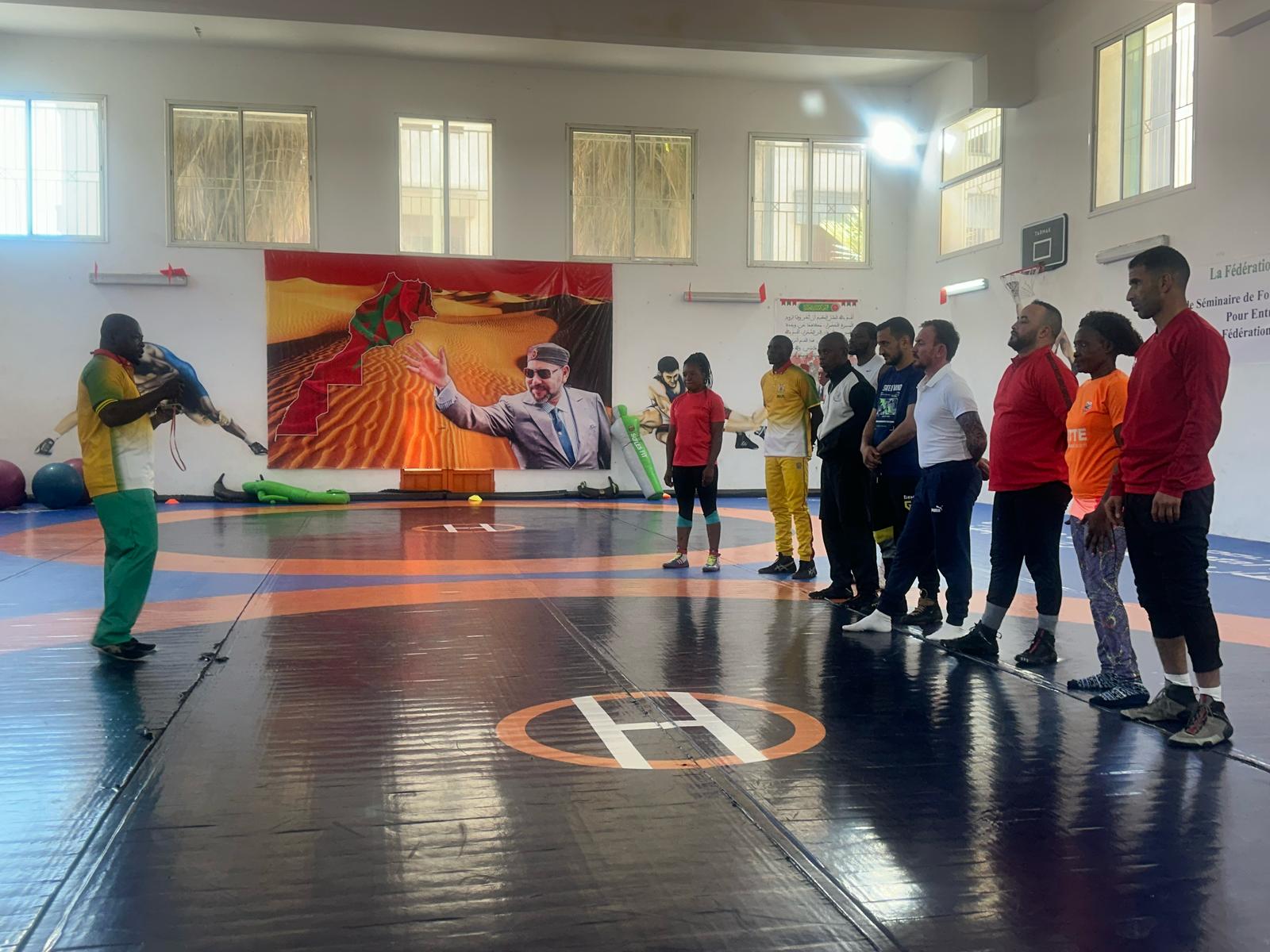 Participants walk through a training session with UWW Development Officier, Vincent AKA. (Photo: United World Wrestling)
Share your thoughts.
Comments