

Safe and Secure Olympic and Paralympic Games Tokyo 2020 - Version 2 of Tokyo 2020 Playbooks Released
Wednesday, April 28, 2021 - 15:03 By International Olympic Committee
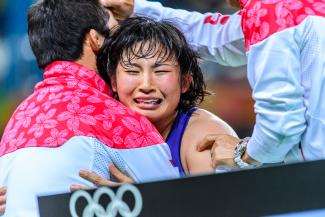
LAUSANNE, Switzerland (April 28) --- The International Olympic Committee (IOC), International Paralympic Committee (IPC) and the Organising Committee of the Olympic and Paralympic Games Tokyo 2020 (Tokyo 2020) have today launched the second editions of the Tokyo 2020 Playbooks, with the version for Athletes and Team Officials.
Building on February’s publication, the new Playbooks provide more specific details to participants about the countermeasures that will help ensure safe and successful Games for all those taking part and the residents of Tokyo and Japan. Some of the key measures in the Playbooks can be found in the five-party joint statement.
The countermeasures detailed in the Playbooks are based on science, benefiting from learnings gathered during the evolution of the COVID-19 pandemic. In addition to implementing the most effective tools being used throughout society, such as screening testing, mask wearing, personal hygiene and physical distancing, they also draw upon the experience of hundreds of sports events that have taken place safely across the world over the past year, with minimal risk to participants and the local population.
The Playbooks have been developed through the ongoing work of the All-Partners Task Force, which includes the Government of Japan, the Tokyo Metropolitan Government, the Tokyo 2020 Organising Committee, the IOC, IPC, World Health Organization and independent experts and organisations from across the world.
Speaking about the Playbooks, IOC President Thomas Bach said: “Tokyo and Japan have accepted the unprecedented challenge of organising the first postponed Olympic and Paralympic Games in history. We thank them for their great work in this respect and, as partners, we understand the great responsibility that everyone attending the Games must accept so that all participants and the Japanese population remain safe. This is why we have created the Playbooks, based on science and the best medical and event expertise available to us.”
He continued: “Providing more details about the operations that stakeholders can expect at Games time, we have also remained flexible to the evolving global situation, combining numerous countermeasures to create the safest possible environment. Increased testing for athletes and stakeholders, before and during the Games, is one important example. We’re also encouraged by the growing number of vaccinations being administered throughout the world. These tools will only work, however, if everyone shows solidarity and follows the guidelines. This is why those violating the rules can expect to be strictly dealt with in Tokyo. This is our commitment to the people of Tokyo and Japan, who are so kindly welcoming us to their city and country this summer.”
IPC President Andrew Parsons said: “With the support of the world’s leading experts in health and sport event delivery, the updated Playbooks offer greater information for everyone attending the Tokyo 2020 Games, outlining the roles and responsibilities of each stakeholder.
“As with the first editions, special considerations for persons with disabilities are included in all Playbooks, and I believe the stringent measures outlined will offer reassurance and comfort to all Games stakeholders, as well as the people of Japan. We are taking every possible measure to deliver safe Games.”
Tokyo 2020 President Hashimoto Seiko said: “The COVID-19 countermeasures included in the first edition of the Playbooks [published February 2021] have been reviewed and significantly updated in order to address the evolving situation of the pandemic. Rules to be observed by all Games participants during their stay in Japan have been expanded and clarified to include further details to ensure safe and secure Games.
“It is important that all stakeholders fully understand these rules, and that each and every one arrives in Japan with the understanding that their cooperation is critical to the success of the Games. We will hold online briefings for each of our stakeholder groups to ensure clear and comprehensive communication on these points.”
One of the key updates in this version of the Playbooks details daily testing, in principle, for athletes and those in regular contact with them, which will be a crucial part of minimising transmission and the risk of an uncontrolled outbreak. Testing will be used for general screening and for those identified as a close contact of a positive case; as well as for diagnosis for those experiencing symptoms of COVID-19.
The latest Playbooks also outline the role of COVID-19 Liaison Officers (CLOs), to be appointed by each stakeholder, who will work very closely with Tokyo 2020 and Japanese health authorities. They will receive extensive training to enable them to play a key role throughout the Games, providing an essential support network for their delegation. The CLOs will ensure all members of their organisation are fully informed of the contents of their relevant Playbooks. In addition, they will be monitoring the implementation of all COVID-19 countermeasures, ensuring participants follow their detailed activity plans and managing any positive cases that are detected.
The publication of version two of the Playbooks builds upon the optimisation and simplification of operational plans, reduced delegations from all Olympic and Paralympic Movement stakeholders, and the decision and announcement in March by the Japanese side, and respected and accepted by the IOC and IPC, to not allow spectators from overseas to enter Japan.
In acknowledging the evolving COVID-19 situation around the world, the IOC, IPC and Tokyo 2020 reinforced their commitment to regularly update the Playbooks. They will continue to receive regular input from the All-Partners Task Force, taking into account the latest advances in science and developments on the ground, in close collaboration with experts. As part of this ongoing evolution, the next version of the Playbooks (which is expected to be final) will be published in June 2021.
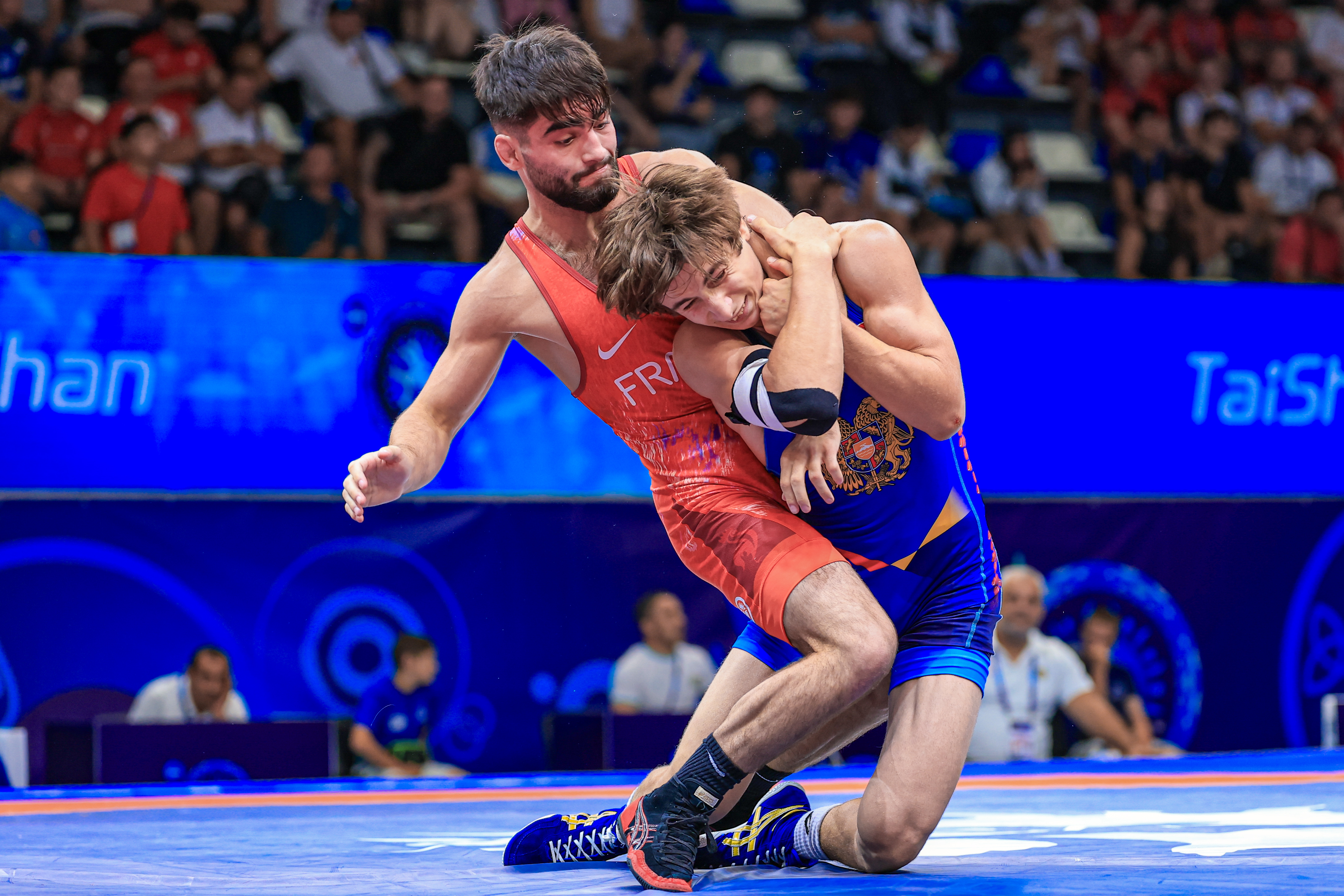 Yurik MKHITARYAN (ARM) reached the 60kg final. (Photo: United World Wrestling / Amirreza Aliasgari)
Share your thoughts.
Comments