#WrestleTokyo

Safe and Secure Olympic and Paralympic Games Tokyo 2020 - Version 2 of Tokyo 2020 Playbooks Released

By International Olympic Committee

LAUSANNE, Switzerland (April 28) --- The International Olympic Committee (IOC), International Paralympic Committee (IPC) and the Organising Committee of the Olympic and Paralympic Games Tokyo 2020 (Tokyo 2020) have today launched the second editions of the Tokyo 2020 Playbooks, with the version for Athletes and Team Officials.

Building on February’s publication, the new Playbooks provide more specific details to participants about the countermeasures that will help ensure safe and successful Games for all those taking part and the residents of Tokyo and Japan. Some of the key measures in the Playbooks can be found in the five-party joint statement.

The countermeasures detailed in the Playbooks are based on science, benefiting from learnings gathered during the evolution of the COVID-19 pandemic. In addition to implementing the most effective tools being used throughout society, such as screening testing, mask wearing, personal hygiene and physical distancing, they also draw upon the experience of hundreds of sports events that have taken place safely across the world over the past year, with minimal risk to participants and the local population.

The Playbooks have been developed through the ongoing work of the All-Partners Task Force, which includes the Government of Japan, the Tokyo Metropolitan Government, the Tokyo 2020 Organising Committee, the IOC, IPC, World Health Organization and independent experts and organisations from across the world.

Speaking about the Playbooks, IOC President Thomas Bach said: “Tokyo and Japan have accepted the unprecedented challenge of organising the first postponed Olympic and Paralympic Games in history. We thank them for their great work in this respect and, as partners, we understand the great responsibility that everyone attending the Games must accept so that all participants and the Japanese population remain safe. This is why we have created the Playbooks, based on science and the best medical and event expertise available to us.”

He continued: “Providing more details about the operations that stakeholders can expect at Games time, we have also remained flexible to the evolving global situation, combining numerous countermeasures to create the safest possible environment. Increased testing for athletes and stakeholders, before and during the Games, is one important example. We’re also encouraged by the growing number of vaccinations being administered throughout the world. These tools will only work, however, if everyone shows solidarity and follows the guidelines. This is why those violating the rules can expect to be strictly dealt with in Tokyo. This is our commitment to the people of Tokyo and Japan, who are so kindly welcoming us to their city and country this summer.”

IPC President Andrew Parsons said: “With the support of the world’s leading experts in health and sport event delivery, the updated Playbooks offer greater information for everyone attending the Tokyo 2020 Games, outlining the roles and responsibilities of each stakeholder.

“As with the first editions, special considerations for persons with disabilities are included in all Playbooks, and I believe the stringent measures outlined will offer reassurance and comfort to all Games stakeholders, as well as the people of Japan. We are taking every possible measure to deliver safe Games.”

Tokyo 2020 President Hashimoto Seiko said: “The COVID-19 countermeasures included in the first edition of the Playbooks [published February 2021] have been reviewed and significantly updated in order to address the evolving situation of the pandemic. Rules to be observed by all Games participants during their stay in Japan have been expanded and clarified to include further details to ensure safe and secure Games.

“It is important that all stakeholders fully understand these rules, and that each and every one arrives in Japan with the understanding that their cooperation is critical to the success of the Games. We will hold online briefings for each of our stakeholder groups to ensure clear and comprehensive communication on these points.”

One of the key updates in this version of the Playbooks details daily testing, in principle, for athletes and those in regular contact with them, which will be a crucial part of minimising transmission and the risk of an uncontrolled outbreak. Testing will be used for general screening and for those identified as a close contact of a positive case; as well as for diagnosis for those experiencing symptoms of COVID-19.

The latest Playbooks also outline the role of COVID-19 Liaison Officers (CLOs), to be appointed by each stakeholder, who will work very closely with Tokyo 2020 and Japanese health authorities. They will receive extensive training to enable them to play a key role throughout the Games, providing an essential support network for their delegation. The CLOs will ensure all members of their organisation are fully informed of the contents of their relevant Playbooks. In addition, they will be monitoring the implementation of all COVID-19 countermeasures, ensuring participants follow their detailed activity plans and managing any positive cases that are detected.

The publication of version two of the Playbooks builds upon the optimisation and simplification of operational plans, reduced delegations from all Olympic and Paralympic Movement stakeholders, and the decision and announcement in March by the Japanese side, and respected and accepted by the IOC and IPC, to not allow spectators from overseas to enter Japan.

In acknowledging the evolving COVID-19 situation around the world, the IOC, IPC and Tokyo 2020 reinforced their commitment to regularly update the Playbooks. They will continue to receive regular input from the All-Partners Task Force, taking into account the latest advances in science and developments on the ground, in close collaboration with experts. As part of this ongoing evolution, the next version of the Playbooks (which is expected to be final) will be published in June 2021.

2026 U23 European Championships

Magamedkhanov, Gaidarli Stop Russia Gold Sweep at U23 European Championships

By Vinay Siwach

ZRENJANIN, Serbia (March 9) -- Russia needed the calm of the Khaniev brothers to help it return to winning ways at the U23 European Championships after it suffered two shocking losses in the Freestyle finals on Tuesday.

After qualifying five finalists in as many weight classes on Monday, Russia expected to win all five gold medals, 57kg, 65kg, 70kg, 79kg and 97kg, on Tuesday.

It began well with Aiandai ONDAR (RUS) winning the first gold of the evening as he defeated former U20 European champion Vasif BAGHIROV (AZE), 7-3, in the final. He scored all his points in the second period after an actionless first period.

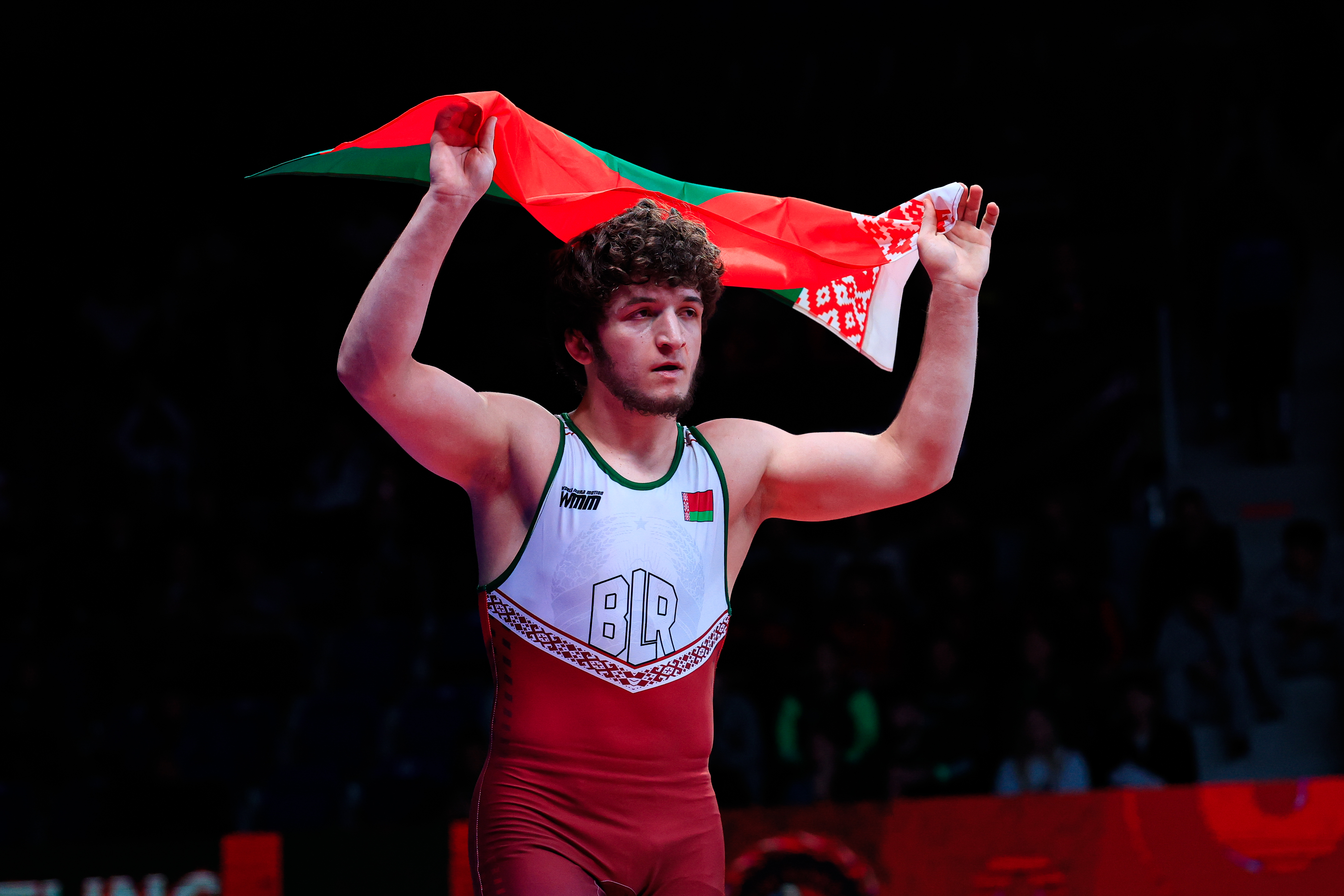
But panic spread in the Russian camp when Magomedkhan MAGAMEDKHANOV (BLR) pulled a rabbit out of the hat by pinning Dzhambulat KIZINOV (RUS) when the Russian was leading 8-0 in the 65kg final.

A few moments later U20 world silver medalist Alexandr GAIDARLI (MDA) downed defending champion Magomed ELTEMIROV (RUS), 3-2, in the 70kg final. He scored a stepout in the final 30 seconds to take a 2-2 criteria lead before a lost challenge from Russia added one more point to his score.

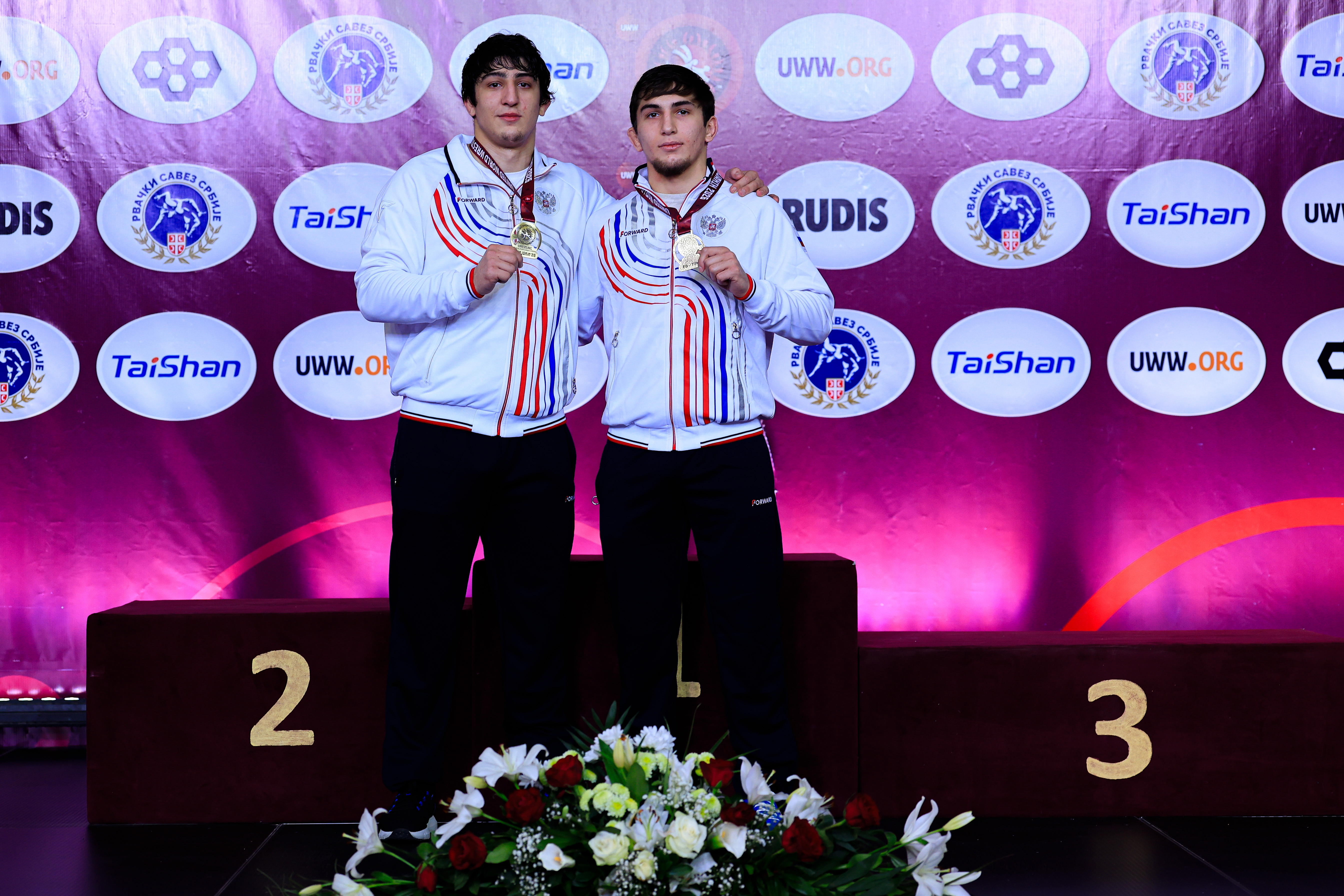
The Khaniev brothers -- Ismail KHANIEV (RUS) and Takhir KHANIEV (RUS) -- salvaged some lost pride for Russia by sweeping the 79kg and 97kg gold medals, respectively as Russia ended with three gold and two silver medals. It has three more wrestlers going for gold in Freestyle on Wednesday.

Magomedkhan MAGAMEDOV (BLR)Magomedkhan MAGAMEDOV (BLR) celebrates after winning the 65kg gold medal. (Photo: United World Wrestling / Kostadin Andonov)
Magamedkhanov, Gaidarli Win

The first shock came in the 65kg final when Magamedkhanov, down 8-0, had little chance of victory as Kizinov needed only two more points to finish the final.

However, Magamedkhanov shot deep and Kizinov answered with a chestwrap defense. But as he tried to roll over Magamedkhanov, Kizinov's back got planted on the mat and Magamedkhanov kept him in this position and the referee called the fall.

Kizinov was shell-shocked as he took time to realize that he was the losing wrestler. Russia threw a pointless challenge, though confirmed falls cannot be challenged unless a foul has been committed. Kizinov accepted his fate as Magamedkhanov's hand was raised.

Then came the 70kg final with returning champ Eltemirov a clear favorite over Gaidarli, a U23 world bronze medalist last year.

Eltemirov led 2-0 when he was hit with an activity clock and as he failed to score any points in that 30-second window, Gaidarli got his first point on the board.

With 36 seconds left in the bout, Gaidarli pushed Eltemirov out of the wrestling zone to earn another point and lead 2-2 on criteria of last point scored. Eltemirov tried various holds to score a point to lead and win but Gaidarli defended. Russia threw a helpless challenge only to see another point added to Gaidarli's score for losing it.

"This is my biggest victory [yet]," Gaidarli said. "You could even say it’s bigger than the World Championship in Bulgaria, because gold is still gold. I consider this my greatest achievement so far."

Gaidarli won a silver medal at the U20 World Championships in Samokov, Bulgaria last year. In a tense final against PJ DUKE (USA) at 70kg, the American defeated Gaidarli, 7-5.

"I would also like to wrestle Duke again and take revenge," he said. "I think we will meet again more than once."  

The sizable Moldovan crowd cheered as Gaidarli's hand was raised and they hung around to get photos with the U23 European champion from Moldova, only the second in the country's history in Freestyle.

Takhir KHANIEV (RUS)Khaniev brothers, Takhir and Ismail, pose with their gold medals. (Photo: United World Wrestling / Kostadin Andonov)

Khaniev Brothers Turnaround

The scene turned from somber to cheerful when Khaniev secured an 11-0 victory over Sabuhi AMIRASLANOV (AZE) in the 79kg final.

He opened the scoring with a stepout before Amiraslanov was put on the activity clock. Amiraslanov failed to score in the designated 30 seconds which gave a point to Khaniev who also scored a stepout to lead 3-0 at the break. A takedown and two high gut-wrenches extended his lead to 9-0 before using a head outside single-leg attack to finish the bout 11-0 just before the clock was about to expire.

"I’m satisfied, but there were some mistakes on my part," Ismail Khaniev said. "I’m only partly satisfied with my wrestling itself. I could have wrestled better and executed more technical actions."

Having won the gold medal at the U23 European Championships last year as well, Khaniev was aware of the competition and did not put himself under undue pressure.

"I already had the experience, I felt confident on the mat, and there wasn’t much pressure," he said. "Our next goal is the Russian Championships. If I qualify there, then the next step would be the World Championships. Otherwise, I will compete for a spot at the U20 World Championships."


His elder brother Takhir was quicker as he defeated former U20 European champion Ivan PRYMACHENKO (UKR), 10-0, in three minutes and 25 seconds in the 97kg final.

Takhir, who defeated world champion Kyle SNYDER (USA) in Tirana, was called passive and on cue he scored a takedown and turn to lead 4-0. He extended his lead to 6-0 with another takedown and a little later, he locked Prymachenko from behind but could only score a stepout along with a point for the Ukrainian's fleeing. 

And 25 seconds into the second period, he finished the bout with an identical move as his brother, head outside single-leg, and score the match-winning takedown.

Photo

RESULTS

57kg
GOLD: Aiandai ONDAR (RUS) df. Vasif BAGHIROV (AZE), 7-3

BRONZE: Nikoloz BOTCHORISHVILI (GEO) df. Rassoul GALBOURAEV (FRA) 
BRONZE: Arman HARUTYUNYAN (ARM) df. Artsiom PAULIUCHENKA (BLR), 10-0

65kg
GOLD: Magomedkhan MAGAMEDKHANOV (BLR) df. Dzhambulat KIZINOV (RUS), via fall (3-8)

BRONZE: Musa AGHAYEV (AZE) df. Arman MUSIKYAN (ARM), 6-4
BRONZE: Viktor BOROHAN (UKR) df. Yusuf TUMER (TUR), 12-6

70kg
GOLD: Alexandr GAIDARLI (MDA) df. Magomed ELTEMIROV (RUS), 3-2

BRONZE: Davit MARGARYAN (ARM) df. Marcel WAGIN (GER), 5-2
BRONZE: Ramik HEYBATOV (AZE) df. Mykyta SARIIEV (UKR), 10-0

79kg
GOLD: Ismail KHANIEV (RUS) df. Sabuhi AMIRASLANOV (AZE), 11-0

BRONZE: Ibrahim YAPRAK (TUR) df. Mateusz PEDZICKI (POL), via inj. def.
BRONZE: Giorgi GOGRITCHIANI (GEO) df. Aliaksandr VIARBITSKI (BLR), 8-7

97kg
GOLD: Takhir KHANIEV (RUS) df. Ivan PRYMACHENKO (UKR), 10-0

BRONZE: Zafar ALIYEV (AZE) df. Emirhan KILIC (TUR), 19-9
BRONZE: Konstantine PETRIASHVILI (GEO) df. Nikolaos KARAVANOS (GRE), 4-0

Semifinals

61kg
GOLD: Levik MIKAYELYAN (ARM) vs. Jeyhun ALLAHVERDIYEV (AZE)

SF 1: Jeyhun ALLAHVERDIYEV (AZE) df. Besir ALILI (MKD), via inj. def. (12-5)
SF 2: Levik MIKAYELYAN (ARM) df. Tolga OZBEK (TUR), 10-3

74kg
GOLD: Manuel WAGIN (GER) vs. Seyfulla ITAEV (FRA)

SF 1: Manuel WAGIN (GER) df. Magomed BAITUKAEV (RUS), 7-1
SF 2: Seyfulla ITAEV (FRA) df. Aghanazar NOVRUZOV (AZE), 7-2

86kg
GOLD: Bozigit ISLAMGEREEV (RUS) vs. Ahmet YAGAN (TUR)

SF 1: Bozigit ISLAMGEREEV (RUS) df. Vasif KHUDIYEV (AZE), 3-2
SF 2: Ahmet YAGAN (TUR) df. Artur KOSTIUK (UKR), 4-2

92kg
GOLD: Fatih ALTUNBAS (TUR) vs. Ali TCOKAEV (AZE)

SF 1: Fatih ALTUNBAS (TUR) df. Krisztian ANGYAL (HUN), 6-2
SF 2: Ali TCOKAEV (AZE) df. Mustafagadzhi MALACHDIBIROV (RUS), 6-4

125kg
GOLD: Khabib DAVUDGADZHIEV (RUS) vs. Yusif DURSUNOV (AZE)

SF 1: Khabib DAVUDGADZHIEV (RUS) df. Aleksandre ABRAMISHVILI (GEO), 6-3
SF 2: Yusif DURSUNOV (AZE) df. Stsiapan MANDRYK (BLR), 3-2