

Seven Storylines to Follow at Russia's Greco-Roman National C'ships
Friday, January 11, 2019 - 15:35 By Tigran Avanian

KALININGRAD, Russia (January 11) - Sergey EMELIN, Stepan MARYANIAN, Artem SURKOV, Alexander CHEKHIRKIN, Musa EVLOEV, and Sergey SEMENOV, the six current Greco-Roman world champions, are exempted from the Russian Greco-Roman National Championships, which will be held in Kaliningrad, Russia, from January 17-21. But this does not make the upcoming competition less interesting, largely due to the fact that Olympic champions, Roman VLASOV and Davit CHAKVETADZE, will strive to regain their former positions.
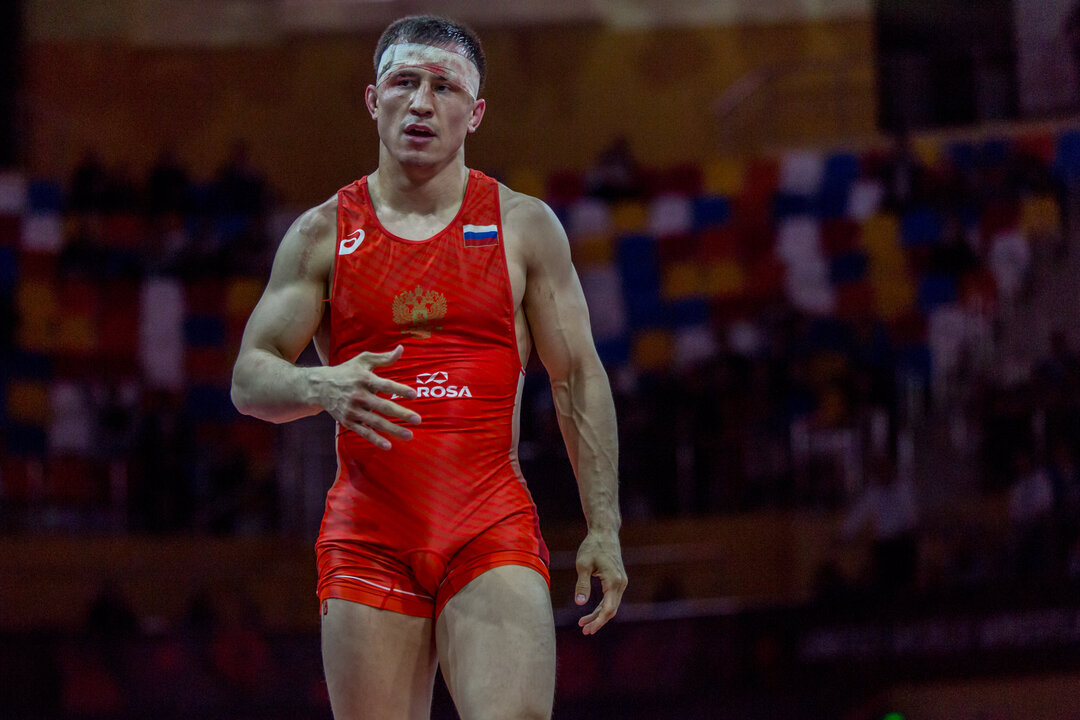 Roman VLASOV, Russia's two-time Olympic champion returns to the mat after suffering a knee injury before the 2018 World Championships. (Photo: Max Rose-Fyne)
1. Roman Vlasov, Old and New Rivals
At 77kg, the current world champion Alexander Chekhirkin was freed from the Russian National Championships, and the two-time Olympic champion Roman Vlasov, who missed the end of last season due to injury, is in line and intends to regain the title of the best wrestler in the country.
He will be confronted by an old rival, 2014 world champion Chingiz LABAZANOV, and two new rivals, Islam OPIEV and Egor KADIROV, who are winners of the junior world and European championships, respectively.
2. Possible Revenge For Davit Chakvetadze
At last year's Russian National Championships, Olympic champion Davit Chakvetadze, who just returned from injury, suffered a crushing defeat to Bekkhan OZDOEV. Ozdoev, the silver medalist of the 2018 European Championships went to the 2018 World Championships but failed to medal.
EuIn Kaliningrad, Chakvetadze will strive for revenge, while there are a number of other ambitious wrestlers, including Alan OSTAEV, who has already defeated world and European champion Maxim MANUKYAN (ARM).
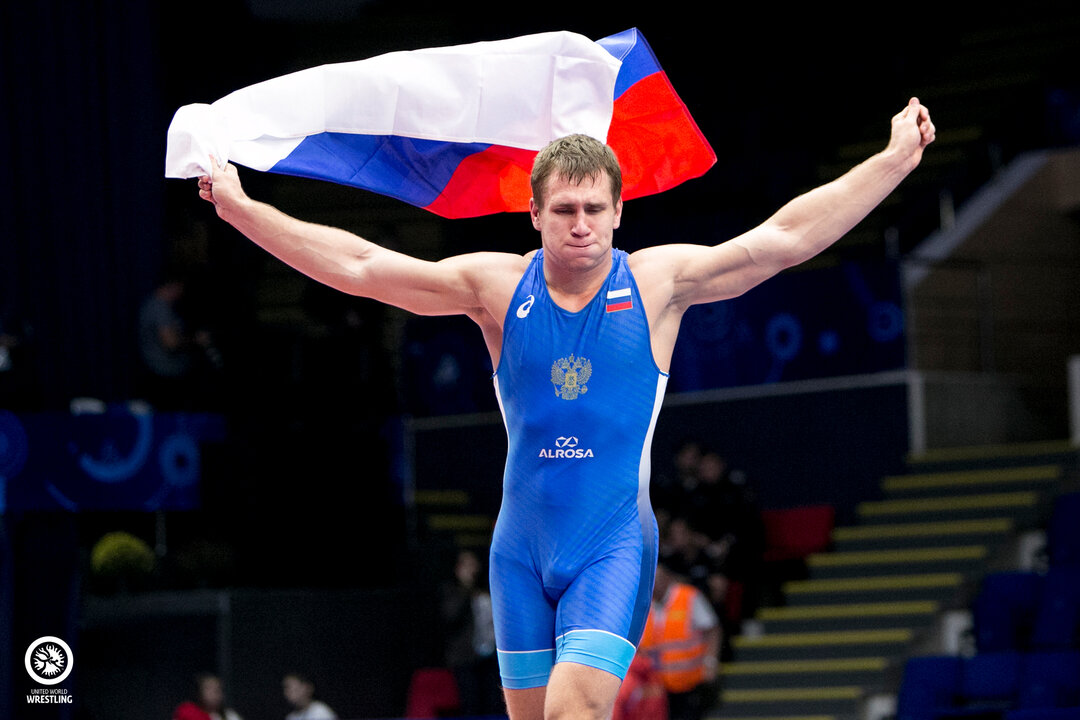 Alexander GOLOVIN celebrates after winning his second U22 World title. Golovin is one of the 97kg favorites. (Photo: Max Rose-Fyne)
3. Nikita Melnikov - Alexander Golovin
The reigning world champion Musa EVLOEV will not wrestle at the Russian National Championships, however, there's high competition in his weight, and the match between 2013 world and 2016 European champion, Nikita MELNIKOV, and two-time U23 world champion Alexander GOLOVIN is expected to happen.
We also single out junior world bronze medalists, Ruslan BEKUZAROV and Arthur SARGSYAN.
4. Trio of Flyers
There's interesting competition looming at 55kg. This category is only a year old - and the leaders here are Vasily TOPOEV and U23 world runner-up Vitaly KABALOEV. But now, Emin SEVERSHAEV, who has been a leader on the junior team for a long time, is ready to join the fight.
5. Adam Kurak - Abuazid Manzigov
This confrontation is already becoming a landmark. Abuyazid MANTSIGOV, the 2017 European bronze medalist missed out on a medal at the 2018 World Championships, while Adam KURAK has taken bronze at the World Championships and won the European Championships twice. In their extreme match before the World Championships, Manzigov was stronger.
How will it be this time? 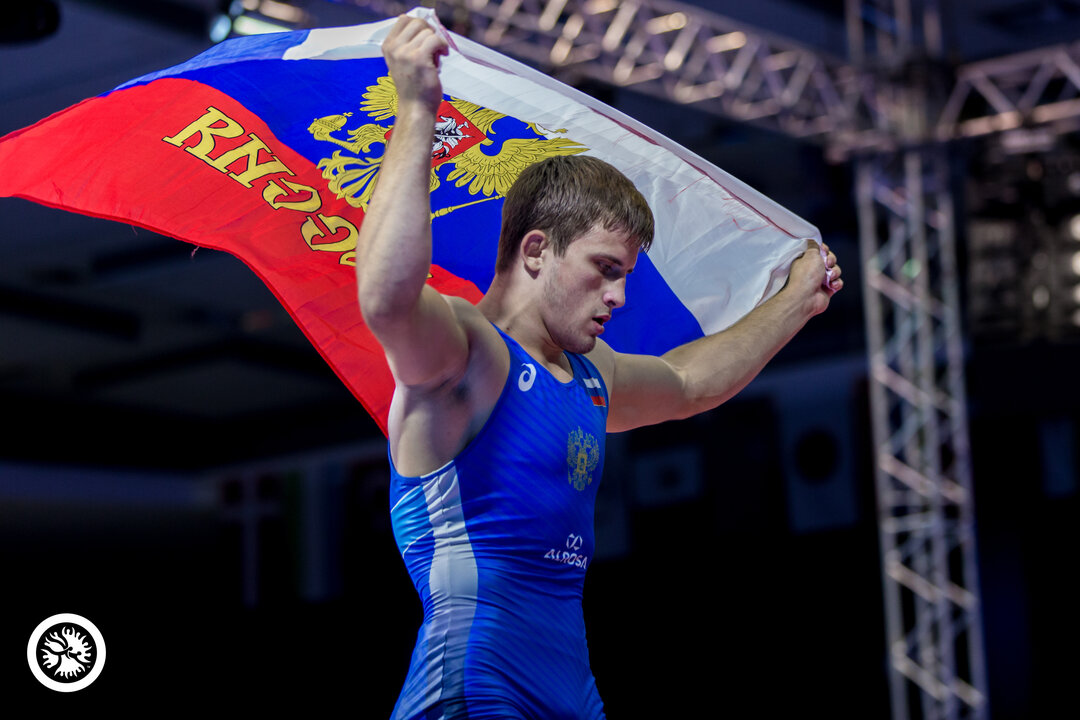 Aleksander KOMAROV has won four age-level world titles and would be among the favorites at 82kg - if he decides to compete on the senior level. (Photo: Max Rose-Fyne)
6. Chance of Alekander Komarov
Aleksander KOMAROV still remains on the junior team, where he can wrestle for one more year. But while there's time before the junior qualifiers, the time has come for the four-time age-level world champion to declare himself for the Senior Russian National Championships - especially with the country going through hard times at 82kg.
After the injury to 2016 world champion Ramazan ABACHARAEV, and Imil SHARAFETDINOV not successfully performing at the 2018 World Championships, isn't it time for Alexander Komarov to take his shot at a non-Olympic weight spot?
7. Favorites in the absence of world champions
In each weight, without mentioning above, there are favorites in the absence of world champions.
At 60kg, without Sergey Emelin, the highest chance of winning goes to the 2012 London Olympic bronze medalist Mingiyan SEMENOV.
In the weight up to 63kg, without Stepan MARYANIAN, the favorite is Ibragim LABAZANOV.
For the third time in a row, in the absence of Artem Surkov at 67kg, Zaur KABALOYEV can win the Russian National Championships.
At heavyweight, without Sergey Semenov, Vitaly SCHUR, the 2018 European runner-up, has the highest chance of success.
This story was translated from wrestrus.ru.
SCHEDULE
January 17 (Thursday)
10:00 - Mandate Commission
16:00 - Meeting of the panel of judges, representatives of the teams
17: 30 - Draw and medical control of weight categories up to 55kg, 60kg, 63kg, and 67kg
January 18 (Friday)
7:00 - Opening of the entrance for athletes
8:00 - Weighing, weight categories up to 55kg ,60kg ,63kg, and 67kg
10:00 - Start of competition
15:00 - Break
16:00 - Draw and medical control of weight categories up to 72kg, 77kg, and 97kg
17:00- Semifinals in weight categories up to 55kg ,60kg, 63kg, and 67 kg
January 19 (Saturday)
7:00 - Opening of the entrance for athletes
8: 00 - The second weighing for weight categories up to 55kg, 60kg, 63kg, and 67 kg
8:15 - Weighing, weight categories up to 72kg, 77kg, and 97kg
10:00 - Start of competition
15: 00 - Break
16: 00 - Draw and medical control for weight categories up to 82kg, 87kg, and 130 kg
17:00 - Opening Ceremony
17:00 - Semifinals in weight categories up to 72kg, 77kg, and 97kg
18:00 - Finals in weight categories up to 55kg ,60kg, 63kg, and 67 kg
January 20 (Sunday)
7:00 - Opening of the entrance for athletes
8:00 - Second weighing for weight categories up to 60kg, 77kg, and 97kg
8:15 - Weighing, weight categories up to 82kg, 87kg, and 130kg
10:00 Start of competition
15: 00 - Break
17:00 - Semifinals in weight categories up to 82kg, 87, and 130 kg
18:00 - Finals in weight categories up to 72kg, 77kg, and 97kg.
January 21 (Monday)
7:00 - Opening of the entrance for athletes
8: 00 -The second weighing for weight categories up to 82kg, 87kg, and 130kg
10:00 - Start of competition
12:00 - Finals in weight categories up to 82kg 87kg, 130kg.
Attention! The program is subject to change.

 Over 100 participants competed in the national youth tournament during the
Share your thoughts.
Comments