

Sun Sets Down Japan’s Irie in Stunner to Make 50kg Semis; Mukaida Advances
Tuesday, September 17, 2019 - 09:12 By Ken Marantz

NUR-SULTAN, Kazakhstan (Sept. 17) --- SUN Yanan (CHN) could not have found a better way to spoil Yuki IRIE (JPN)’s birthday.
Sun, avenging two losses over the past year to the Japanese, used two big throws then held on for dear life to score a 13-12 victory in the 50kg quarterfinals as the women’s competition got underway on Day 4 of the World Championships.
Sun will attempt to make the final for the first time since winning the 51kg gold in 2013 when she faces 2018 world silver medalist Mariya STADNIK (AZE) in the semifinals, which will be held at the start of the night session at Barys Arena.
The other semifinal will be a clash between Valentina ISLAMOVA BRIK (KAZ) and Alina VUC (ROU).
Two of the four weight classes in action, the women’s 50kg and 53kg, are Olympic weight classes. As such, the wrestlers who advanced to the semifinals clinched berths for their country at the Tokyo 2020 Olympics.
For Asian champion Irie, who defeated two-time world champion Yui SUSAKI (JPN) for a place on the team to Nur-Sultan, her only hope will be for Sun to defeat Stadnik, then make her way through the repechage on Wednesday to the bronze-medal match.
Irie had defeated Sun, the Rio 2016 Olympic bronze medalist and a third-place finisher a year ago in Budapest, at last year’s Women’s World Cup, and again in the final at the Asian Championships in April in Xi’an, China.
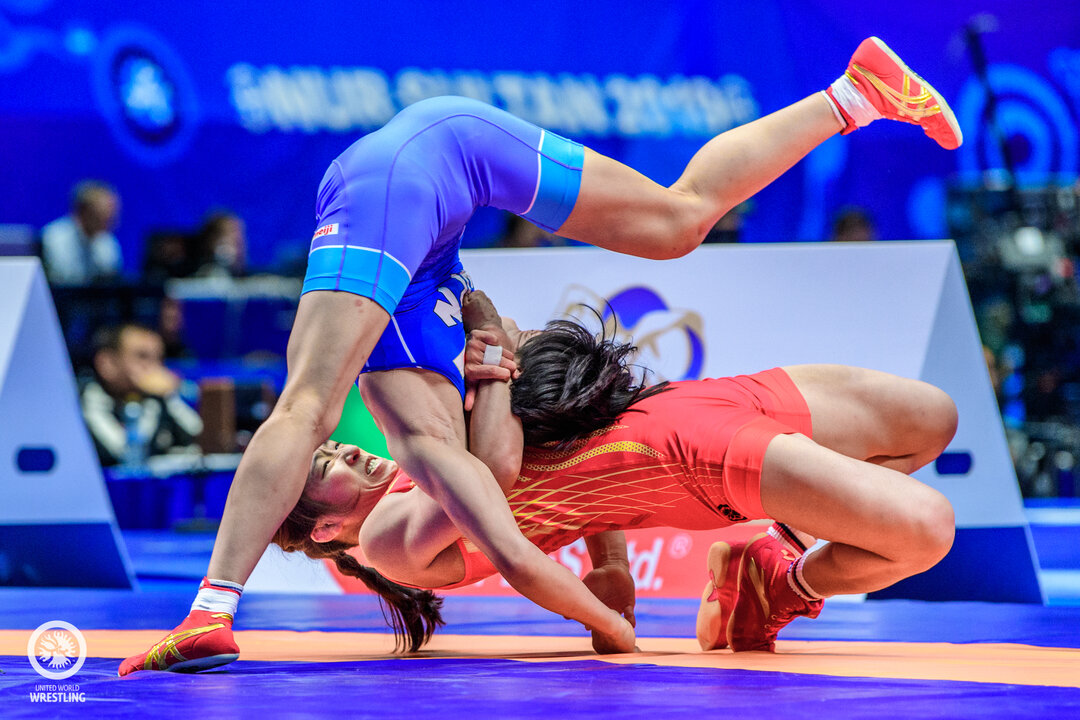 SUN Yanan (CHN) throws Yuki IRIE (JPN) in the opening period of the 50kg quarterfinals. (Photo: Tony Rotundo)
But this time Sun had a strategy to gain revenge. In the first period, when Irie shot for a takedown, Sun locked onto her head, then lifted her over for 4 points. Irie gained a penalty point for grabbing fingers, making it 4-1 going into the second period.
Irie again attacked, but Sun got behind and, with the two standing, launched a textbook back suplex for 5 points and a 9-1 lead. The two traded exposure points, to make it 11-3, then Irie started her comeback, cutting the lead to three. But a late takedown left her one point short and absolutely devastated on her 27thbirthday.
It marks the first time that Japan has not made it to the final of the lightest women’s weight class at the World Championships since 2009.
There was some consolation for the Irie family when younger sister Nanami advanced to the semifinals of the non-Olympic 55kg class. She will take on Marina SEDNEVA (KAZ) for a place in the final.
The other big name in action, two-time world champion Mayu MUKAIDA (JPN) looked sharp in advancing to the semifinals, capped by a 12-1 technical fall over Sara HILDEBRANDT (USA).
Mukaida’s stiffest test came in the second round, when she forged out a 7-0 victory over Vinesh VINESH (IND), the gold medalist at both the Asian Championships and Asian Games at 50kg in 2018.
The other semifinal will be an all-Asian affair between PAK Young Mi (PRK)---who had stunned Mukaida with a last-second victory in the final at the Asian Championships---and 2018 world bronze medalist PANG Qianyu (CHN).
In the other semifinal at 55kg, Jacarra WINCHESTER (USA) will face Bediha GUN (TUR).
Leading the semifinalists at 72kg is Natalia VOROBEVA (RUS), the Rio 2016 silver medalist and 2015 world champion at 69kg. She will have to battle the hometown crowd when she faces Zhamila BAKBERGENOVA (KAZ).
Battling for the other place in the final will be Asian 76kg champion Paliha PALIHA (CHN) vs European gold medalist Alina MAKHYNIA (UKR).
The night session will feature the final medal matches in Greco-Roman at 60kg, 77kg and 130kg. In the repechage rounds for places in the bronze-medal matches Tuesday, Mohammadali Geraei (IRI) advanced at 77kg, giving Iran a shot at a medal in all three divisions.
Also making it through was 34-year-old Heiki NABI (EST) at 130kg. A gold medalist in his second appearance at the World Championships back in 2006, he has since then won another world gold, a world bronze, and an Olympic silver (in 2012).
Day 4 results
Greco-Roman Pairings
60kg (39 entries)
Gold – Sergey EMELIN (RUS) vs Kenichiro FUMITA (JPN)
Bronze – Lenur TEMIROV (UKR) vs Mirambek AINAGULOV (KAZ)
Bronze – Elmurat TASMURADOV (UZB) vs Alireza NEJATI (IRI)
77kg (38 entries)
Gold – Alex KESSIDIS (SWE) vs Tamas LORINCZ (HUN)
Bronze –Mohammadali Geraei (IRI) vs Karapet CHALYAN (ARM)
Bronze – Jalgasbay BURDIMURATOV (UZB) vs Ashkat DILMUKHAMEDOV (KAZ)
130kg (31 entries)
Gold – Oscar PINO HINDS (CUB) vs Riza KAYAALP (TUR)
Bronze –Heiki NABI (EST) vs Amir GHASEMI (IRI)
Bronze – Iakobi KAJAIA (GEO) vs Eduard POPP (GER)
Women’s Wrestling
50kg (29 entries)
Semifinal – Alina VUC (ROU) vs Valentina ISLAMOVA BRIK (KAZ)
Semifinal – SUN Yanan (CHN) vs Mariya STADNIK (AZE)
53kg (30 entries)
Semifinal – Mayu MUKAIDA (JPN) vs Maria PREVOLARAKI (GRE)
Semifinal – PAK Yong Mi (PRK) vs PANG Qianyu (CHN)
55kg (18 entries)
Semifinal – Marina SEDNEVA (KAZ) vs Nanami IRIE (JPN)
Semifinal – Jacarra WINCHESTER (USA) vs Bediha GUN (TUR)
72kg (12 entries)
Semifinal – Zhamila BAKBERGENOVA (KAZ) vs Natalia VOROBEVA (RUS)
Semifinal – Paliha PALIHA (CHN) vs Alina MAKHYNIA (UKR)

 Over 100 participants competed in the national youth tournament during the
Share your thoughts.
Comments