

Susaki 2.0 Ready to Rumble at Asian Championships
Saturday, March 28, 2026 - 07:14 By Vinay Siwach

BISHKEK, Kyrgyzstan (March 27) -- In what has become a lasting photo of wrestling from the 2024 Paris Olympics, a wide-eyed Yui SUSAKI (JPN) is seen staring blankly into nothing.
The photo was taken after Susaki suffered her first-ever international loss. Vinesh PHOGAT (IND) had just defeated her in the opening round of the Paris Games. It was not a familiar feeling for Susaki. Not in international wrestling at least.
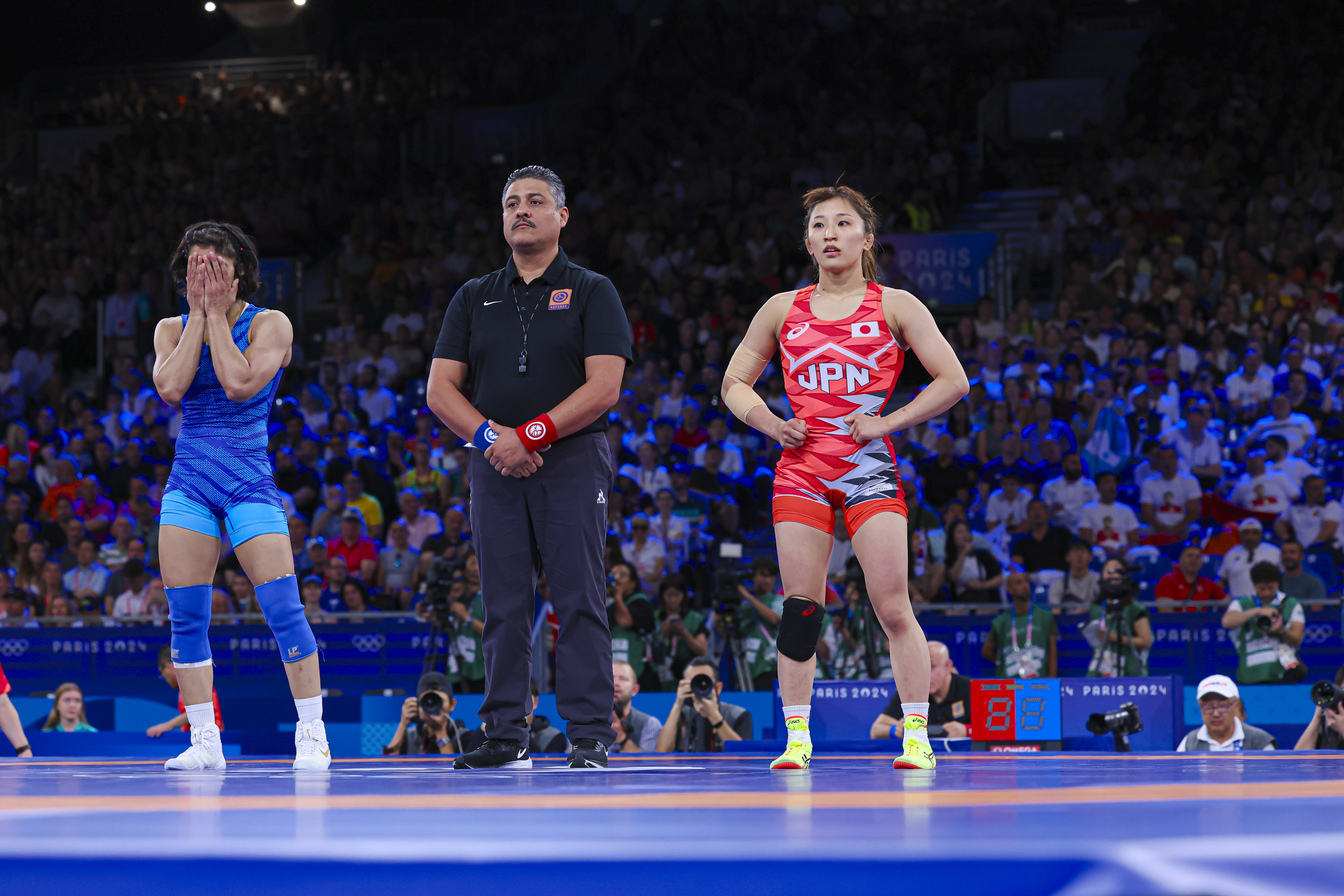 Yui SUSAKI (JPN) lost her first bout at the Paris Olympics. (Photo: United World Wrestling)
It was only after she walked off the mat and faced the cameras waiting for her in the field of play mixed zone that Susaki realized what had happened. She burst into tears.
Almost two years after that after that loss, a 'new' Susaki is returning to action at next week's Asian Championships in Bishkek, Kyrgyzstan in a bid to re-establish herself as the dominant force she was before Paris.
"The defeat at the Paris Olympics and the year-and-a-half that followed were an incredibly difficult and painful time," Susaki says.
Susaki went on to win a bronze medal at the Paris Olympics, a downgrade from the gold medal she won in Tokyo where she outscored her opponents 41-0. The loss shocked the world as Susaki was considered unbeatable. She was a three-time world champion boasting of a 96-0 winning streak, never lost an international bout and was the first wrestler to win the Golden Grand Slam, winning the Olympic gold and all age-group world titles including senior.
A second Olympic title seemed inevitable. There was no stopping.
While the loss was on the mat, Susaki believes that things off the mat may have contributed to her loss as well.
"In recent years, my desire to give back and do things for those around me had grown stronger," she says. "My focus had shifted toward others. When my focus is on others, I feel pressure, my mind gets cluttered with distractions, and doubts arise, leading me to overthink things."
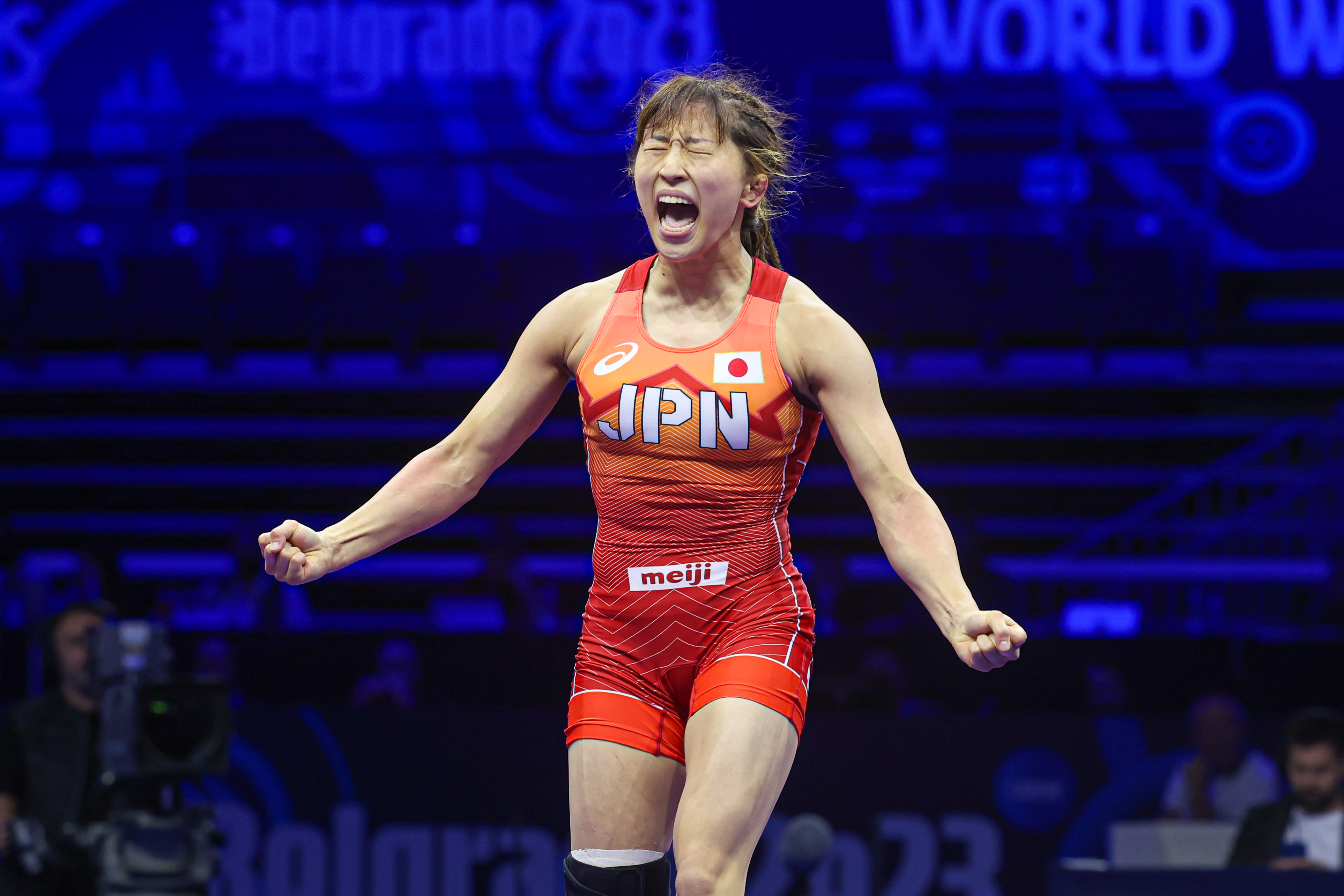 Yui SUSAKI (JPN) celebrates after winning the world title in 2023. (Photo: United World Wrestling / Kadir Caliskan)
She is relieved that she did not overthink the loss in Paris after she returned to Japan.
"There were moments when I lost faith in myself [after that Paris loss]," she says. "But since then, I’ve focused more than ever on self-reflection and self-dialogue in my personal life, as well as on developing my character as a person. I’ve gained a deeper understanding of myself, and I feel I’ve developed a firm sense of self."
The version that Susaki has been working on over the last year did not begin just after the Olympics. There was one more bump before she made an important career decision.
Susaki was finding it incredibly difficult to reduce weight to continue wrestling at 50kg. So in September 2025, she decided to wrestle at 53kg at the National Sports Festival in Japan. It did not go as planned.
She suffered her first domestic loss in six years when world champion Moe KIYOOKA (JPN) defeated her at the festival. What was more alarming was that Susaki failed to finish a takedown in the final minute despite getting control over Kiyooka.
The 26-year-old returned to the drawing board with a sense of urgency as the Emperor's Cup was looming. The 2025 December tournament was the first step towards making the Japan team for the 2026 Asian Championships, World Championships and the Asian Games.
"The answer I arrived at after overcoming it all was simple: I wrestle because I love it and because I want to become an Olympic champion," she said. "I wrestle not for anyone else, but for myself -- to make my dream come true."
Susaki, along with her team, devised a better plan to reduce weight and remain at 50kg. She ate precise and molded her training in a way in which she managed to contain the weight.
In December, she won the Emperor's Cup at 50kg without much trouble and earn a spot on the Japan team for the Asian Championships which only be her third in her 12-year international career.
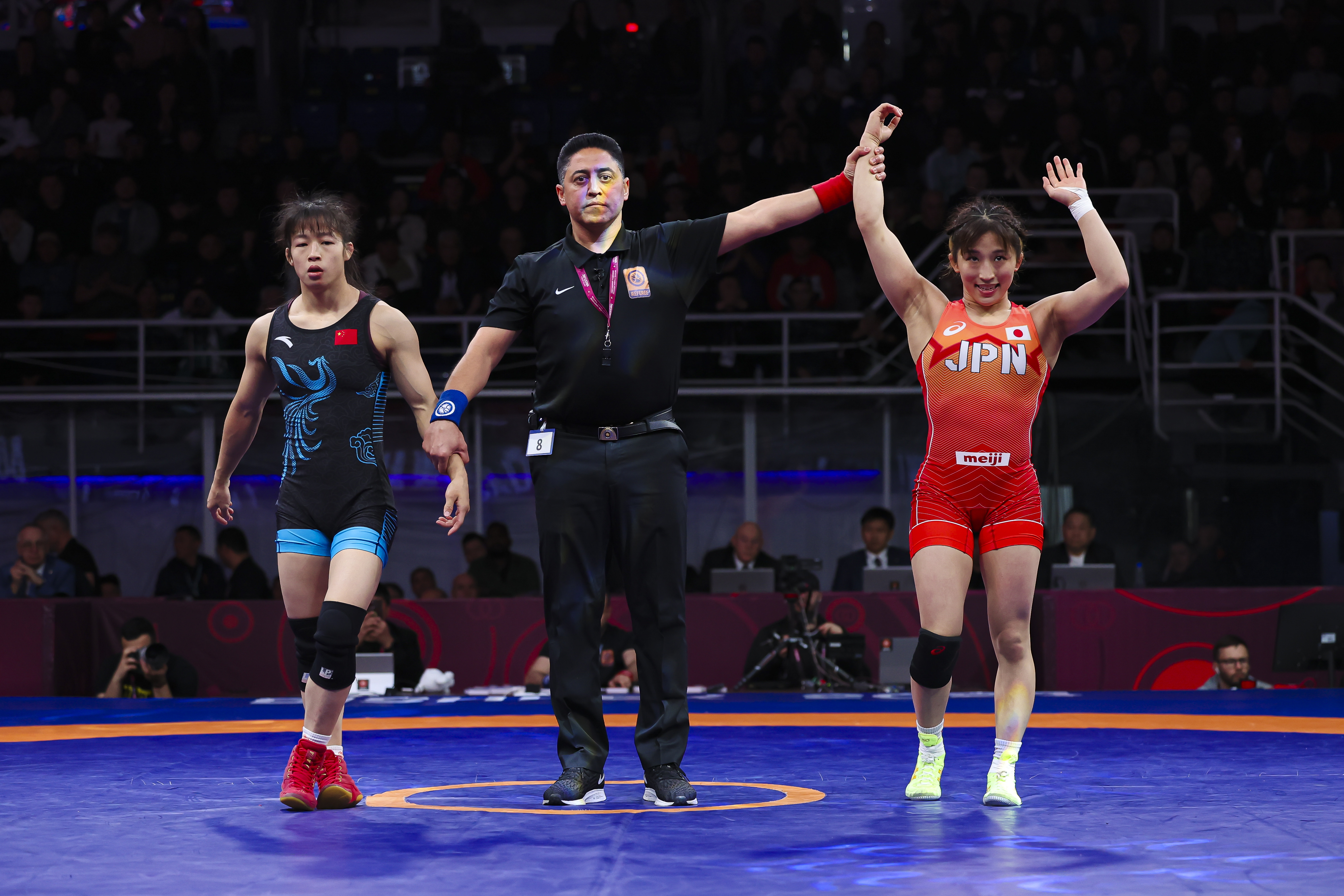 Yui SUSAKI (JPN) defeated Ziqi FENG (CHN) in the 50kg final at the Asian Championships in 2024. (Photo: United World Wrestling / Kadir Caliskan)
Incidentally, her last Asian Championships was also in Bishkek in 2024, and she won gold after beating Ziqi FENG (CHN) in the final. She is likely to face Feng again as the Paris Olympic bronze medalist is among a strong field at 50kg this year.
One of the challenges that Susaki will be keen on taking on is a bout against Son Hyang KIM (PRK), a wrestler Susaki has beaten before. The two met in the 48kg final of the 2017 Asian Championships, Susaki's first, and the Japanese wrestler won 10-0.
Then in the same year, the two met at the World Championships and Kim managed to keep it tighter but failed to stop Susaki from winning, 5-2. Susaki went on to win her first senior world title.
While the matches against formidable opponents are something she is looking forward to, Susaki is more excited to return to an international tournament after a break and kick start her new Olympic cycle.
"I’m incredibly excited to be competing in a UWW international tournament for the first time in a year and eight months," she said. "I want to win this tournament to get off to a strong start, so that I can compete in the Los Angeles Olympics and reclaim the gold medal. I also want wrestling fans to see how much stronger Yui Susaki has become.
"I think you’ll get to see a whole new Yui Susaki!"
Share your thoughts.
Comments