

Takatani Takes Title at 86kg to Clinch World Team Spot; Minagawa Denies Kagami in Rematch
Friday, June 14, 2019 - 22:34 By Ken Marantz

TOKYO (June 14)---Sosuke TAKATANI showed he could pull his weight by winning a third different weight class in three years, while Hiroe MINAGAWA avenged her previous day’s loss to teen star Yuka KAGAMI to join him on Japan’s team to the World Championships.
Takatani continued to settle into the Olympic freestyle weight class of 86kg, soundly defeating Masao MATSUSAKA 8-0 in the final on the second day of the four-day All-Japan Invitational Championships at Tokyo’s Komazawa Gym.
Takatani, a world silver medalist in 2014 at 74kg, won his third straight title at the tournament called the Meiji Cup and sixth overall. He won his fourth title at 74kg in 2017, then won the 79kg crown last year as he transitioned to 86kg.
In his first foray at 86kg, Takatani won the gold at the All-Japan Championships (called the Emperor’s Cup) last December. That victory, combined with the Meiji Cup triumph, automatically earned him a place on Japan’s team to this year’s World Championships in Kazakhstan.
In the semifinals at the Emperor’s Cup, Takatani was stretched to the limit in scraping out a 2-1 win over Matsusaka. But on Friday, he was easily the superior wrestler, scoring takedowns with a pair of low tackles in the first period, then adding a 4-point takedown in the last 15 seconds.
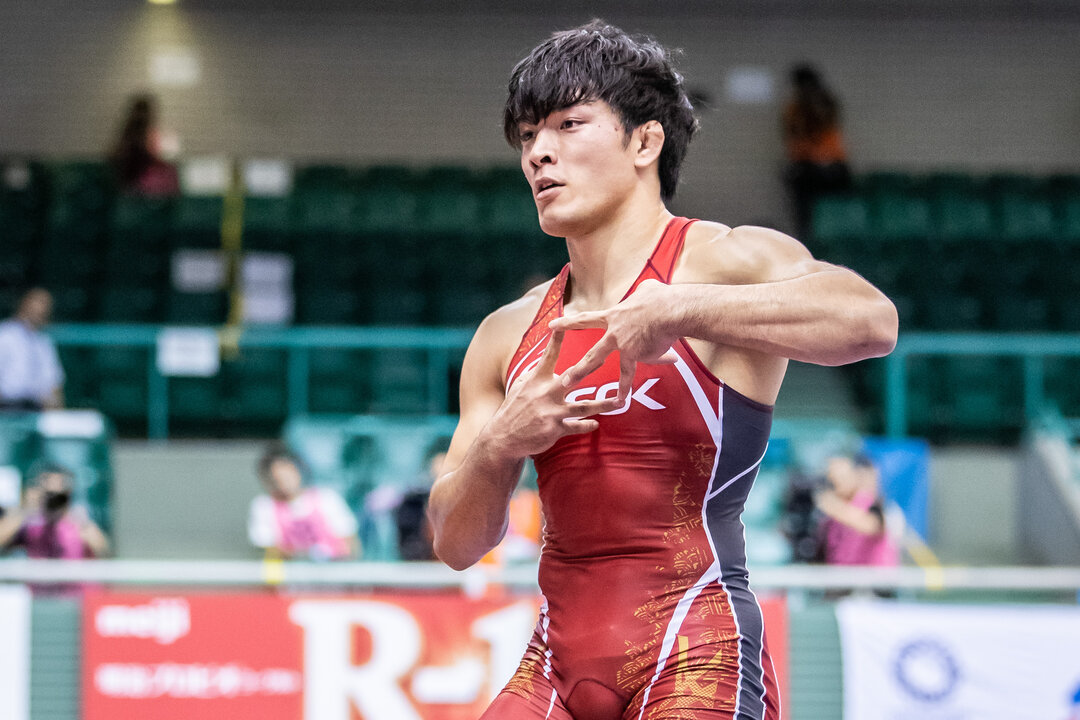 Sosuke TAKATANI defeated Masao MATSUSAKA 8-0 in the 86kg finals. (Photo: Sachiko Hotaka)
“I had a tough match with Matsusaka at the Emperor’s Cup, so to win so solidly in the final shows I’ve made progress,” the 30-year-old Kyoto native said. “I give it a 90 [out of 100]. The other 10 is room for improvement. I’ll start thinking about that from tomorrow.”
As Takatani continues to adjust to the increased power of his new opponents, the two-time Olympian said that not having to worry about weight control eliminates one source of stress.
“I felt no pressure at all,” he said. “Up to now, I had to fight with making weight. But after going up to 86kg, I don’t have to worry about weight and can focus entirely on my wrestling.”
Takatani can now focus on Nur-Sultan 2019, where, by proclamation by the Japan Wrestling Federation, winning a medal will earn a Japanese wrestler a highly desired place on the Tokyo 2020 Olympics team.
“For the London and Rio Olympics, I made the team by winning a spot in the Asian qualifying tournaments,” Takatani said. “This year, I want to make the team for the Tokyo Olympics at the World Championships.”
Wrestlers who win the same weight class at both the Emperor’s Cup and Meiji Cup earn a ticket to Nur-Sultan. If the winners are different, the two will meet in a playoff set for July 6.
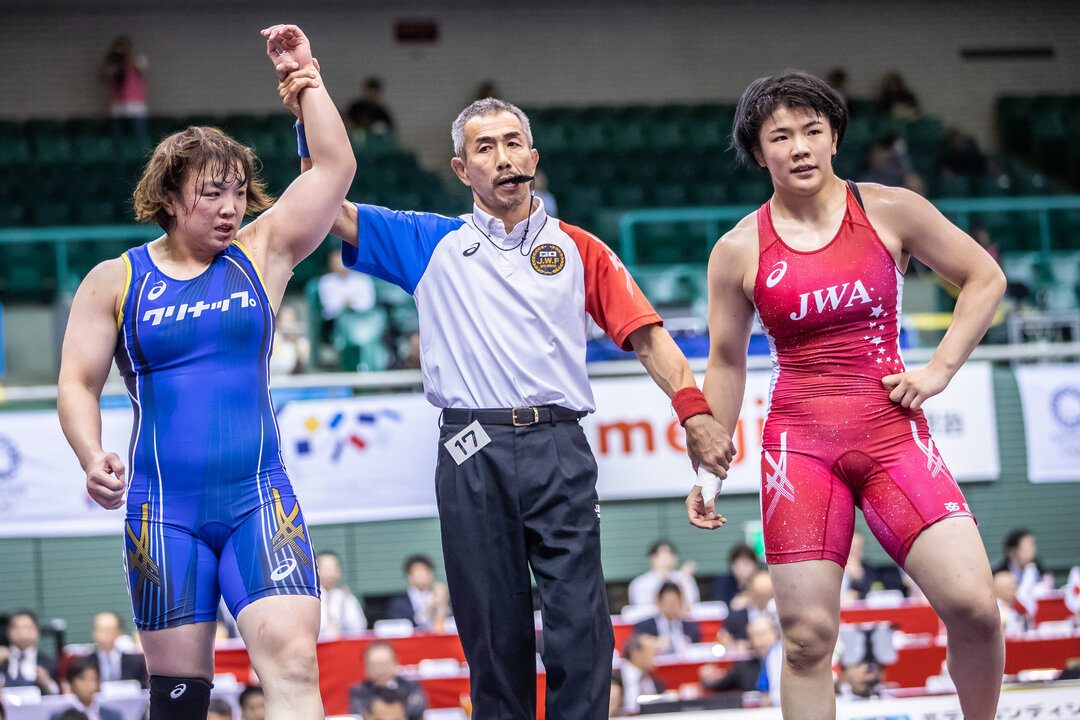 Hiroe MINAGAWA avenged her previous day’s loss to teen star Yuka KAGAMI to join him on Japan’s team to the World Championships. (Photo: Sachiko Hotaka)
Minagawa, who won a second world bronze medal last year in Budapest, followed up on her victory at the Emperor’s Cup by defeating two-time world cadet champion Kagami 3-1 in the women’s 76kg final.
As the division had only six entries, the Nordic group system was employed, with two pools of three each. Minagawa and Kagami were drawn in the same group, and the 17-year-old Kagami came away with a 3-1 win Thursday over the veteran who is 14 years her senior.
In the final, however, Minagawa turned the tables, although not without a scare in the closing seconds.
Minagawa scored an activity-clock point and a step-out to take a 2-0 lead into the second period. Kagami received a point with Minagawa on the activity clock with 15 seconds left, then went on the attack.
In an intense flurry at the edge, Kagami seemed to force out Minagawa with 2.6 seconds left on the clock. First, she was awarded a point, then it was taken away. The Kagami side then challenged, and upon further review it was found that the referee had prematurely blown the whistle, negating the final move and giving Minagawa a point for an unsuccessful challenge.
“Yesterday, my match was pathetic,” Minagawa said. “It was the first time in a while that I lost to a Japanese opponent. The biggest problem was mental, but today I steadied my mind going into the match and I think that was a reason why I could win.”
Kagami, as the Emperor’s Cup champ at 72kg, remains eligible to enter the world team playoff in that weight class.
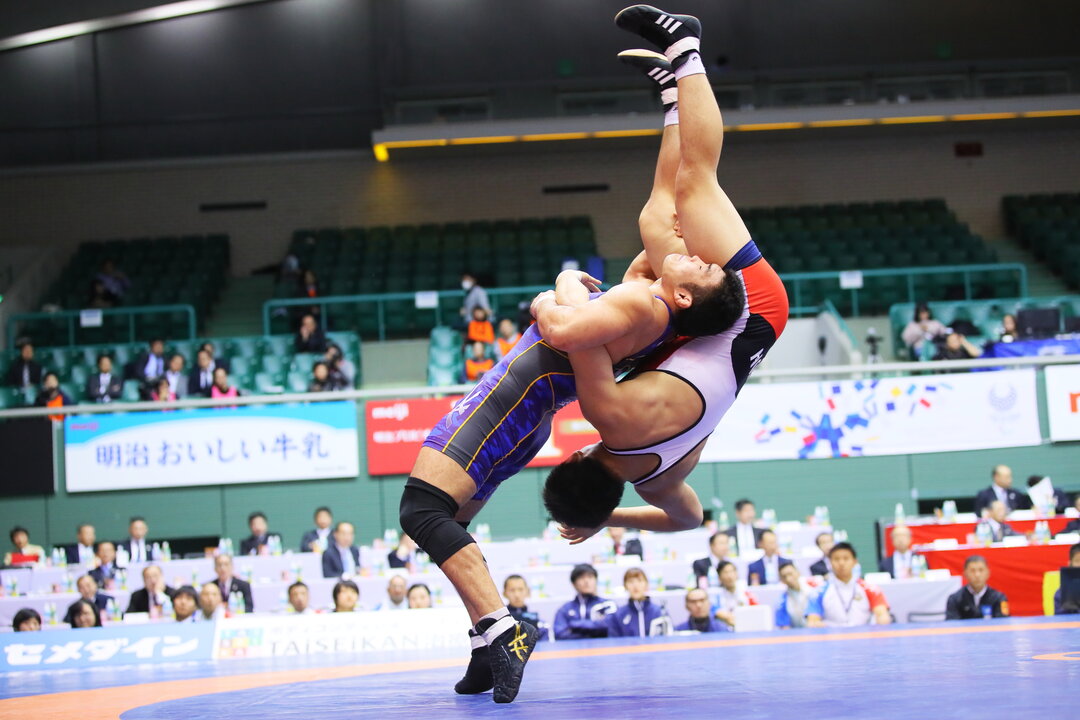 Naoya AKAGUMA won his second consecutive Emperor's Cup by defeating Takeshi YAMAGUCHI, 3-2 in the 97kg finals. (Photo: Sachiko Hotaka)
In other finals, Naoya AKAGUMA repeated his Emperor’s Cup win in the freestyle 97kg final over Takeshi YAMAGUCHI, scoring a takedown in the last 20 seconds for a 3-2 win and a second trip to the World Championships.
In Greco-Roman, Masato SUMI (87kg) and Yuta NARA (97kg) booked places on the plane to Nur-Sultan, while Shohei YABIKU set up a playoff with Emperor’s Cup winner Naotsugu SHOJI at 77kg by beating him in the final, capping an 8-0 technical fall with a spectacular 5-point back suplex.
World junior and U23 champion Saki IGARASHI won her first Meiji Cup title by beating Kana HIGASHIKAWA by fall in the 55kg final. She can make her first senior worlds by winning a playoff with Nao TANIYAMA, who missed the tournament due to injury.
Also coming away with her first title was Yumeka TANABE, a former world cadet champion who defeated Kiwa IWASAWA, 11-8, in a nail-biting 59kg final. Tanabe is the daughter of Athens 2004 bronze medalist Chikara TANABE.
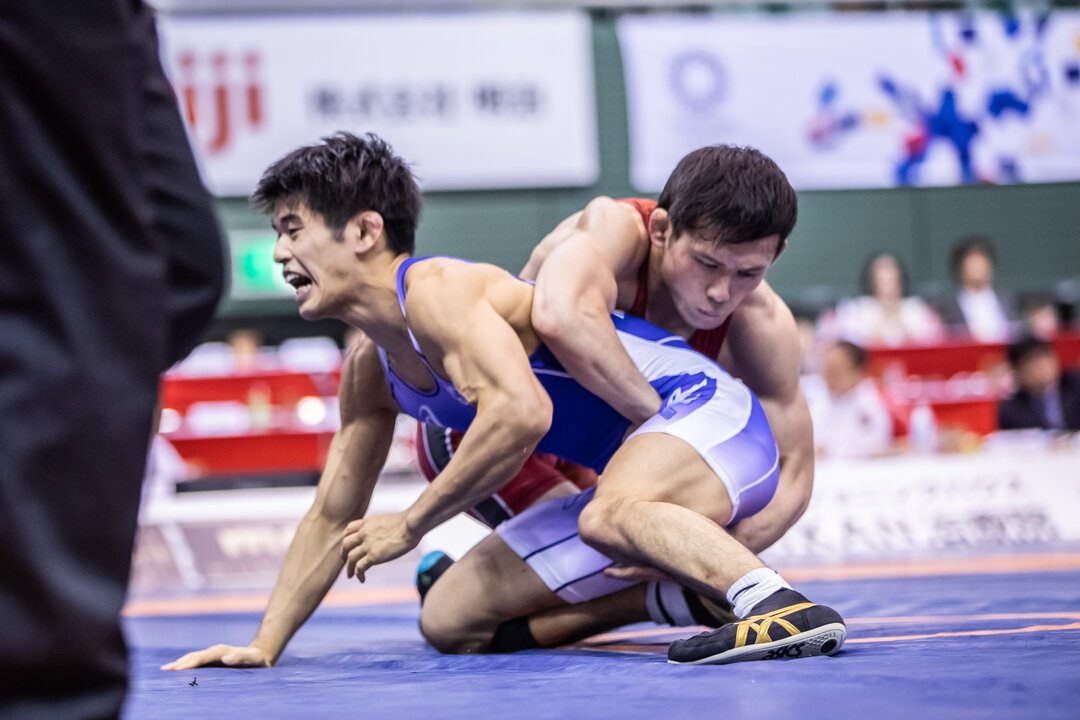 Yuki TAKAHASHI, the 2017 57kg world champion, advanced to Saturday's finals. (Photo: Sachiko Hotaka)
Takahashi cruises into final; ailing Fujinami falls short
Meanwhile, former world champion Yuki TAKAHASHI remained on track to regain the world crown when he advanced to the freestyle 57kg final.
Takahashi, who had to settle for bronze medals at both last year’s World Championships and this year’s Asian Championships, showed a more aggressive side earlier than usual, and had no need to put on one of patented comebacks.
Takahashi scored takedowns in the opening seconds in both of his matches. He defeated Toshihiro HASEGAWA 7-4 in the semifinals to set up a repeat of the Emperor’s Cup final with Kaiki YAMAGUCHI.
“One thing I was doing was letting the opponent get to my legs too much,” Takahashi said. “In this tense situation with a connection to the Olympics, you can’t make even one mistake.
Takahashi has long rued his failure to make it to Rio 2014. “I’ve been thinking about it for the last four years. If I win one more match, I’m on the team to the worlds, so I won’t let my guard down.”
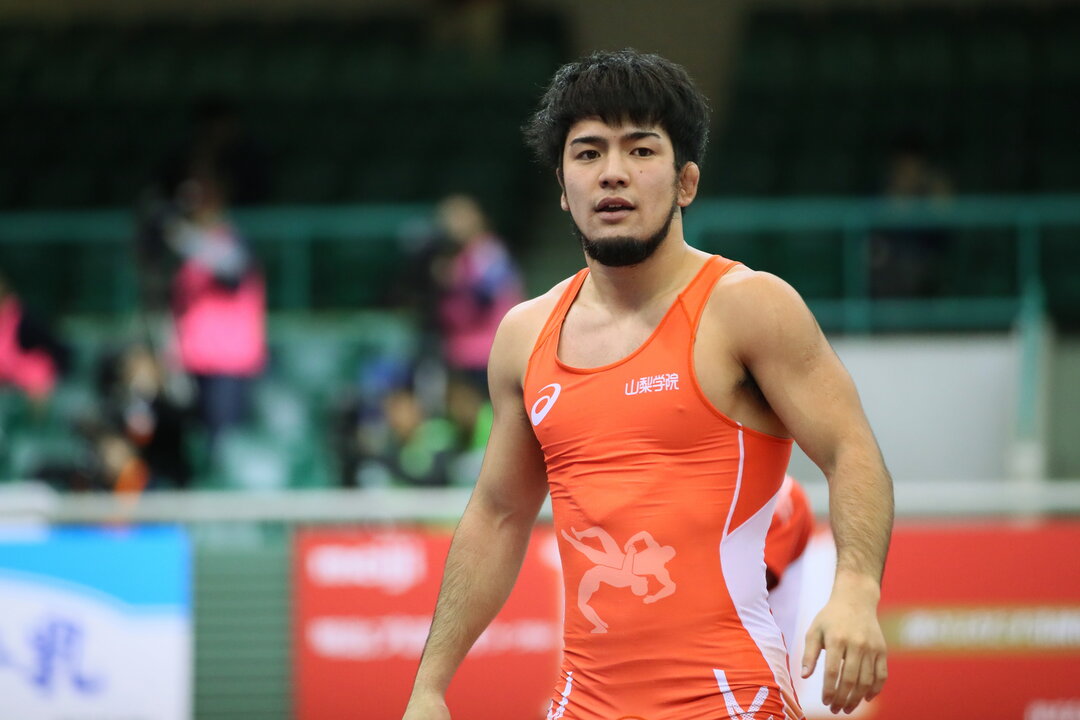 Yuhi FUJINAMI, a 2017 world bronze medalist at 70kg, fell to Mao OKUI and will have to earn his ticket to the worlds via a playoff. (Photo: Sachiko Hotaka)
For the second straight year, former world bronze medalist Yuhi FUJINAMI will have to earn his ticket to the worlds via a playoff, although this time he tried to put aside his injuries to compete at the Meiji Cup.
Fujinami showed that his determination to maintain his grip on the freestyle 74kg class could not overcome the effects of a recent back injury, combined with the knee injury he suffered at the Asian Championships.
Fujinami, hoping to cobble together the victories he needed to clinch his place at the World Championships, instead will need to return to action in three weeks for the playoff after losing by fall to Mao OKUI in the semifinals.
“It’s disappointing, and pitiful. It’s an important experience, and all I can do is try to see the positive in it,” Fujinami said. “I’ve just been continually injured. It’s my own responsibility to take care of myself, but I didn’t practice nearly enough, and I had a lot of worries going into this tournament.
“To be honest, I had a feeling I could lose. It’s not an easy weight class to win. I don’t want to sound like I’m making excuses, but in terms of condition, I feel at about 20 percent.”
Fujinami, a 2017 world bronze medalist at 70kg, injured his right knee in winning his opening match at the Asian Championships in Xi’an, China. He withdrew from the tournament as a precaution in preparation for the Meiji Cup---only to wrench his back a week ago in practice.
His limited mobility could be clearly seen, and after giving up a go-ahead takedown to World University bronze medalist Okui in the second period, his desperation back suplex was easily stopped, leading to a fall at 4:23.
Assuming he can recover in time, Fujinami, as Emperor’s Cup champion, will face either Okui or Jintaro MOTOYAMA in the playoff for the ticket to Nur-Sultan. Motoyama was a world U23 bronze medalist last year at 70kg.
Fujinami said he considered but decided against skipping the Meiji Cup and putting everything on the line in the playoff, which is what he did last year to make the team to Budapest 2018.
“I did that last year, and I didn’t want it to seem like I was running away. I thought I would do what I could and see if I could get a good result.”
Another factor might have been that, as a recent graduate of Yamanashi Gakuin University, he wanted to appear in the uniform of his new employer, Japan Beverage.
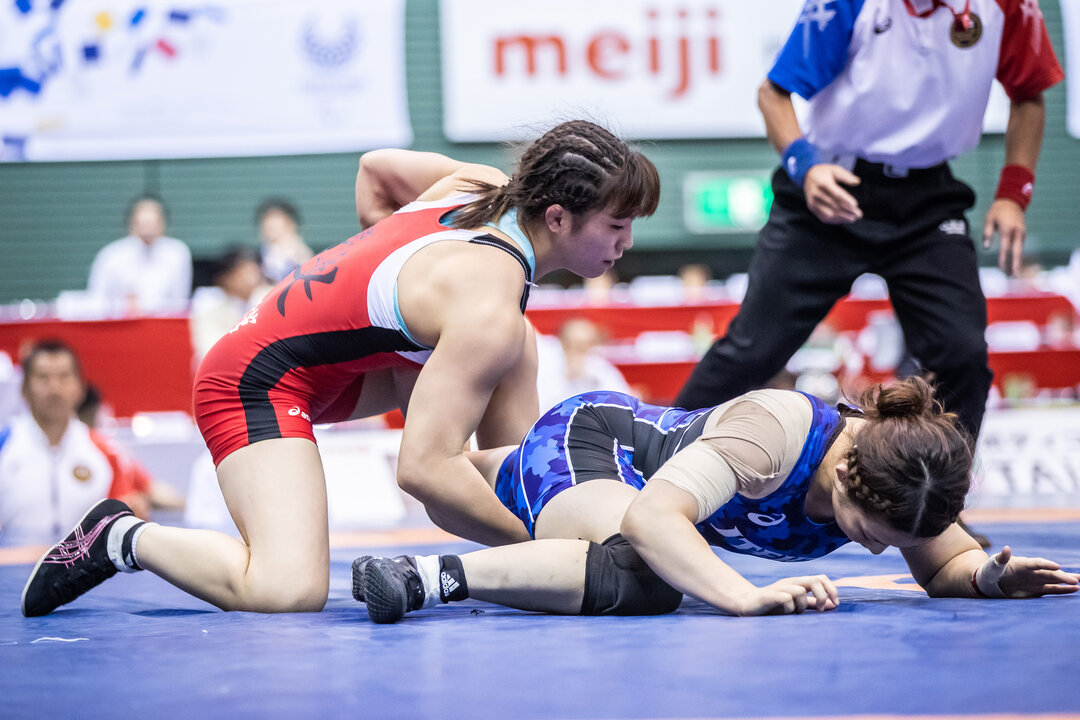 Budapest world silver medalist Yukako KAWAI advanced to the women’s 62kg final where she'll take on Yuzuka INAGAKI. (Photo: Sachiko Hotaka)
Meanwhile, world silver medalist Yukako KAWAI advanced to the women’s 62kg final, where she will face high schooler Yuzuka INAGAKI, the Emperor’s Cup champ at 59kg who is taking a shot at the Olympic weight class.
Day 2 Results
Freestyle
57kg (12 entries)
Semifinals
Yuki TAKAHASHI df. Toshihiro HASEGAWA, 7-4
Kaiki YAMAGUCHI df. Daiki ARAKI by TF, 10-0, 5:35
61kg (11 entries)
Semifinals
Ken KIKUCHI df. Keita SHIMIZU, 6-4
Yo NAKATA df. Wataru TADANO by TF, 10-0, 4:40
74kg (12 entries)
Semifinals
Mao OKUI df. Yuhi FUJINAMI by Fall, 4:23 (4-1)
Jintaro MOTOYAMA df. Ken HOSAKA, 8-1
79kg (4 entries)
Round-Robin, Final Standings
1. Yudai TAKANASHI (3-0)
2. Komei KAWABATA (2-1)
3. Yuto IZUTSU (1-2)
Key match: Yudai TAKANASHI df. Komei KAWABATA, 5-4 in 2nd round
86kg (12 entries)
Final - Sosuke TAKATANI df. Masao MATSUSAKA, 8-0
3rd place – Hayato ISHIGURO df. Yuya NISHIKIDO, 4-2
3rd place – Takahiro MURAYAMA df. Shota SHIRAI by Def.
92kg (5 entries)
Round-robin (through 3 rounds)
1. Takuma OTSU (2-0); 2. Takumi TANIZAKI (2-1); 3. Koji YAMANE (1-2); 4. Akinobu TAKEUCHI (1-1); 5. Yudai SHIGYO (0-2)
97kg (12 entries)
Final - Naoya AKAGUMA df. Takeshi YAMAGUCHI, 3-2
3rd place – Keiwan YOSHIDA df. Yusuke FUJITA, 2-2
3rd place – Taira SONODA df. Atsushi MATSUMOTO, 7-0
125kg (12 entries)
Final - Taiki YAMAMOTO df. Katsutoshi NAKAZAWA, 3-2
3rd place - Nobuyoshi ARAKIDA df. Masae TOMIE by Fall, :54 (4-0)
3rd place - Tetsuya TANAKA df. Yasuhiro YAMAMOTO by Def.
Greco-Roman
55kg (8 entries)
Semifinals
Shota OGAWA df. Hiromu KATAGIRI by TF, 9-0, 1:50
Hirokazu ONO df. Kazuto KATO, 5-0
63kg (9 entries)
Final - Yoshiki YAMADA df. Ichito TOKUHIGA, 2-0
3rd place - Kohei YOSHIKAWA df. Naoki GODA, 6-4
3rd place - Masaki ISHIKAWA df. Ryota KOSHIBA by TF, 9-1, 2:30
67kg (12 entries)
Semifinals
Shogo TAKAHASHI df. Katsuaki ENDO, 2-1
Tsuchika SHIMOYAMADA df. Yamato UI by TF, 8-0, 1:58
77kg (11 entries)
Final - Shohei YABIKU df. Naotsugu SHOJI by TF, 8-0, 2:24
3rd place - Amane SHIMOYAMADA df. Takeshi IZUMI by Fall, 5:06 (10-4)
3rd place - Kodai SAKURABA df. Shoma YAMASAKI by TF, 8-0, 5:19
87kg (7 entries)
Final - Masato SUMI df. Takahiro TSURUDA, 5-3
3rd place – Ryota NASUKAWA df. Kanta SHIOKAWA, 9-4
Semifinals
Takahiro TSURUDA df. Ryota NASUKAWA by Fall, 2:07 (7-4)
Masato SUMI df. Kanta SHIOKAWA, 2-1
97kg (9 entries)
Final - Yuta NARA df. Masaaki SHIKIYA, 3-1
3rd place – Naoki MATSUMOTO df. Yoshiki SHIRATORI, 5-1
3rd place – Taichi OKA df. Yuri NAKAZATO, 4-1
130kg (8 entries)
Semifinals
Arata SONODA df. Shoma SUZUKI by TF, 8-0, :37
Keita BANCHI df. Sota OKUMURA, 3-1
Women’s Wrestling
55kg (6 entries)
Final - Saki IGARASHI df. Kana HIGASHIKAWA by Fall, 1:36 (8-0)
3rd place – Hikari HIGUCHI df. Mizuki ISHIMORI, 10-2
Semifinals
Saki IGARASHI df. Mizuki ISHIMORI by Fall, 5:26 (6-1)
Kana HIGASHIKAWA df. Hikari HIGUCHI, 5-4
59kg (6 entries)
Final - Yumeka TANABE df. Kiwa IWASAWA, 11-8
3rd place – Sena NAGAMOTO df. Ayami SUGIYAMA, 3-1
Semifinals
Kiwa IWASAWA df. Sena NAGAMOTO, 7-4
Yumeka TANABE df. Ayami SUGIYAMA by TF, 12-2, 5:08
62kg (12 entries)
Semifinals
Yukako KAWAI df. Kiwa SAKAE, 4-0
Yuzuka INAGAKI df. Kumi IRIE, 2-0
65kg (5 entries)
Round-Robin, Final Standings
1. Misuzu ENAMOTO (4-0)
2. Miki KAWAUCHI (3-1)
3. Saki KAWAUCHI (2-2)
Key match: Misuzu ENAMOTO df. Miki KAWAUCHI, 8-0 in 4th round
72kg (4 entries)
Round-Robin (through 2 rounds)
1. Mei SHINDO (2-0); 2. Karen SUZUKI (1-1); 3. Mai HAYAKAWA (1-1); 4. Kanon KOBAYASHI (0-2)
76kg (6 entries)
Final - Hiroe MINAGAWA df. Yuka KAGAMI, 3-1
3rd place – Yasuha MATSUYUKI df. Miki SAITO by Def.
Semifinals
Yuka KAGAMI df. Miki SAITO by Def.
Hiroe MINAGAWA df. Yasuha MATSUYUKI, 2-1

 Mavlet BATIROV (RUS) is a two-time Olympic champion. (Photo: United World Wrestling / Martin Gabor)
 Tonya VERBEEK (CAN) was the head coach of the Canadian national team. (Photo: United World Wrestling / Tony Rotundo)
 Armenia coach Levon JULFALAKYAN (ARM) inducted into UWW Hall of Fame. (Photo: United World Wrestling)
  Vassolos PAGONIS, referee. (Photo: United World Wrestling)
Share your thoughts.
Comments