

Tazhudinov adds Asian Games title; Iran finishes with 3 golds
Saturday, October 7, 2023 - 11:39 By Vinay Siwach

LIN'AN, Hangzhou, China (October 7) -- Akhmed TAZHUDINOV (BRN) has not been home to Dagestan yet. The world champion is on the road since winning the gold medal in Belgrade, traveling to Bahrain and now to Hangzhou, China for the Asian Games.
If his village Gergebil was planning for a welcome for his world title, it would now need to be a grand one as Tazhudinov added an Asian Games title on Sunday.
After beating Kyle SNYDER (USA) and Abdulrashid SADULAEV (AIN) in back-to-back matches at the World Championships, Tazhudinov had to travel to Bahrain. The much-awaited welcome in Dagestan was postponed with the Asian Games scheduled from October 4-7 in Hangzhou.
And since it's a once-in-a-four- years Games, Tazhudinov decided to give it a shot.
"This tournament is a bit different from others because it happens only once in four years," Tazhudinov said. "That’s why we didn’t take any rest. We didn’t fly to Dagestan. We went directly to Bahrain, rested a little bit, and started the preparations for the Asian Games. And won it."
If the World Championships saw a high-flying Tazhudinov, the Asian Games witnessed a Tazhudinov who was content with scoring points in a much-reserved manner.
Out of his four wins to the gold medal, only one was a fall while others were on points. He defeated Awusayiman HABILA (CHN) 7-3 in the opening bout, pinned Kanybek ABDULKHAIROV (KGZ) in the quarterfinals, and won 6-1 against Juhwan SEO (KOR) in the semifinals.
Wrestling Mojtaba GOLEIJ (IRI) in the final, Tazhudinov put out his best performance with Goleij struggling to break the world champion's defense and giving up two takedowns in Tazhudinov's 6-1.
The 20-year-old had beaten Goleij at the Asian Championships semifinal as well but that victory was much closer as he won 13-8. Tazhudinov explained that wrestling at two tournaments in the space of two weeks made him tired which forced him to change the approach.
"I didn’t have enough time to recover after the World Championships that’s why the games went a bit tough for me," he said.
The gold medal made Tazhudinov the first wrestler from Bahrain to win a medal. Before Hangzhou, Bahrain had only entered wrestling at the Asian Games once, in 2018 when Adam BATIROV (BRN) finished seventh in Jakarta. Tazhudinov also credited his coach Shamil OMAROV for his contribution to the historic achievement.
"My coach is very experienced, he raised a two-time Olympic champion [Sadulaev]," he said. "I learn a lot from him, he supports us and he is always here with us."
For now, both Tazhudinov and Omarov will fly to Dagestan and plan for the next season.
"I haven’t been home yet in Dagestan. But I hope they will meet me there nicely," he said. "I don’t know yet about the next tournament. I just want to rest now."
 Hassan YAZDANI (IRI) defeated Deepak PUNIA in the 86kg gold medal bout. (Photo: UWW / Sachiko Hotaka)
Yazdani defends gold
Hassan YAZDANI (IRI) was easily the biggest attraction of the final day in wrestling as Iranian fans cheered every point he scored. And Yazdani was cheered on several occasions as he comfortably defended his 86kg gold medal at the Asian Games beating Deepak PUNIA 10-0, his fourth technical superiority win in four bouts in Hangzhou.
Wrestling two weeks after the World Championships in which he reached the final but suffered a fall against David TAYLOR (USA), Yazdani was once again in top form despite a heavily tapped right shoulder.
After a slow first period with Yazdani being the only active wrestler, the final finished in just 2:29 as Yazdani's gut wrenched Punia.
There were little celebrations from Yazdani as he continued to stress that only an Olympic gold medal would make him celebrate a victory.
"Paris Olympics!," Yazdani said to the waiting media in the mixed zone at the Lin'an Sports Culture and Exhibition Center.
 Amir Hossein ZARE (IRI) completed a 7-0 win over Lkhagvagerel MUNKHTUR (MGL). (Photo: UWW / Sachiko Hotaka)
World champion Amir Hossein ZARE (IRI) won his first Asian Games gold medal by beating Asian champion Lkhagvagerel MUNKHTUR (MGL) 7-0. His high-paced wrestling at this weight makes it extremely difficult for his opponents to remain in the contest.
"His conditioning is very high," Munkhtur said after the final. "The strength part is normal but it's his conditioning which keeps him going for six minutes."
Zare hardly broke a sweat and forced stepout in the final before getting two takedowns to finish the bout.
Zare reclaimed the 125kg world title from Taha AKGUL (TUR) after beating both Akgul and Geno PETRIASHVILI (GEO) in the semifinals and final in Belgrade.
 Yones EMAMI (IRI) became the Asian Games champion at 74kg. (Photo: UWW / Sachiko Hotaka)
At 74kg, Yones EMAMI (IRI) put away the disappointment of missing out on a medal at the World Championships with the 74kg gold in the Asian Games. Emami defeated Asian Championships silver medalist Kirin KINOSHITA (JPN) 9-0 in the final.
With Iran winning three gold medals on the final day, it emerged as the most successful country at the 19th Asian Games, winning five gold, four silver and one bronze medal. Japan finished second with five gold, three silver and four bronze medals.
In the bronze medal bouts, China and Uzbekistan won two each finish the competition on a high.
Defending champion at 74kg Bekzod ABDURAKHMONOV (UZB) bounced back after losing to Emami in the semifinal. He pinned Perman HAMMADOV (TKM) to capture his third Asian Games medal.
Orozobek TOKTOMAMBETOV (KGZ) beat Magomet EVLOEV (TJK), 4-2, in a tense bout to win the second 74kg bronze.
Javrail SHAPIEV (UZB) added the second bronze of the night to Uzbekistan's tally as he defeated Magomed SHARIPOV (BRN) 3-0. He was joined by Dovletmyrat ORAZGYLYJOV (TKM) on the podium after the Turkmen denied Bat Erdene BYAMBASUREN (MGL), 12-4.
At 97kg, Asian Championships silver medalist Awusayiman HABILA (CHN) managed to hold off Juhwan SEO (KOR) for a 2-1 victory to give the home country a bronze medal on the final day. The other bronze medal went to Gankhuyag GANBAATAR (MGL) who used two big throws to beat Alisher YERGALI (KAZ), 8-1.
More glory was in store for China as BUHEEERDUN (CHN) managed to go past Yusup BATIRMURZAEV (KAZ), 5-2. Veteran Aiaal LAZAREV (KGZ) dished out a final-second gut-wrench to beat Khusanboy RAKHIMOV (UZB), 7-6. Lazarev trailed 6-3 but scored a takedown and turned Rakhimov just before the clock expired to win a hard-fought bronze.
 The 86kg medalists at the Asian Games. (Photo: UWW / Sachiko Hotaka)
RESULTS
74kg
GOLD: Yones EMAMI (IRI) df. Kirin KINOSHITA (JPN), 9-0
BRONZE: Bekzod ABDURAKHMONOV (UZB) df. Perman HOMMADOV (TKM), via fall
BRONZE: Orozobek TOKTOMAMBETOV (KGZ) df. Magomet EVLOEV (TJK), 4-2
86kg
GOLD: Hassan YAZDANI (IRI) df. Deepak PUNIA, 10-0
BRONZE: Javrail SHAPIEV (UZB) df. Magomed SHARIPOV (BRN), 3-0
BRONZE: Dovletmyrat ORAZGYLYJOV (TKM) df. Bat Erdene BYAMBASUREN (MGL), 12-4
97kg
GOLD: Akhmed TAZHUDINOV (BRN) df. Mojtaba GOLEIJ (IRI), 6-1
BRONZE: Awusayiman HABILA (CHN) df. Juhwan SEO (KOR), 2-1
BRONZE: Gankhuyag GANBAATAR (MGL) df. Alisher YERGALI (KAZ), 8-1
125kg
GOLD: Amir Hossein ZARE (IRI) df. Lkhagvagerel MUNKHTUR (MGL), 7-0
BRONZE: BUHEEERDUN (CHN) df. Yusup BATIRMURZAEV (KAZ), 5-2
BRONZE: Aiaal LAZAREV (KGZ) df. Khusanboy RAKHIMOV (UZB), 7-6
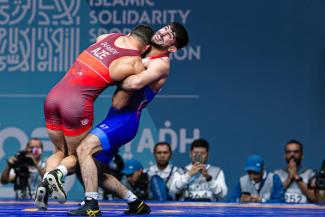
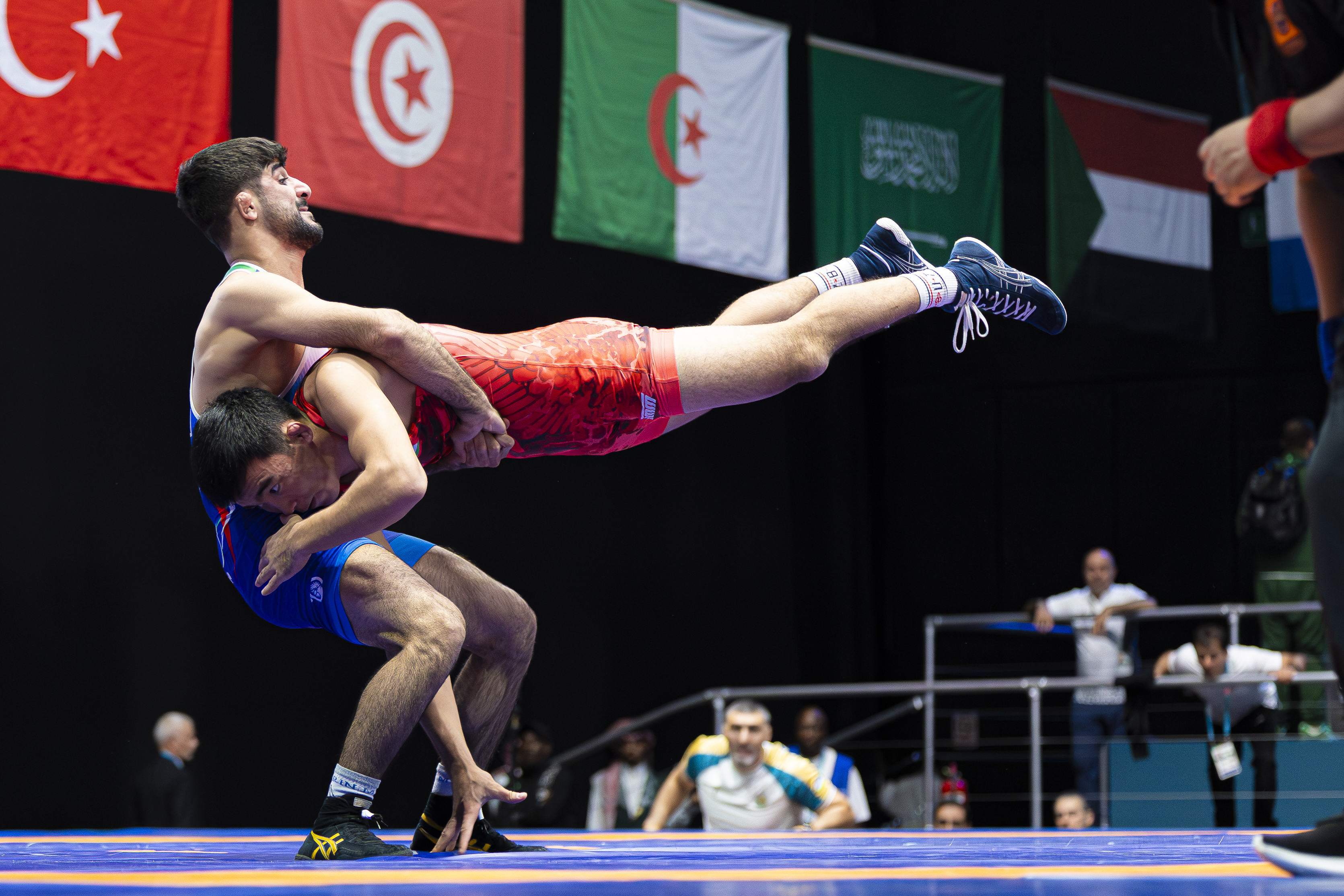 Saeid ESMAEILI (IRI) throws Aytjan KHALMAKHANOV (UZB) during their 67kg bout. (Photo: United World Wrestling / Kadir Caliskan)
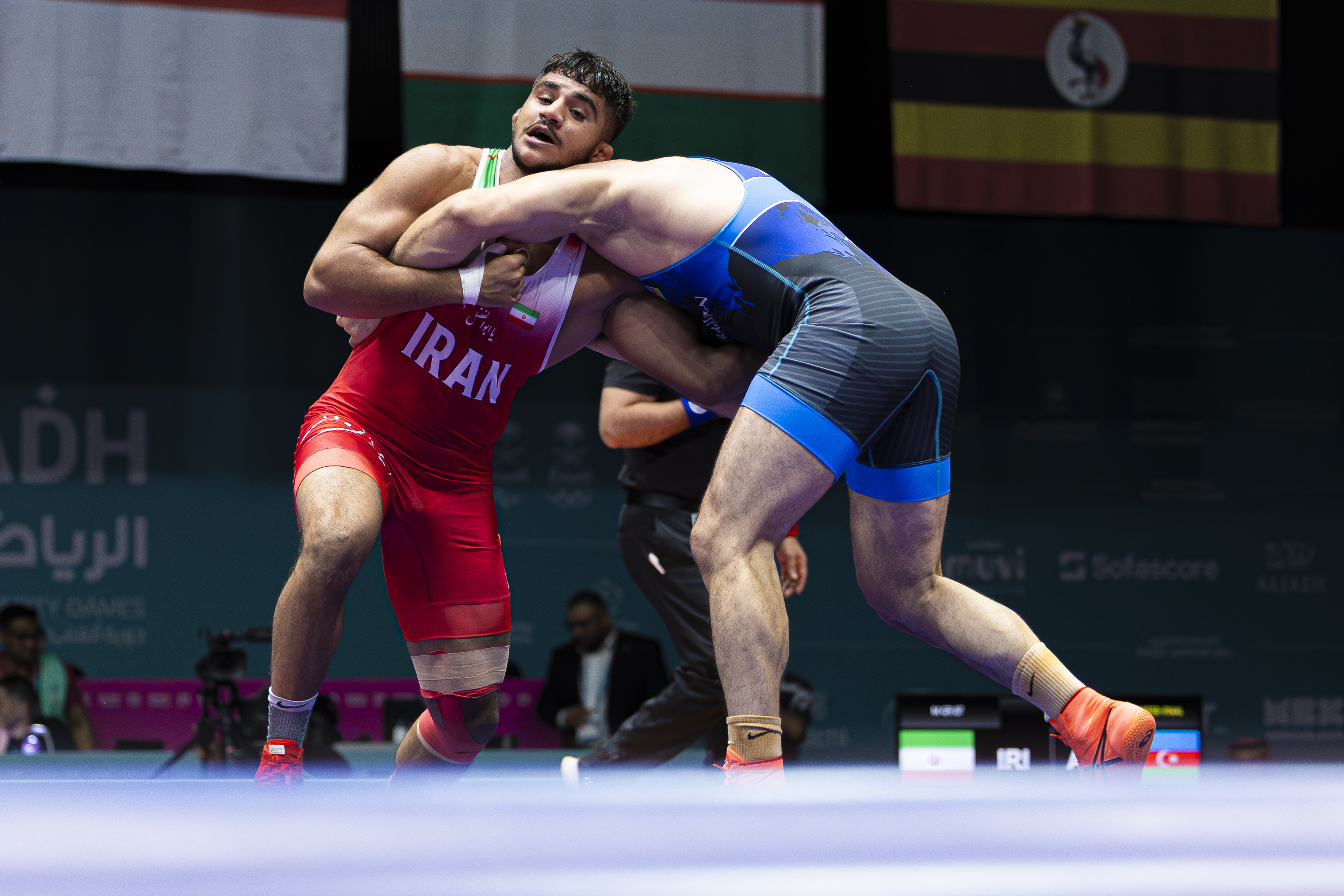 Gholamreza FAROKHI (IRI) won his fourth gold medal this year. (Photo: United World Wrestling / Kadir Caliskan)
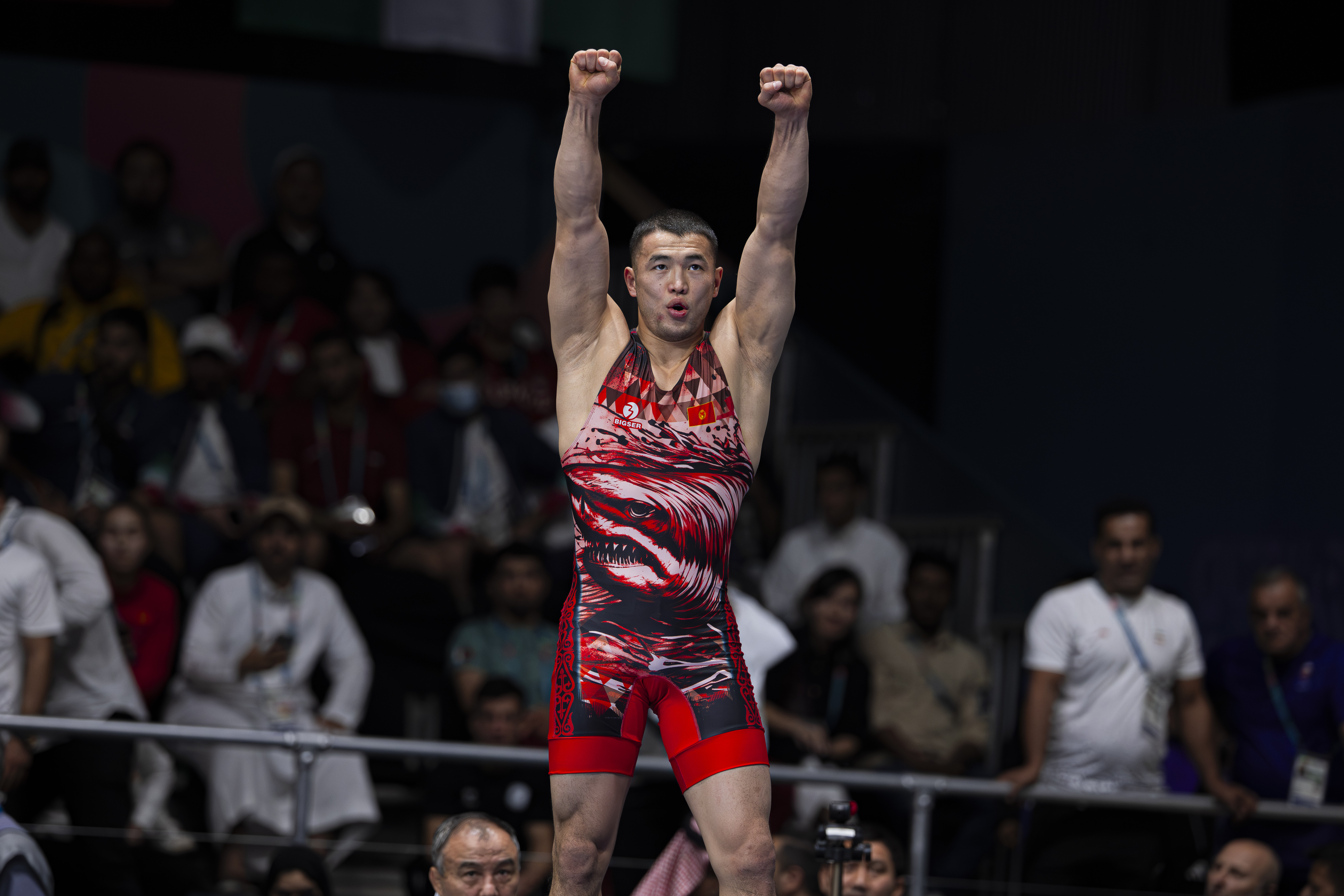 Akzhol MAKHMUDOV (KGZ) won the 77kg gold medal at the Islamic Solidarity Games. (Photo: United World Wrestling / Kadir Caliskan)
Share your thoughts.
Comments