

Teen phenom Fujinami excited, not nervous, about global senior debut
Thursday, September 30, 2021 - 08:11 By Ken Marantz

TOKYO (September 30) -- Teenager Akari FUJINAMI (JPN) was bred to wrestle for fun as much as victories. She's had an awful lot of both in her budding career.
Fujinami, regarded as one of Japan's top future prospects, will face the toughest test of her young life when she makes her international senior debut at the World Championships in Oslo in the women's 53kg division, which gets underway October 5.
Fujinami, still a month shy of her 18th birthday, stormed her way onto a young but not-to-be-underestimated Japanese team by winning the two national championship tournaments that served as the domestic qualifiers. Those were her first-ever senior-level competitions.
The 2018 world cadet champion says she has no jitters about about making the jump directly from cadet to senior, following a route previously taken by recently crowned Olympic champion Yui SUSAKI (JPN).
"My feelings right now are that I'm excited," Fujinami said in a telephone interview from her home in central Japan. "I really want the tournament to start soon. I'm don't feel nervous at all. I'm fired up. I'm looking forward to seeing how I can do."
Leave it to Japan, the preeminent powerhouse in women's wrestling, to be missing the Olympic champion and still have a wrestler of her caliber to take her place.
 Akari FUJINAMI (JPN) addressing the media after the Emperor's Cup in December, 2020. (Photo: UWW / Ken Marantz)
Mayu MUKAIDA (JPN) was busy preparing for her gold-medal run at 53kg at the Tokyo Olympics and did not enter the two national tournaments -- the All-Japan Emperor's Cup in December 2020 and the All-Japan Invitational Meiji Cup last May. In fact, none of Japan's Olympians, including the four other gold medalists, will be making the trip to Oslo.
But it cannot be said that Fujinami had an easy path to Oslo. At both tournaments, she encountered both two-time world champion Haruna OKUNO (JPN) and 2019 world silver medalist Nanami IRIE (JPN) -- and won each time. And quite handily, in fact.
"It gives me a lot of confidence," said Fujinami, who beat Irie in both finals without conceding a point.
Fujinami is yet to face Mukaida in an official match, but seeing her fellow Mie Prefecture native win the Olympic gold medal has stoked a fire in Fujinami. If Mukaida (now Shidochi following her recent marriage) intends to defend her Olympic title, she will likely have to get past Fujinami first.
"I watched [her matches]," Fujinami said. "I thought she was fantastic, but my stronger feeling was that I have to beat this person and win the gold medal at the 2024 Paris Olympics."
Fujinami, a senior at Inabe Gakuen High School, has not lost a match since the national junior high school championships in June 2017, and is currently on a 79-match winning streak. Of those 79 wins, put together while accumulating 20 tournament titles, all but 15 were by fall or technical fall.
Fujinami has appeared in five international tournaments, and has yet to lose to a non-Japanese opponent. In 2018, she reeled off victories at the Klippan Lady (cadet division), Asian cadet, World cadet and Asian U15 championships.
She won a second straight Klippan Lady title in February 2019 -- with four straight technical falls -- but with the start of the worldwide pandemic, that would prove to be her last international competition until Oslo.
"It will be the first time in two years for me to face a foreign opponent," Fujinami said. "But I don't think there will be any big difference from what I normally do."
 Akari FUJINAMI (JPN), right, during the U15 Asian Championships in 2018. (Photo: UWW / Ken Marantz)
Along with Mukaida, the Oslo field will also be missing Tokyo Olympic silver medalist Qianyu PANG (CHN). But Fujinami might have to contend with bronze medalist Bolortuya BAT OCHIR (MGL), along with newly crowned world junior champion Emma MALMGREN (SWE).
She's ready for the challenge. "I'd really like to face them," she said.
Fujinami said she is well prepared for the World Championships, and will be heading to Oslo coming off a national team training camp. Prior to that, she was able to practice even though her school was still having only online teaching. The wrestling team was able to use the school's wrestling room.
Obviously too dominant for her female teammates, Fujinami spars with the boys at Inabe Gakuin. "They are around the same weight," she said. "It's a hard workout that's like matches."
Fujinami has also been invited in the past to train with the team at Nippon Sports Science University, where four-time Olympic champion Kaori ICHO (JPN) is currently an assistant coach.
"I haven't gone there recently because of the coronavirus," said Fujinami, who has not officially committed to a university after graduation next March, but said she will likely go to NSSU.
Fujinami started wrestling at age three, following her older brother Yuhi into the kids wrestling club run by her father Toshikazu, who is still her coach at Inabe Gakuen. Yuhi went on to win a bronze medal at the 2017 world championships at freestyle 70kg.
"I wanted to imitate what my brother was doing, so that's why I started wrestling," said Fujinami.
While Japanese wrestling often has a Spartan image, such was not the case at the Inabe Club. It would not be until her third year of elementary school that she would win her first national schoolgirls title.
"In the beginning, I was actually weak," Fujinami said. "My mother and father, and they'll say it even now, they wanted me to have fun wrestling, and I think they thought I wouldn't be an athlete with high aims.
"But as I stayed with it, I really got into it and wanted to become a world-beater. But I didn't feel that way when I was little."
With their mutual success, Fujinami and her brother developed a sibling rivalry that was, and still is, always friendly.
"I got along well with my brother and still do now," Fujinami said. "In 2017 he won a bronze medal at the World Championships, but I want to better his record and win a gold medal."
On the mat, Fujinami's main weapon is a lightning-quick single-leg takedown, which, like many Japanese, she quickly transitions to a lace-lock. She has recently focused on improving her ground wrestling, both offensively and defensively.
While she said she did not have a favorite wrestler growing up -- despite the fact that superstar Saori YOSHIDA (JPN) is also a Mie native -- Fujinami mentioned Takuto OTOGURO (JPN) when asked during a Zoom press conference whose style of wrestling she liked.
"I often watch and learn from his videos," she said of the Tokyo Olympic gold medalist at freestyle 65kg. "He can score a tackle from anywhere. He's really amazing. Like that, I want to do wrestling that's fun to watch, where a lot happens."
In Oslo, Fujinami plans to maintain her pre-match routine of eating "sekihan," a dish of rice boiled with red beans that she will bring with her. What won't be routine these days is competing in front of a crowd.
In the few domestic tournaments that weren't canceled amid the pandemic, fans and friends were not allowed.
"Having a crowd really livens up the matches, and for us athletes, its raises our motivation," Fujinami said.
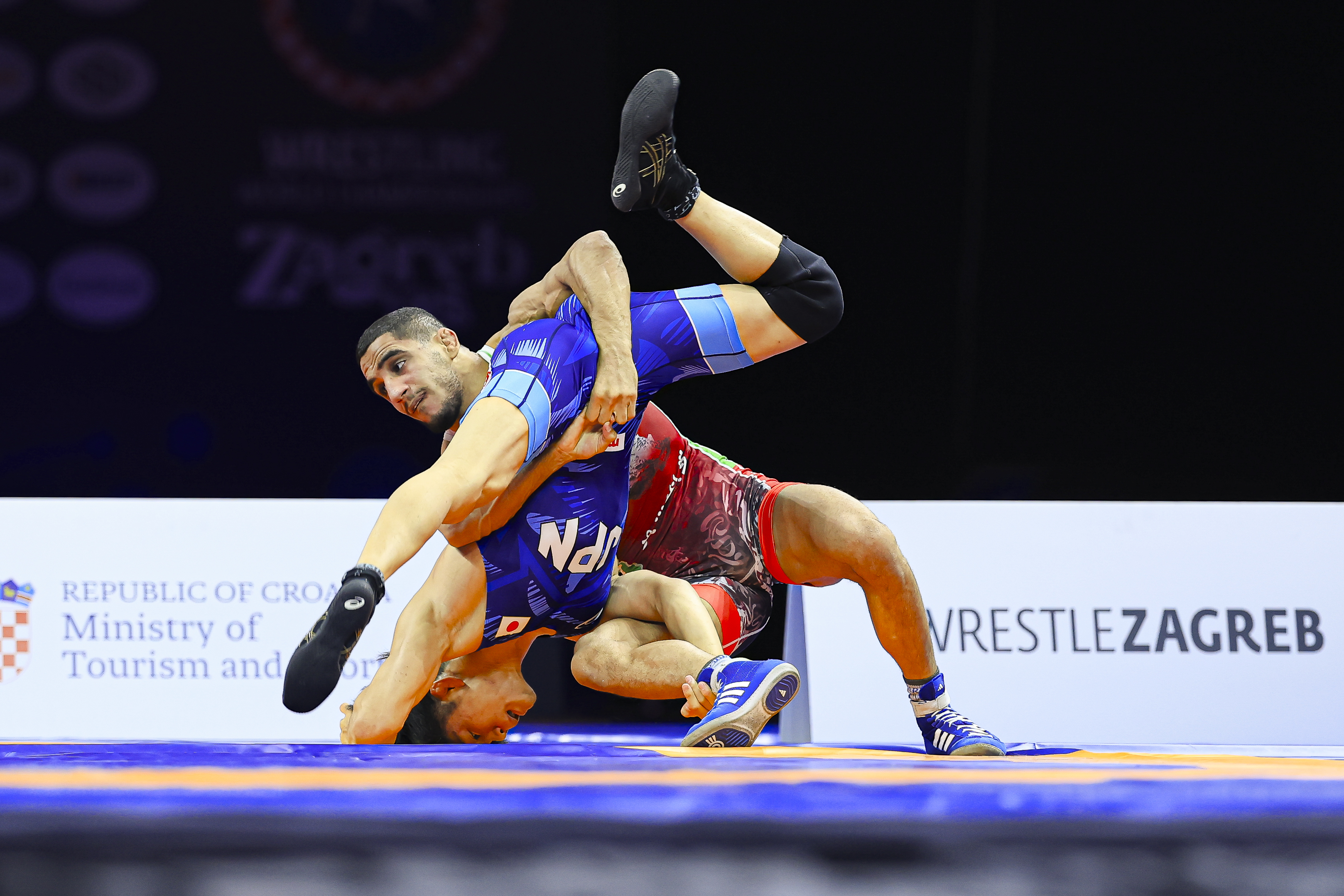 Rahman AMOUZAD (IRI) counters Kotaro KIYOOKA (JPN) in the 65kg final. (Photo: United World Wrestling / Kadir Caliskan)
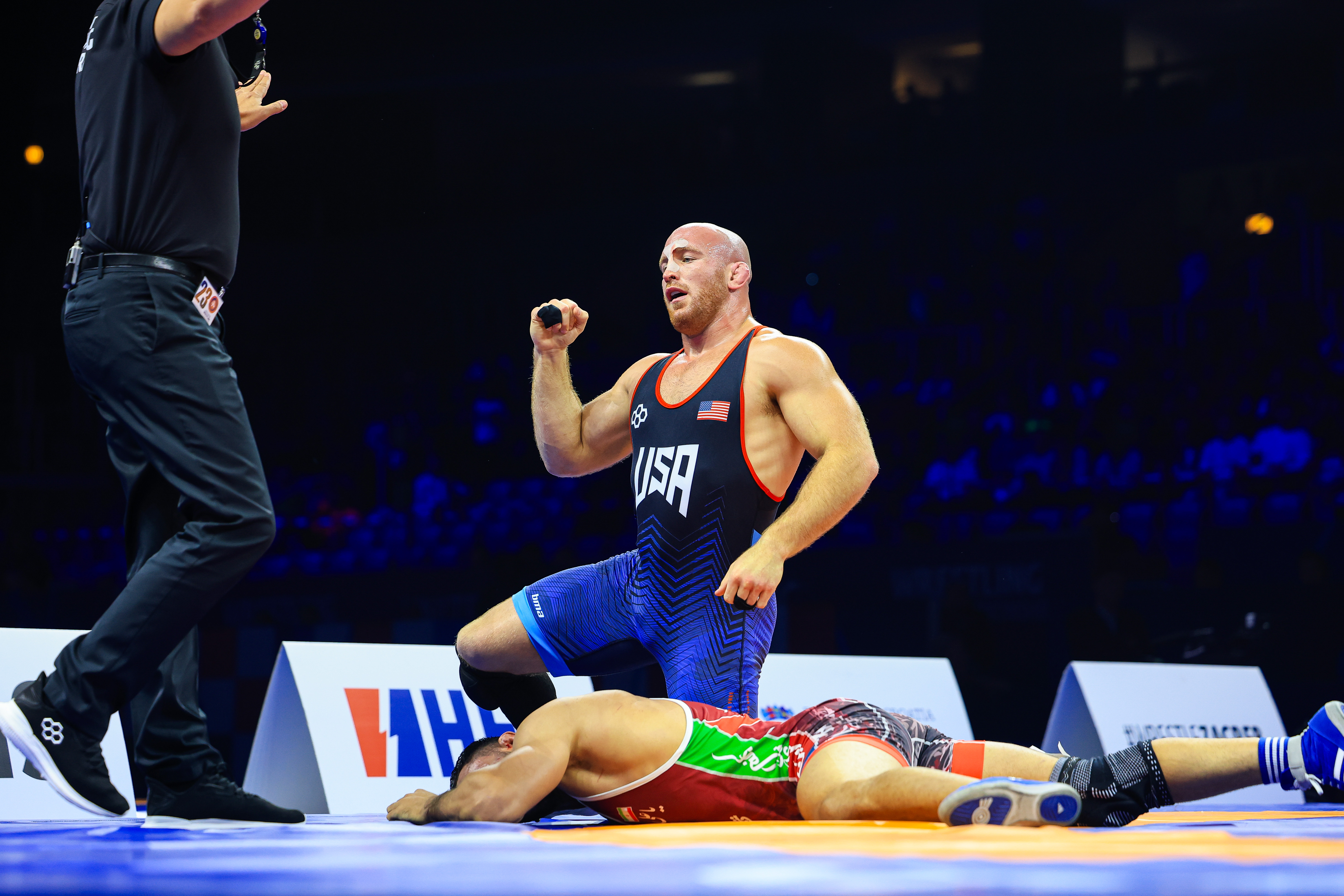 Kyle SNYDER (USA) celebrates after beating Amirali AZARPIRA (IRI) in the 97kg final. (Photo: United World Wrestling / Kadir Caliskan)
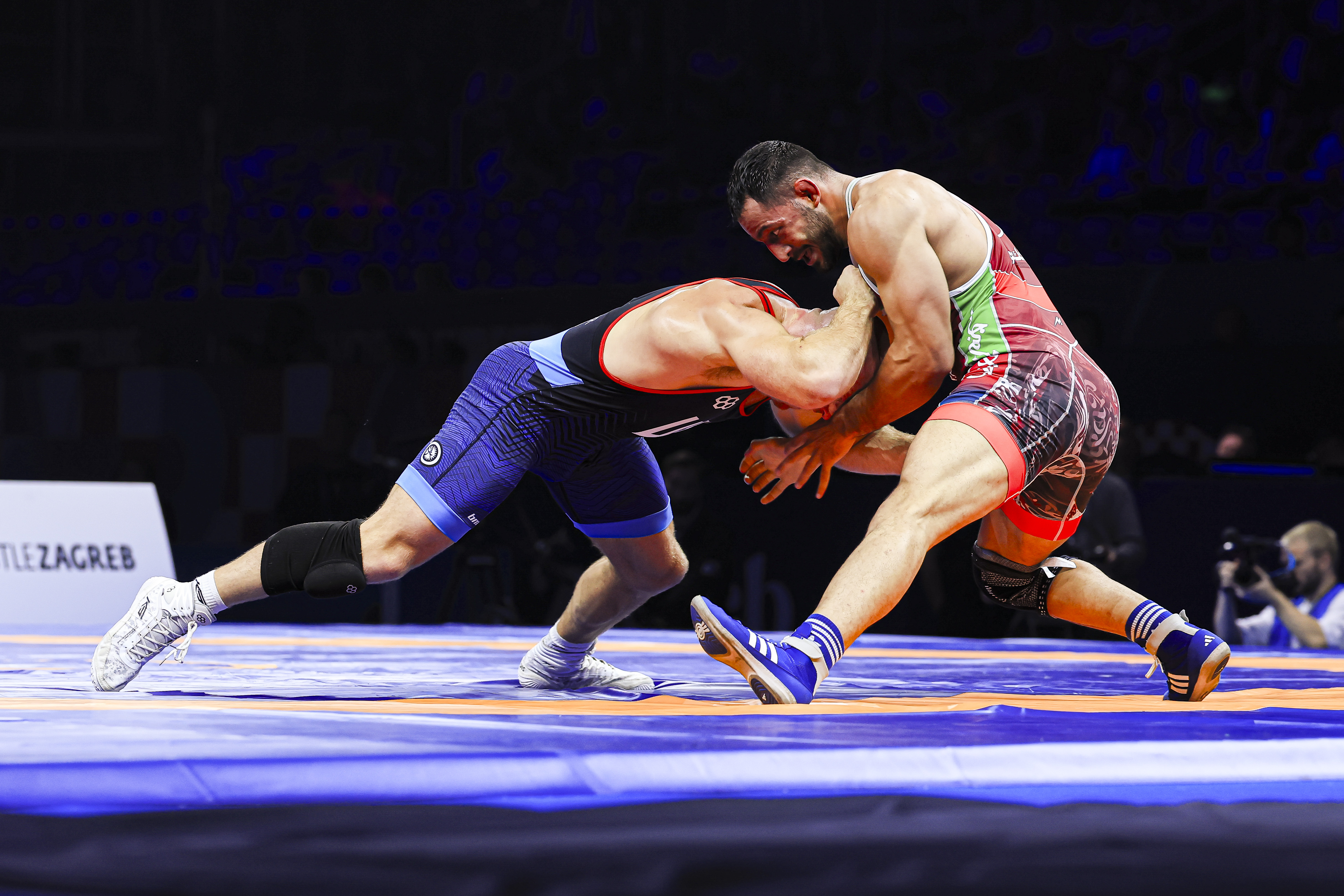 Kyle SNYDER (USA) scores the match-winning stepouts against Amirali AZARPIRA (IRI) during the 97kg final. (Photo: United World Wrestling / Kadir Caliskan)
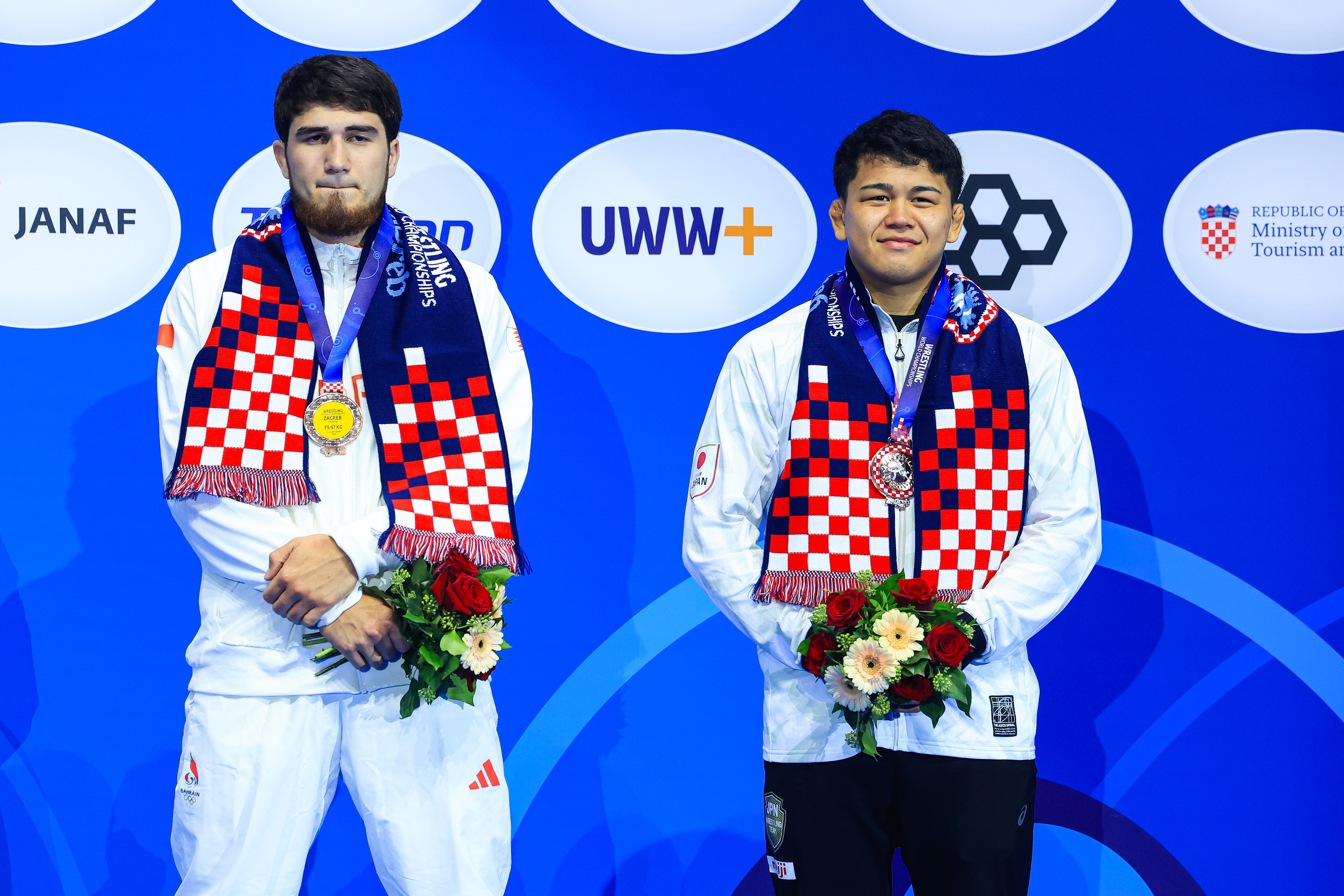 Akhmed TAZHUDINOV (BRN), left, and Arash YOSHIDA (JPN), the two bronze medalists at 97kg. (Photo: United World Wrestling / Kadir Caliskan)
Share your thoughts.
Comments