BISHKEK, Kyrgyzstan (April 16) -- Zholaman SHARSHENBEKOV (KGZ) also had to contend with a Japanese opponent in the final but never came close to suffering the same fate as his famous compatriot. A pair of Iranians were not so fortunate.
Sharshenbekov achieved a three-peat of Asian Championships titles with an 11-0 victory over Kaito INABA (JPN) in the Greco 60kg final on Tuesday in Bishkek, as the host nation ended a well-attended and organized tournament with four golds overall.
"First of all, I dedicate this victory to all the fans, coaches, and family," Sharshenbekov said. "This is not just my victory, it belongs to everyone. I really wanted to give the joy of victory to my country wrestling at home."
Shingo HARADA (JPN) at 72kg and teenager Taizo YOSHIDA (JPN) at 82kg won over the hearts of the crowd with stunning victories over Iranian opponents, which they capped by donning traditional Kyrgyz caps as part of their victory celebrations.
Iran, which put four wrestlers into the final, won the other golds at stake, with former world champion and Tokyo Olympic bronze medalist Mohammadhadi SARAVI (IRI) completely dominating at 97kg, and young Saeid ESMAEILI LEIVESI (IRI) winning his first Asian title at 67kg.
Iran won four golds overall and easily won the team title for the third straight year with 200 points. Kyrgyzstan, with one champion, finished second with 144, just two points ahead of third-place Japan and its three gold medalists.
 Zholaman SHARSHENBEKOV (KGZ) celebrates after winning the 60kg gold medal in Bishkek. (Photo: United World Wrestling / Kostadin Andonov)
Sharshebekov thrilled a home crowd still buzzing from the loss the previous night in the 77kg final by national hero Akzhol MAKHMODOV (KGZ) as both wrestlers begin their final preparations for a run at elusive gold medals at the Paris Olympics.
The defending champion was taken into the second period for the first time in four matches on the day, but the outcome was still the same as he fended off a determined but overmatched Inaba.
Sharshenbekov got the scoring started by limp-arming out of a whizzer for a takedown, to which a fleeing point was tacked on. That became significant, as it put Sharshenbekov on top of par terre, from which he scored a 2-point throw. He added a driving takedown to take a 7-0 lead into the second period.
Inaba, desperate for points as the clock winded down, secured a front headlock from standing, but Sharshenbekov showed what separates the best from the rest when he quickly squirmed out and secured a bear hug himself, then slammed Inaba down for 4 to end the match with 32 seconds left.
It was a testament to Sharshenbekov's high-tempo style that he was not assessed a passivity point in the second period, as would typically be the case for a wrestler nursing a lead.
"He built up a lead, but I thought in terms of response that it was still within a range in which I could catch up," Inaba said. "In the end, I lost by technical [superiority]. There are still many areas where I am lacking and need to improve on."
Inaba, who was seventh at the 2023 world U23, earned the trip to Bishkek by winning his first national title last December in the absence of Tokyo Olympics silver medalist Kenichiro FUMITA (JPN), one of his training partners in the group of current and past Nippon Sports Science University wrestlers.
Fumita, the losing finalist to Sharshenbekov at last year's World Championships, opted to skip the Asian Championships as he preps for a potential rematch in Paris.
Sharshenbekov also earned his fifth Asian medal overall, having lost in the 2018 final to Shota TANOKURA (JPN) and again in 2020 to Fumita. Shashenbekov also has world silver medals from 2019 and 2021.
"It’s been my fourth time wrestling with a Japanese wrestler, they’re very strong," Sharshenbekov said. "There are no weak wrestlers there, everyone is world-level strong."
Asked about competing in the wake of Makhmudov's shocking loss in the 77kg final the day before to Nao KUSAKA (JPN), Sharshenbekov said it is just part of the sport.
"I think maybe Akzhol was sick or something, only God knows the reason," he said. "This is a big sport, it is impossible to never lose. Sometimes you win, another day you lose. I believe fans shall support him at these kinds of moments. Sometimes athletes can lose. With God’s help, I think he will show his best at the Olympics."
 Shingo HARADA (JPN) donned a traditional Kyrgyz hat during his celebration after winning the 72kg gold medal. (Photo: United World Wrestling / Kadir Caliskan)
At 72kg, the unheralded Harada rallied from a five-point deficit to defeat 2019 world U20 bronze medalist Mohammadreza ROSTAMI (IRI) 9-5 for an unlikely gold.
Rostami, getting the first chance at par terre, used a front headlock for a pair of rolls to go up 5- 0, although Harada delivered a psychological hit when he rolled Rostami with a whizzer for 2 with two seconds left in the first period.
Harada then went ahead on criteria 5-5 when, on top in par terre, he missed a reverse body lift, but was successful with a second attempt. A second exposure was waved off on challenge because his hands went to the legs.
But Rostami had little in the tank and it was Harada who picked up points, padding his lead with a takedown and a tilt.
"I didn't expect it, but it seemed that he was running out of steam," Harada said. "I thought I had probably put in more time training."
Harada was not a totally unknown quantity, having opened eyes by making the semifinals at last year's World Championships in Belgrade and eventually finishing a commendable fifth. He said he takes something away with each overseas outing.
"I always train with Japanese, so there are actions and dynamic movements that I can't anticipate from people from overseas," Harada said. "You don't see them very much in Japan, so it is a learning experience."
After his victory, Harada was handed a Japanese flag as well as an "ak-kalpak," the elongated wool Kyrgyz hat, which he put on for his victory lap to the delight of the crowd.
"I also fought against a Kyrgyz wrestler [in the quarterfinals], but I was happy because in the end they still supported me," Harada said.
 Taizo YOSHIDA (JPN) scores upon Rasoul GARMSIRI (IRI) in the 82kg final during the Asian Championships. (Photo: United World Wrestling / Amirreza Aliasgari)
The 17-year-old Yoshida's remarkable accomplishment at 82kg came as he was making his international senior debut as the first male high schooler to represent Japan at the Asian Championships since 1989, and the first-ever in Greco.
The reigning world U17 champion, Yoshida looked like a seasoned pro by combining power, technique and composure in toppling Rasoul GARMSIRI (IRI) 9-0 in the final, blissfully unaware his opponent was the 2022 champion.
"Last year I won the U17, so I had the experience of being in a final and the atmosphere of the venue," Yoshida said. "I wasn't very nervous and I was able to stay relaxed."
Yoshida got a bit of a break in the first period when he was reversed while in par terre, but Garmsiri was instead tagged with a 2-point leg-blocking penalty. Leading 3-0 in the second period, it was Yoshida who was the aggressor, and he scored 4 with a reverse body lock throw. He then stopped a front headlock roll attempt for 2 to end the match at 5:31.
"I was the challenger and I didn't know anything about my opponent," Yoshida said. "When I heard he was the champion from two years ago, I was surprised."
Yoshida, who won the national high school title at freestyle 80kg in his most recent tournament before coming to Bishkek, said Kusaka's momentous victory over Makhmudov inspired him.
The two share a special relationship beyond being teammates in Bishkek -- Yoshida is currently a student at Kusaka's alma mater of Takamatsu Kita High School in western Japan.
"Yesterday, my 'senpai' Kusaka won the title by beating Makhmudov, and I thought he was so cool," Yoshida said. He added that roommates Harada and Inaba encouraged him. "Even though I am a high school student, my elder teammates were saying 'you're gonna win it.' That made me determined to win the championship."
In restoring some pride for Iran after the two defeats, Mohammadhadi SARAVI (IRI) showed the might of the top tier of wrestlers from the Middle East powerhouse when he overwhelmed Iussuf MATSIYEV (KAZ) 9-0 in the 97kg final.
Saravi, a world bronze medalist the past two years after winning the gold in 2021, put together a pair of gut wrenches from par terre, then executed a takedown-roll combination to put away 2022 world U20 silver medalist Matsiyev in just under two minutes.
Saravi has now medaled in 16 consecutive international tournaments dating back to 2019, all of which ended with victories -- 11 golds and five bronzes. His most recent triumphs include last October's Asian Games and the Yasar Dogu tournament in Turkiye in March.
 Saeid ESMAEILI LEIVESI (IRI) defeated Razzak BEISHEKEEV (KGZ) in the 67kg final. (Photo: United World Wrestling / Kostadin Andonov)
Earlier, 2022 world U20 champion Saeid ESMAEILI LEIVESI (IRI) denied the host country a gold when he edged Razzak BEISHEKEEV (KGZ) 3-1 in the 67kg final.
The 21-year-old Esmaeili Leivesi held out while on the bottom of par terre in the first period, then scored 2 in the second period with a good second effort when he was on top.
With the silver, Beishekeev improved on the bronze he won last year. He was also a bronze medalist at the Asian Games.
 World bronze medalist Liguo CAO (CHN) earned a bronze medal at 60kg at the Asian Championships. (Photo: United World Wrestling / Kostadin Andonov)
China chalks up 4 bronze medals
China came away with four bronze medals, including one captured by Houzhi HAO (CHN) at 97kg when he defeated Beksultan MAKHMUDOV (KGZ) 5-3 and prevented him from joining his more famous younger brother Akzhol as a medalist in their home tournament.
Hao gave up a passivity point and roll in the first period, but went ahead with a roll of his own when put on top in par terre. He added a late counter takedown to win 5-3.
Liguo CAO (CHN) got the ball rolling for China when he added to his expansive collection of bronze medals with a 7-3 victory over Galym KABDUNASSAROV (KAZ) at 60kg. Cao, a world bronze medalist, scored six points in the second period to secure his second straight Asian bronze.
At 67kg, Lei LI (CHN) spoiled Turkmenistan's hopes of a first Asian medal since 2018, scoring a stepout and takedown in the second period for a 4-2 victory over a fatigued Rovshen ATDAYEV (TKM).
Ji LENG (CHN) earned the first major medal of his career when he got a roll from par terre and a stepout in the second period for a 4-2 victory over Adilkhan SATAYEV (KAZ) for a 72kg bronze.
Hanjae CHUNG (KOR), the silver medalist at 60kg last year, moved up to two divisions and took the other bronze at 67kg by edging Almatbek AMANBEK (KAZ) 1-1 on last-point criteria after both wrestlers received a passivity point.
Chung had to endure a second turn on the bottom of par terre a second time, but Amanbek was unable to take advantage.
Amirreza DEHBOZORGI (IRI), the lone Iranian to fail to make the final, assured he would not leave empty-handed when he stormed to a 9-0 victory at 60kg over former champion Ilkhom BAKHROMOV (UZB).
Dehbozorgi, the world U20 bronze medalist, put the Uzbek away in his first chance at par terre, scoring a roll, a 4-point throw and a second roll to end it in just under two minutes.
At 72kg, Abdullo ALIEV (UZB) struck with a slick 2-point throw soon after the opening whistle and made that hold up in a 2-2 criteria victory over Adilkhan NURLANBEKOV (KGZ), who was denied a third straight Asian bronze. Nurlanbekov had a chance in the second period, but his throw from par terre yielded only a stepout point.
Bekzat ORUNKUL UULU (KGZ) added a bronze medal to the home team's tally that made the difference in the team race with a 3-1 victory over Sejin YANG (KOR) at 82kg, scoring with a somewhat unorthodox front roll off par terre in the first period.
Mukhammadkodir RASULOV (UZB) posted a nearly identical victory over Rohit DAHIYA (IND) for the other 82kg bronze, getting a more conventional gut wrench to also win 3-1.
Jeongyul KWON (KOR) won the other bronze at 97kg, scoring a 2-point exposure in the first period and holding on for a 2-2 victory on big-point criteria over Badamdorj BALTMUNKH (MGL). Mongolia has yet to win an Asian medal in Greco.

Day 5 Results
Greco-Roman
60kg (17 entries)
GOLD: Zholaman SHARSHENBEKOV (KGZ) df. Kaito INABA (JPN) by TF, 11-0, 5:28
BRONZE: Amirreza DEHBOZORGI (IRI) df. Ilkhom BAKHROMOV (UZB) by TF, 9-0, 1:57
BRONZE: Liguo CAO (CHN) df. Galym KABDUNASSAROV (KAZ), 7-3
67kg (15 entries)
GOLD: Saeid ESMAEILI LEIVESI (IRI) df. Razzak BEISHEKEEV (KGZ), 3-1
BRONZE: Hanjae CHUNG (KOR) df. Almatbek AMANBEK (KAZ) 1-1
BRONZE: Lei LI (CHN) df. Rovshen ATDAYEV (TKM), 4-2
72kg (11 entries)
GOLD: Shingo HARADA (JPN) df. Mohammadreza ROSTAMI (IRI), 9-5
BRONZE: Abdullo ALIEV (UZB) df. Adilkhan NURLANBEKOV (KGZ) 2-2
BRONZE: Ji LENG (CHN) df. Adilkhan SATAYEV (KAZ), 4-2
82kg (9 entries)
GOLD: Taizo YOSHIDA (JPN) df. Rasoul GARMSIRI (IRI) by TF, 9-0, 5:31
BRONZE: Mukhammadkodir RASULOV (UZB) df. Rohit DAHIYA (IND), 3-1
BRONZE: Bekzat ORUNKUL UULU (KGZ) df. Sejin YANG (KOR), 3-1
97kg (10 entries)
GOLD: Mohammadhadi SARAVI (IRI) df. Iussuf MATSIYEV (KAZ) by TF, 9-0, 1:59
BRONZE: Jeongyul KWON (KOR) df. Badamdorj BALTMUNKH (MGL), 2-2
BRONZE: Houzhi HAO (CHN) df. Beksultan MAKHMUDOV (KGZ) 5-3



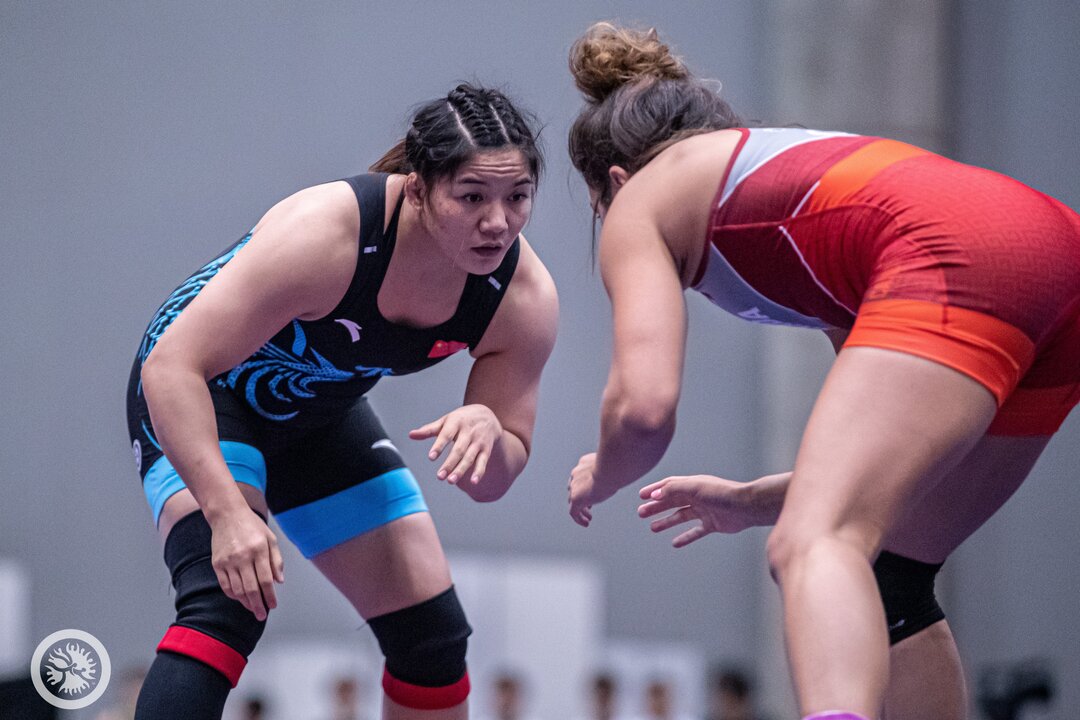 ZHOU Qian (CHN) defeated 2018 world champion Justina DI STASIO (CAN), 2-2, and will wrestle for gold at 76kg. (Photo: Sachiko Hotaka)
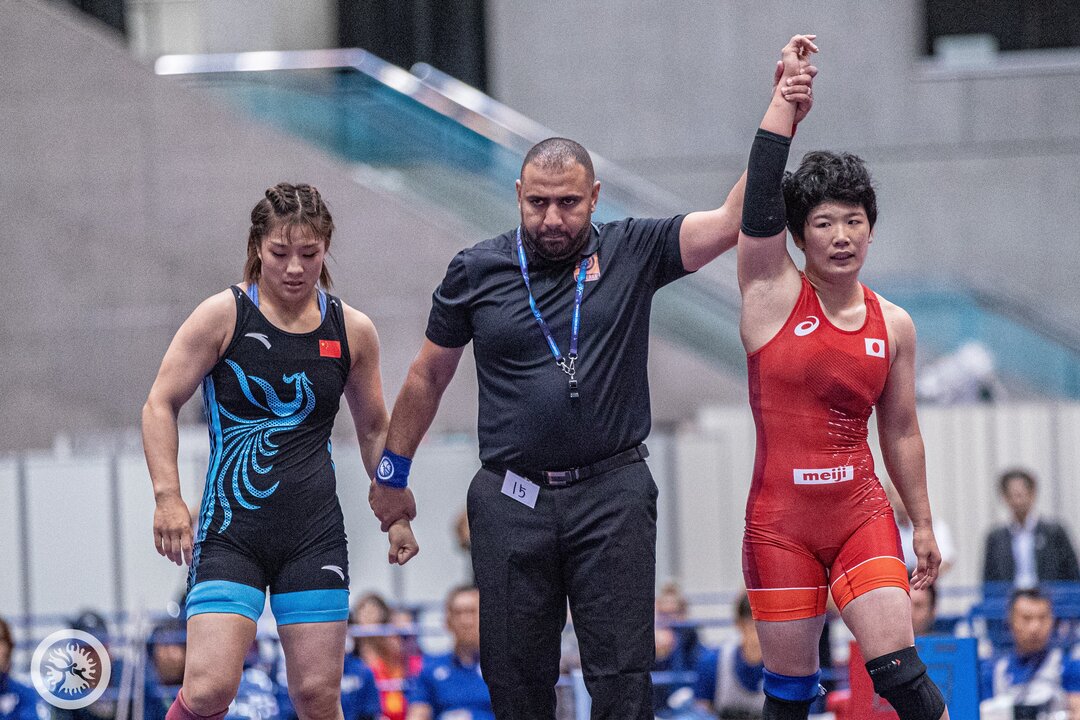 Yui SAKANO (JPN) scored a stunning 4-3 win over world bronze medalist PEI Xingru (CHN) in the 62kg semifinals. (Photo: Sachiko Hotaka)
Share your thoughts.
Comments