

U20 Worlds: Iran wins golds, U.S. team title
Sunday, September 8, 2024 - 23:21 By Vinay Siwach

PONTEVEDRA, Spain (September 8) -- Iran won two gold, a silver, and a bronze medal on the final day of the U20 World Championships, but it failed to stop the United States from winning the team title. The U.S. collected the top rank in the team race with 175 points, 15 better than Iran, which finished second. Japan finished third with 90 points.
This was the first time since 2017 that the U.S. won the team title and stopped Iran from completing a hat trick of top-place finishes. All 10 U.S. wrestlers competed for a medal and nine won a medal.
The U.S. fielded a very young team, with five wrestlers who were only 18 years old and eight wrestlers who could wrestle at the U20 level again next year.
"Everyone put themselves in the position to get on the podium and win the best medal they could," J'den COX, coach of Team USA, said. "Everyone is going to get better but overall it was great. They are the best in the world. I get it that individually in some cases we didn't get where we wanted to go but as a whole, we wrestled an amazing tournament."
 Amirreza MASOUMI (IRI) scores a takedown against Benjamin KUETER (USA). (Photo: United World Wrestling / Kostadin Andonov)
However, the final day of the U20 Worlds in Pontevedra, Spain did not go as planned for the U.S. It had five wrestlers on the mat and only one won his match. Marcus BLAZE (USA) won a bronze medal over Tolga OZBEK (TUR).
Ladarion LOCKETT (USA), Joshua BARR (USA) and Benjamin KUETER (USA) all dropped their finals while Connor MIRASOLA (USA) lost his bronze medal match.
Kueter, a U20 world champion at 97kg in 2022, was wrestling at 125kg and reached the final. However, he ran into a mountain named Amirreza MASOUMI (IRI) who already has a U23 world gold, two U20 world golds, and a U17 world gold.
 Amirreza MASOUMI (IRI) gestures towards the crowd after winning the 125kg final in Pontevedra. (Photo: United World Championships / Jake Kirkman)
Masoumi added a third U20 world gold medal to his name after he won the 125kg final 4-2 over Kueter and is now a five-time age-group world champion. A naturally aggressive wrestler, Masoumi dropped that approach and was happy to win his matches by sitting on the lead.
He did the same against Kueter in the final as he scored a takedown, a point for Kueter's passivity and a stepout. As he defended his 4-0 lead, Kueter managed to trip him in the final 30 seconds to score a takedown for two points.
"My opponent in the final is a well-known wrestler as he won the World Championships Sofia, Bulgaria, two years ago," Masoumi said. "He had taken a year off from wrestling but had improved a lot since then. He’s a skilled and accomplished wrestler. Thank God I was able to use my knowledge of him to wrestle smartly and win 4-2"
Kueter did trouble Masoumi in the final but Masoumi, despite wrestling with a heavily tapped left hand, never dropped his guard. Masoumi said he had broken his wrist before coming to Spain so he was careful with his attacks.
While he won his four bouts outscoring his opponents 32-3, Masoumi had only one technical superiority win. In 2022, when he won both the U20 and U23 world titles, Masoumi won all but one of his matches via superiority.
"I had an injury in my hand and it was broken, so I tried to be careful with it," he said. "Otherwise, I’m always aggressive and a fighter."
He will be in Tirana, Albania in a month's time to wrestle at the U23 World Championships. He won the gold medal in 2022 but skipped the 2023 edition. But Masoumi said his main focus is to make the senior team.
"In the match against Amirhossein ZARE (IRI) in Croatia, I lost," he said of his 5-0 loss to Olympic silver medalist Zare at the Ranking Series in Zagreb in January. "Some might say that Amir Reza Masoumi has settled, but no, I’m not satisfied at all. I’m preparing myself for the World Championships in Zagreb, aiming for the national team selection."
 Ali REZAEI (IRI) scores the match-winning takedown against Ladarion LOCKETT (USA) in the 74kg final. (Photo: United World Wrestling / Jake Kirkman)
Ali REZAEI (IRI) was the second gold medal for the day for Iran after he defeated 2023 U17 world champion Lockett 3-3 on criteria in a thrilling 74kg final. Rezaei is the first U20 world champion from Iran at 74kg in 15 years.
Lockett was leading the final 3-1 after scoring a takedown in the second period and Rezaei, who won a silver medal last year, needed at least a takedown to win.
It came in the fifth minute of the bout when Lockett missed a sweep single and Rezaei showed exceptional speed to get him a bodylock and finish with a takedown. Leading 3-3 on criteria, Rezaei did not allow Lockett to get into any attacking positions and won the gold medal.
 Ali REZAEI (IRI) defends an attack from Ladarion LOCKETT (USA) in the 74kg final. (Photo: United World Wrestling / Jake Kirkman)
"I went through a tough final but with the great analysis from the coaches, I managed to defeat the strong American opponent," Rezaei said. "I hope to continue on this path and become a world and Olympic champion."
In Amman, Rezaei dropped the 70kg final against Meyer SHAPIRO (USA) 11-6 but planned to win the gold in Pontevedra.
"Last year, I won silver," he said. "I’ve been waiting for this moment for about a year and a half, and thankfully, in the final, my opponent was an American, and I managed to beat him. This journey continues."
 Ibragim KADIEV (AIN) won the 86kg gold medal in Pontevedra. (Photo: United World Wrestling / Kostadin Andonov)
The third American to suffer a loss in the final was Burr as Ibragim KADIEV (AIN) beat him 8-2 in the 86kg final. Kadiev won his second U20 world gold medal after winning the 79kg gold in Amman last year.
In the final against Burr, Kadiev jumped to a 3-0 lead 15 seconds into the match. Burr did get on a few leg attacks but he was able to score only a stepout in the first period, cutting the lead to 3-1 at the break.
Kadiev, who took multiple medical timeouts for his injured knee, scored a counter against Burr and got two more points. The U.S. challenged the decision to award two points to Kadiev as Burr was never in danger but the replays showed Burr's back on the mat. The lost challenge made the score 6-1. Burr scored a stepout with 12 seconds left and then tried a front headlock throw but Kadiev stopped it to get two points and an 8-2 win.
"The American opponent was the toughest one for me," Kadiev said. "I also injured my knee. I didn’t attack much, because I couldn’t risk it. If only I hadn’t injured the knee, the match would have gone in a different way. My wrestling style is to attack from the very first second, and then in the second period the opponent gets tired and it’s easier to finish him."
Kadiev will get a chance to showcase his skills again at the U23 Worlds next month in Tirana. He also said that winning the gold medal last year made his more happy than this year.
"When I first won the U20 Worlds, I was much happier than now," he said. "This time there is no such feeling of excitement as it was last time. I wrestle more confidently, and we’ve worked on our mistakes with the coaches. I don’t know how fast I can recover from this knee injury. Hopefully, I can still make it to the U23 Worlds."
At 92kg, Mustafagadzhi MALACHDIBIROV (AIN) got some motivation from Kadiev as he finished his final against Sali SALIEV (BUL), 11-0, well before time.
Malachdibirov got Saliev in a gut-wrench and managed to turn him to win the gold medal at 92kg.
 Masanosuke ONO (JPN) asks for the 'champion belt' after his 61kg final. (Photo: United World Wrestling / Jake Kirkman)
Ono warning before Tirana
At the non-Olympic World Championships in Tirana from October 28 to 31, one wrestler to watch will be Masanosuke ONO (JPN) who destroyed everyone in Pontevedra to win the 61kg gold medal.
After winning his four bouts on Saturday, Ono returned to wrestle Ebrahim KHARI (IRI) for the final. It was expected to be an action-packed final but Ono finished it in one action.
As soon as the referee blew the whistle, Ono got an attack on Khari and scored a takedown. 26 seconds later, Ono had finished the final using the gut-wrench to win the gold medal in 26 seconds.
"I was surprised that it ended sooner than I expected, but it was a very enjoyable 25 seconds," Ono said. "I'm satisfied."
Ono will now look to win the gold medal at 61kg in Tirana. However, he is aware that his opponents in Tirana will be more powerful.
"I'm still not satisfied unless I win there (Tirana)," he said.
Ono began wrestling only after his teacher in the music class during kindergarten encouraged him to wrestle. Ono, now at the Yamanashi Gakuin University, trains under former world champion Yuka TAKAHASHI (JPN) and is from the Matsue City, Shimane Prefecture, which is in the countryside.
RESULTS
61kg
GOLD: Masanosuke ONO (JPN) df. Ebrahim KHARI (IRI), 10-0
BRONZE: BHUVANESH (IND) df. Abdinur NURLANBEK (KAZ), 6-5
BRONZE: Marcus BLAZE (USA) df. Tolga OZBEK (TUR), 5-0
74kg
GOLD: Ali REZAEI (IRI) df. Ladarion LOCKETT (USA), 3-3
BRONZE: Aghanazar NOVRUZOV (AZE) df. Tamir ESHINIMAEV (AIN), 4-1
BRONZE: Shingo ANDO (JPN) df. Muhamed BEKTEMIROV (AUT), 9-3
86kg
GOLD: Ibragim KADIEV (AIN) df. Joshua BARR (USA), 8-2
BRONZE: Ahmet YAGAN (TUR) df. Ryogo ASANO (JPN), 3-2
BRONZE: Abolfazl RAHMANI (IRI) df. Gabriele NICCOLINI (ITA), 9-2
92kg
GOLD: Mustafagadzhi MALACHDIBIROV (AIN) vs. Sali SALIEV (BUL), 11-0
BRONZE: Kamil KURUGLIYEV (KAZ) df. Amirreza DALIRI (IRI), 8-5
BRONZE: Anar JAFARLI (AZE) df. Connor MIRASOLA (USA), 6-2
125kg
GOLD: Amirreza MASOUMI (IRI) df. Benjamin KUETER (USA), 4-2
BRONZE: Nambardagva BATBAYAR (MGL) df. Alikhan KUSSAINOV (KAZ), 4-1
BRONZE: Hakan BUYUKCINGIL (TUR) df. Jaspooran SINGH (IND), 3-2
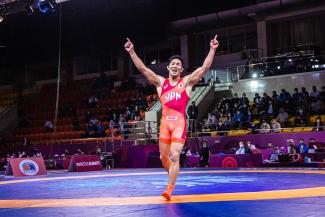
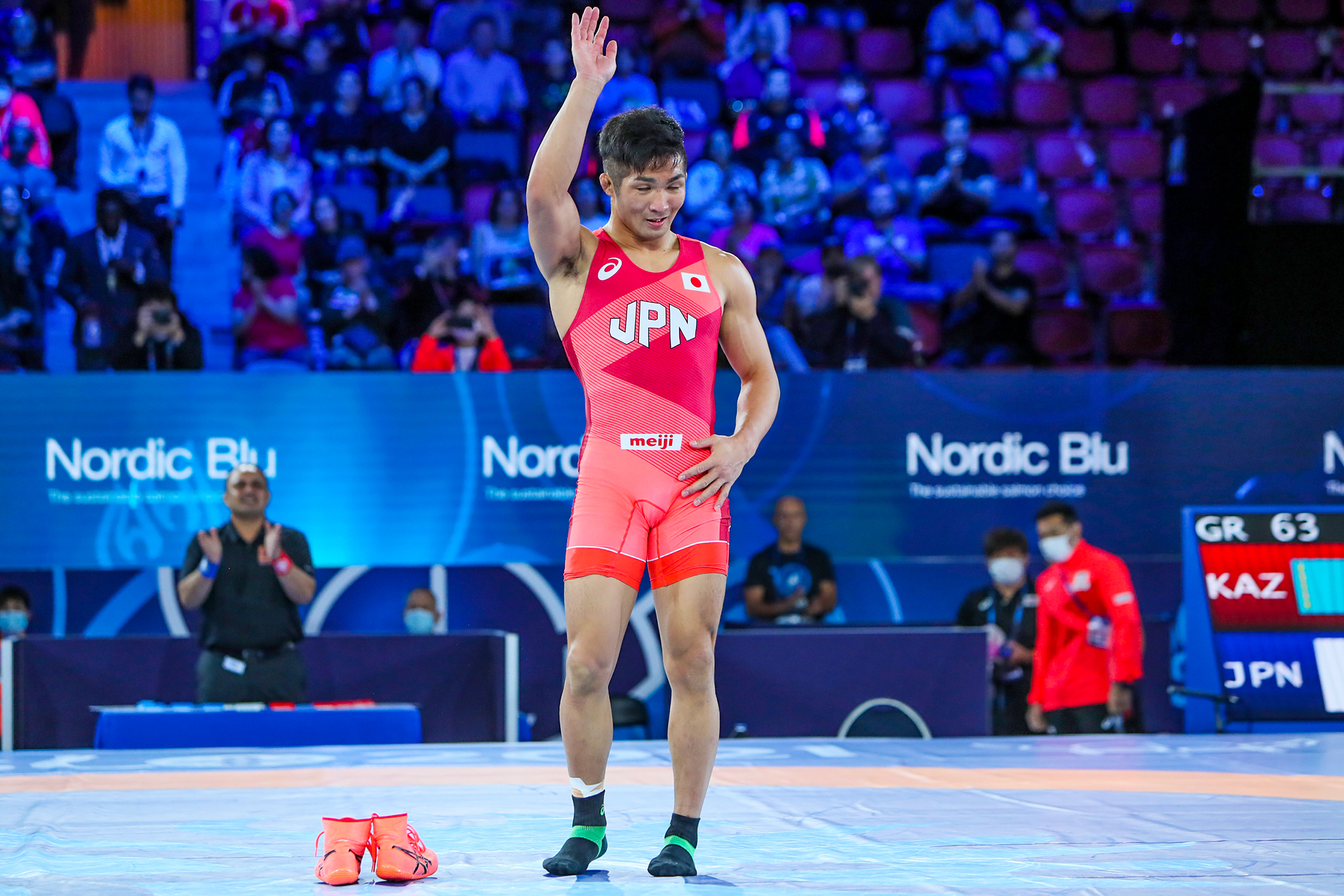 Tsuchika SHIMOYAMADA (AUS) had left his shoes on the mat during the 2021 World Championships to mark his retirement. (Photo: United World Wrestling / Martin Gabor)
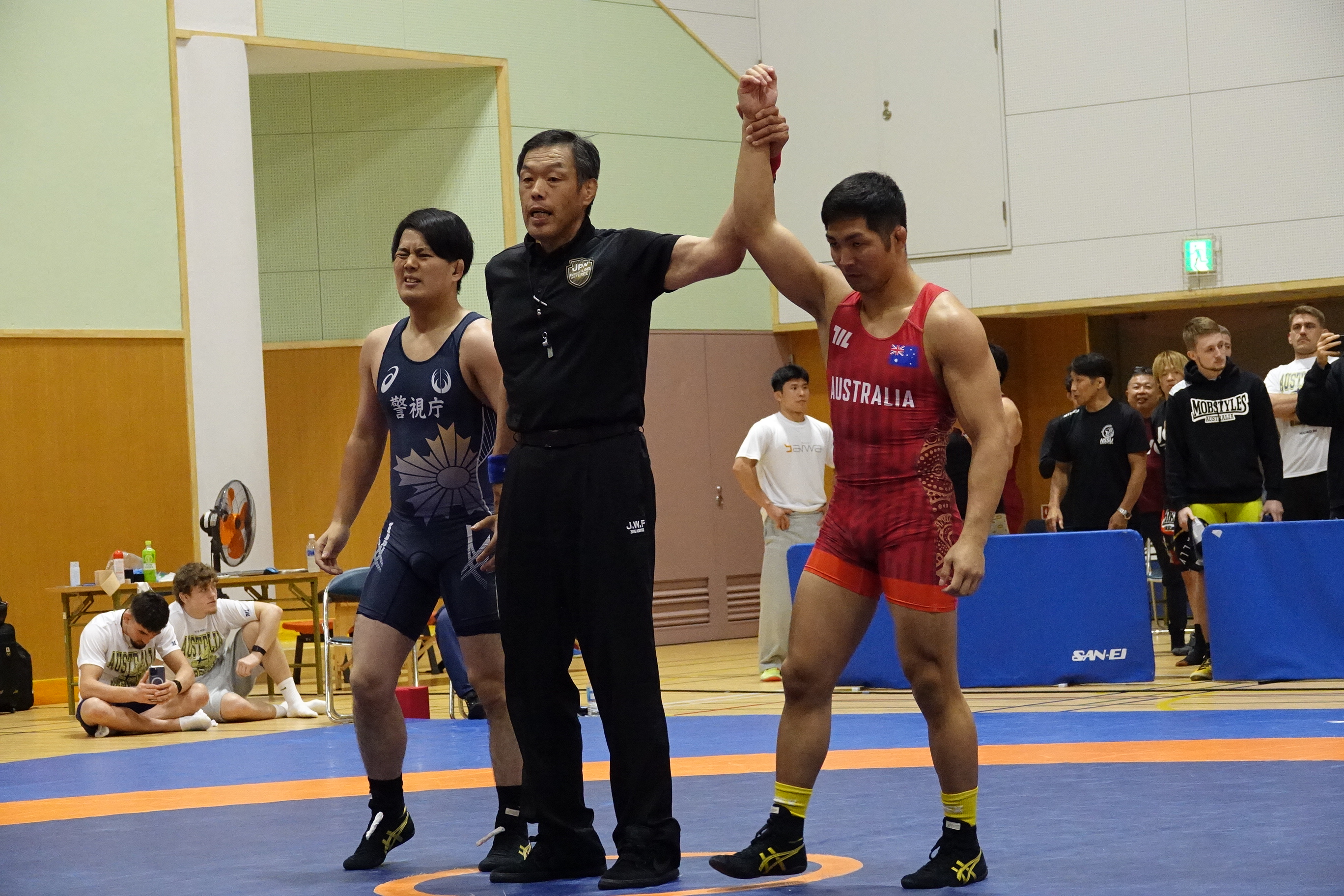 Tsuchika SHIMOYAMADA advances to the semifinals at the All-Japan Non-Student Championships in July with a 52-second win over Kokoro GOTO. (Photo: Koji Fuse / wrestling-spirits.jp)
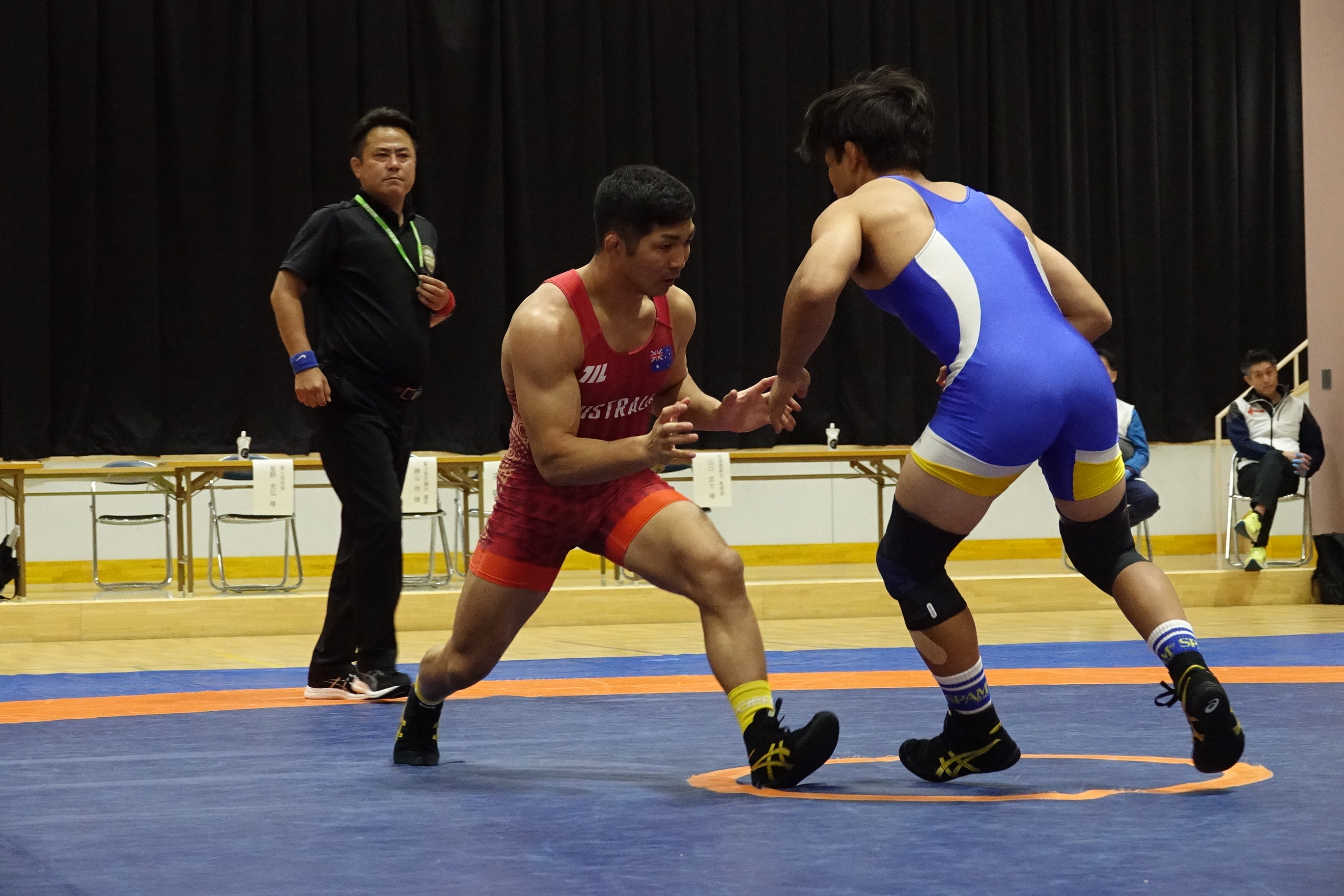 Tsuchika SHIMOYAMA faces Keitaro ONO in his opening match at the All-Japan Non-Student Championships in July. (Photo: Koji Fuse / wrestling-spirits.jp)
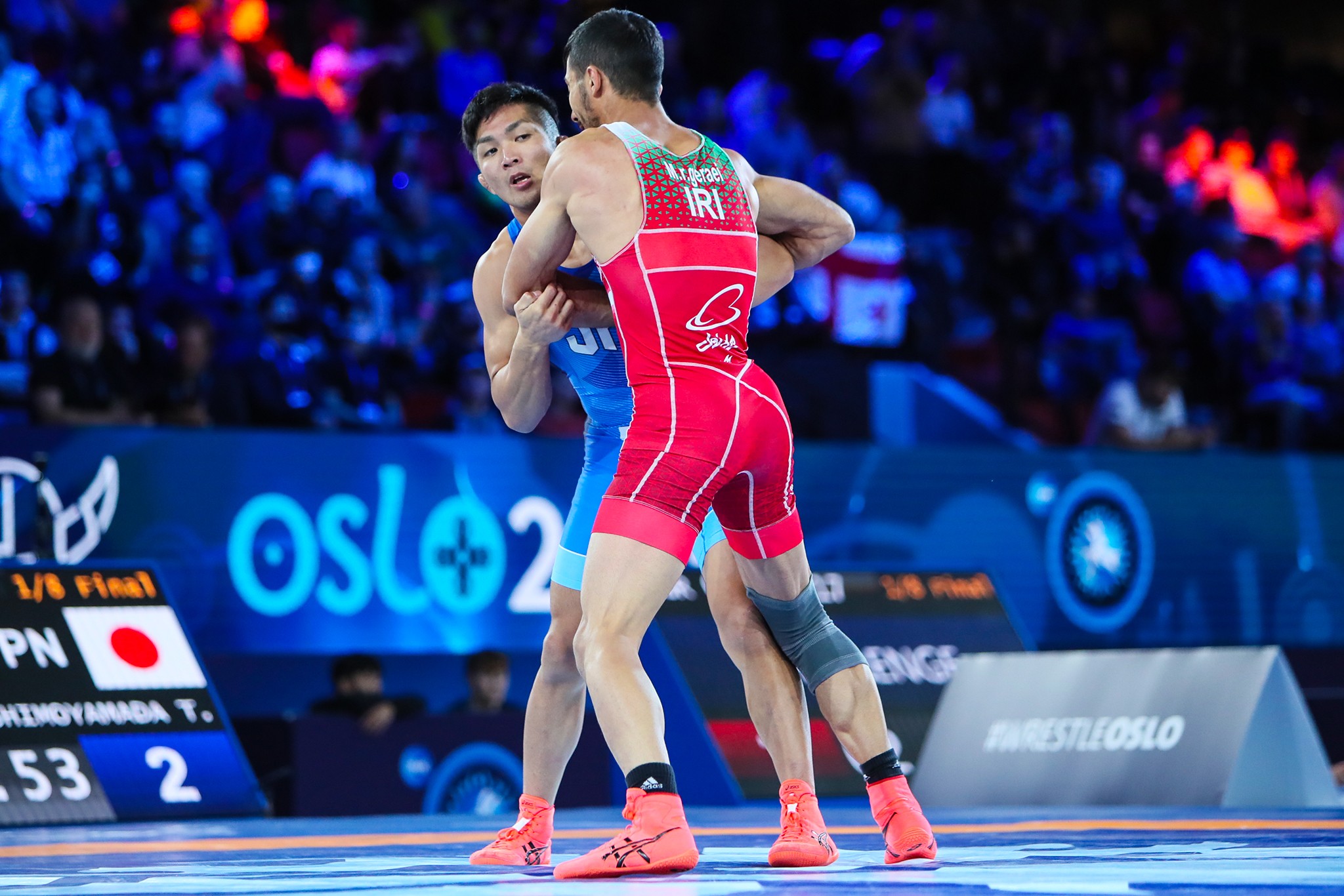 Tsuchika SHIMOYAMADA (AUS) was dominating Mohammadreza GERAEI (IRI) in their match at the 2021 World Championships before being pinned. (Photo: United World Wrestling / Martin Gabor)
Share your thoughts.
Comments