

#WrestleZagreb

WATCH: Tumur-Ochir's underhook supremacy

By Vinay Siwach

ZAGREB, Croatia (February 13) -- When Tulga TUMUR-OCHIR (MGL) walked back to the center after winning the bout against Evan HENDERSON (USA), he made it look rather casual.

The World Championships bronze medalist had performed a classy underhook throw for four points and won the quarterfinal 12-1 at the Zagreb Open Ranking Series last week. The bout had a lot of setups and transitions but one that stood out, perhaps in the whole tournament, was that underhook.

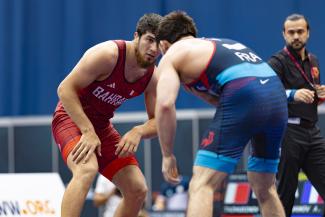
Hassan YAZDANI (IRI) and Rahman AMOUZAD (IRI) are at the top among underhooks. It's typical Iran style to attack and defend using the same setup. But Tumur-Ochir's underhook is very underrated.

An epic throw still fresh in the memory was against Bajrang PUNIA (IND) in the bronze medal bout at the 2019 World Championships which Punia survived after a long bridge position.

In Zagreb, Tumur-Ochir was more relaxed and after leading 8-1 at the break, he got into a dominant position. He put the underhook in place and snapped Henderson. Realizing that Henderson was ready for it, Tumur-Ochir quickly moved to grab for the inside leg and score a pushout. It was a little too far to control and Henderson defended with force.

Henderson pounced on an off-balance Tumur-Ochir and tried to get his arms around the Mongolian's back and almost got it. However, the underhook was still intact.

As Henderson tried to push his opponent to the mat, Tumur-Ochir flung a massive throw using the set underhook and power from his hips. The toss was worth four and victory.

And if the follow-through is a thing in wrestling, Tumur-Ochir perfected that as well. The grip was strong and the ties controlled. Tumur-Ochir made sure that Henderson lands on his back and not land on his arms which would have resulted in only two points for Tumur-Ochir.

Henderson was disappointed in losing that position as he slammed the mat after the bout. But there is little one can do when Tumur-Ochir gets going with those near-perfect underhooks.

Perhaps that was the reason Ismail MUSUKAEV (HUN) franticly moved away from Tumur-Ochir in the semifinals. But as Musukaev's conditioning worsened, TUmur-Ochir got his hands in the perfect place, scoring via stepouts and a takedown to win 6-1.

Then Joseph MCKENNA (USA) faced the wrath in the final. The first takedown scored by Tumur-Ochir in the second minute was a fake. He got an underhook on McKenna and as the latter defended it, Tumur-Ochir bent and hit a double-leg. In the second period, he once again put McKenna on the spot and hit the single leg using a similar setup.

With Tumur-Ochir becoming a big threat in 65kg, it would be a big test for veterans who have dominated this weight class so far.

But one bout that will test Tumur-Ochir will be against world champion Amouzad who is exceptional with his underhook, a move which made him the Asian and the world champion last year.

With the Asian Championships around the corner, this bout is more than a mere possibility.
#JapanWrestling

Fujinami to move up to 57kg in quest for consecutive Olympic golds

By Ken Marantz

TOKYO (November 26) -- Akari FUJINAMI (JPN) won't be defending her Olympic gold at women's 53kg at the 2028 Los Angeles Games. That's bad news for anyone aiming to strike gold at 57kg.

Fujinami has announced that she will move up to the next Olympic weight class starting next year, the Japan federation website and Japan media widely recently reported.

Fujinami, who turned 21 on November 11, cited the difficulty of cutting weight for the decision, as well as the historic aspect that no woman wrestler has ever won a second straight Olympic gold after moving to a higher weight class.

"I have decided to move up to the 57kg weight class," Fujinami said after Sunday's East Japan Collegiate Women's League, a team tournament that marked her first competition since winning the gold at the Paris Olympics in August. "Considering my height and my normal weight, I think I can give my best performance at 57."

Fujinami competed at 59kg in the five-team league tournament (one school was a no-show), which was run in a round-robin, duel-meet format with only three weight classes -- 53kg, 59kg and 76kg.

She won both of her matches by fall, extending her current winning streak to 139 matches dating back to her junior high school days in September 2017.

The 1.64-meter Fujinami was actually wrestling near her natural weight, which she says is "about 61kg." But even against two opponents from higher weight classes -- Ikuei University's Ichika ARAI (JPN) was the 2023 world U20 silver medalist at 57kg -- her skills and speed were still overwhelming.

"It has been really hard to cut down to 53kg," Fujinami said. "I felt I lost muscle during the process. I feel I can give my best performance by going down three kilos from my natural weight."

Asked when she expects to make her full-fledged "debut" at the new weight, she replied in a text message, "It will be sometime next year. I haven't decided exactly when yet."

With a full schedule of post-Olympic TV appearances and local events curtailing her training, she has already ruled out appearing at next month's Emperor's Cup All-Japan Championships.

It is likely she will compete at the Meiji Cup All-Japan Invitational Championships in the spring, as that tournament, along with the Emperor's Cup, will serve as qualifiers for the 2025 World Championships.

The move up to 57kg will likely put her on a collision course with the reigning Olympic champion, Tsugumi SAKURAI (JPN). The two met last year at the East Japan Collegiate tournament, with Fujinami coming away with a 5-0 victory.

The challenge of possibly accomplishing a historic first appeals to Fujinami, who last year won her second career world title at 53kg in Belgrade.

"I heard that no [woman] has moved up a weight class and won another Olympic gold," Fujinami said. "It will difficult, but that's what makes it challenging. I hope I can become stronger at the next [Olympics] in Los Angeles."

Two Japanese women -- Saori YOSHIDA (JPN) and Kaori ICHO (JPN) -- have won an additional Olympic gold after going down a weight, but that was mainly because the number of weight classes was expanded from four to six, allowing them to compete more closely to their normal weight.

Among men, the legendary Aleksandr MEDVED (URS) won the freestyle 97kg gold in 1964, then triumphed again at 97+kg in 1968, while Levan TEDASHVILI (URS) won at freestyle 82kg in 1972 and 90kg in 1976. More recently, Abdulrashid SADULAEV claimed the freestyle 86kg gold in 2016, then won again at 97kg in 2021.

Fujinami said she doesn't expect to make any major alterations to her wrestling style at the heavier weight.

"I have no intention of making any big changes in my wrestling style," she said. "I will still try to keep the opponent from getting at my legs, and take the initiative to score points. Still, I can feel the extra weight of four kilos, so how I increase my weight could affect how I perform."

At this year's East Japan league tournament, Fujinami's Nippon Sport Science University was relegated to second by Ikuei University, which won 2-1 in their duel meet. Ikuei got victories from Moe KIYOOKA (JPN) and Ami ISHII (JPN), who both won gold medals at last month's Non-Olympic Weight Category World Championships.