

Weekly FIVE! September 25, 2018
Tuesday, September 25, 2018 - 12:35 By Eric Olanowski

Taking a look at the 2019 World Championship host city and the team results from the 2018 Junior World Championships. Also discussing two stars who were forced to pull out of the #Budapest2018 World Championships after suffering recent injuries.
1. Astana to Host 2019 Senior Wrestling World Championships
United World Wrestling has announced the city of Astana will host the 2019 Senior Wrestling World Championships September 14-22 at the Daulet Arena.
The Kazakhstan capital city has hosted several United World Wrestling events in recent years, including the 2014 Senior Asian Wrestling Championships, 2016 Asian Olympic Qualifier, and the 2018 Grappling World Championships.
Competition to host the championships was intense, as the 2019 world championships will serve as the first qualification event for the 2020 Olympic Games in Tokyo.
The top six finishers in each Olympic weight category in Astana will secure an Olympic qualification for their nation, with the remaining qualification spots earned at continental competitions and a “Last Chance Qualifier” during the 2020 competition calendar.
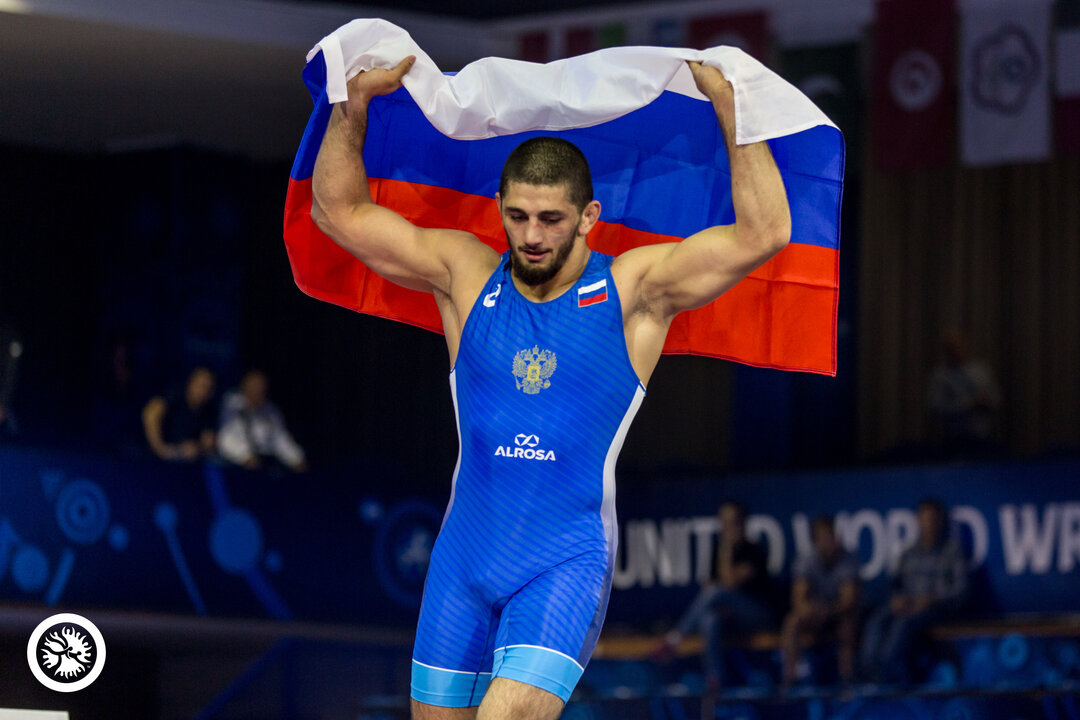 df. Zachery Samuel ELAM (USA) -by VSU, 11 - 0-6.jpg) Magomedkhan MAGOMEDOV (RUS) beat Zachery Samuel ELAM (USA), 11-0 to win the 97kg gold medal at the Junior World Championships. (Photo by Max Rose-Fyne)
Magomedkhan MAGOMEDOV (RUS) beat Zachery Samuel ELAM (USA), 11-0 to win the 97kg gold medal at the Junior World Championships. (Photo by Max Rose-Fyne)
2. Russia Wins Five Gold Medals and Junior World Team Title
Russia closed out the 2018 Junior World Championships winning the freestyle team title on the backs of five individual gold medals. Heading into the final day of wrestling, the Russian Federation led the second-place United States by 31 points and finished 67 points ahead of the returning champions.
Russia grabbed a trio of gold medals on the sixth day of competition and seized championships from Abasgadzhi MAGOMEDOV (RUS) and Soslan KHINCHAGOV (RUS) on the seventh and final day of wrestling at Trnava’s City Sports Hall.
Overall, Russia capped off the 2018 Junior World Championships with seven medalists. In addition to their five gold medals, they also won a silver and bronze medal. Though they had seven medalists a year ago, there five gold medals are an improvement from last year’s four gold medals.
Team Scores
GOLD – Russia (182 points)
SILVER – United States (115 points)
BRONZE – Iran (98 points)
Fourth – Azerbaijan (91 points)
Fifth – India (84 points)
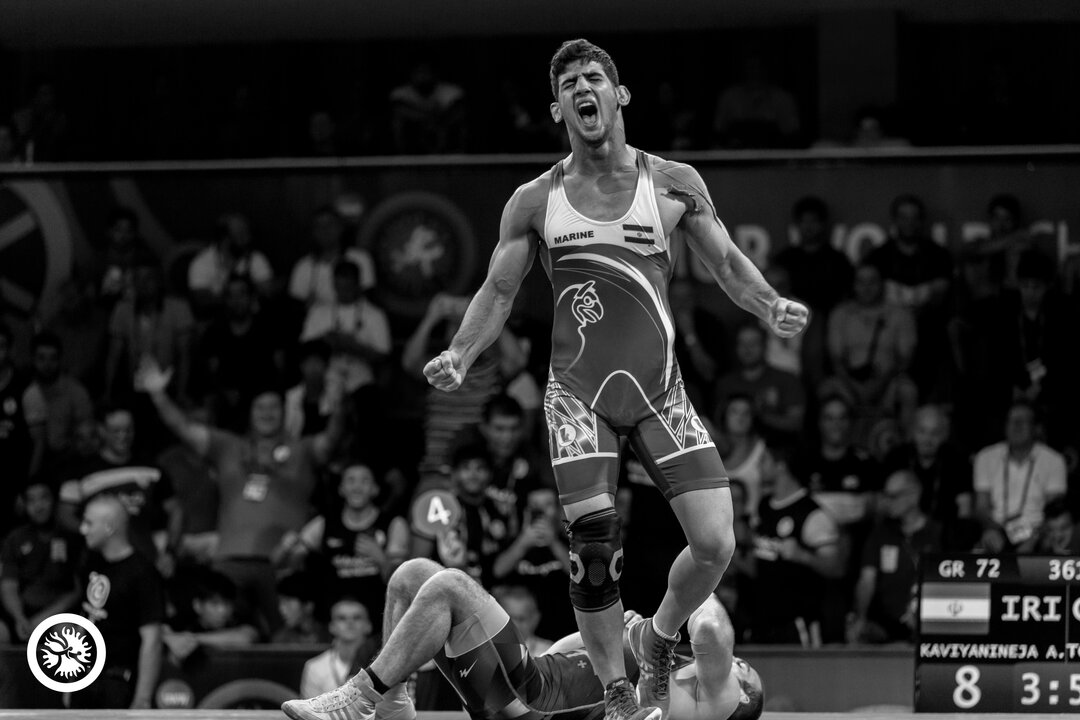 df. Nikoloz TCHIKAIDZE (GEO) -by VFA, 12 - 2-7.jpg) Amin KAVIYANINEJAD (IRI) flexes after scoring the 12technicalcal superiority victory over Nikoloz TCHIKAIDZE (GEO) in the Greco-Roman 72kg finals. (Photo by Max Rose-Fyne)
Amin KAVIYANINEJAD (IRI) flexes after scoring the 12technicalcal superiority victory over Nikoloz TCHIKAIDZE (GEO) in the Greco-Roman 72kg finals. (Photo by Max Rose-Fyne)
3. Iran Wins Greco-Roman Team Title, Komarov Wins Fourth World Gold
Iran, with four gold medalists and 136 points wrapped up the Greco-Roman team title at the 2018 Trnava Junior World Championships, four points ahead of second-place Russia.
Amin KAVIYANINEJAD (IRI), with his left shoulder heavily taped, claimed back-to-back junior titles, making it his third overall age-level world championship.
Meanwhile, Russia, led by Aleksandr KOMAROV who earned his fourth age-level world title finished in second place with 131 points.
Komarov shutout out Andrew BERREYESA (USA) 10-0 in the 77kg finals to reach the top of the junior world podium for the second straight year.
“These World Championships were the toughest yet. But it a great learning experience, and it feels good to win again,” said Komarov. “Now, my attention turns toward the senior-level and the 2020 Tokyo Olympic Games.”
Team Scores
GOLD - Iran - (136 points)
SILVER- Russia (131 points)
BRONZE - Armenia (83 points)
Fourth - Turkey (79 points)
Fifth - India (73 points)
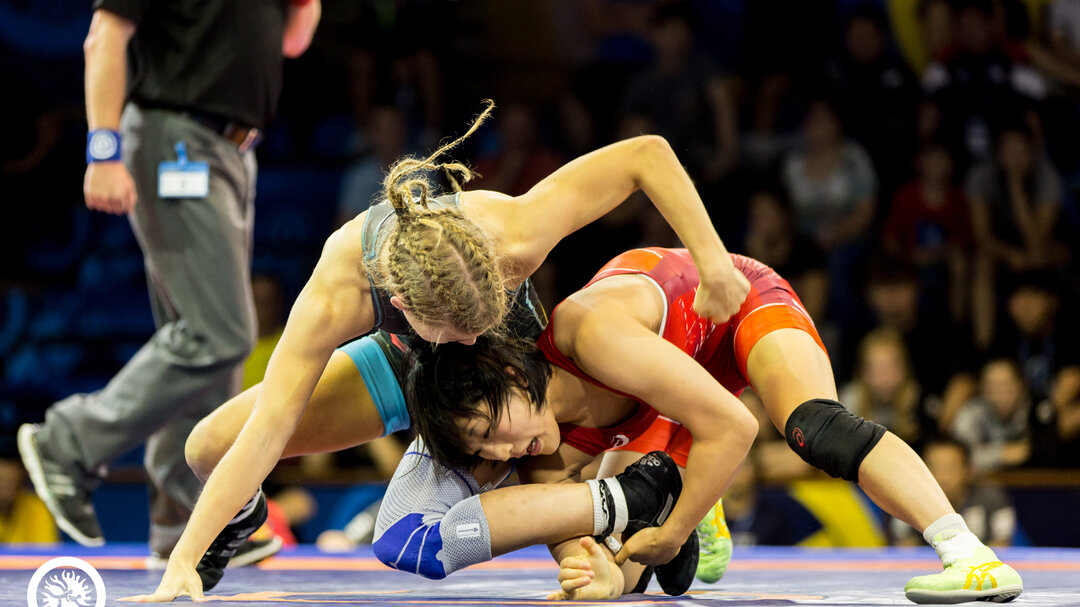 df. Ellen RIESTERER (GER) -by VSU, 10 - 0-10.jpg) In the 50kg finals, Yui SUSAKI (JPN) beat Ellen RIESTERER (GER) to win her fifth world title in three different age groups. (Photo by Max Rose-Fyne)
In the 50kg finals, Yui SUSAKI (JPN) beat Ellen RIESTERER (GER) to win her fifth world title in three different age groups. (Photo by Max Rose-Fyne)
4. Japanese Women Win Six Golds, World Team Title
For the eighth straight year, Japan left the Junior World Championships with the women’s wrestling team title. The most dominant women’s wrestling nation in the world finished 55 points ahead of second place Russia, and 88 points ahead of third place China.
Japan closed out the fifth day of competition with four additional gold medals, bringing their tournament total to six overall individual champions. This is the fifth straight year that Japan has finished the Junior World Championships with at least four gold medalists. It’s also the most golds they’ve won since winning six golds at the 2016 Junior World Championships.
They also won a silver and three bronze medals. In total, Japan medaled in all ten women’s wrestling weight classes.
One of the biggest notes from women's wrestling was Japan's 19-year-old superstar Yui SUSAKI (JPN) winning her fifth straight world title across three age divisions, confirming her as one of the best wrestlers in the world, regardless of age, gender or style.
Susaki’s next competition will be October’s senior-level World Championships in Budapest, Hungary.
Also of note, Koumba LARROQUE (FRA) won her fourth age-level world championship. Larroque didn't give up an offensive point the entire tournament, outscoring her Junior World Championship opponents 33-0, including an overwhelming 6-0 finals win over Russia's Evgeniia ZAKHARCHENKO (RUS).
Team Scores
GOLD - Japan (215 points)
SILVER – Russia (160 points)
BRONZE – China (127 points)
Fourth – Ukraine (73 points)
Fifth – Mongolia (67 points)
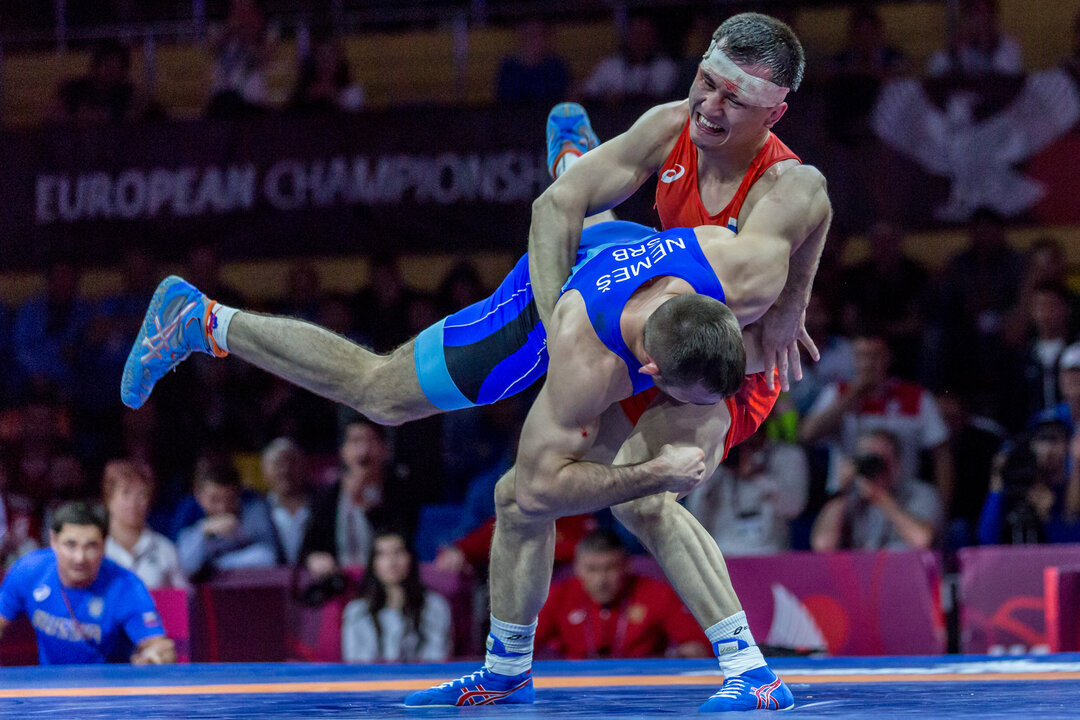 df. Viktor NEMES (SRB) -by VPO1, 5 - 1-2.jpg) Roman VLASOV (RUS) defeated Viktor NEMES (SRB), 5-1 to win the 2018 European gold medal. Photo by Max Rose-Fyne.
Roman VLASOV (RUS) defeated Viktor NEMES (SRB), 5-1 to win the 2018 European gold medal. Photo by Max Rose-Fyne.
5. Vlasov and Phogat to Miss #Budapest2018 World Championships
Vinesh PHOGAT (IND) and Roman VLASOV (RUS) recently suffered injuries and have been forced to pull out of the #Budapest2018 World Championships.
According to Indian journalist Vinay Siwach, Phogat, the 24-year old rising Indian star tore ligaments in her elbow while practice Friday, trying to finish a takedown against training partner Pooja DHANDA (IND). The Asian Games and Commonwealth Games gold medalist was expected to compete for a medal in women's wrestling at 50kg.
Another blow to the #Budapest2018 entry list came when two-time Olympic champion Roman Vlasov announced that he recently underwent surgery for a right knee injury. Vlasov, the four-time world and Olympic champion and reigning European champion was registered at GR 77kg.
Click HERE for full Scroll.in's full release on Phogat
Weekly FIVE! In Social Media
1. "Difficulties will not break me."
2. "The 2018 #beach#wrestling #world #championships will be held in #sarigerme #turkey #beachwrestling"
3. Respect.
4. Big Move Day 6 from the Junior World Championships - TRNAVA 2018
5. Photo from the Freestyle Finals. - #uww #wrestling

Share your thoughts.
Comments