

#WrestleOslo

What's the driving force behind Vlasov's attempt to win a third Olympic title?

By Eric Olanowski

CORSIER-SUR-VEVEY, Switzerland (December 9) -- Roman VLASOV (RWF) was denied a chance to go for a third Olympic gold earlier this year, but made sure he would not miss out on his shot at winning a third world title.

Vlasov chalked up a meticulous and hard-fought 2-1 victory over ‘20 European champion Sanan SULEYMANOV (AZE) to take the 77kg at October’s World Championships in Oslo.

"I was super tired, I couldn't even celebrate as I usually do," Vlasov said. "I left all my power and energy on the mat."

Prior to the Tokyo snub, Vlasov considered ending his career. But the desire to achieve his dream of matching the legendary Alexander KARELIN (RWF) with three Olympic golds inspired him to reset his sights for the 2024 Paris Olympics. Like his hero and son’s god father, Karelin, Vlasov is a native of Novosibirsk in southwestern Siberia and was mentored by the great coach Viktor KUZNETSOV.

Oslo would be the first stop on the long road to Paris, as it would provide confirmation that he could live up to his own expectations. A world champion in 2011 and 2015, he finished out of the medals in 2017 and 2019.

"The last time I won the World Championships was in 2015, before in 2011. It’s been a long time," Vlasov said. "I missed these emotions. To be the best in the world is the thing I’ve been dreaming about. It’s the thing I think about when I wake up in the morning before going to training."

After barreling through the rounds, winning each of his four matches by at least seven points, Vlasov found a formidable foe in Suleymanov, this year's European bronze medalist and the ‘19 U23 world silver medalist.

Vlasov, a four-time European champion who turned 31 in Oslo, had the first chance in par terre, but could only get a 1-point stepout after walking the airborne Suleymanov over the edge.

But Suleymanov had no answer when the roles were reversed in the second period, and Vlasov clinched the win when he deftly evaded a stepout attempt in the final 20 seconds.

"The final match did not go as planned," Vlasov said. "I had to wrestle super hard to keep that one point scored. Patience brought the gold."

Patience and appreciation of each victory along the way are what will look to get him to the Paris Games, a lesson he learned from the Tokyo debacle.

"The last Olympic cycle I made the mistake of counting down the days to the Olympics," Vlasov said. "This time I just enjoy every title. Today I am the happiest man on Earth, tomorrow we’ll be the new day, the new qualification for the new world championships. "The Olympics are the dream of every athlete. I’ve been there twice, and I want to become a three-time Olympic champion. But it’s better not to go ahead of time."
#development

Italy Organizes UWW Level 3 Technical Course for Coaches

By United World Wrestling Press

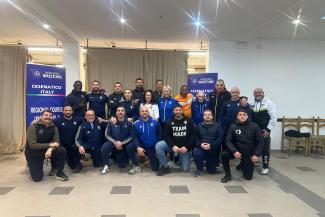
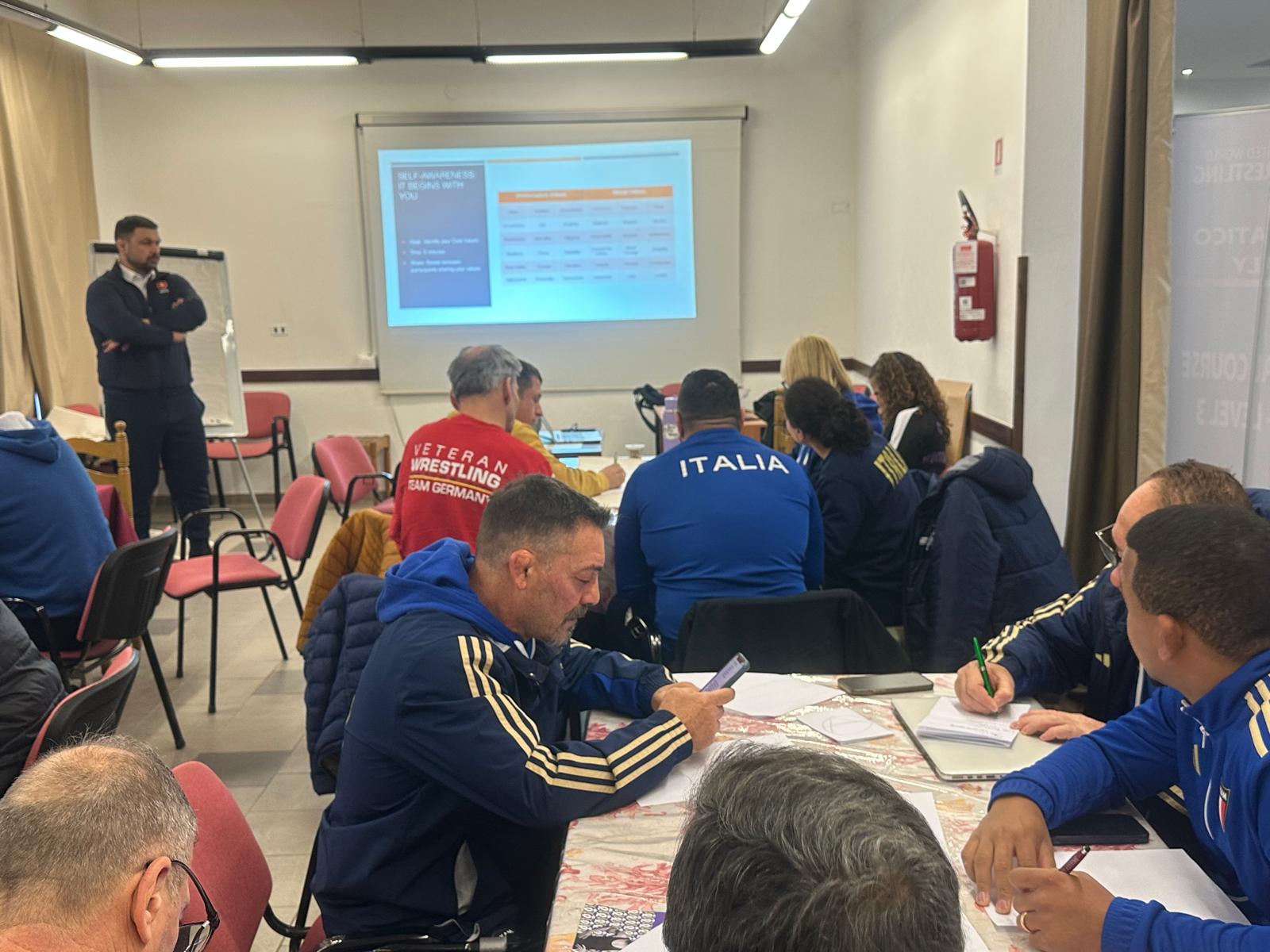
CESEBATICO, Italy (February 9) -- A United World Wrestling Level 3 Technical Course for coaches was successfully organized in Cesenatico, Italy from January 5 to 9, 2026. The course was organized in collaboration with UWW and the FIJLKAM.

Organised after a international tournament, the course brought together 33 coaches from Italy and other countries, including Germany, Poland, Croatia and Ivory Coast creating a rich environment for technical exchange, professional development and international cooperation.

This tournament provided an important practical framework for the educational programme, allowing coaches to observe real competition situations, analyze match management and technical-tactical aspects, and directly link theoretical learning to high-level competitive practice.

The programme was led by UWW Development Officer Vincent AKA, with practical sessions conducted by Olympic Champion and UWW expert Komeil GHASEMI. The course followed the new UWW education pathway, focusing on advanced coaching competencies for high-performance environments.

Italy

The key topics in the course included coaching philosophy and leadership, advanced planning and periodization, pedagogical situations and match analysis, technical and tactical development, safeguarding, anti-doping and athlete protection and introduction to Beach Wrestling.

Both theoretical and practical evaluations were conducted, allowing participants to apply their knowledge in real coaching situations. At the conclusion of the course, all successful participants were awarded the UWW Level 3 Coaching Certificate.

"I want to thank everyone for this course, for what you did, and for how we got along together," Carmelo RICCARDO, a coach and participant said. "It was a wonderful experience and very interesting course. Thanks to the UWW and FIJLKAM for these important opportunities for growth."

The Italian Wrestling Federation provided high-quality facilities, with classrooms and training venues meeting international standards. All activities were centralized at Villaggio Accademia Cesenatico, ensuring optimal logistical conditions for both learning and training.

The course benefited from the continuous presence of national federation representatives, including the Technical and Sports Directors, as well as the participation of FIJLKAM leadership during the closing ceremony—demonstrating strong institutional commitment to coach education.

After the course, it achieved its educational and development objectives. The combination of high-level technical content, structured evaluations, international expertise, and strong human values.

The course not only strengthened the competencies of participating coaches but also reinforced Italy’s role as a key hub for wrestling education and excellence in Europe, contributing sustainably to the long-term development of the sport.

Sustainability

From a sustainability perspective, the use of the covered stadium contributed to the efficient organization of Beach Wrestling activities by optimizing existing infrastructure. By adapting a multi-purpose covered venue for Beach Wrestling sessions, the organizers limited the need for additional temporary installations, reduced logistical and environmental impact, and ensured continuity of activities regardless of weather conditions.

This approach reflects UWW’s commitment to sustainable event organization through the рационal use of facilities and long-term infrastructure legacy.