

Women's World Cup

Women's World Cup Schedule Released

By Eric Olanowski

CORSIER-SUR-VEVEY (March 12) – United World Wrestling released the schedule for Women’s Wrestling World Cup which kicks off March 17-18. The dual-meet based events is an annual highlight of the international wrestling calendar, being held in Takasaki, Japan.

The eight participating teams have been separated into two pools with Japan and Belarus leading groups A and B. After tying for second place at the 2017 World Championships with the United States, Belarus has been awarded the Group B tiebreaker. Pool A will consist of Canada, Japan, Sweden and the United States and Pool B will consist of Belarus, China, Mongolia, and Romania.

Considered the most dominant women’s wrestling nation in the world, Japan has won nine World Cup titles, while China has captured six. The United States is the only other nation to have won the cup, capturing the 2003 title in Tokyo.
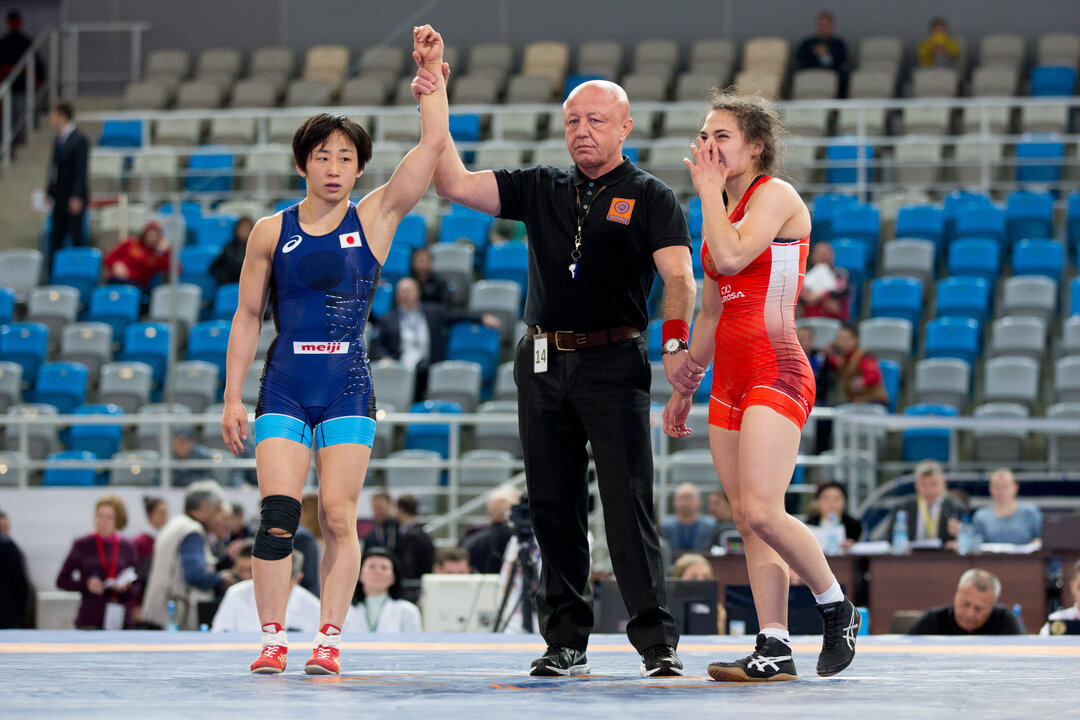
Photo: Yuki ERIE (JPN) 

Japan, who won last year’s World Cup in Russia, will be without 2017 World Champion Yui SUSAKI (48kg) who lost in a recent wrestle-off against rival Yuki IRIE (JPN). Otherwise, the Japanese side is scheduled to start a number of world and Olympic champions to Takasaki, including RIO 2016 titlists Risako KAWAI (63kg) and Sara DOSHO (69kg).

Saturday, March 17 (Local Time)
9:00 am: Canada v. United States (Mat A) // Mongolia v. China (Mat B)
10:15 am: Japan v. Sweden  (Mat A) // Belarus  v. Romania (Mat B)
11:30 am: Sweden v. United States  (Mat A) // Romania v. China (Mat B)
12:45 pm: Japan v. Canada (Mat A) // Belarus  v. Mongolia (Mat B)
4:30 pm: Opening Ceremonies
5:00 pm: Sweden v. Canada (Mat A) // Romania v. Belarus  (Mat B)
6:15 pm: Japan v. United States (Mat A) // Belarus v. China (Mat B)

Sunday, March 18 (Local Time)
9:00 am: Seventh Place Match
10:30 am: Fifth Place Match
1:00 pm: Bronze Medal Match
2:30 pm: Gold Medal Match


#development

ASDEC Chair Niamkey Leads Workshop on Sports Development

By United World Wrestling Press

LAUSANNE, Switzerland (May 9) -- Collaboration, innovation and open exchange was at the heart of a two-day workshop, organised by the ASOIF Sport Development and Education Commission (ASDEC) on May 5 and 6 in Lausanne, Switzerland. The meeting brought together more than 60 participants from 30 International Federations (IFs) for two days of peer exchange and practical discussion on key issues shaping the future of sport development.

Held in a collaborative and informal setting, the workshop focused on topics including coach development, officiating, National Federation support, and the evolving delivery of sport development programme.

During the workshop, Olympic Solidarity hosted roundtable discussions giving participants an opportunity to exchange feedback, ideas and perspectives on existing programmes and future collaboration opportunities.

Participant feedback strongly highlighted the value of the workshop as a trusted environment for open discussion, practical learning and networking across International Federations. Many participants - particularly first-time attendees, but also experienced delegates who had attended numerous workshops - emphasised the importance of having a collaborative and non-political space in which to share challenges, ideas and experiences openly.

ASDEC Chair Deqa NIAMKEY, Development Director at United World Wrestling, highlighted after the workshop:

"The ASDEC Workshop 2026 was a great success, offering International Federations a wide range of relevant topics, including updates on the current trends and landscape of sports business industry, participation programmes, and strategies for entering new markets," Niamkey said.

"The workshop also fostered meaningful discussions with key partners focused on the development and growth of our sports. It continues to serve as an important platform for networking, exchanging ideas, sharing best practices, and transferring knowledge, all in line with ASOIF’s broader good governance strategy."

The workshop concept is fully aligned with the third strategic pillar of the ASOIF Strategy 2026–2032, which focuses, among other priorities, on developing and modernising platforms for shared learning and adding value by addressing member priorities and sector developments.

Read More: From AI to Officiating, ASOIF Workshop Explores Future of Sport Development