

#wrestlebishkek

#WrestleBishkek: Ravi returns with golden aim

By Vinay Siwach

NEW DELHI, India (May 16) -- Three months back, Ravi KUMAR (IND) was keen on starting the season with a bang. He was in "perfect shape" to wrestle.

Then at one training session, it all changed.

"The hit was so loud that I felt that I will need surgery," Kumar said. "My medial collateral ligament [MCL] and anterior cruciate ligament [ACL] broke."

That was February 6 and since then Kumar has been in rehabilitation, nursing his knee injury. But earlier this month, he return to the mat training sessions and is now making a comeback to competition, 10 months since his last, the World Championships. 

"I can't wait."

The Tokyo Olympic silver medalist will wrestle at the Bishkek Ranking Series scheduled for June 1 to 4. Wrestling at 61kg, Kumar will try to regain his form that helped him win three Asian titles, a Commonwealth Games gold medal and become India's biggest hope for Paris Olympics.

"This competition is very important," he said. "I have missed many. I will try to do my best and attain a level which I had before the injury."

An MCL or ACL tear can require surgery but Kumar says his injury was on the borderline and he opted out of the surgery which could have kept him away from the mat for more than six months.

"My partner got hold of my leg and while I was trying to move away, I hit his shoulder with my knee," he said. "So February, March, April I was in rehabilitation." 

That meant he missed the second Ranking Series and the Asian Championships in which he won three back-to-back gold medals, the first Indian to the title thrice.

In his absence, U23 world champion AMAN (IND) won the gold medal at 57kg to keep the top medal in India. Incidentally, Aman also trains at the same stadium.

Both Kumar and Aman are registered at 61kg for Bishkek along with a third Indian PANKAJ. European champion at 57kg Aliabbas RZAZADE (AZE) is also in the same weight class and so is the Asian champion at 61kg Taiyrbek ZHUMASHBEK UULU (KGZ) and so is former Asian champion Ulukbek ZHOLDOSHBEKOV (KGZ).

"See if I prepare for every wrestler separately, I will never win," Ravi said. "I have to focus on doing my work and make myself the best. Then whoever is the opponent, it does not matter."

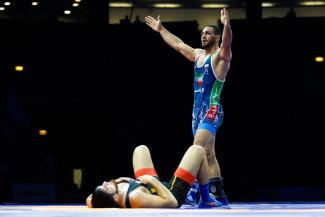
Ravi KUMAR (IND)Ravi KUMAR (IND) lost to Gulomjon ABDULLAEV (UZB) at the World Championships. (Photo: UWW / Martin Gabor)

Kumar, however, would have liked to wrestle Abdullaev, a wrestler who has constantly troubled him since his U20 days. Abdullaev leads the head-to-head record 3-2 after his win in Belgrade.

"Abdullaev has an attack on my left leg and he hits on me," he said. "It's kind of perfect. He always hits on me.

"That day in Belgrade, my body could not get going. Even if I had won against Abdullaev, I don't know what the next result could have been. I wanted to work, but my body didn't. My weight also was set a day before the bout so I slept with ease. I did not do anything in the morning. No warm-up as such. I remained lazy."

While he reflects on the World Championships bout, Kumar knows that it doesn't matter now. With the Asian Games and the Olympic qualifying World Championships scheduled, he has to focus on the upcoming tournaments.

"I will be back on the mat after a long time," he said. "So it's very different to be in a competition. Training is great but when you are in a tournament, it's a different feeling. So I want to be good in Bishkek."

Undoubtedly, Kumar will be the favorite to win the gold in his weight class but with young blood coming up, he will be tested.

"It's wrestling," he said. "No one can predict the result because I am not in regular competition. But if I control the bouts, the result will be in my favor."
#WomensWrestling

'Women who fight are strong and beautiful': How wrestlers have broken barriers, one takedown at a time

By United World Wrestling Press

CORSIER-SUR-VEVEY, Switzerland (March 8) -- They come from the gleaming futuristic city that is Tokyo to an ancient Moldovan hamlet; the American suburbs to the rustic Indian villages. They belong to diverse backgrounds, different cultures and have undertaken contrasting journeys from obscurity to the top.

It doesn’t matter if you are Nonoka OZAKI (JPN), Anastasia NICHITA (MDA), Amit ELOR (USA) or ANTIM (IND). One thing binds them all.

At every step, they were told: “Wrestling isn't for girls.” Taunted and heckled for cutting their hair short and playing a ‘man’s sport’, they shattered stereotypes and broke barriers one takedown at a time. Today, they are role models for wrestlers not just in their respective countries but beyond borders.

“Every time I was told that wrestling isn’t for girls, I thought, "I'll prove them wrong. Gender has nothing to do with strength,” two-time world champion Ozaki says.

Elor adds: “Every time I felt doubted or like I didn’t belong, it only made me work harder to prove them wrong. I love showing that women are just as tough, skilled, and capable as anyone else on the mat.”

For some, discrimination started at home. Antim -- Hindi for ‘last’ -- got her name because her family hoped she would be the last girl child. Antim grew up to land an ever-lasting punch to patriarchy with her exploits on the mat, which have contributed to the changing mindset towards women in her village in Northern India.

Thousands of miles away, Nichita faced similar struggles. Growing up in Tataresti, Moldova, Nichita was told by her family not to wrestle, as it wasn’t ‘meant for girls’. “But I loved this sport so much that I didn’t pay attention to what others were saying. When you do something with your heart, something you truly love, it doesn’t matter what others think,” she says.

Sarah HILDEBRANDT (USA)Sarah HILDEBRANDT (USA) is the Olympic champion at 50kg. (Photo: United World Wrestling / Kadir Caliskan)

Empowerment and self-belief

Sarah HILDEBRANDT (USA) insists wrestling ‘empowered’ her ‘confidence and self-belief because its lessons and processes’ gave her the opportunity to ‘combine things like strength and grace, logic and intuition, deliberateness and flow…and endless other dualities’.

Hildebrandt won the gold medal in the 50 kg weight class at last year’s Paris Olympics. It was a classic redemption for her, having missed out on the gold medal in a cruel manner at the Tokyo Olympics. And on her way to the top of the podium in Paris, Hildebrandt showcased her wide-ranging skills, which she says also help her in everyday life.

"Through that, I’ve gotten to learn just who I am and challenge myself not only to grow through wrestling but also to express who I’ve uncovered. To feel confidence because what I uncover is authentically ME," Hildebrandt says. "It’s given me identity- not through accolade or achievement but through my process and the values I sharpen as I work toward those achievements. I can apply these lessons and skills to all areas of my life. It’s invaluable."

Zaineb SGHAIER (TUN)Zaineb SGHAIER (TUN) is a two-time Olympian from Tunisia. (Photo: United World Wrestling /Amirreza Aliasgari)

Teenage prodigy Zaineb SGHAIER (TUN) agrees that wrestling is a great source of 'confidence and patience', which help them in daily life. "It might not be easy to be a woman wrestler in a male-dominated society but with love for the wrestling and passion rooted in our hearts, no one can stop us," the two-time Olympian says.

Hildebrandt is conscious that the sport will test them in ‘countless ways’. “Being a woman in this sport is an additional test at times. But a woman wrestler is not deterred by those tests. They recognize the power the lessons in wrestling hold,” the American wrestler says. “The vulnerability required to step on the mat is exactly why it is the greatest sport in the world and a woman wrestler is a woman who craves that so they can discover just who they are.”

Anastasia NICHITA (MDA)Paris Olympic silver medalist at 57kg Anastasia NICHITA (MDA). (Photo: United World Wrestling / Kadir Caliskan)

Indeed, the challenges for a wrestler extend beyond the mat. For Nichita, the constant injuries pegged her back but she braved them to finish second on the podium in the French capital last year.

"The biggest obstacle I had to overcome was injuries. Throughout my career, I’ve had to push through many injuries—knees, shoulders, back, ribs—but it was all worth it for the sake of my dream and my love for wrestling,” Nichita says.

Eventually, love for the sport is what keeps them going.

For Ozaki, wrestling is a way to best express herself. “Women who fight are strong and beautiful,” she says. “You can see this by watching women’s wrestling.”

Elor dreams that ‘women’s wrestling continues to grow worldwide, with more opportunities, more support, and more respect.’

As the new Olympic cycle gains momentum, the wrestlers are resetting their targets and evolving their training plans. Nichita, for one, hopes to covert her Paris silver into gold at the 2028 Los Angeles Olympics gold medal. ”I know it will be very difficult,” she says. “But after everything I’ve been through, nothing scares me anymore.

But amidst her personal goals, she hasn’t lost the sight of the bigger picture: “I will continue to prove that wrestling is not just for boys."