

Top Stories of the Decade

Wrestling Introduces New Weight Categories, Gender Equity, and Ranking Series

By Eric Olanowski

CORSIER-SUR -VEVEY, Switzerland (December 29) -- The growth of international wrestling since 2010 has required a number of changes, but few have seemed to impact as many wrestlers and fans as the addition of weight categories, expansion of women's opportunities, and the introduction of a yearlong competition calendar, knowns as the Ranking Series.

 Heading into the 2017 World Championships in Paris, Wrestling enjoyed eight weight categories in each style, with six aimed at Olympic participation. During a bureau meeting at the event, it was decided to increase that total allotment to 10 weight categories and slightly shift a number of weight categories across the styles to better match anticipated participation. The additional weights also prompted a two-day format with same-day weigh-ins.

"These improvements made are incredible for the sport of wrestling," UWW President Nenad Lalović said at the time. "Our sport has never been stronger, and I believe that with the new categories and the improved competition format we will see continued growth in participation, support and viewership. I also believe these new rules will also encourage healthier wrestlers."

Another significant shift in the sport came with the launch of the Ranking Series in 2018, which uses four previously independent events, plus the world and continental championships to determine a points champion for the season. The rankings also determine the top seeds at the world championships and Olympic Games. 

“The Ranking Series makes it easier for fans, athletes, and coaches to understand the impact of each tournament and match," said Lalovic.

The Ranking Series was tweaked heading into the 2019 season with more weight placed on the number of participants to help determine the ultimate allocation of points per event. The shift proved prescient as participation in the events more than doubled in 2019.

As of 2019, the points earned from the World Championships, Continental Championships and Ranking Series events are as follows:

Wrestling’s growth hasn’t been contained to competition formats. In an effort to ensure better governance and compliance with IOC norms, wrestling has reached out to female leaders around the world to ensure their participation in the sport’s growth. Wrestling has utilized national federations, IOC-backed initiatives, and created an annual Women in Wrestling Global Forum to ensure increased outreach and education of women in the wrestling community.

“The past few years has seen wrestling provide more opportunities to female leaders and competitors than ever before,” said UWW Development Director Deqa Niamkey. “I’m pleased with our growth and looking forward to the next ten years!”

In addition to professional opportunities for women in wrestling, there has also been a much-increased focus on their mat achievements. From photos to stories to documentaries the women of wrestling are covered equally to men and have enjoyed several breakout moments, including many listed in the Top Ten Stories of the Decade.

#JapanWrestling

World Champs Morikawa, Ishii Set Up Clash in 68kg Final

By Ken Marantz

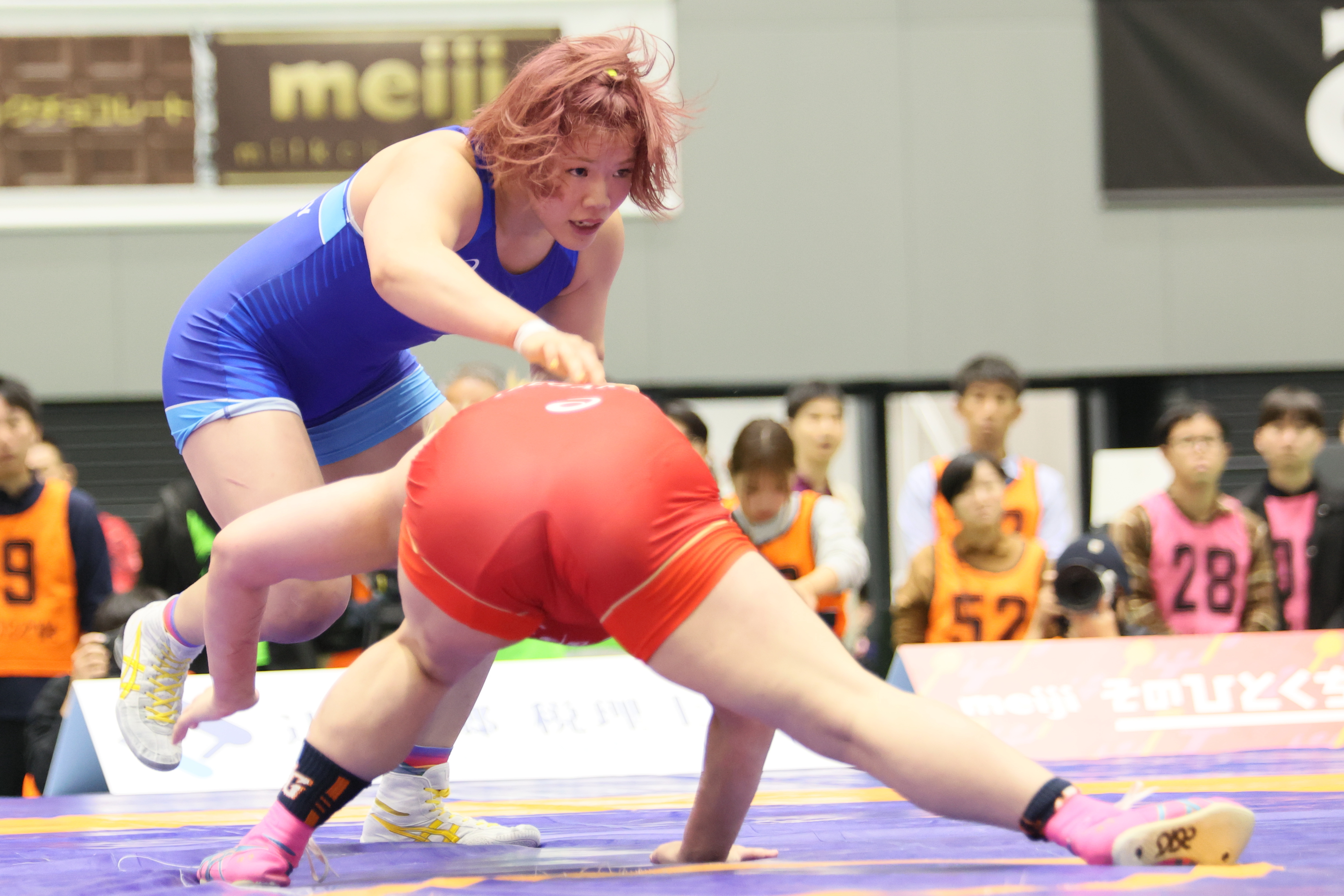
TOKYO (May 22) -- The first of what could be several clashes of Japanese women titans was set up when reigning world champions Miwa MORIKAWA and Ami ISHII advanced to the 68kg final at the Meiji Cup All-Japan Championships in Tokyo on Friday.

Morikawa, the world champion at 65kg, had her hands full in grinding out a 3-2 win over world U20 champion Rey HOSHINO in their semifinal, scoring the decisive takedown off a counter in the final minute.

Ishii, the current 68kg world champ, had little trouble piling up the takedowns in a 10-0 victory over former world champion Masako FURUICHI.

Morikawa got the best of Ishii at the Emperor's Cup All-Japan Championships last December, winning 5-3 to earn a trip to the Asian Championships, where she had to settle for the silver medal.

This time there is more at stake in the final on Saturday, as the Meiji Cup is serving as the final qualifier for this year's Asian Games, to be hosted by Japan, and the World Championships.

Winners of both the Emperor's Cup and Meiji Cup automatically earn places on the national team; if they are different, a playoff is held between the two at the end of the day.

Given the stakes, Morikawa knows Ishii will be coming at her with all guns blazing, knowing she need to beat Morikawa twice to earn a national team berth.

"That [Emperor's Cup win] doesn't matter," Morikawa said. "In that match, I went all out to the end and came up with the victory. I think that tomorrow, she will really be coming after me. I have to show the willpower and guts to not give in. I will do my utmost to secure the national team place in one fell swoop."

Morikawa naturally would not reveal what strategy she has for Ishii, but says she will rely on what her coach, four-time Olympic champion Kaori ICHO, comes up with.

"She's really good with her attacks, and my strong point is defense," Morikawa said. "Kaori will devise a plan, and I'll just go along with that."

Yuka KAGAMI (JPN)Yuka KAGAMI (JPN) reached the 76kg final at the Meiji Cup. (Photo: wrestling-spirits.jp / Takeo Yabuki)

In other semifinals on the second day of the four-day tournament at Tokyo's Komazawa Gym, Paris Olympic champion Yuka KAGAMI moved a step closer to returning to the global stage by making the 76kg final.

Kagami posted a slim 2-1 victory over Ayana MORO, with all of the points scored on the activity clock, to set up a meeting with Yasuha MATSUYUKI, who dealt her a stunning loss in the final of the Emperor's Cup, which was her first competition since Paris.

"I came to realize that last time, the fighting spirit that I had at the Olympics was taking a nap," Kagami said. "For these five months, I have prepared to come here and definitely win the title, then the playoff."

At 53kg, world champion Haruna MURAYAMA outlasted longtime rival and former Olympic champion Mayu SHIDOCHI 2-1 -- with all points scored on the activity clock -- to set up a final against Moe KIYOOKA for the second straight year.

Murayama defeated Kiyooka, the world 55kg champion in 2024, twice last year -- 3-1 in the final, then again 4-1 in the playoff -- to make the team to the World Championships in Zagreb, where she claimed her fourth career gold.

Kiyooka came back to win the Emperor's Cup title in Murayama's absence, and will be looking to avenge last year's losses as she attempts to fill the void left when Olympic champion Akari FUJINAMI moved up to 57kg.

In a tragic incident, Taishi NARIKUNI's bid to repeat the Freestyle-Greco double that he accomplished at the Emperor's Cup ended when he suffered a serious eye injury in his Greco 70kg quarterfinal -- which he won nonetheless, but then was easily beaten in the semifinals.

Facing Takara FUKUZAWA in the last eight, Narikuni took a hard shoulder to the eye, which knocked him woozy for awhile. He managed to continue on, finishing up a 5-0 victory. But, wearing a patch over his right eye in the semifinals against Hajime KIKUTA, he went down 8-0 in 28 seconds.

Narikuni was scheduled to also take the mat later in the day in the Freestyle 72kg final, but would end up defaulting that match. Family members said he was taken to the hospital and was diagnosed with a broke cheek bone below his eye and would undergo surgery on Saturday.

As defending Freestyle 97kg champion Arash YOSHIDA awaited his final, it was a tough day for rest of his family, whose Iranian father runs the kids wrestling club where the siblings got their start in the sport.

Keivan YOSHIDA, Arash's older brother who preceded him as 97kg champion in 2024, was ousted in the semifinals at 125kg, losing 11-1 to Hosei FUJITA.

Just moments later on an adjacent mat, younger brother Ariya YOSHIDA was dealt a tough 10-9 loss at 79kg to Kanata YAMAGUCHI.

In the final, Yamaguchi will face another wrestler with Iranian heritage, newly crowned Asian champion Keyvan GHAREHDAGHI, a 10-0 winner over Kohei KITAMURA in the other semifinal.