

Yang Stuns Geraei to Give China 1st Greco-Roman Gold Since 2012
Tuesday, February 27, 2018 - 18:20 By Ken Marantz
YANG Bin gave China its first Greco-Roman gold medal at an Asian Championships in six years with a stunning victory, while host Kyrgyzstan's vocal fans were twice denied a title to highlight the opening night of finals in Bishkek.
Yang surprised favorite and Paris 2017 world bronze medalist Mohammadali GERAEI (IRI) in the 77kg final by grinding out a hard-fought 7-6 win.
"I was very confident, and I thought I was the best in this category," said Yang, a bronze medalist a year ago in New Delhi.
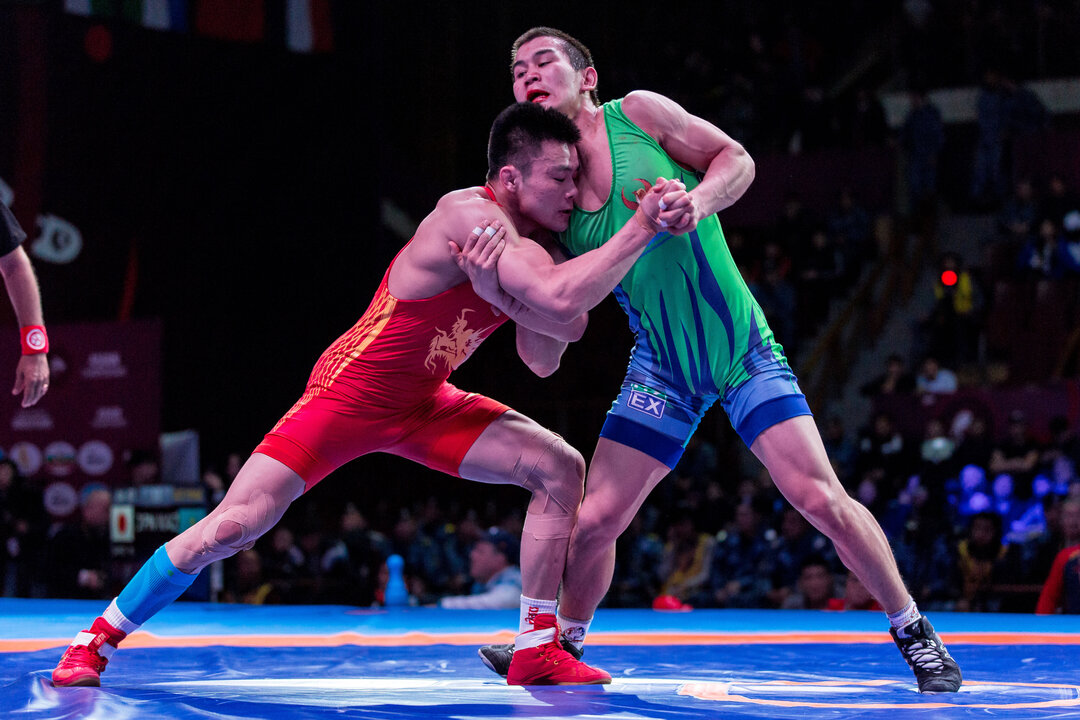 df. BERDIMURATOV (UZB) -by VPO1, 5 - 1-2.jpg) The match that began and ended with flurries of action was decided when Yang scored with a step-out with :13 left in which Geraei went sprawling awkwardly into the referee.
The match that began and ended with flurries of action was decided when Yang scored with a step-out with :13 left in which Geraei went sprawling awkwardly into the referee.
That tied the match at 6-6 and would have given the Chinese the win on criteria, but he received another point when Geraei's challenge that Yang had grabbed his singlet was rejected.
"At the very end, I used my technique and got the point, and I believed that the referee would give a fair judgement," Yang said of the call.
That made Yang the first Chinese to win an Asian gold in Greco-Roman since Zheng Pan took the 66kg title at Gumi 2012.
"Actually we have been working so many years to get an Asian champion," Yang said. "Sometimes, we had second or third, we just need some luck, because they are similar levels. Today we are happy to see this result."
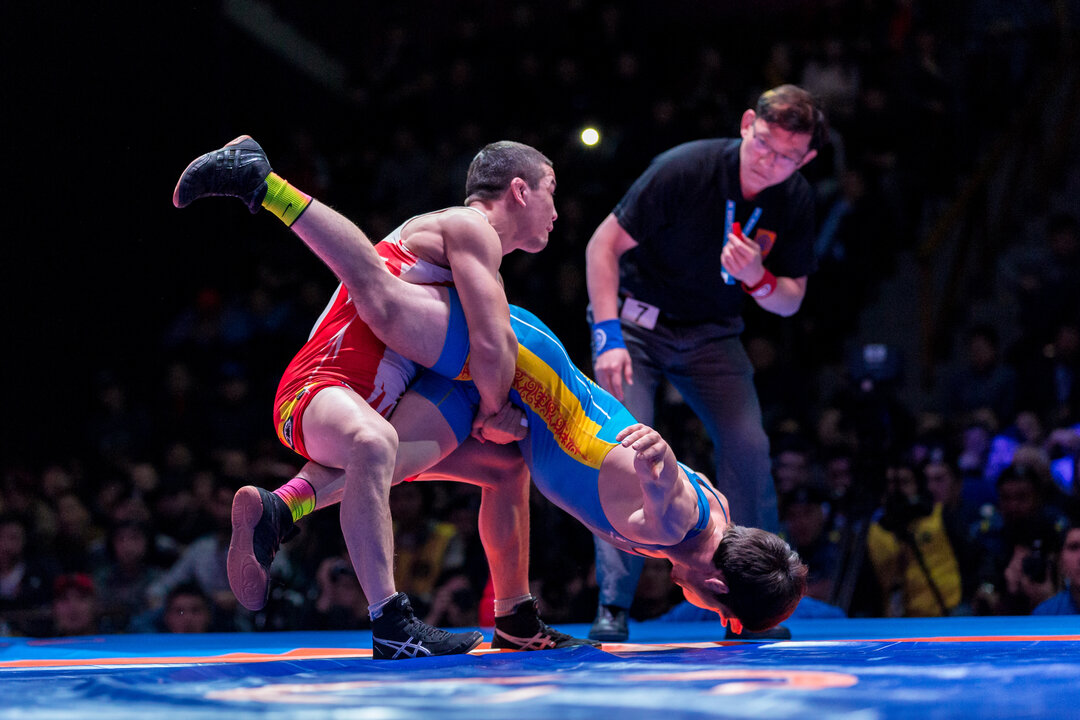 df. AMATOV (KGZ) -by VSU, 8 - 0.jpg)
Kyrgyzstan had wrestlers in the first two finals of the night, and neither could come away victorious, much to the chagrin of the packed house of 3,000 at the Kozhomkul Sports Palace.
First, teenager Zholaman SHARSHENBAKOV's late rally in the 55kg came up just short in a 5-4 loss to Shota TANOKURA (JPN). Then Urmalbek AMATOV was overwhelmed by veteran Elmurat TASMURADOV (UZB), who ended their 63kg final with an 8-0 technical fall with 1:49 remaining.
Despite Geraei's defeat, Iran still came away with two golds, as New Delhi 2017 champions Hossein NOURI (87kg) and Behnam MEHDIZADEH (130kg) both posted tepid yet solid victories. Mehdizadeh had also won in 2014.
Nouri, the Paris 2017 world bronze medalist, notched a 3-0 victory over unheralded Masato SUMI (JPN), while Mehdizadeh followed by beating Muminjon ABDULLAEV (UZB) 3-1.
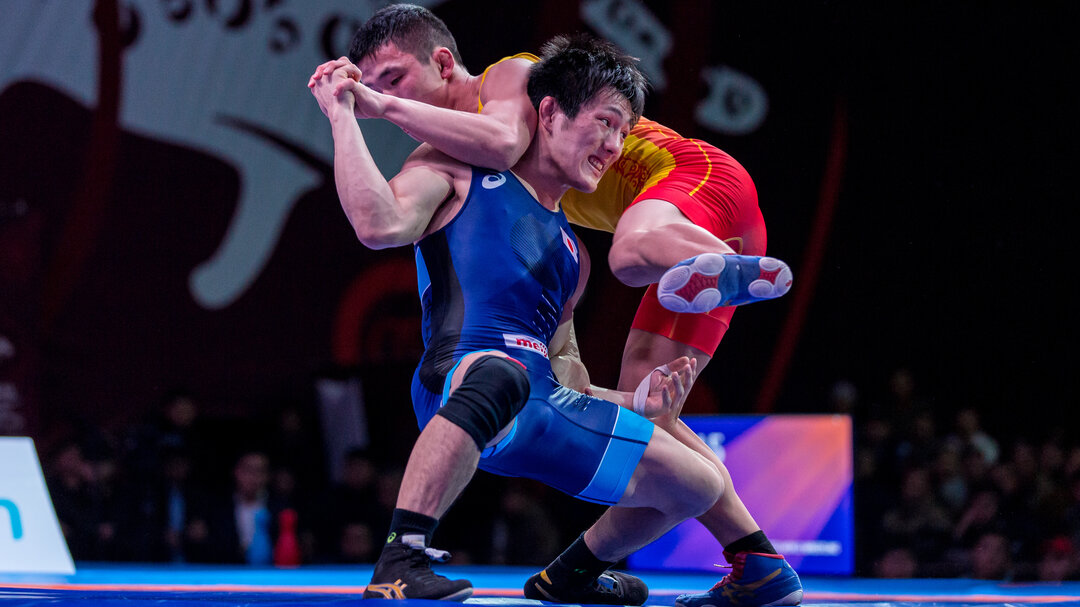 df. SHARSHENBEKOV (KGZ) -by VPO1, 5 - 4-2.jpg)
Japan's Tanokura took an unusual path to a continental crown. An Asian medalist in both 2012 and 2013, he struggled to find success when the 55kg weight class was eliminated and he had to face naturally bigger opponents. Two years ago, he retired to become a high school physical education teacher.
But when the lighter weight class was reinstated, his college coach and current Japan national team coach Shingo Matsumoto persuaded him to return during nights out for Korean barbecue.
His victory at the Japan championships in December vindicated his decision and put him on the team to Bishkek, where he added the gold medal to the silver and bronze medals he had previously won. It also makes him eye bigger things.
"Of course, my goal is to be world champion," Tanokura said. "In Asia, the level is high in the lighter weights, so to win the Asian title this time is a step ahead. There is still progress to be made."
Against Sharshenbekov, Tanokura used a front headlock throw and a penalty point to build up a 5-0 lead going into the second period. But the Krygyz wrestler gradually whittled away at the gap, cutting it to one with a takedown with :40 remaining. But with the deafening crowd urging his opponent on, Tanokura managed to hold on for the win.
"It was something else," Tanokura said of the crowd noise. "It's unusual for the Asian Championships to draw such a big crowd. I knew it wouldn't be easy to win. But I stayed aggressive and that led to coming away with the victory."
At 63kg, Rio 2016 Olympic bronze medalist Tasmuradov quieted the crowd with his one-sided win over Amatov, scoring with push-outs, rolls and a takedown for his fourth Asian title overall and first since 2015. He also has three world bronze medals.
Meanwhile, Kazakhstan, which had been shut out of the finals, came away with three bronze medals from Khorian ZHAKANSHA (55kg), Mirambek AINAGULOV (63kg) and Maxat YEREZHEPOV (77kg).
It was the fifth Asian medal for Yerezhepov, who last year defeated Yang in the semifinals en route to the 75kg gold.
Kyrgyzstan and China both claimed two bronzes, while India, South Korea, and Turkmenistan had one each.
Greco-Roman
55kg (10 entries)
Gold - Shota TANOKURA (JPN) df. Zholaman SHARSENBEKOV (KGZ), 5-4
Bronze – Khorian ZHAKANSHA (KAZ) df. CAO Liguo (CHN), 7-4
Bronze – Kumar RAJENDER (IND) df. Javokhir MIRAKHMEDOV (UZB), 3x-3
63kg (9 entries)
Gold - Elmurat TASMURADOV (UZB) df. Urmalbek AMATOV (KGZ) by TF, 8-0, 1:44
Bronze – Mirambek AINAGULOV (KAZ) df. Vikram KURADE (IND) by TF, 9-0, 3:39
Bronze – JUNG Dokyung (KOR) df. Takayuki INOGUCHI (JPN), 2-0
77kg (12 entries)
Gold - YANG Bin (CHN) df. Mohammadali GERAEI (IRI), 7-6
Bronze – Shermet PERMANOV (TKM) df. Jalgasbay BERDIMURATOV (UZB), 7-3
Bronze – Maxat YEREZHEPOV (KAZ) df. Shohei YABIKU (JPN), 3-2
87 kg (10 entries)
Gold - Hossein NOURI (IRI) df. Masato SUMI (JPN), 3-0
Bronze – PENG Fei (CHN) df. Husham THAALEBI (IRQ), 3-0
Bronze – Azai BEISHEBEKOV (KGZ) df. Khussein MUTSOLGOV (KAZ), 5-2
130 kg (10 entries)
Gold - Behnam MEHDIZADEH (IRI) df. Muminjon ABDULLAEV (UZB), 3-1
Bronze – Murat RAMONOV (KGZ) df. Anton SAVENKO (KAZ), by Fall, 4:24 (4-0)
Bronze – NIE Xiaoming (CHN) df. Naveen NAVEEN (IND) 3-1

Share your thoughts.
Comments