

Dauletbekov settles score with Karimi to win Asian 86kg gold
Friday, April 14, 2023 - 13:30 By Ken Marantz

ASTANA, Kazakhstan (April 14) -- Although he was the reigning champion, Azamat DAULETBEKOV (KAZ) could have been regarded as the challenger in the final, given how his opponent had dominated him over the years. Spurred on by a vocal home crowd, the futility came to a joyous end.
Daultetbekov defended his 86kg title with an inspired victory over powerful Alireza KARIMI (IRI), capturing one of Kazakhstan's two gold medals in the last five freestyle weight classes on the final day of the Asian Championships on Friday in Astana.
"It means a lot to win the Asian Championships on home soil," Daultetbekov said. "I'm very happy. I thank all the fans who came here to support us."
Teenager Arash YOSHIDA (JPN), whose wrestling bloodline runs deep and to a faraway land, marked his international debut with a spectacular run to the 92kg gold, while Lkhagvagerel MUNKHTUR (MGL) brought down the curtain on the tournament by taking the 125kg title and exorcising a demon of his own.
Kazakhstan put four wrestlers into the finals at the packed Zhaksylyk Ushkempirov Martial ArtsPalace, but only Darkhan YESSENGALI (KAZ) could join Dauletbekov at the top of the podium.
Taiyrbek ZHUMASHBEK UULU (KGZ) won the other gold at stake at 61kg, adding to the Asian U23 title he won last year.
Combined with its two golds from Thursday, Kazakhstan easily secured the team title with 179 points. Japan finished second at 129, while Iran slipped to a surprising third with 124, just four points ahead of Mongolia.
Dauletbekov, a 2022 world bronze medalist, earned his second career Asian gold and fourth medal overall by finally settling a score with Karimi, who had beaten him numerous times over nearly a decade. The most recent loss was a 4-0 defeat at the World Cup in December.
But with his adrenaline in overdrive, Dauletbekov dug deep and found the will to finally come out on top, beating the two-time former Asian champion 4-1 and sending the home crowd into a frenzy.
After Karimi got the lone point of the first period with an activity point, the match opened up in the second period. Dauletbekov struck by using a snapdown and spin behind to take the lead, which he padded with a similar takedown gained after blunting a Karimi tackle attempt.
"I’ve wrestled with that Iranian athlete five or six times, and lost all the matches," Dauletbekov said. "I'm very happy to win today at home. At the last match, I followed the strategy of our coaches. This victory is important for me and I am happy to win in Kazakhstan."
For the 29-year-old Dauletbekov, the next objective is clear -- making it to an elusive Olympics for the first time, which he hopes to do by qualifying at this year's World Championships.
"The goal is to get qualified for the Olympic Games at the World Championships," he said. "We will train hard to reach the goal."
At 92kg, Yoshida won a battle of 19-year-olds over Rizabek AITMUKHAN (KAZ), putting on an impressive show of speed and power for an 11-4 victory in the final.
Yoshida's victory made him, at 19 years and 3 months, Japan's youngest-ever male Asian champion. Yu Shiotani was 19 years and 5 months when he won the Greco 55kg gold at the 2021 Asian Championships.
Yoshida continually took the fight to Aitmukhan, scoring three stepouts and a single-leg takedown for a 6-0 first period lead. Aitmukhan got on the scoreboard with a single-leg takedown of his own to start the second period. But after that, Yoshida twice scored a takedown that Aitmukhan could only answer with a stepout, and Yoshida finished up the scoring with go-behind takedown.
"Honestly speaking, I never imagined it," Yoshida said of his victory, which gave Japan its lone freestyle gold of the tournament. "It was my first international tournament. The anxiety and nervousness were big."
For Yoshida, the key match came in the quarterfinals, when he trailed 6-3 against Gankhuyag GANBAATAR (MGL) before rallying to a 9-7 victory.
"That match was the toughest," Yoshida said. "The last minute, I was just going on emotions and was able to pull out the win."
 Arash YOSHIDA (JPN) is now the youngest male wrestler from Japan to win the Asian Championships. (Photo: UWW / Kadir Caliskan)
If Yoshida's aggressive, in-your-face style seems to resemble that of the Iranians, that's no coincidence. Yoshida's father Javid ESFANJANI is Iranian, a former wrestler who settled in Japan and started a kids' wrestling school in Chiba Prefecture, east of Tokyo. That's where Arash and his siblings got their start in the sport.
As if part of a Hollywood script, Yoshida's first international match coincidentally came against an Iranian -- which he won by a 10-0 technical fall over Arashk MOHEBI (IRI). The significance was not lost on the Nihon University student.
"I wrestled an Iranian for the first time [in my career]," Yoshida said. "Iran is strong, a wrestling powerhouse. Honestly speaking, I could not have said for sure that I was going to win. I was very anxious. But I was able to do what I do best, which was good."
 Lkhagvagerel MUNKHTUR (MGL) became the first Mongolian heavyweight to win the Asian gold in 22 years. (Photo: UWW / Kadir Caliskan)
Like Dauletbekov, Munkhtur's path to the gold was blocked by an opponent whom he had had his trouble with in recent years and was the defending champion wrestling at home to boot.
But the Mongolian eked out a 1-1 victory over Yusup BATIRMURZAEV (KAZ), by virtue of receiving the second of the two activity points in a match in which neither could launch an effective attack.
Batirmurzaev got his activity point in the first period, and Munkhtur's came in the second. That, and the crowd urging him on, sparked Batirmurzaev, who at one point worked in for a body lock throw, but the Mongolian slipped out of the hold.
"I have wrestled him before and lost twice. I have one win against him, but I really planned this win," Munkhtur said. "Because I have wrestled him before, I know his positions and I know the good and bad ones."
The two had faced each other three times in the past three years, with Batirmurzaev winning the first two and Munkhtur winning the most recent, 2-1 in the first round at last year's Yasar Dogu tournament in Istanbul.
Munkhtur only made the final in Astana by the skin of his teeth. In the semifinals, the Mongolian pulled out an 8-7 victory over Amirreza MASOUMI (IRI) by scoring a 4-point trip in the final 10 seconds left.
"I had a knee injury and I have been on a break," Munkhtur added. "It was really hard mentally. So I meditated a lot, now I am healthy and I will go to the next Ranking Series event."
Yessengali, the 2019 Asian U23 silver medalist, burst out of the blocks in the 74kg final against Kirin KINOSHITA (JPN), taking a quick six-point lead that he rode to a 7-2 victory.
Yessengali secured a front headlock, from which he scored a 4-point throw that he followed up with a 2-point roll. He added a stepout in the second period, before giving up a stepout and fleeing point to Kinoshita which had little effect on the outcome.
 Taiyrbek ZHUMASHBEK UULU (KGZ) scored a 4-2 win over Minghu LIU (CHN) in the 61kg final. (Photo: UWW / Kadir Caliskan)
In the 61kg final, Zhumashbek Uulu was able to neutralize the speed of Minghu LIU (CHN) to forge a 4-2 victory and give Kyrgyzstan its lone freestyle gold.
"It was my first senior Asian championships and the final opponent, the Chinese wrestler, was good," said Zhumashbek Uulu, the 2022 world U23 silver medalist and Asian U23 champion. "But he got tired, and our score was 4-2."
Liu had the advantage after the first period, coming back with an explosive double-leg takedown to go ahead 2-1. But Zhumashbek Uulu fended off all of Liu's attacks in the second period and went ahead to stay with a pair of stepouts before receiving an activity point.
Mongolia picks up 3 bronzes; Bahrain gets 2
In the third-place matches, Mongolia came away with three bronzes to cap a productive night, while BUHEEERDUN (CHN) gets the award for best snatching of a victory from what seemed like a sure defeat.
At 61kg, Tuvshintulga TUMENBILEG (MGL) kept the pressure on and got the takedown he needed with :04 left for a 4-4 win over Sardor RUZIMOV (UZB), giving him a second Asian bronze -- seven years after his first.
Compatriot Suldkhuu OLONBAYAR (MGL) earned his first major medal on any level when he cobbled together a 6-0 victory at 74kg over Byungmin GONG (KOR), a gold medalist two years ago at 79kg.
Olonbayar led 3-0 courtesy of two activity points and a penalty point when he scored his first technical points with a driving takedown off a counter. He added a takedown for good measure.
Ganbaatar also came away with a second career bronze several years after his first one, when the Zagreb Open bronze medalist used a pair of 4-point throws to put away Ajiniyaz SAPARNIYAZOV (UZB) by 10-0 technical fall at 92kg.
Ganbaatar stuck Saparniyazov with a hip throw for 4, then after scoring a takedown, unleashed a 4-point arm throw to end the match at 1:18. For Saparniyazov, he was left with his third fifth-place finish in four years.
At 125kg, 2019 Asian junior silver medalist Buheeerdun pulled a victory out of his hat with a fall over Masoumi, adding more misery to the Iranian.
Buheeerdun had sheepishly given up three straight stepouts to the powerful Masoumi, but when the two locked up and the Iranian attempted a backdrop, the Chinese landed on top of him with a mighty thud, then clamped down for the fall in 1:05.
The Russian-born pair of Magomedrasul ASLUEV (BRN) and Magomed SHARIPOV (BRN) gave Bahrain its second and third medals of the tournament with victories in their bronze-medal matches.
Asluev scored a double-leg takedown just after receiving an activity point early in the second period and held on for a 3-2 victory over Adilet ZHAPARKULOV (KGZ) at 74kg.
A short time later Sharipov had a much easier time in dispatching Mirlan CHYNYBEKOV (KGZ) by a 10-0 technical fall at 92kg. A takedown and two gut wrenches, then consecutive single-leg takedowns, and that was it for Chynybekov in 1:43.
At 61kg, Yasin REZAEIAGHOUZGOLEH (IRI) gave Iran its lone win of the medal matches when he put on a clinic of counter wrestling, scoring a pair of 2-point exposures and a stepout off counters to the single-leg attack of Kodai OGAWA (JPN) and riding that to a 7-4 victory.
Ogawa's points came after he twice got behind and in control, but he could not get the Iranian's knees to the mat and had to settle for stepouts, with a fleeing point tagged on each time. Rezeiaghouzgoleh had a takedown of his own early in the second period.
Bobur ISLOMOV (UZB) won his second straight bronze medal, overwhelming Weng Gary CHOW (SGP) with a 10-0 technical fall in 1:30 at 86kg, the same result and scoreline when the two met in the first round last year in Mongolia.
Islomov got a quick takedown and, locking up an arm, added a tilt and two rolls for an 8-0 lead. The overmatched Chow showed some spirit by attempting an arm throw, but Islomov stopped it and got behind for the takedown that ended the match.
Hayato ISHIGURO (JPN), coming off winning a silver medal at the Zagreb Open, picked up his first major senior medal with an 11-0 technical fall over LIN Zushen (CHN) at 86kg.
Ishiguro, who has a 2019 World U23 bronze and 2018 world junior gold to his credit, showed his dexterity with a nifty ankle pick for one of his three takedowns. He finished off the win in the second period with a takedown-gut wrench combination.
Anirudh KUMAR (IND) took home the other bronze at 125kg with a 12-2 technical fall over Sardorbek KHOLMATOV (UZB).
Kholmatov had drawn first blood with a driving takedown over the edge, but Kumar came right back with one of his own, although his was good for four points. He repeated the move for 2, then recorded three straight go-behind takedowns to end the proceedings in 2:29.

Day 6 Results
Freestyle
61kg (13 entries)
GOLD: Taiyrbek ZHUMASHBEK UULU (KGZ) df. LIU Minghu (CHN), 4-2
BRONZE: Tuvshintulga TUMENBILEG (MGL) df. Sardor RUZIMOV (UZB), 4-4
BRONZE: Yasin REZAEIAGHOUZGOLEH (IRI) df. Kodai OGAWA (JPN), 7-4
Semifinal: LIU Minghu (CHN) df. Sardor RUZIMOV (UZB), 8-2
Semifinal: Taiyrbek ZHUMASHBEK UULU (KGZ) df. Yasin REZAEIAGHOUZGOLEH (IRI), 11-2
74kg (16 entries)
GOLD: Darkhan YESSENGALI (KAZ) df. Kirin KINOSHITA (JPN), 7-2
BRONZE: Suldkhuu OLONBAYAR (MGL) df. Byungmin GONG (KOR), 6-0
BRONZE: Magomedrasul ASLUEV (BRN) df. Adilet ZHAPARKULOV (KGZ), 3-2
Semifinal: Kirin KINOSHITA (JPN) df. Suldkhuu OLONBAYAR (MGL) by TF, 12-2, 4:43
Semifinal: Darkhan YESSENGALI (KAZ) df. Magomedrasul ASLUEV (BRN), 2-1
86kg (13 entries)
GOLD: Azamat DAULETBEKOV (KAZ) df. Alireza KARIMI (IRI), 4-1
BRONZE: Bobur ISLOMOV (UZB) df. Weng Gary CHOW (SGP) by TF, 10-0, 1:29
BRONZE: Hayato ISHIGURO (JPN) df. LIN Zushen (CHN) by TF, 11-0, 3:31
Semifinal: Azamat DAULETBEKOV (KAZ) df. Bobur ISLOMOV (UZB) by TF, 10-0, 2:14
Semifinal: Alireza KARIMI (IRI) df. Hayato ISHIGURO (JPN), 9-2
92kg (12 entries)
GOLD: Arash YOSHIDA (JPN) df. Rizabek AITMUKHAN (KAZ), 11-4
BRONZE: Gankhuyag GANBAATAR (MGL) df. Ajiniyaz SAPARNIYAZOV (UZB) by TF, 10-0, 1:18
BRONZE: Magomed SHARIPOV (BRN) df. Mirlan CHYNYBEKOV (KGZ) by TF, 10-0, 1:43
Semifinal: Arash YOSHIDA (JPN) df. Ajiniyaz SAPARNIYAZOV (UZB) by TF, 13-2, 4:10
Semifinal: Rizabek AITMUKHAN (KAZ) df. Magomed SHARIPOV (BRN), 6-1
125kg (11 entries)
GOLD: Lkhagvagerel MUNKHTUR (MGL) df. Yusup BATIRMURZAEV (KAZ), 1-1
BRONZE: Buheeerdun BUHEEERDUN (CHN) df. Amirreza MASOUMI (IRI) by Fall, 1:05 (4-2)
BRONZE: Anirudh KUMAR (IND) df. Sardorbek KHOLMATOV (UZB) by TF, 12-2, 2:29
Semifinal: Lkhagvagerel MUNKHTUR (MGL) df. Amirreza MASOUMI (IRI), 8-6
Semifinal: Yusup BATIRMURZAEV (KAZ) df. Sardorbek KHOLMATOV (UZB) by Fall, 4:46 (7-0)
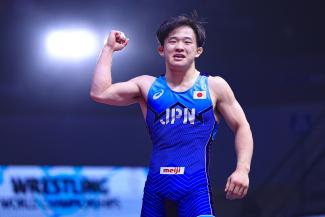

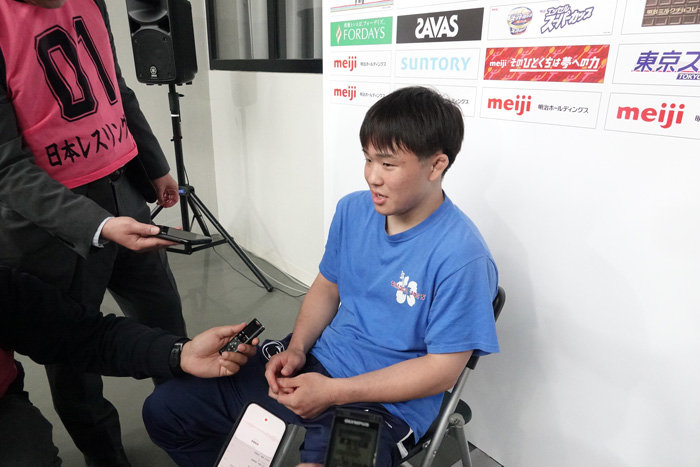 Masanosuke ONO (JPN) giving interview on the sidelines of the Meiji Cup. (Photo: wrestling-spirits.jp / Ikuo Higuchi)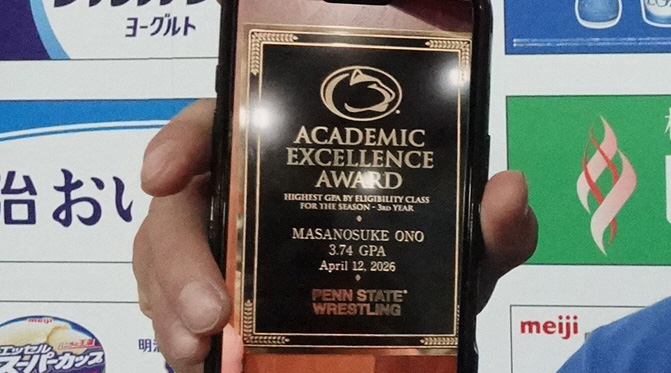
Share your thoughts.
Comments