

#JapanWrestling

Ex-Olympic medalist Ota continues mission of opening wrestling mat to those with Down syndrome

By Ikuo Higuchi

(Editor's Note: The following is an edited version of a two-part series that appeared on the Japan Wrestling Federation website on Jan. 18 with excerpts from previous stories. It has been translated and published by permission.)

"Through wrestling, society can be changed. Those with Down syndrome can be given courage by wrestling."

On the second floor of a non-descript building near Tokyo Dome in the heart of the city, the club members gathered in a small martial arts gym with a wall-to-wall mat to resume activities that, for some, date back to the start of the club in 2005.

Unavoidably suspended during the pandemic, the Waku-waku Wrestling Club -- specifically for those with Down syndrome -- was restarted in mid-January to central Tokyo, continuing the mission of its founder of enabling people with Down syndrome to become sharper physically and emotionally, and give them hope in life.

The club ("waku-waku" is an onomatopoeic expression of the feeling of excitement) is the lifework of Takuya OTA, the 1996 Atlanta Olympic bronze medalist at freestyle 74kg.  "It has become a part of my life," says the 53-year-old  Ota,  who, following a long stint as coach at Waseda University, is currently the head coach at Chuo University. "I get my power to go on from these kids."

The flame of Ota's interest in helping those with Down syndrome was ignited after being deeply moved by the book "Tatta Hitotsu no Takaramono (The One and Only Treasure)," a mother's account of raising a son with the disorder published in 2004. The book by Hiromi Kato was made into a TV drama, titled "The One and Only," which won the Asian Television Award for drama in 2005.

When Ota started the project, he was already working full-time coaching world-class competitors at Waseda, Japan's longest-running team. He had also launched the Waseda Club for kids, fueled by his determination to spread the word about the wonders of wrestling to as many people as possible.

According to the Mayo Clinic website, Down syndrome is a "genetic disorder" caused by abnormal cell division during gestation, with the resulting extra genetic material causing "the developmental changes and physical features of Down syndrome."

It affects 1 in 1,000 newborns and varies in severity. The website notes: "Better understanding of Down syndrome and early interventions can greatly increase the quality of life for children and adults with this disorder and help them live fulfilling lives."

After reading Kato's book, Ota began to think to himself, "How would it be if I had them try wrestling?" For those who are often neglected or ignored by society and suffer from uninformed biases, could not wrestling be a means to help give them more worth to their lives?

In July 2005, he started the first wrestling club specifically for this purpose, taking under his wing an inaugural group of six kids.

That's not to say there were no initial concerns. Children with Down syndrome are not on the same physical level as their healthy peers, and there were some whose spines might not hold up to the rigors of wrestling. Was wrestling something they could do? But there was no way to know until they tried, and Ota wanted to give them the chance.

And given the chance, they showed that they were able to move around just like the others. Not so much at first, but as they got used to it, they gained strength and confidence. They began to understand the rules and learned the techniques as Ota put priority on safety and stopped any potentially dangerous action.

Ota
Just like any wrestling practice anywhere in Japan, Coach Takuya Ota addresses the wrestlers before the start as the Waku-Waku Wrestling Club resumed in January for the first time since the start of the pandemic. (Photo: Japanese Wrestling Federation)

Getting big names involved

Perhaps no observers were more surprised, and overjoyed, by the success of the project than the parents. They could see their children who had mostly been kept out of sports getting exercise, having fun and, most importantly, building their self-esteem.

In 2017, reigning world champion and future Olympic gold medalist Yui SUSAKI was in her freshman year at Waseda when she offered her time to the Waku-waku Wrestling Club.

"I became aware Waku-waku Wrestling from the federation website and other sources," Susaki said. "I thought that after entering college, I wanted to be involved, so I participated joined the practices once a month as a coach. Everyone in Waku-waku has a pure love for wrestling, and each time it stimulated me as well," she added with a glisten in her eyes.

Yui SUSAKI (JPN)Future Olympic champion Yui SUSAKI and Beijing Olympic silver medalist Kenichi YUMOTO pose with two proud participants at the 2017 Waku-waku Waseda Cup. (Photo: Japan Wrestling Federation)

Also coming on board to help out was Kenichi YUMOTO, the 60kg freestyle silver medalist at the 2008 Beijing Olympics with deep connections to Ota -- they are both natives of Wakayama Prefecture and alumni of Nippon Sports Science University. Yumoto made his presence felt at practices, patiently teaching techniques.

The club continued unabated until the coronavirus pandemic hit the world in 2020, leaving no sport unaffected. Ota's contract had just ended at Waseda and he made the move to Chuo University, which is located in the western Tokyo suburb of Hachioji. That left the club without the wrestling room at Waseda, and combined with the pandemic, caused a halt to the operations.

The recent easing of pandemic restrictions in Japan allowed the club to restart, and Ota was fortunate to make arrangements for use of the martial arts gym near Tokyo Dome in Bunkyo Ward.  It was a special moment for everyone involved.

"People with Down syndrome are fundamentally averse to combative sports," he said. "But when they continue doing it, I find that their fighting spirit come out. I hear from parents, 'He's no longer timid' or 'He's become able to do things on his own.' I feel that the parents also sense that by wrestling, they have unlimited potential for personal growth."

While there were only five participants on that first day of restarting the club, the room was filled with a positive energy, from the smiles on their faces as they practiced moves to the way they proudly raised their hands when asked for sparring partners.

Among those taking the mat was 24-year-old Aruban Kubota, who was one of the original members of the club in 2005 as an elementary school first-grader. Kubota, whose first name is derived from his father's native country of Albania, is currently employed in a public welfare center.

"At first, he would always sit off to the side at practice," recalls his mother, Rimiko. "But before we knew it, he starting joining the group and would decide things by himself. He started acting on his own."

Rimiko says the wait for the club to restart seemed interminable. "I am so grateful to Coach Ota," she says.

In July 2009 , Ota, looking to give the members a chance to put their new-found skills to the same test as all wrestlers, organized the "1st Waseda Cup." Other clubs for Down syndrome kids had cropped up, mostly at the urging of Ota through his wrestling connections, and the tournament drew 29 entries from three clubs.

The tournament, which would later be renamed the "Waku-waku Waseda Cup" and gain sponsorship from a company employing former Waseda wrestlers, has drawn entries from children to adults in their 20s. The level continues to improve and, unlike in the early years when it was difficult for the participants to control their emotions, matches are no longer halted and can proceed smoothly.

"At first, our main objective was to just get them to be able to go out onto the mat by themselves," Ota said in an interview after the 2016 tournament. "Now, they understand the rules and can have what we would consider a regular match."

All participants receive a medal, but the highlight of the award ceremony is the selection of  the MVP and Fighting Spirit Award which come with a trophy. As Ota holds the microphone before making the announcement, the winners (who are eligible for MVP) watch him as if in prayer while the whole venue takes on a atmosphere of smiles.

Ota2A club member does a double-leg takedown drill as the others watch. (Photo: Japanese Wrestling Federation)

Aiming for the Special Olympics

As could be seen by the enthusiasm at the 2021 Tokyo Paralympics, sports is not the exclusive dominion of the able-bodied. People with Down syndrome or other intellectual disabilities are also making strides toward participating in sports.

In October 2020, an athletics competition solely for those with Down syndrome was held in Miyazaki in southern Japan, and earlier this year, a division for Down syndrome entrants was set up for the first time at a swimming meet in Chiba, east of Tokyo.

On an international scale, Virtus, an organization established for the development of elite sport worldwide for athletes with intellectual impairments, had judo on the program at the 1st Oceania/Asian Games held in November last year in Australia. Japan athletes took part, widening the scope of opportunities for those with Down syndrome.

Ota is also looking beyond Japan's shores. Ota's next goal is to get wrestling into the Special Olympics, which has a history of over 50 years and differs from the Paralympics in that it is specifically for those with intellectual disabilities. Currently, there are over 20 sports in the Special Olympics, including judo.

Ota has visited the headquarters in Washington, D.C., where he was told that for wrestling to be included, it was necessary for the sport to expand in Japan and for more countries around the world to start programs. As it is still evolving and not well-known in Japan, it marks a high hurdle to be cleared.

But he is undaunted. "Even if you have a disability, as long as there is a sport providing a stage to shine, one can have a big presence in society," Ota said.

--Translation and editing by Ken Marantz
#wrestlebishkek

Vintage Susaki in Asian final; Morikawa vs Zhumanazarova for 68kg Gold

By Ken Marantz & Vinay Siwach

BISHKEK, Kyrgyzstan (April 8) -- Yui SUSAKI (JPN) may have been away from the mat for over 20 months but she showed no signs of rust as she reached the Asian Championships final at 50kg in Bishkek on Wednesday. 

With two falls and a technical superiority win, it was vintage Susaki as she did not give up a single point in the three bouts. First up was Ziqi FENG (CHN), a fellow bronze medalist from 2024 Paris Olympics, and Susaki blocked an arm-spin attempt from Feng to score two points. As Feng landed on her back, Susaki kept her in the same position to secure the first fall.

NEELAM (IND) tried to challenge Susaki a few times in the quarterfinals but her attempted front headlock counters did not work and Susaki scored an 11-0 technical superiority win in 2:51. The semifinal was a similar story as Susaki pinned Maral TANGIRBERGENOVA (KAZ) in just two minutes.

Susaki scored a go-behind to open the scoring before a gut-wrench turn gave her a 4-0 lead. A sweep-single to takedown made it 6-0, and Susaki continued the sequence into an arm-bar to secure the fall.

"This is my first official UWW tournament in one year and eight months and I'm really happy to be back on this stage, and I'm filled with gratitude," Susaki said. "In my three matches, I was able to put out what I did in practice. Looking ahead to tomorrow's final, I think they were good matches."

The theme of the final will also be vintage as Susaki faces an opponent she last wrestled nine years ago. She will take on Son Hyang KIM (PRK) for the gold medal bout, a wrestler Susaki defeated 10-0 to win her first Asian gold aged 18 in 2017.

While she is focused on winning the gold medal on Thursday, Susaki is treating the Asian Championships as the launch pad for a newer version of herself.

"I'm here to start toward winning this year's World Championships and Asian Games, and then the Los Angeles Olympics. To face the DPR Korean and firmly win would establish my presence to the world," she said.

The new Susaki also includes a improved weight management, an issue she struggled with in the past. After the Paris Olympics, Susaki gave considerable thought to moving up to 53kg but as the 2025 Emperor's Cup approached in December, she decided to remain at 50kg, a weight in which she won Olympic gold in Tokyo.

"It's my first time to get down to 50kg overseas since the Paris Olympics," she said. "Since then, I've made some changes to my diet, and it was really smooth this time and I was able to maintain my strength. I could keep eating while dropping weight, so my condition is very good."

Susaki will have a chance to win her third Asian title on Thursday when she takes on Kim. 

A former world bronze medalist, Kim wrestled Aktenge KEUNIMJAEVA (UZB) in the other semifinal and scored an early takedown to open the scoring. She used a lace lock and twisted the Uzbekistan wrestler over three times for an 8-0 lead before the match hit the minute mark.

But Keunimjaeva, a three-time Asian bronze medalist, did not go down meekly, as she used a whizzer for a 4-point takedown at the edge to cut the lead in half before the break. Kim opened the second period with a duck under to a double-leg takedown to make it 10-4.

Two years ago in the Asian Olympic qualifying tournament in Bishkek, Keunimjaeva pulled off a miracle late comeback to beat Kim, and she nearly did it again. Locking Kim's arms, Keunimjaeva muscled Kim directly to her back for a 4-pointer in the last 20 seconds. But she failed to get the fall, and Kim got a late exposure for a 12-8 win.

In other semifinals, local stars Aiperi MEDET KYZY (KGZ) and Meerim ZHUMANAZAROVA (KGZ) both made it to gold medal bouts at 76kg and 68kg respectively.

After her close call in the quarterfinals, Medet Kyzy leaves no margin for error in storming to an 11-0 win over Hui Tsz CHANG (TPE) in pursuit of her third straight Asian gold and fourth overall. Medet Kyzy spins behind for the opening takedown, then hits two gut wrenches, then adds a 2-point exposure. When Chang tries to escape by going over the top, Medet Kyzy somersaults her over onto her back for the winning points that end the match in 1:04. An unsuccessful challenge of who-knows-what adds a final point.

Two-time Asian bronze medalist Davaanasan ENKH AMAR (MGL) enters her first-ever Asian Championships final after a 7-2 win over Gulmaral YERKEBAYEVA (KAZ). She got the first point for Yerkebayeva's passivity before a double-leg takedown to lead 3-0. As the clock ticked, Yerkebayeva tried a few fake attacks but missed them and Enkh Amar scored two counter takedowns to extend her lead to 7-0. Yerkebayeva scored a late takedown to cut the lead. 

68kg semifinals - Miwa MORIKAWA (JPN), wrestling her first Asian Championships at 68kg, into the finals after 7-0 victory over former world silver medalist Delgermaa ENKHSAIKHAN (MGL) in the semifinals. She started off with a point for Enkhsaikhan's passivity, then got a takedown when she was put on the activity clock. As the match progressed, Morikawa kept her pressure and scored two different takedowns on the edge to enter the final

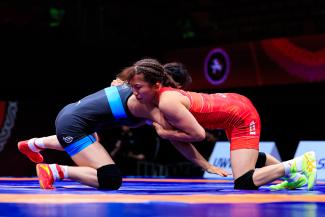
Two-time Olympic medalist Meerim ZHUMANAZAROVA (KGZ) ends the reign of defending champion Zelu LI (CHN) with a 1-1 victory, much to the delight of the home crowd despite the lack of technical points scored — Zhumanazarova came out on top by virtue of receiving the second of the two activity points. LI gets her activity point in the first period as neither wrestler can find an opening. In the second period, Zhumanazarova gets in on a single-leg takedown, but Li forces the situation to a stalemate. Li is then put on the activity clock, which puts Zhumanazarova up on criteria. In the final minute, Li twice launches an attack, but Zhumanazarova sprawls to safety to make the final for the first time since 2022.

59kg semifinals - Sena NAGAMOTO (JPN) becomes the third Japan wrestler to reach the final after a 10-0 blanking of Ulmeken ESENBAEVA (UZB) in the 59kg semifinals. She built a 6-0 lead in the first period before another takedown to start the second period to make it 8-0. A sweep-single takedown was her last move to complete a technical superiority victory.

Mengyu XIE (CHN), a former Asian champion looking to improve on her bronze medal from 2025, shrugs NEHA (IND) by and gets behind for an early takedown, to which she adds a gut-wrench. Neha comes back with counter roll for 2 from a front body lock, which the Chinese side unsuccessfully challenges, cutting Xie's lead to 4-3 at the break. A deep single-leg takedown and gut wrench by Xie makes it 8-3. When Xie shoots for a double, Neha locks her up again, this time spinning behind for a takedown, making it 8-5 with a minute to go. Neha twice tries to force Xie over with a front headlock roll, but each time, the Chinese resists and holds the Indian's back toward the mat for a pair of 2-point exposures and a 12-5 win.

55kg semifinals - World bronze medalist Sowaka UCHIDA (JPN) continues to dominate in her senior Asian debut, advancing to the final with a one-side 10-0 victory over Ariunzaya ODONCHIMEG (MGL). Uchida, who won world U17 and U20 titles in recent years but had never competed in a continental tournament, finishes off the match after a second takedown, locking Odonchimeg's arm and levering her over three times to end the bout in 1:33.

Uchida will face returning silver medalist Yuxuan LI (CHN) for the gold medal after the China wrestler completed a dominant 11-1 victory over Hansika LAMBA (IND). Li got on the scoreboard when Lamba was called passive in the first period. Li then tripped Lamba for a takedown and used two gut-wrenches to lead 7-0. Lamba tried getting a takedown but Li was quick to counter and scored a takedown before giving up a reversal for a 9-1 lead. She finished the match with a takedown 6 seconds before the clock expired.

Qualification Session Higlights

12:42: Gulmaral YERKEBAYEVA (KAZ) with an excellent fake attack to get a takedown against KAJAL (IND) to secure the win int the 76kg quarterfinals. Kajal led 3-1 when Yerkebayeva scored a stepout with 25 seconds left. Yerkebayeva managed a leg attack soon but let it go when Kajal fell forward to defend it. The Kazakhstan wrestler just jumped behind to get a takedown which stunned Kajal. Yerkebayev with a 5-3 win, as India challenged at the end and lost it.

12:37: Former world silver medalist Davaanasan ENKH AMAR (MGL) secures her spot in the 76kg semifinals with an 8-2 victory over Eunju HWANG (KOR). Leading 4-0, Enkh Amar gains two takedowns in the second period before Hwang gets on the scoreboard with a late takedown

12:35: Aiperi MEDET KYZY (KGZ), one of the host nation's top stars, avoided what would have arguably been the biggest upset of the tournament so far when she snatched a victory from the jaws of defeat in her 76kg quarterfinal with Wenji LI (CHN). Li, the 2023 Asian U23 champion at 72kg, was the dominant wrestler, using her double-leg takedown to build up a 6-2 lead deep into the second period. But there is a reason that Medet Kyzy is a three-time Asian champion and three-time world medalist. Just when it looked like all was lost, she shot in on a double, rose up to secure a bear hug, and tripped Li directly to her back in the final minute. That four points would have given her the win, but Li wasn't going anywhere and Medet Kyzy secured the fall with :29 left.

12:25: Two-time Olympic medalist Meerim ZHUMANAZAROVA (KGZ), looking for her first Asian gold to go with two bronzes and a silver, gets her campaign at 68kg started with an 11-0 win over Thi Linh DANG (VIE). Zhumanazarova is limited to two takedowns in the first period by the gutsy Dang, but after a second-period takedown, she ends the match with a 4-point takedown.

12:24: After a slow first period in which Yelena SHALYGINA (KAZ) got a point for Miwa MORIKAWA (JPN) passivity in their 68kg bout, Morikawa managed to score 10 points in the second to complete a victory over the Kazakhstan wrestler. A takedown and gut-wrenches is what Morikawa used to score her points.

12:16: Yui SUSAKI (JPN) uses her low single to deadly effectiveness in an 11-0 victory over NEELAM (IND) at 50kg that she completes eight seconds inside the first-period buzzer. Neelam did her best to counter Susaki's singles, but the Japanese star kept piling up the points in a four-takedown effort.

12:10: Son Hyang KIM (PRK) continues to impress at 50kg, hitting three gut wrenches after her second takedown to defeat Munkhnar BYAMBASUREN (MGL) 10-0 in 1:10 and advance to the semifinals

12:07: Sena NAGAMOTO (JPN), winner at the Zagreb Ranking Series who is making her senior Asian debut, gets off to a roaring start at 59kg with an 10-0 victory over Sezim ZHUMANAZAROVA (KGZ)

12:02: Former Asian champion and world bronze medalist Mengyu XIE (CHN) overwhelms two-time Asian medalist Bolortuya KHURELKHUU (MGL), scoring seven points in the first period and then ending the match in the second for an 11-0 win to advance to the 59kg semifinals

11:59: Rising star Sowaka UCHIDA (JPN), a 2025 world bronze medalist a year after winning the world U20 gold, storms to a 10-0 victory over Jeongbin OH (KOR) to secure her spot in the 55kg semifinals

11:58: Ulmeken ESENBAEVA (UZB), a multiple-time medalist at age-group Asian Championships, begins with a fall over Hyebin AHN (KOR) at 59kg.

11:56: Wenji LI (CHN) proves too powerful for Yasuha MATSUYUKI (JPN) in their qualifying round bout at 76kg, handing the Japanese squad its first loss by topping off two of her three takedowns with 2-point rolls in a 12-2 technical superiority win in 5:31

11:55: NEHA (IND), a former U20 world bronze medalist, starts with a fall over Viktoriia KHUSAINOVA (KAZ) at 59kg. She built a 6-0 lead before scoring a takedown and then used a cradle to secure the fall

11:53: An impressive start for last year's runner-up at 55kg, Yuxuan LI (CHN). After a stepout to get started against Aruuke KADYRBEK KYZY (KGZ), Li gains a takedown, then reels off four gut wrenches in succession for an 11-0 victory in just over a minute.

11:52: Five-time Asian medalist and 2023 world silver medalist Delgermaa ENKHSAIKHAN (MGL) scores two stepouts in the first period, the second with Svetlana OKNAZAROVA (UZB) on the activity clock, and adds two takedowns in the second before finishing the match with a 4-point takedown in the last seconds for an 11-0 victory at 68kg.

11:41: Yi Hui LIN (TPE) stuns Ngoc Linh DO (VIE) with a 4-point takedown with :16 left, then holds on for a 5-4 victory  at 50kg in the opening match on Mat B.

11:35: Son Hyang KIM (PRK), a world bronze medalist and Asian silver medalist way back in 2017, storms into the quarterfinals at 50kg with a 10-0 thrashing of Nipuni HEWA PEDIGE (SRI). Kim's most recent accomplishment was a silver at the 2023 Asian Games.

11:34: 53-second fall for Yui SUSAKI (JPN) in her first international match since the 2024 Paris Olympics! Susaki got Ziqi FENG (CHN) in her opening bout at 50kg, a rematch of the final from the 2024 Asian Championships final. Susaki tried two leg attacks but failed to covert them into points. Out of nowhere, Feng tried an arm-spin which was blocked by Susaki. Feng fell back first on the mat and Susaki kept the pressure to secure the fall!

11:30: After two days of exciting Greco-Roman in the morning, the Asian Championships will see Women's Wrestling on the mats. Local stars Meerim ZHUMANAZAROVA (KGZ) and Aiperi MEDET KYZY (KGZ) will be the favorites at 68kg and 76kg