

Homebound for Now, Susaki Never Wavers from Revived Quest for Olympic Gold
Wednesday, June 10, 2020 - 15:03 By Ken Marantz
TOKYO -- Having seen her Olympic dream all but crushed, and then suddenly revived through a twist of fate over which she had no control, Yui SUSAKI (JPN) knows she must take advantage of whatever opportunities life throws her way.
And if she has to wait another year to achieve her goal at the Tokyo Olympics, then she is going to look for the silver lining in the delay of her quest for gold.
"This is the first time for me to be away from wrestling for so long," Susaki said in an interview by email. "I really want to wrestle again as soon as possible. Even so, there is also the plus side that I can use this time to do image training while watching videos, and put together a training regimen for the parts where I am weakest."
In what area Susaki, who will turn 21 on June 30, has a weakness, or if she has any at all, might be up for debate, but the two-time senior world champion in the women's 50kg class does not want any more missteps along the way. Like the majority of the sports world, Susaki has spent the past month training at home, preparing for the day when she can get back on the mat.
There is a possibility that the National Training Center might be reopened following the lifting of the nationwide state of emergency by the Japanese government, but as of this writing, a definite date had not yet been decided. Susaki also cannot train at Waseda University, where she is a student and which has been closed since March.
So, limited to keeping in shape at her home in Chiba Prefecture, east of Tokyo, Susaki said she goes through two workouts a day of about an hour each. She runs three to five kilometers and exercises or weight trains in a local park or at home.
She does get a chance for some wrestling-oriented training. Her older sister Mai joins Yui to work on takedowns. Like their father Yasuhiro, Mai wrestled at Waseda, and once finished third at the Klippan Lady Open. "On the weekends when my sister is not working, we train together with takedown drills," Susaki said.
The family reunions are a welcome bonus as they deal with the societal effects of the crisis, which means an absence of contact with friends and teammates. For Susaki, it is the longest she has spent time with her family since she left home in the second year of junior high school to join the Japan Olympic Committee Elite Academy.
"To spend so much time with my whole family is really a fresh feeling and I'm really happy," Susaki said. "The time is so valuable. They look forward to seeing me perform on big stages like the Olympics and World Championships, and are with me through their support. This really hit me as we spend so much time together. My determination [for success] is also for my family."
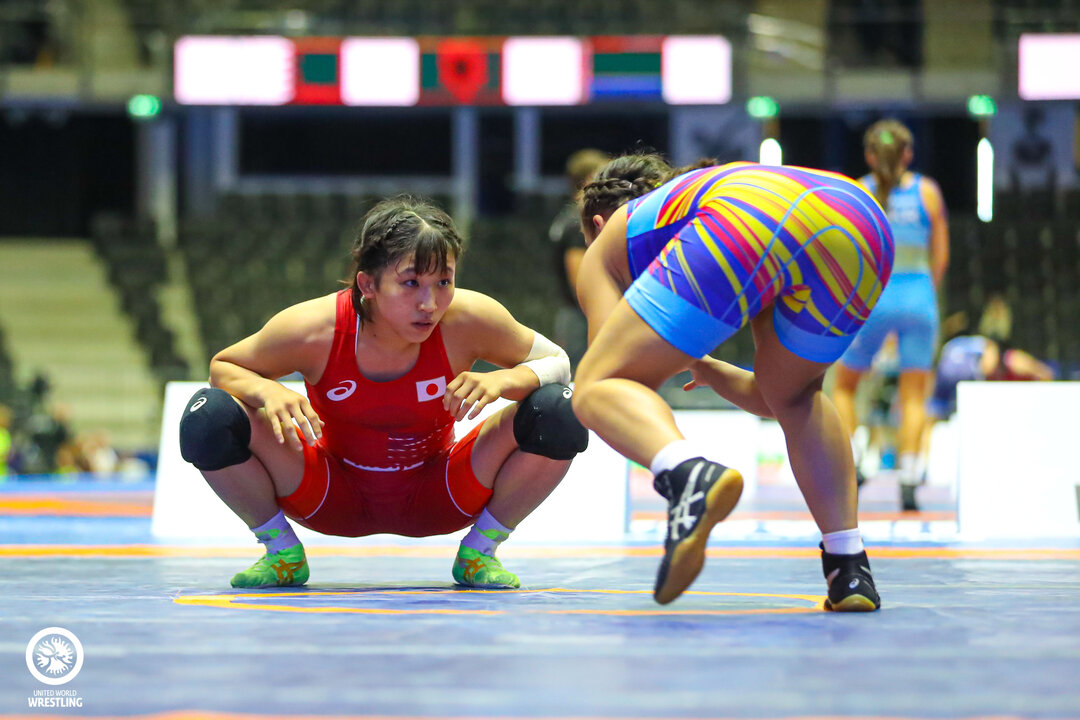 Yui SUSAKI (JPN) starts each match off in her patented low-level stance. (Photo: Kadir Caliskan)
In between her training sessions, Susaki participates in online classes at Waseda, where she is enrolled in the Faculty of Sports Sciences, which includes among its professors two-time Olympic freestyle medalist Akira OTA (JPN). It was significant that Susaki opted to follow in the family footsteps and enroll in Waseda instead of going to wrestling powerhouse Shigakkan University.
Shigakkan, previously known as Chukyo Women's University, has produced every Japanese Olympian in women's wrestling since it was added to the Olympic program at Athens 2004. That includes such luminaries as Saori YOSHIDA (JPN) and Kaori ICHO (JPN), and current stars Risako KAWAI (JPN) and Sara DOSHO (JPN), who will aim to defend the Olympic titles they won at Rio 2016.
Under the assumption that the Tokyo Olympics will be held as rescheduled in summer 2021, Shigakkan's monopoly will end as world 76kg silver medalist Hiroe MINAGAWA (JPN), who competed collegiately at Ritsumeikan University, has already clinched her place on the Japan squad.
For Susaki to join her, she needs to first secure a place at the Asian Olympic qualifying tournament, currently set for Xi'an, China, in March 2021. At the time that she won the 50kg title at the All-Japan Championships in December last year to earn the right to enter the qualifier, she had two months to prepare. Little did she or anyone else know that it would stretch to 15 months after first being moved out of China then postponed altogether.
"It was very difficult to prepare myself for the competition under the circumstances where we didn't know if it would be held or not," Susaki said. "When it was postponed a year, I thought about the positive side, as it gives me another year to get stronger. From now, I will get stronger."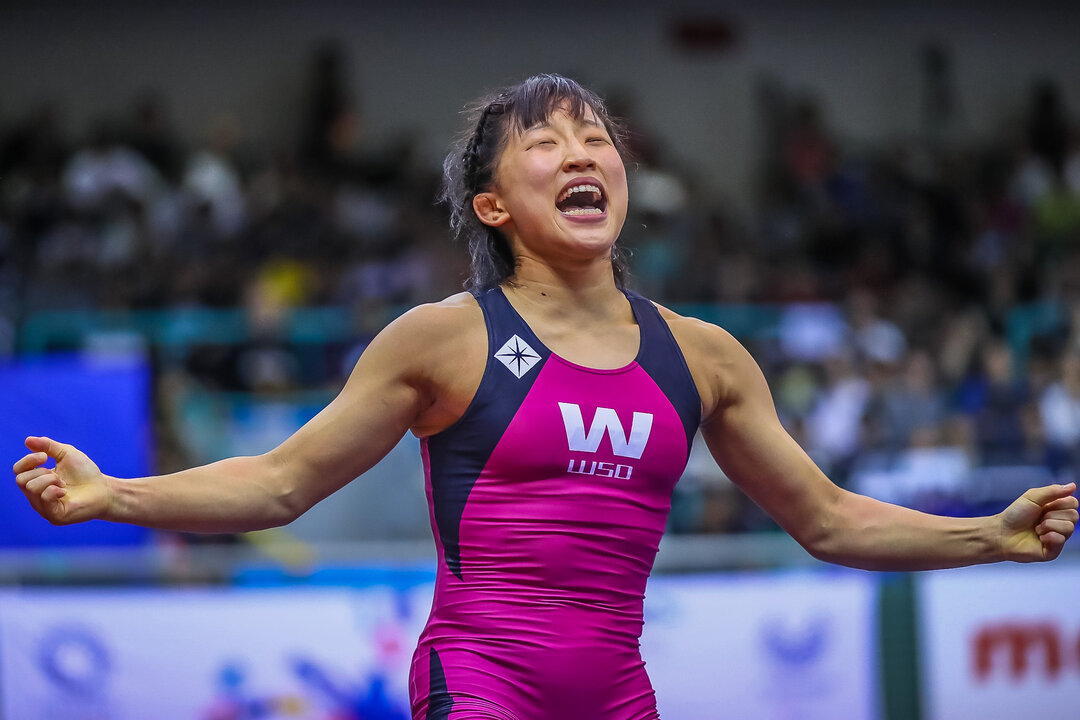 Yui SUSAKI (JPN) celebrates after defeating rival Yuki IRIE (JPN). (Photo: Sachiko Hotaka)
A 0.01 Percent Chance
That Susaki will be taking the mat in Xi'an, barring injury or other unforeseen circumstances, is a testament to the unpredictability of sports.
Susaki's Olympic dream appeared to be shattered when she lost a playoff to nemesis Yuki IRIE (JPN) for a place on the team to the World Championships in Nur-Sultan last September. That held major significance, as an expected medal in the Kazakh capital would have clinched a place at the Tokyo Olympics for Irie, the only wrestler in the world who has beaten Susaki since elementary school.
But Irie suffered a heartbreaking 13-12 loss in the quarterfinals to Rio 2016 bronze medalist SUN Yanan (CHN). Then, more significantly for Susaki and her fans around the globe, Sun was beaten by eventual champion Mariya STADNIK (AZE) in the semifinals--knocking Irie out of a place in the repechage and a chance for a bronze medal.
Susaki had continued practicing, taking to heart her coach Shoko YOSHIMURA's words that "if there is still a 0.01 percent chance, you have to keep fighting."
"I had practice at the time, so I didn't see the match between Sun Yanan and Irie in real time," Susaki said. "I did see the match between Sun Yanan and Mariya Stadnik."
That unlocked the door to the Olympics, but to open it up, she first had to make it to the Asian qualifier. And to do that, she had to beat Irie--and Rio 2016 gold medalist Eri TOSAKA (JPN), for that matter--which she did with a razor-thin 2-1 victory in the final at the All-Japan, also known as the Emperor's Cup.
"I went into the match against Irie at the Emperor's Cup regarding myself as the 'challenger'," Susaki said, adding that she told herself, "'This is your last chance. Definitely make this yours and get to the Tokyo Olympics.' That feeling was so strong.
"When I lost in the playoff, I was confused and lost confidence in myself. But making use of that time, I was able to compete confidently at the Emperor's Cup, for all of the people who believed in me and supported me as well as myself."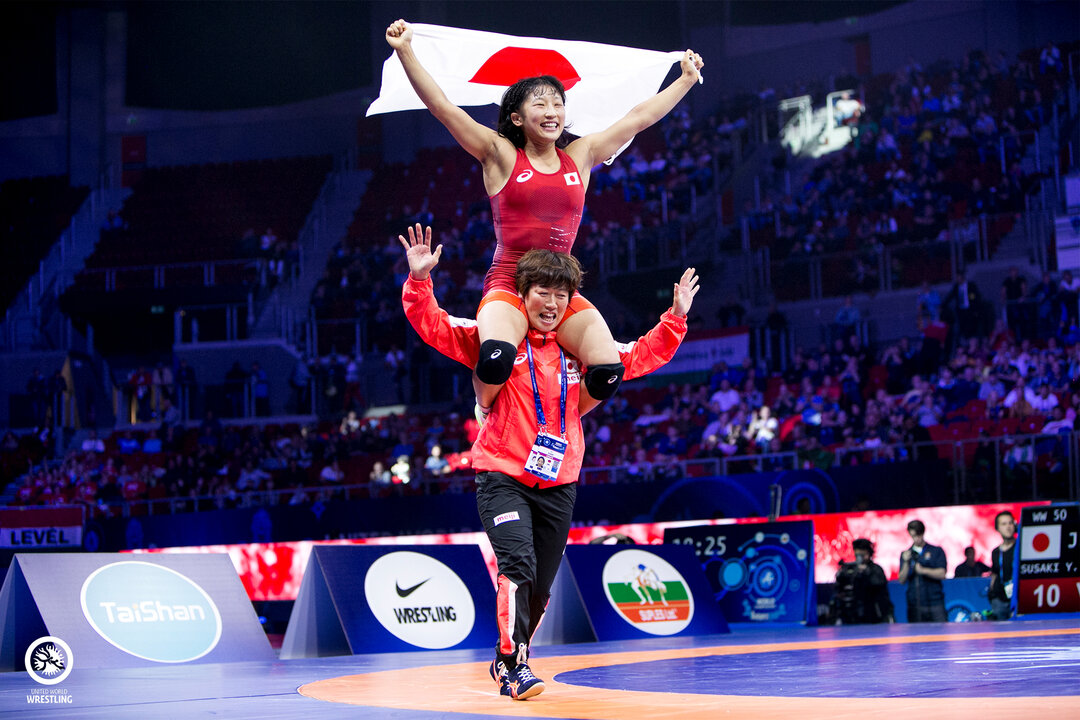 Yui SUSAKI (JPN) celebrates with her coach after winning her second consecutive senior-level world title. (Photo: Gabor Martin)
Success Comes Early, Often
Her Olympic aspirations began burning not long after Susaki started wrestling as an elementary school first-grader at the local Matsudo Junior Wrestling School. By third grade, she had her first age-group national title and began dreaming of emulating Yoshida and win an Olympic gold.
The next year in 2009, she lost in the fourth-grade 26kg final to future world junior champion Saki IGARASHI (JPN)--Susaki would not lose again until 2015--but came back to take the national crowns in fifth grade and sixth grade.
Success continued in junior high school, where she won both of the major national titles all three years and never tasted defeat. She also made her mark on the global stage, winning cadet titles at the Klippan Lady Open three years in a row, and the first of three consecutive world cadet golds.
In her second year of junior high school, she was recruited to join the JOC Elite Academy under Yoshimura, a former five-time world champion who still mentors her today.
Asked what sets Susaki apart from other top wrestlers, Yoshimura said, "The skill and physical strength to achieve a goal cannot be gained without having the will. Since she has a strong will and the energy, she can increase the amount of practice, effort, and training. She thinks of a methodology for applying various things to wrestling."
Moving on to high school, Susaki followed up her victory at the 2015 world cadet by making the final in her debut at the Emperor's Cup. In the gold-medal match, she was dealt the first of three career losses by Irie, who rolled to a 10-0 technical fall. That ended an 83-match winning streak dating back to her first year of junior high school and not including elementary school, although she came back the next year to win her first All-Japan title.
In 2017, she made the jump directly from cadet world champion to senior world champion, winning the 48kg gold in Paris, which made her the first high schooler to win a world title since Icho in 2002. That year began and ended in vastly different ways, as she won at the Yarygin Grand Prix in her senior debut, but lost to Irie in the Emperor's Cup semifinal, snapping a 63-match winning streak.
Entering Waseda in April 2018, she beat Irie at the All-Japan Invitational Championships, then again in a playoff to earn a ticket to that year's World Championships in Budapest, where she manhandled Stadnik in the 50kg final for her second straight gold. That victory came a little over a month after she added a world junior title to her collection.
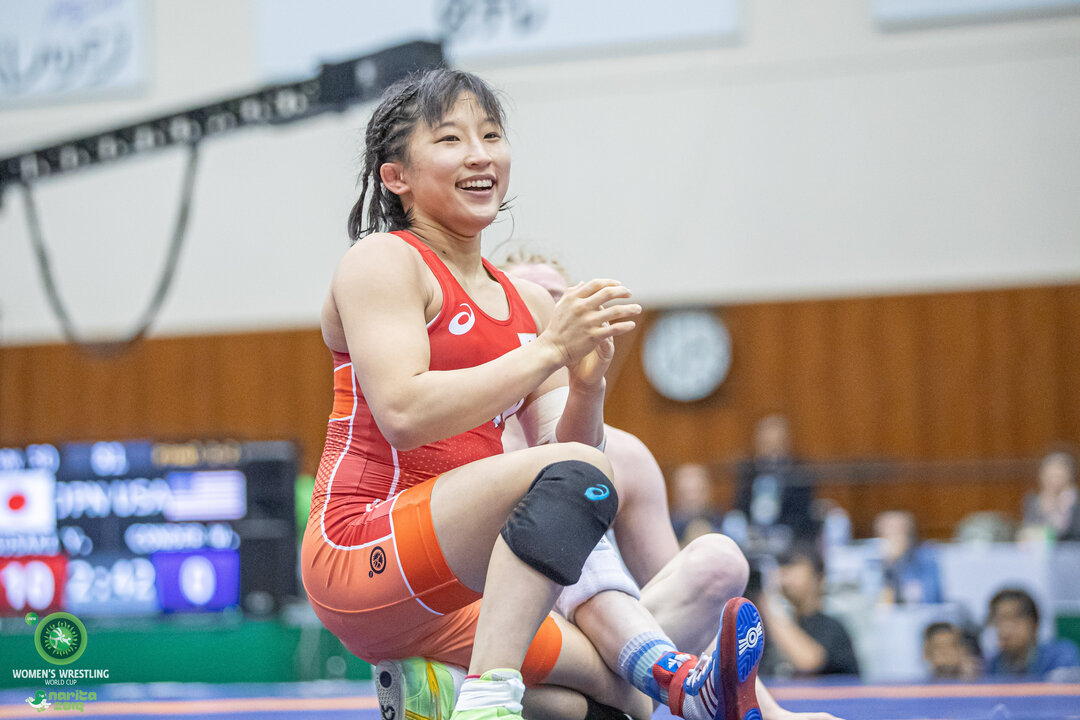 Yui SUSAKI (JPN) smiles after a win at the '19 Women's Wrestling World Cup. (Photo: Sachiko Hotaka)
The Joy of Wrestling
In the video of her rout of Stadnik, the American commentator made this observation of Susaki: "She absolutely loves wrestling. When you see her wrestle, she smiles, she's really enjoying it, she's having fun, she's relaxed out there."
Asked if this was an accurate assessment, Susaki confirmed that it was.
"Yes, it's accurate," she said. "I really love wrestling and always enjoy being in a match. It's fun for me when I get the most out of my abilities to win a gold medal at the World Championships or I defeat a powerful opponent.
"I get nervous before a match, but I know the effort I made preparing for the match, and how hard I practiced for the purpose of winning. I go into the match in the spirit that, 'I know I am OK. Now just put everything into enjoying the match.'"
Susaki's fierce determination and bubbly personality has endeared her to fans both at home and abroad. Given the chance to address her international fans in this UWW story, Susaki wanted to convey her gratitude for their support, and encourage them to continue efforts to overcome the pandemic.
"I am very happy to all my fans around the world and am grateful from the bottom of my heart," she said. "They encourage me when I lose, and they share the joy when I win. Thanks to all of the fans, I have able to do my best.
"Right now, the coronavirus has caused a serious crisis around the world. We can all pull together to get through this and look forward to the day when we can wrestle again and have matches again. I'm going to do everything I can to make progress and again give everyone a good show on the world stage."
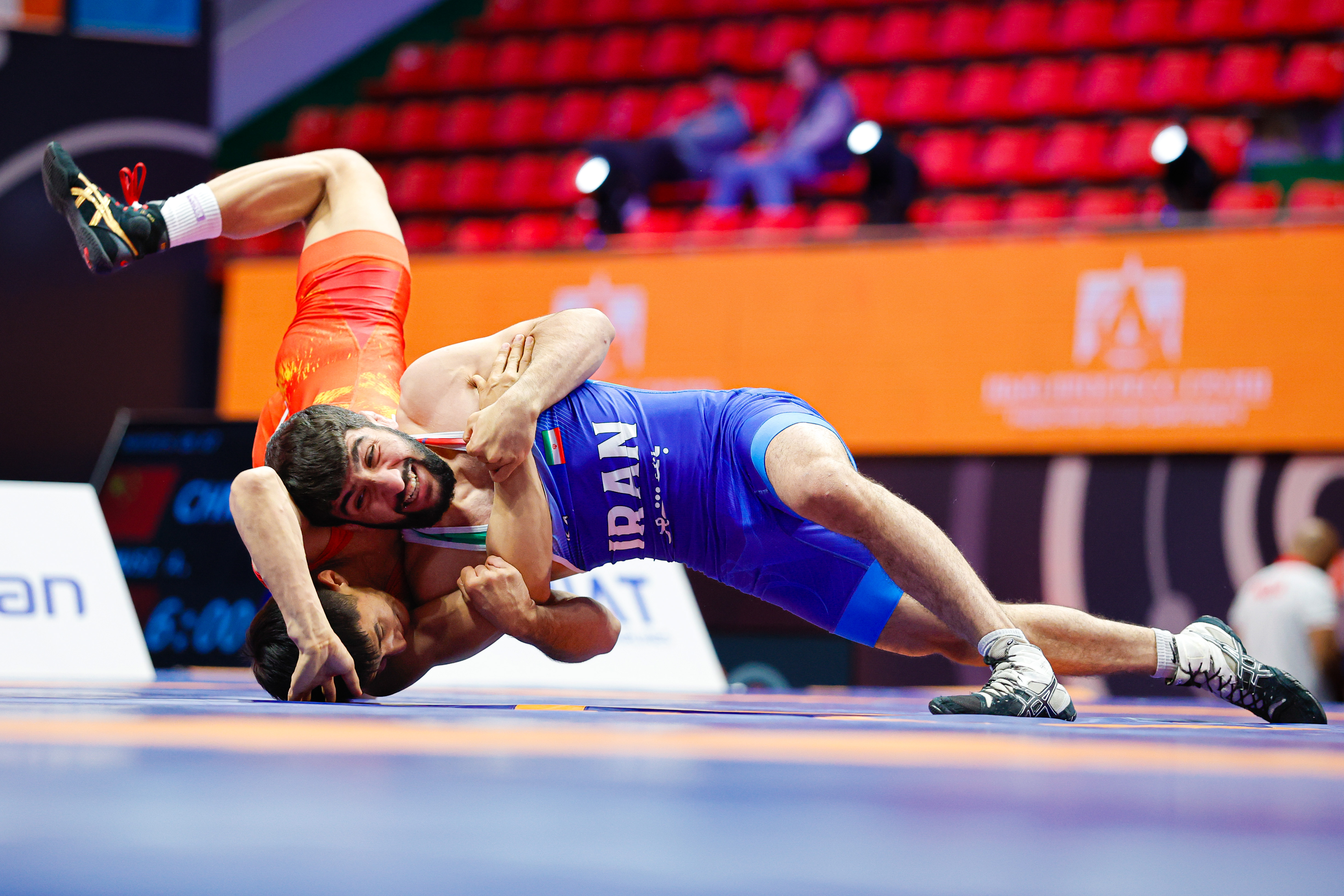 Payam AHMADI (IRI) blanked his opponents 33-0 in four bouts in Ulaanbaatar. (Photo: United World Wrestling / Kostadin Andonov)
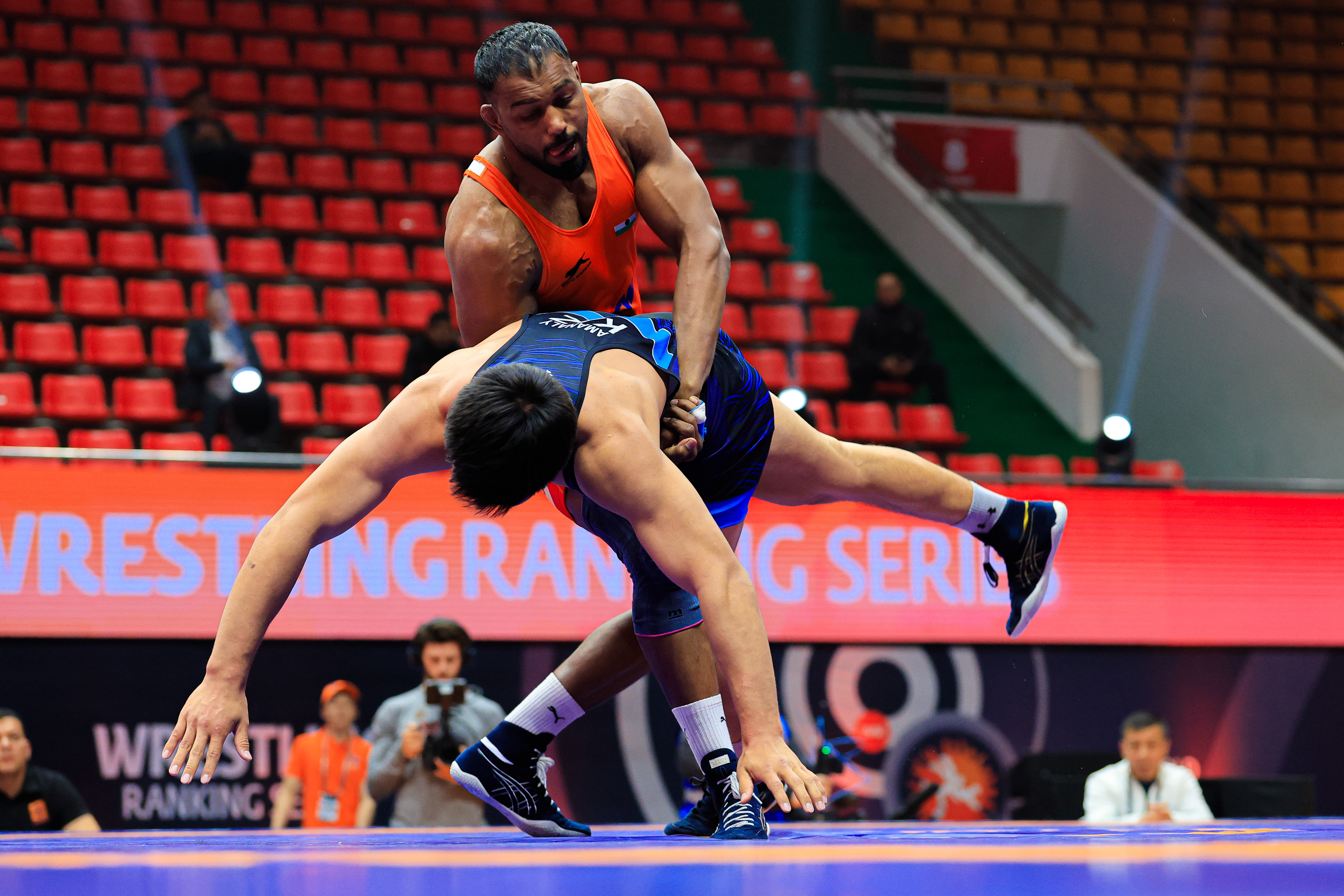 NITESH (IND) throws Nurassyl AMANALY (KAZ) during the 97kg final in Ulaanbaatar. (Photo: United World Wrestling / Kostadin Andonov)
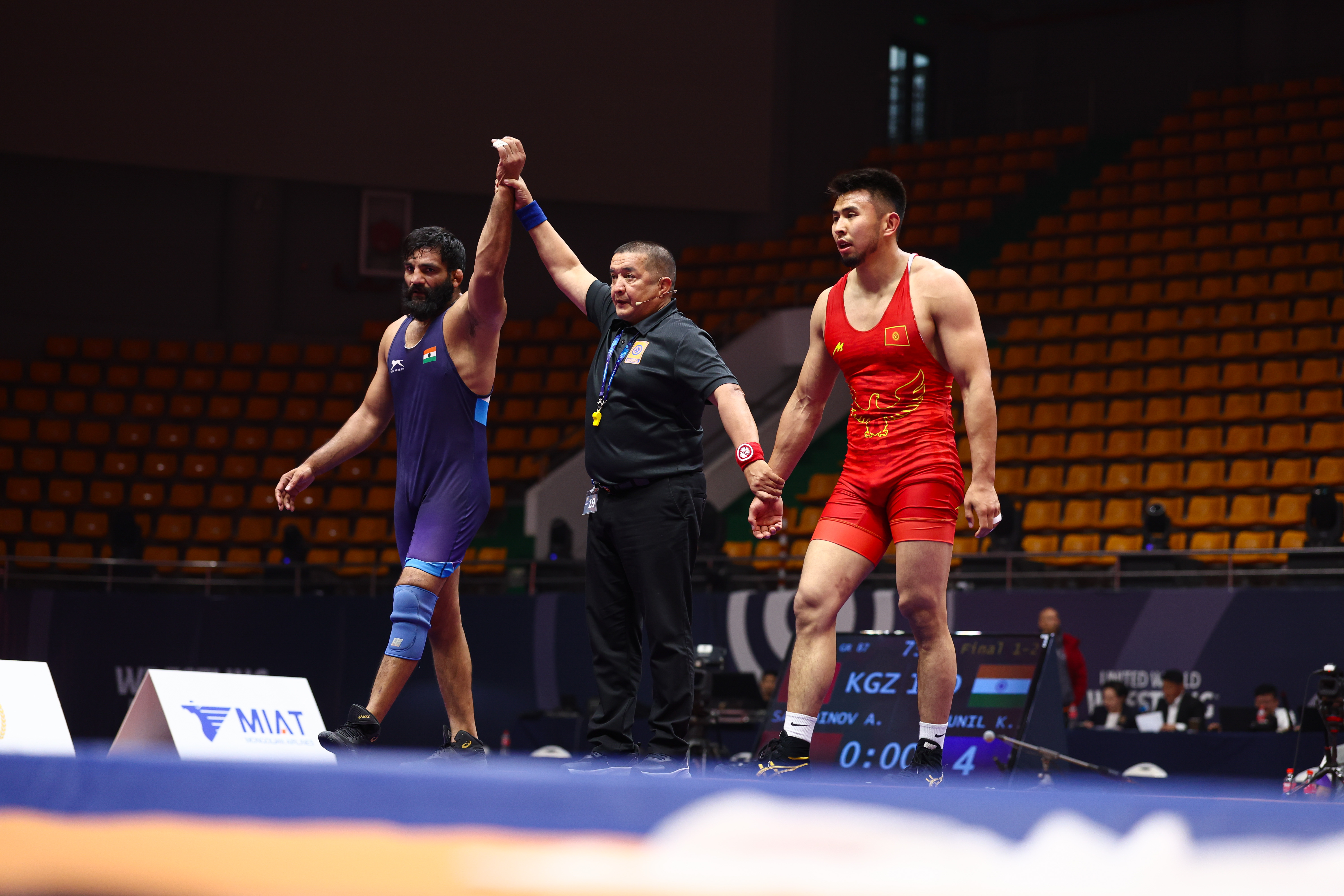 Sunil KUMAR (IND), blue, won the 87kg gold medal at the Ulaanbaatar Open. (Photo: United World Wrestling / Jake Kirkman)
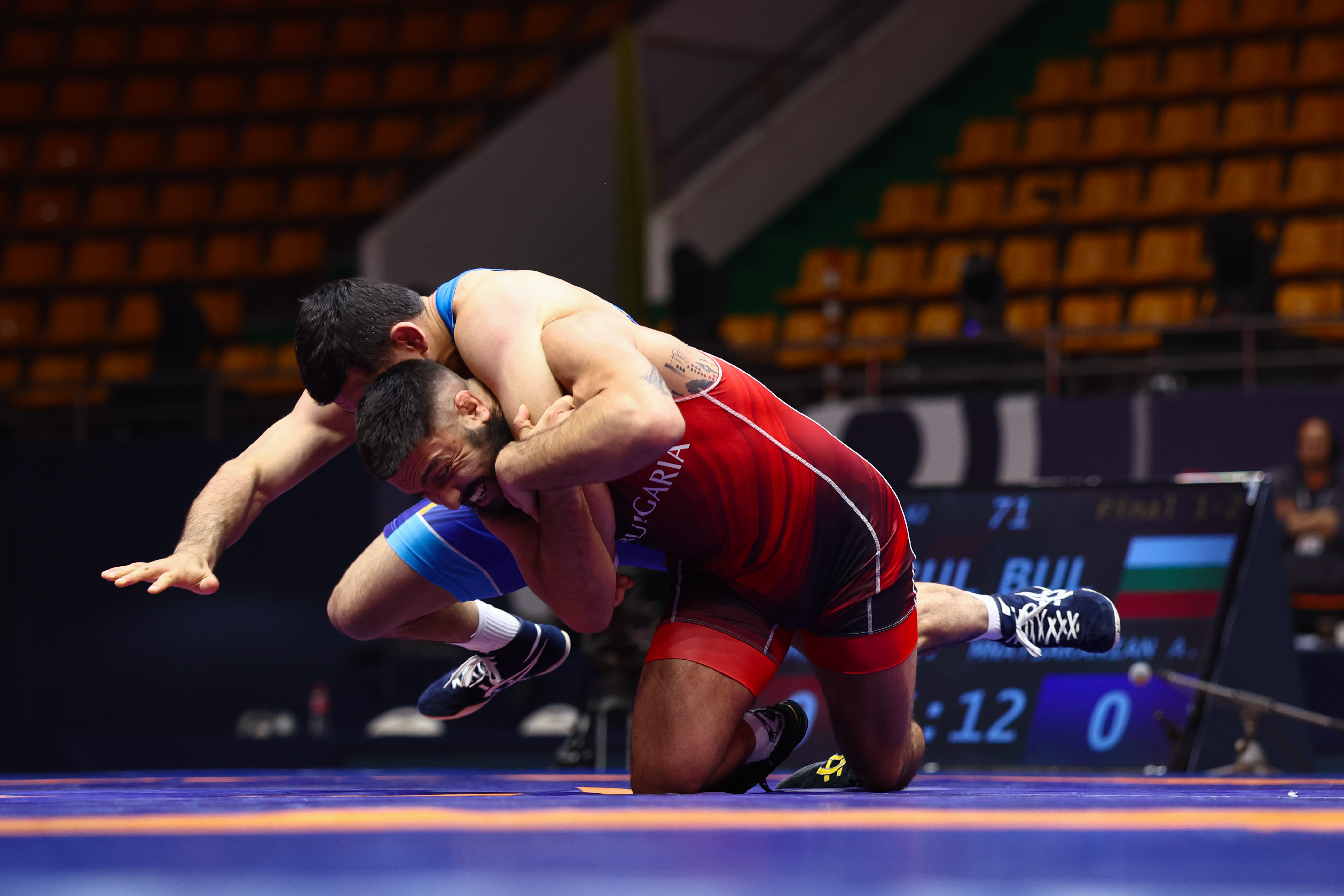 Deyvid DIMITROV (BUL) scores four points on Aik MNATSAKANIAN (BUL) using an arm throw during the 82kg final. (Photo: United World Wrestling / Jake Kirkman)
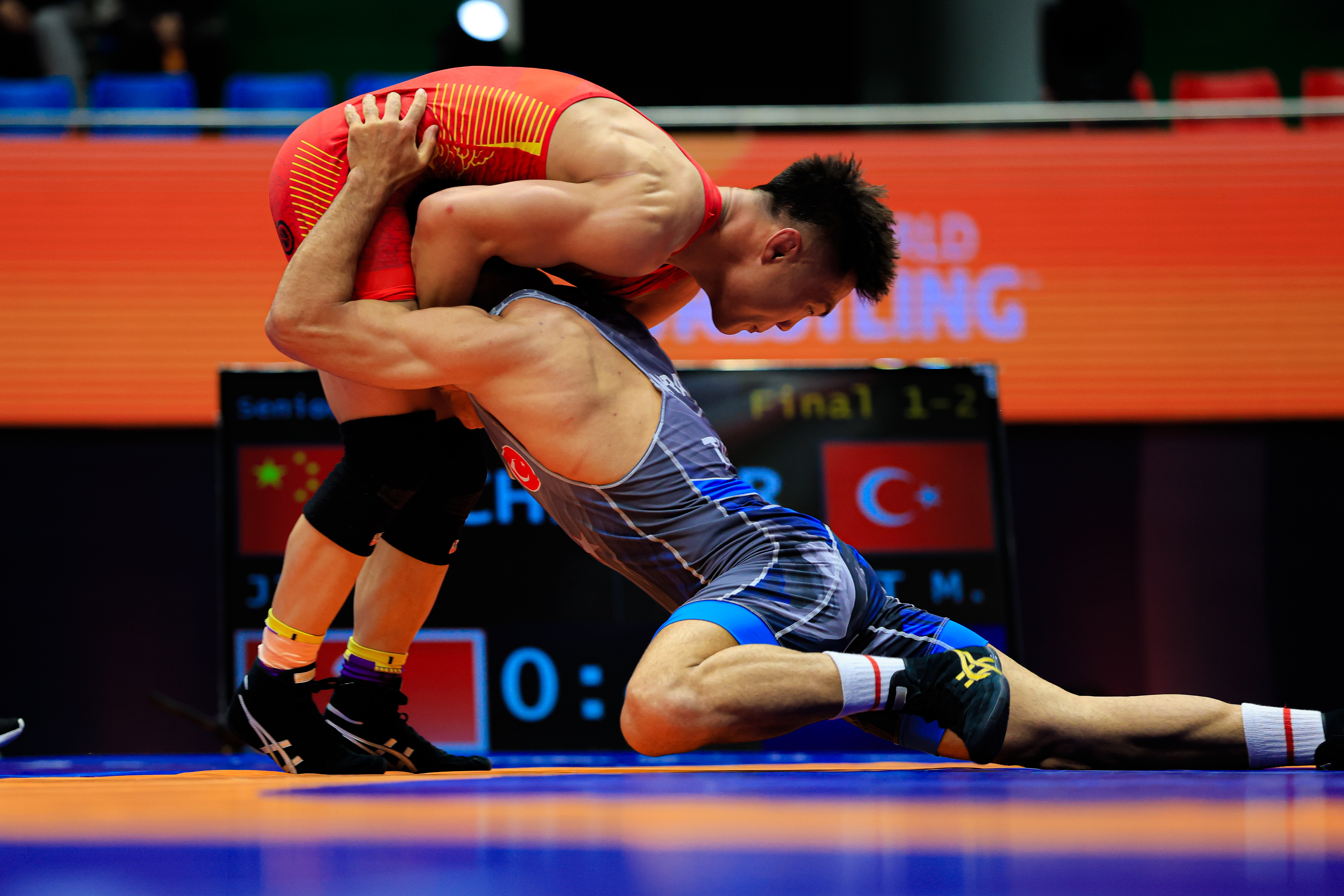 Xinxin JIN (CHN) sets up a counter throw from the edge against Murat FIRAT (TUR) during the 67kg final at the Ulaanbaatar Open. (Photo: United World Wrestling / Kostadin Andonov)
Share your thoughts.
Comments