

Narikuni Finally Joins Former Kids Club Teammates as National Champion
Thursday, December 16, 2021 - 16:23 By Ken Marantz

TOKYO, Japan (December 16) -- Above the bandage covering the two stitches he received on the top of his head, Taishi NARIKUNI now finally wears the metaphorical crown of national champion that had already been won by so many of his former kids wrestling club teammates.
"It took a long time, and I went through a lot," said Narikuni, after winning the freestyle 70kg title on Thursday at the Emperor's Cup All-Japan Championships, the first of two domestic qualifiers for next year's World Championships in Belgrade.
Narikuni, who had to overcome a blip in his career caused by a combination of bad luck and his own carelessness, defeated Hikaru TAKATA 7-3 in the final as champions were crowned in eight weight classes across all three styles on the opening day of the four-day tournament at Tokyo's Komazawa Gym.
Narikuni's victory coincided with that at 97kg by Takashi ISHIGURO, who got his start in the sport alongside Narikuni at the Tokyo-based Gold Kids club run by Narikuni's mother -- a two-time former world champion. Ishiguro picked up his second national title.
In other action, former world cadet and junior champion Yuka KAGAMI reestablished herself as the nation's premier women's heavyweight by defending her 76kg crown, while MASATO SUMI avenged a loss in last year's final at Greco 87kg to take his fifth career gold medal.
Although the daily infection rate is well down in Tokyo, the tournament is being run under strict coronavirus protocols, with no spectators or family allowed, and entries limited to a maximum of 12 per weight class. Each division is completed in one day, and there is no repechage and only one bronze-medal match.
For unannounced reasons, none of Japan's medalists from the Tokyo Olympics are taking part, although 11 of the nation's 12 medalists from the World Championships in Oslo are in attendance.
 (From left to right) Taishi Narikuni, Takashi Ishiguro, Hayato Ishiguro and Narikuni's mother, Akiko (sitting). (Photo: Tateo Yabuki / Japan Wrestling Federation)
The 24-year-old Narikuni was a high-flying national collegiate champion when his career took a dark twist in 2017. He was slapped with a two-year doping ban after a doctor mistakenly prescribed a cold medication containing a banned substance.
Although the ban ended, he did not return to competition in earnest until last May at the Meiji Cup All-Japan Invitational Championships, which is the second domestic qualifier for the World Championships. He placed third there, giving him a boost of confidence that he could still be competitive at a high level.
Perhaps a bit too much confidence, as Narikuni declared at the time a lofty goal of winning world golds in both freestyle and Greco, akin to making him the "Shohei Ohtani of wrestling," a reference to the Japanese baseball star known for his ability to be both a pitcher and slugger.
Narikuni takes a somewhat unique stance when it comes to training---he barely wrestles. Currently, when he is not at his part-time job at a karaoke parlor, he's a coach at Gold Kids, where he mentors youngsters in tumbling and apparatus as well as wrestling.
Since the Meiji Cup, his workouts consisted solely of weight training, running and light sparring with the kids. He did not participate in live wrestling until 10 days before the Emperor's Cup, including sessions with his pal Ishiguro, who was also a junior high school classmate.
"We practiced together from about a week ago," Narikuni said. "It really rubbed off on me."
Even with the big weight difference between the two, "It was a great workout. It's because of that that I won."
Narikuni said he never feels he has lost any sharpness by lack of live wrestling.
"I've been doing it since I was little," he said. "It's ingrained in my body. And also, I coach kids, and I roll around with them. So my body remembers the moves."
Those moves were first developed in the club started by his mother, who won world titles in 1990 and 1991 under her maiden Akiko IIJIMA. Among the notable alumni of the club are Tokyo Olympic champion Takuto OTOGURO, world bronze medalist Toshihiro HASEGAWA, and Ishiguro's younger brother Hayato, a 2018 world junior champion who last year won his first national title at 86kg.
"It was frustrating, I mean, really," Narikuni said of watching those he grew up having such success. "Even Hayato won a title. Other kids I was with at Gold, they're all winning championships, going to the Olympics. To be honest, I felt I was left behind."
For now, Narikuni is catching up and is halfway to getting to the World Championships, although he said he still has a ways to go before he can have success there. In the final, Narikuni saw a 5-1 lead against Takata trimmed to two points by giving up a takedown with a minute to go, although a late takedown off a counter gave him the 7-3 win.
"In terms of execution, I give it a zero," Narikuni said. "I'm happy that it's my first title, but honestly speaking, with this performance I can't beat the world, so the joy is honestly not there."
Narikuni ended the match in actual pain. In the final seconds, he suffered a gash when his head collided with Takata's teeth, and he needed two stitches from the tournament doctor before his post-match press conference.
Asked what he needs to be a world-beater, the Tokyo native replied, "Everything, the mental side, the physical side. I'm really not there."
 Takashi Ishiguro won the gold at 97kg. (Photo: Tateo Yabuki / Japan Wrestling Federation)
Takashi Ishiguro, who won his first national title at 92kg in 2017, picked up his second by overwhelming national collegiate champion Keiwan YOSHIDA 10-0 in the 97kg final.
Ishiguro opened the scoring with a nifty ankle pick, then picked up four points with a double-leg tackle to the back. Two quick rolls after that and the match was ended at 2:34.
For those in the Olympic weights, the tournament is also serving as the qualifier for the Asian Games, to be held in September in Hangzhou, China. That might present a problem for the Japan federation, as it falls during the week after the World Championships, and it's unknown what wrestlers who qualify for both will do.
Ishiguro, who competed at this year's World Championships in Oslo, where he lost in the first round to superstar Abdulrashid SADULAEV (RWF), relishes the chance to prove himself on the continent after placing third at the Asian Championships last April.
"If I can't be competitive in Asia, I can't fight against the world," Ishiguro said. "I want to have the ability to take on Iran and Mongolia."
The other freestyle gold up for grabs on Thursday went to Taiki YAMAMATO, who won his second straight title and fourth overall with a close 3-2 victory over Hiroto NINOMIYA in the 125kg final.
Yamamoto, nursing a 2-0 lead after receiving two activity points, gave up a takedown with just under a minute left to fall behind on criteria, but came right back with a stepout point with :46 left for the victory.
 Yuka Kagami won the gold at 76kg over Nodoka YAMAMOTO. (Tateo Yabuki / Japan Wrestling Federation)
At women's 76kg, Kagami proved golden again by scoring a second-period takedown to notch a 2-2 win in the final over unheralded Nodoka YAMAMOTO.
"I was focused on staying aggressive, and I gave up points from my attack, but I never lost faith and kept up the attack in my style of wrestling to the end, and I think that's what led to this result," Kagami said.
Kagami said it was frustrating to watch the success of the Japanese women at the Tokyo Olympics, where the hosts won four of the six golds, but also motivated her to have similar success at Paris 2024.
"Seeing the Japanese wrestlers do so well invigorated me, but at the same time, I was gritting my teeth to the fact that I was not among them," Kagami said. "I want to definitely appear at the Paris Olympics and, to become the first Japanese in the heaviest [women's] weight to win a gold medal, I will dedicate myself to training from now."
Yamamoto had prevented the latest showdown between Kagami and rival Yasuha MATSUYUKI, who defeated Kagami a little over a month ago at the national collegiate championships. The 18-year-old Yamamoto knocked off Matsuyuki, her senior teammate at Shigakkan University, 2-1 in the semifinals.
The clash between Kagami and Matsuyuki, both former world cadet champions, at the college championships was the fourth meeting in a one-year span as they vie to fill the shoes of retired three-time world medalist Hiroe MINAGAWA.
"Since I had little time to practice after the inter-collegiates, I think this is the best I could do at this point," said Matsuyuki, who has been plagued with a knee injury dating back to July.
Matsuyuki said she may have subconsciously been looking past Yamamoto to a clash with Kagami. "I didn't have it that much in mind, but I might have thought that way unconsciously," she said.
At women's 59kg, 2018 Asian silver medalist Sara NATAMI took advantage of the absence of world silver medalist Akie HANAI and won her second career national title with a 10-0 technical fall over Himeka TOKUHARA.
In Greco-Roman, Sumi turned the tables on his Japan Self-Defense Forces teammate So SAKABE, avenging a loss in last year's final at 87kg by scoring a 5-1 victory in the final.
Put in the par terre first, Sumi took full advantage by powering Sakabe over with a pair of gut wrenches. Taking the bottom position in the second period, Sumi wriggled free of danger to secure the victory.
The title provides some consolation for Sumi, a 2018 Asian silver medalist who failed in two shots to qualify for the Tokyo Olympics.
"This year was the Tokyo Olympics, and I was sent as the Japan entry to the Olympic qualifiers, but unfortunately I was unable to secure a place, which was a shameful result," Sumi said.
"After that, I came back to Japan and it was very frustrating to watch the Tokyo Olympics. I set a goal to be ready in December for this tournament and it's good that I could win it."
Sakabe advanced to the final with a 4-1 victory over Satoki MUKAI, last year's 82kg champion who won a bronze medal at this year's Asian Championships.
Kodai SAKURABA, who finished eighth at the Oslo World Championships at 77kg, picked up his first national title with a 10-4 victory over collegiate champion Nao KUSAKA.
Kusaka was looking to add to the 72kg gold he won in 2019, which had made him the youngest national Greco champ in history.
At 82kg, Yuya OKAJIMA filled the gap left by Mukai and regained the title he won in 2018 by scoring a pair of takedown-gut wrench combinations in an 8-0 technical fall over Masao TANAKA.
Day 1 Results
Freestyle
70kg (12 entries)
Final - Taishi NARIKUNI df. Hikaru TAKATA, 7-3
3rd Place - Ryosuke KERA df. Ryo YONEZAWA, 3-3
Semifinal - Narikumi df. Yonezawa by TF, 11-0, 5:07
Semifinal - Takata df. Kera, 3-2
97kg (6 entries)
Final - Takashi ISHIGURO df. Keiwan YOSHIDA by TF, 10-0, 2:34
3rd Place - Shohei YAMASAKI df. Yohei SHINADA, 5-0
Semifinal - Ishiguro df. Shinada by TF, 11-0, 1:21
Semifinal - Yoshida df. Yamasaki, 9-7
125kg (10 entries)
Final - Taiki YAMAMATO df. Hiroto NINOMIYA, 3-2
3rd Place - Kai SHUTTO df. Sota YAMAMOTO, 4-2
Semifinal - T. Yamamoto df. Shutto, 3-0
Semifinal - Ninomiya df. S. Yamamoto by TF, 10-0, 1:40
Greco-Roman
77kg (11 entries)
Final - Kodai SAKURABA df. Nao KUSAKA, 10-4
3rd Place - Minto MAEDA df. Shunsuke MIZUGUCHI by TF, 9-0, 2:18
Semifinal - Sakuraba df. Mizuguchi by TF, 10-1, 2:50
Semifinal - Kusaka df. Maeda, 4-1
82kg (12 entries)
Final -Yuya OKAJIMA df. Masao TANAKA by TF, 8-0, 3:36
3rd Place - Yoji KAWAMURA df. Tatsuya FUJII, 3-1
Semifinal - Tanaka df. Kawamura, 5-3
Semifinal - Okajima df. Fujii, 2-2
87kg (11 entries)
Final - Masato SUMI df. So SAKABE, 5-1
3rd Place - Satoki MUKAI df. Ryota NASUKAWA, 5-3
Semifinal - Sumi df. Nasukawa, 8-1
Semifinal - Sakabe df. Mukai, 4-1
Women's Wrestling
59kg (10 entries)
Final - Sara NATAMI df. Himeka TOKUHARA by TF, 11-0, 4:18
3rd Place - Yumeka TANABE df. Yumi KON by TF, 10-0, 5:00
Semifinal - Natami df. Kon by TF, 10-0, 3:17
Semifinal - Tokuhara df. Tanabe, 3-3
76kg (5 entries)
Final - Yuka KAGAMI df. Nodoka YAMAMOTO, 2-2
3rd Place - Miku SAITO df. Yasuha MATSUYUKI by Def.
Semifinal - Yamamoto df. Matsuyuki, 2-1
Semifinal - Kagami df. Saito by TF, 11-0, 1:45
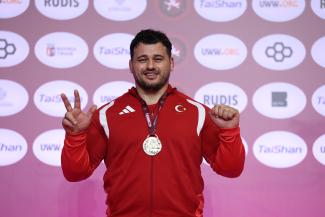
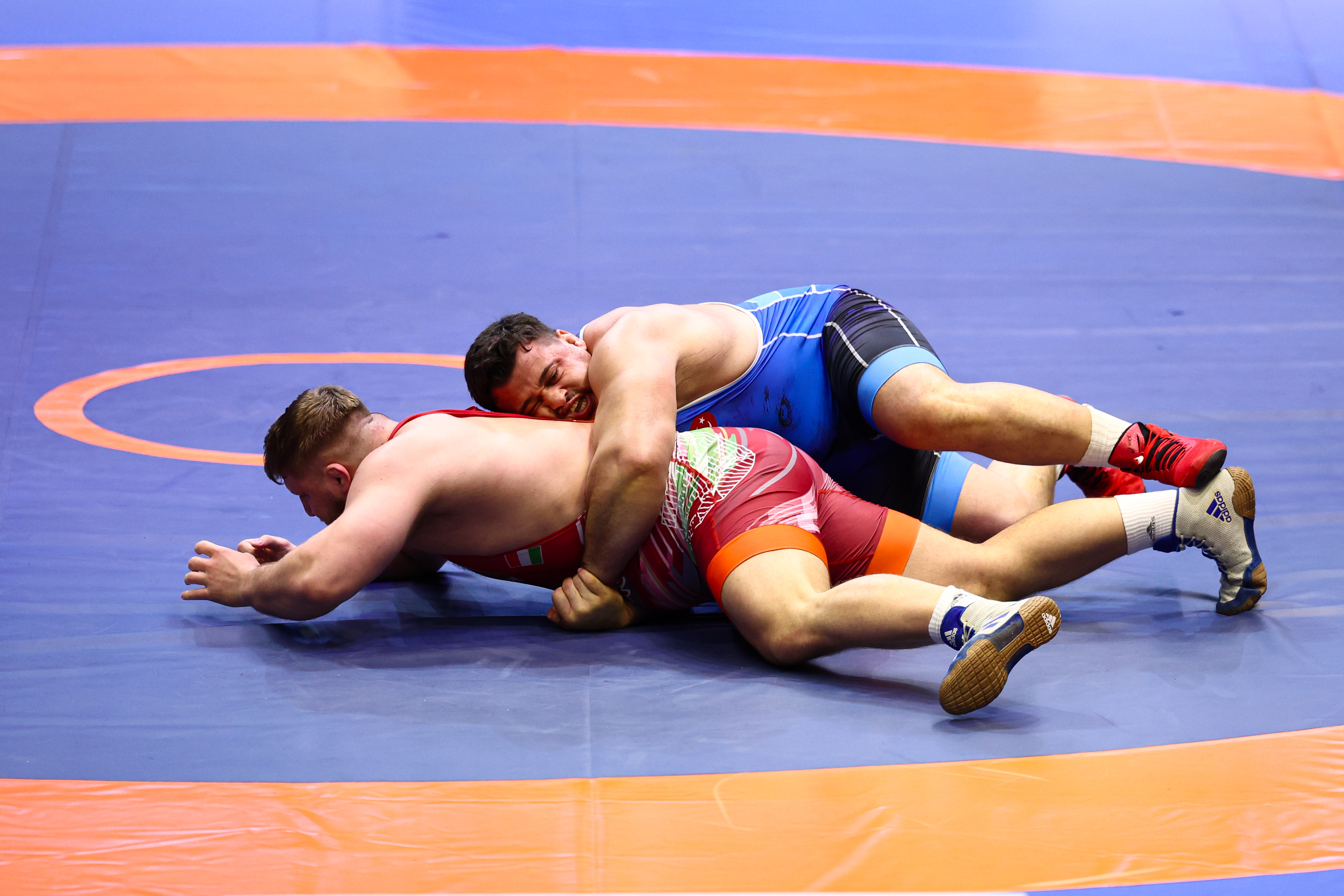 Riza KAYAALP (TUR) turns Darius VITEK (HUN) in the 130kg final. (Photo: United World Wrestling / Kadir Caliskan)
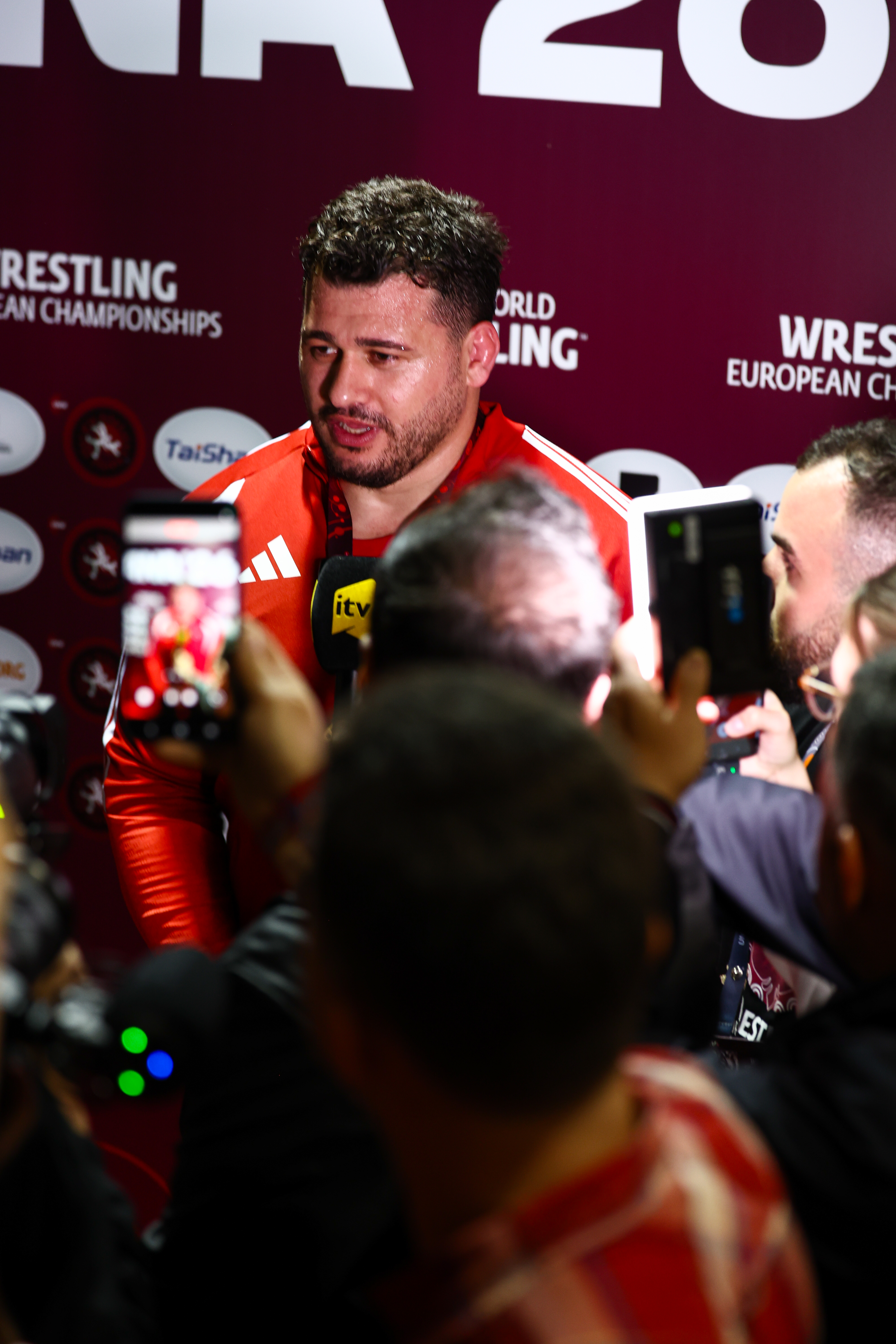 Riza KAYAALP (TUR) speaks to the media after winning the gold medal at the European Championships. (United World Wrestling / Jake Kirkman)
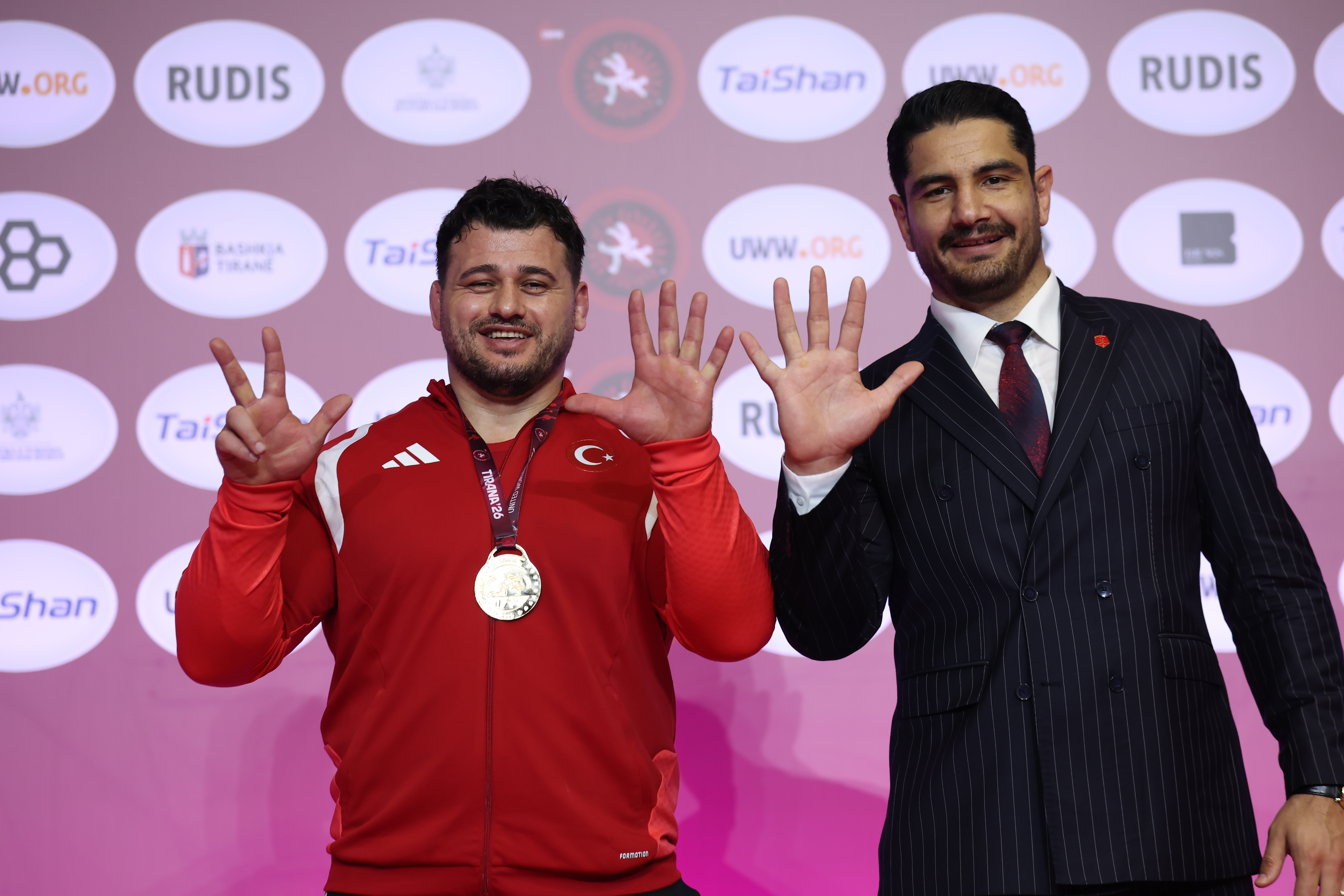 Riza KAYAALP (TUR) with Taha AKGUL (TUR) at the medal ceremony in Tirana. (Photo: United World Wrestling / Kadir Caliskan)
Share your thoughts.
Comments