

Paris 2024: Petriashvili survives late Zare surge for 1st gold
Saturday, August 10, 2024 - 23:31 By Ken Marantz

PARIS (August 10) -- Geno PETRIASHVILI (GEO) had the elusive gold medal in the bag until he didn't. A successful challenge reopened the door for his opponent, and the Georgian great barely managed to keep him from charging through it.
Petriashvili survived an incredible late surge by Amir Hossein ZARE (IRI), capturing the freestyle 125kg gold with a dramatic 10-9 victory on Saturday at the Paris Olympics to complete the full set of Olympic medals and avenge losses at two recent World Championships.
"It was really hard, emotionally and physically," Petriashvili said. "Every moment was really hard for me because this is the Olympic Games. In the last two Olympics, I lost. I wanted to win this match today."
In other finals at the Champs de Mars Arena, Sakura MOTOKI (JPN) stormed to the women's 62kg title to give Japan its third women's gold and sixth overall in wrestling, while Russian-born Razambek JAMALOV (UZB) became Uzbekistan's third-ever Olympic wrestling champion and first since 2004 with a victory at freestyle 74kg.
 Geno PETRIASHVILI (GEO) celebrates after winning the 125kg final in Paris. (Photo: United World Wrestling / Amirreza Aliasgari)
Petriashvili, a bronze medalist at the 2016 Rio Olympics, met the rising star Zare for the first time at the Tokyo Olympics in 2021, where he defeated him 6-3 in the semifinal en route to the silver medal.
But the 23-year-old Zare would not only win their next two encounters, in the finals at the 2021 and 2023 World Championships, he would win big -- 9-2 at the former and 11-0 at the latter.
That made the veteran Petriashvilli the decided underdog in the final, which started with him giving up an early stepout. And he looked to be heading for another one when he suddenly spun around and threw Zare for a 4-point takedown.
That seemed to energize the 30-year-old, who got a single-leg takedown, then reeled off three gut wrenches to make it 12-1.
But wait. As Petriashvili and the Georgian contingent celebrated, Iran challenged the final gut wrench, claiming it was done out of bounds. The judge agreed, the score was reset at 10-1 and the match continued.
Surely he couldn't squander a nine-point lead. Or could he? Zare, who has made conditioning an integral part of his preparation, fought on with a passion and scores a stepout to start the second period that gets a fleeing point tacked on. Of some concern is that Petriashvili takes a timeout for an apparent right elbow injury.
With 1:20 left, Zare adds a takedown to make it 10-5. With the crowd in a frenzy, Zare gets behind for a takedown, then adds a gut wrench to pull within one.
"When it was 10-9 in the last seconds, I was like, 'Don't give up,'" Petriashvili said. "It was a crazy match."
With the seconds ticking down and flashes of Petriashvili's last-second loss to Gable STEVESON (USA) in the Tokyo final coming to mind, he grabs for a leg and hangs on for dear life. Time expires before Zare can get close to breaking the hold.
"Maybe I wanted it more than him," Petriashvili said. "I lost in Tokyo in the last seconds. The next two years were difficult. Every night, I was thinking about it. Today, I won. I will not forget this moment. This is a beautiful moment."
Petriashvili had long been one-half of an elite duo in the 125kg class with rival Taha AKGUL (TUR), who lost 2-1 to Zare in the semifinals. The two had a stranglehold on the global title from 2014 to 2019, until Steveson broke the streak in Tokyo and Zare worked his way to the top.
There will be no more battles between the two. Akgul indicated that he was retiring after winning a bronze medal a short time earlier.
"Taha is a world-class wrestler," Petriashvili said. "I want to congratulate him on his career. He won a lot of medals, a lot of championships. What can I say about Taha? He is world-class. For me, it was a big honor to compete with him."
 Sakura MOTOKI (JPN) celebrates after winning the 62kg gold medal at the Paris Olympics. (Photo: United World Wrestling / Kadir Caliskan)
Motoki kept the Japanese juggernaut in Paris going with her fourth technical fall or fall in four matches, using a low single to maximum effect in a 12-1 victory over Tokyo bronze medalist Iryna KOLIADENKO (UKR).
"Over this year, I went through a lot with losses and injuries, but many people helped me to overcome it all," Motoki said. "To be able to have my wrestling [at a level] to win the gold medal makes me so happy."
After giving up an activity point, Motoki went to work, getting a low-single takedown and adding a lace-lock roll for a 4-1 lead at the break. She repeated the process two more times in the second
period to end the match at 4:57.
Motoki, who had to dispel self-doubts that had seeped in during the run-up to Paris, had her most challenging moment the previous day in the semifinals, when she was losing 7-2 to European champion Grace BULLEN (NOR) and was being tripped backward, only to pull off one of the most memorable moves of the Olympic tournament.
As she went back, she locked onto Bullen's arms and arched into a bridge that allowed her flip Bullen onto her back for a stunning victory by fall.
"Yesterday, I was on the verge of losing, but I think some god came to my rescue," Motoki said. "I thought that If I didn't take advantage of this chance now, it might never come again. I put in all this effort to get here today, so I was going to give everything I had on the mat up to the very end."
Motoki had faced the highest level of adversity just surviving a grueling qualifying process for Paris. A world bronze medalist at 59kg, she moved up to the Olympic weight and had to win out among a domestic field that included Tokyo Olympic champion Yukako KAWAI (JPN) and world champion Nonoka OZAKI (JPN), who would end up with a 68kg bronze in Paris.
After securing her ticket to Paris with a silver medal behind Aisuluu TYNYBEKOVA (KGZ) at last year's World Championships in Belgrade, Motoki fell into a slump due to her inability to defeat Tynybekova.
She lost to her at the Zagreb Open in January -- where she defeated Koliadenko 5-2 in their only previous meeting -- and again in the final of the Asian Championships in April. In the end, there would be no rematch between them in Paris.
"I wanted to get revenge on Aisuluu, and I continually trained for it," Motoki said. "I didn't get to face her. But I was able to get revenge on my weaker self."
Motoki follows Kaori ICHO (JPN) and Risako KAWAI (JPN) in maintaining Japan's stranglehold on the Olympic 62kg/63kg weight class, which the country has won every time since women's wrestling was added to the Olympic program. Icho won it in 2004, 2008 and 2012 (she dropped to 58kg in 2016 for her fourth gold) and Kawai followed in 2016 and 2021.
"It's true, Japan has a history of winning in this category," Motoki said.
"But for me, I was very anxious because I kept losing before coming to Paris and I was kind of not sure that I would actually win the gold medal. I couldn't be more grateful for having had this opportunity." Motoki said it was the support of all those around her that enabled her to make her first ascension to the top of the podium at a senior global tournament at the Olympics.
"There were many times I fell into despair, but many people supported and encouraged me," Motoki said. "I would like to divide this medal with all these people who took some of the weight that I had to endure during this year. It's a medal for them as well."
In addition to adding to the Japanese medal tally, Motoki, whose father Yasutoshi competed in Greco at the 2000 Sydney Olympics but did not medal, became the second wrestler from Ikuei University to win a gold, joining teammate and 57kg champion Tsugumi SAKURAI (JPN).
 Razambek JAMALOV (UZB) pinned Daichi TAKATANI (JPN) in the 74kg. (Photo: United World Wrestling / Kadir Caliskan)
In the freestyle 74kg final, Russian-born Razambek JAMALOV (UZB) give Uzbekistan just its third-ever Olympic wrestling gold and its first since 2004 with a victory by fall over Daichi TAKATANI (JPN).
"The path to the gold was not easy," Jamalov said. "I had five difficult fights. I have fought against some of my opponents before. It was not easy, but I managed to win."
Jamalov countered a single-leg attempt from the takedown machine Takatani by slipping in a grapevine, then transitioned to a cradle that he used to turn the Japanese over and secure a fall
in 2:12.
"I was trying to make him follow my technique," Jamalov said. "Because he works very well with his legs, I was trying to control it and impose my fighting technique on him. That was my main strategy."
Unlike the typical losing finalist, Takatani may have earned the unofficial title of Happiest Silver Medalist at the Games with his post-match antics.
"To lose in the final by fall is just my style," said Takatani, who advanced to the final with a wild 20-12 victory over world silver medalist Dake. "I am really happy. It's been a tough 24 years of wrestling life."
On the mat, he hugged Jamalov, then lifted him up into the air. He followed that by sprinting into the stands to unite with his wife, exchanging hand slaps and taking selfies with fans of all nations along the way. He even signed someone's Olympic flag.
"Before my match, I saw Kyle (DAKE (USA)) going into the stands, and he looked so cool up there," Takatani said. "I wanted to do the same thing, whether I won or lost. I copied him. My wife was here in Paris to cheer me on. I was happy that I could share my success with her."
By medaling in his Olympic debut, Takatani did what popular older brother Sohsuke couldn't in three Olympic appearances. Sohsuke was a world 74kg bronze medalist in 2014 -- an achievement that Daichi matched last year in Belgrade.
Their dream of competing in the Olympics together was shattered when Sohsuke's streak of 12 consecutive national titles ended last December.
 Aisuluu TYNYBEKOVA (KGZ) clicks a picture with fans after winning the bronze medal at 62kg. (Photo: United World Wrestling / Kadir Caliskan)
Tynybekova, Dake, Akgul take bronzes, with a bit of drama
Tynybekova wasn't able to achieve her goal of becoming Kyrgyzstan's first-ever Olympic gold medalist in any sport, but will go home with a women's 62kg bronze after snatching a 6-6 victory from the jaws of defeat against Orkhon PUREVDORJ (MGL).
Tynybekova, the silver medalist in Tokyo who was ousted in the semifinals by Koliadenko, was completely outwrestled in the first period by 2017 world champion Purevdorj, who stormed to a 6-0 lead. Tynybekova, the epitome of the never-say-die athlete, finally got on the scoreboard with a hard-earned takedown, but the prospects remained bleak going into the final minute.
But Tynybekova, a three-time world and six-time Asian champion, made up the deficit in one-fell swoop with a driving 4-point double-leg takedown with 20 seconds left that also put her ahead on criteria.
Bullen, a world bronze medalist and the reigning European champion, gave Norway its first-ever Olympic women's medal when she captured the other 62kg bronze with a quick 11-0 victory over Ana GODINEZ (CAN).
Bullen, who was placed in Norway as a child as an Eritrean refugee, scored a single-leg takedown, trapped Godinez's ankle underneath and pressed ahead for a 2-point exposure, then transitioned to a lace lock for three rolls to end the match after just 57 seconds. An unsuccessful challenge added the final point.
"I'm very happy that I can show the power that I have inside me, even though I don't believe it myself sometimes," Bullen said. "But in this tournament, in a big place like the Olympics, I can show that to the world and show what Norwegian wrestling can give to the world."
 Chermen VALIEV (ALB) became the first Albanian to win an Olympic medal. (Photo: United World Wrestling / Amirrza Aliasgari)
It was also a historic day for the tiny Albania, for which Russian-born Chermen VALIEV (ALB) gave his adopted country its first-ever Olympic medal in any sport when he forged a 6-2 victory over Viktor RASSADIN (TJK) to take home a freestyle 74kg bronze.
"It is indeed the first medal ever for Albania," Valiev said. "I'm very happy to have won this medal and I'm sure they are very pleased as well."
Valiev went up 2-0 in the first period with an activity clock point and stepout, then added a takedown to start the second period. Rassadin, another native Russian who was looking to become just the second Olympic medalist in Tajikistan history, struck back with a takedown, but Valiev added a stepout with a challenge point tacked on.
Valiev, who began competing for Albania in 2022, saw his chance for gold end in the quarterfinals when he leading Jamalov, only to lose 6-5 after twice being assessed a penalty point for fleeing in the final seconds.
In the other 74kg bronze-medal match, Dake, miffed over how a second-period challenge was adjudicated, responded by hitting a 5-point back suplex that propelled him a 10-4 victory over world bronze medalist Hetik CABOLOV (SRB) for his second straight Olympic bronze medal.
Dake fell behind 4-1 after the unsuccessful challenge in the final minute, which sparked him to a quick takedown with :30 left. But the three-time former world champion was hardly done. as he slipped behind and launched Cabolov with the highest-scoring move in the sport, then added a gut wrench for good measure.
After the match, Dake set the new precedent of going deep into the stands to celebrate with friends and family.
"Going up in the stands was pretty special," he said. "Without them, I wouldn't be able to do what I do. My wife is unbelievable – we have three kids with another one on the way. She truly is the rock for all these things to happen. I can't thank her enough."
 Taha AKGUL (TUR) and Aiaal LAZAREV (KGZ) both retired in Paris. (Photo: United World Wrestling / Kadir Caliskan)
At freestyle 125kg, Akgul captured his third Olympic medal by securing all of his points in the first period and cruising the rest of the way in a 7-0 victory over Aiaal LAZAREV (KGZ).
Akgul started with a stepout, then scored a takedown and two lace-lock rolls before going on the defensive and winning what proved to be the final bout of his career.
"In every competition, we come for gold," Akgul said. "In the Paris Olympics, too. Now, I'm happy I have finished with this third Olympic medal. I will relax a little bit because, with my wife, we are waiting for a baby."
After the match, both the 33-year-old Akgul and the 38-year-old Lazarev, a six-time Asian medalist who failed to medal in three Olympic appearances, "announced" their retirements by taking off their wrestling shoes and leaving them on the mat.
"Actually, I didn't see him while I was taking off my shoes," Akgul said. "When I saw him, it was so emotional. Two wrestlers retire together. I was so emotional because I gave all my life to wrestling."
Two-time European bronze medalist Giorgi MESHVILDISHVILI (AZE), a native Georgian making his Olympic debut at age 32, won the other freestyle 125kg bronze with a solid 9-3 victory over Robert BARAN (POL).
Meshvildishvili fell behind momentarily when Baran scored a first-period takedown to go up 2-2 on criteria, but responded with a takedown for a 4-2 lead into the break. He then added a stepout and two takedowns to seal the deal.
Day 6 Results
Freestyle
65kg
SF1: Kotaro KIYOOKA (JPN) df. Tulga TUMUR OCHIR (MGL), 5-1
SF1: Rahman AMOUZAD (IRI) df. Ismail MUSUKAEV (HUN) by TF, 10-0, 2:27
74kg
GOLD: Razambek JAMALOV (UZB) df. Daichi TAKATANI (JPN) by Fall, 2:12 (5-0)
BRONZE: Kyle DAKE (USA) df. Hetik CABOLOV (SRB), 10-4
BRONZE: Chermen VALIEV (ALB) df. Viktor RASSADIN (TJK), 6-2
97kg
SF1: Givi MATCHARASHVILI (GEO) df. Magomedkhan MAGOMEDOV (AZE), 5-0
SF1: Akhmed TAZHUDINOV (BRN) df. Kyle SNYDER (USA), 6-4
125kg
GOLD: Geno PETRIASHVILI (GEO) df. Amir ZARE (IRI), 10-9
BRONZE: Taha AKGUL (TUR) df. Aiaal LAZAREV (KGZ), 7-0
BRONZE: Giorgi MESHVILDISHVILI (AZE) df. Robert BARAN (POL), 9-3
Women's Wrestling
62kg
GOLD: Sakura MOTOKI (JPN) df. Iryna KOLIADENKO (UKR) by TF, 12-1, 4:57
BRONZE: Aisuluu TYNYBEKOVA (KGZ) df. Orkhon PUREVDORJ (MGL), 6-6
BRONZE: Grace BULLEN (NOR) df. Ana GODINEZ (CAN) by TF, 11-0, :57
76kg
SF1: Kennedy BLADES (USA) df. Aiperi MEDET KYZY (KGZ), 8-6
SF1: Yuka KAGAMI (JPN) df. Tatiana RENTERIA (COL), 4-2
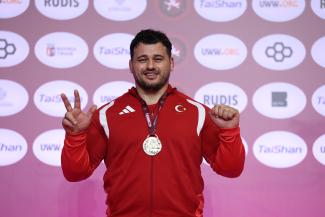
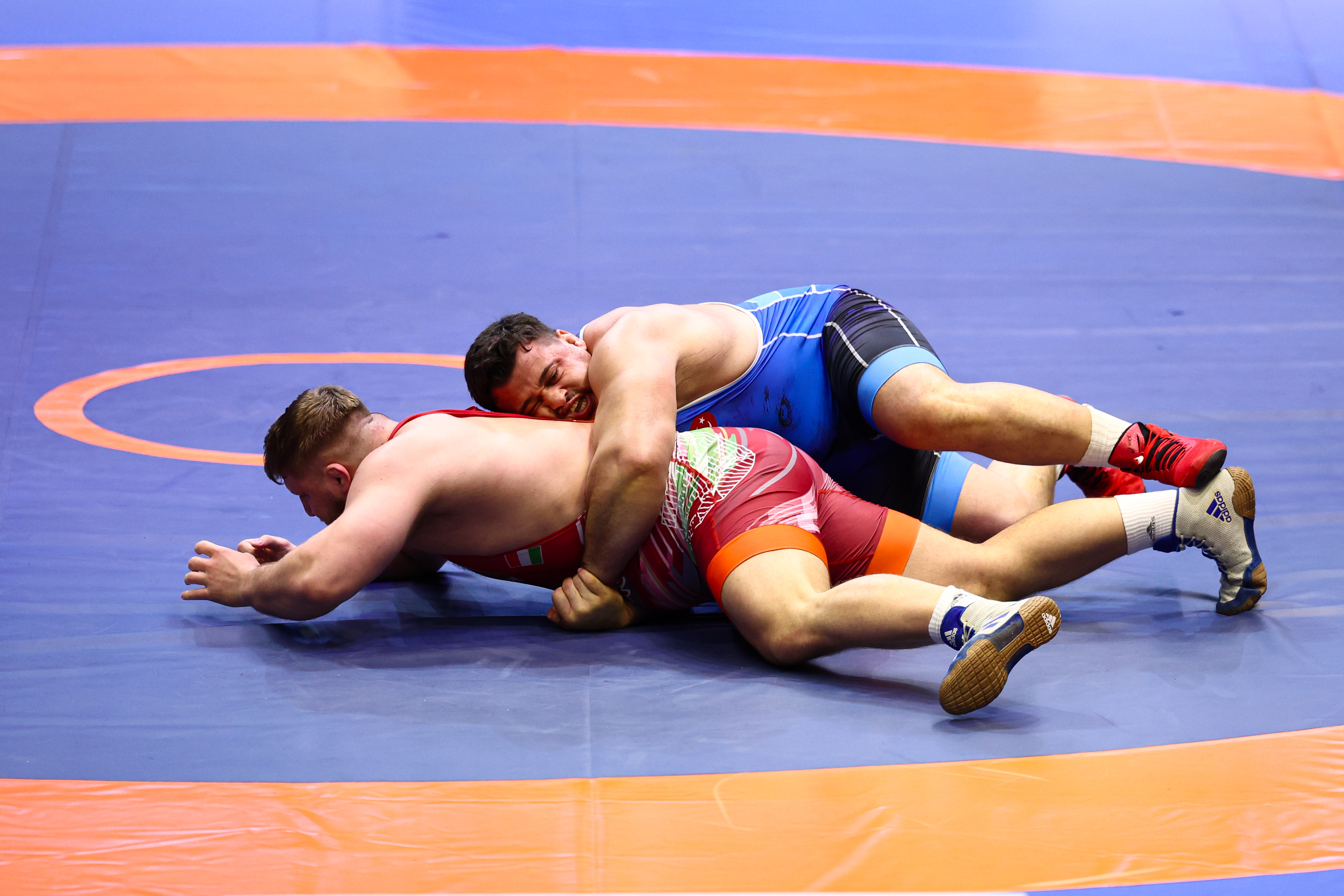 Riza KAYAALP (TUR) turns Darius VITEK (HUN) in the 130kg final. (Photo: United World Wrestling / Kadir Caliskan)
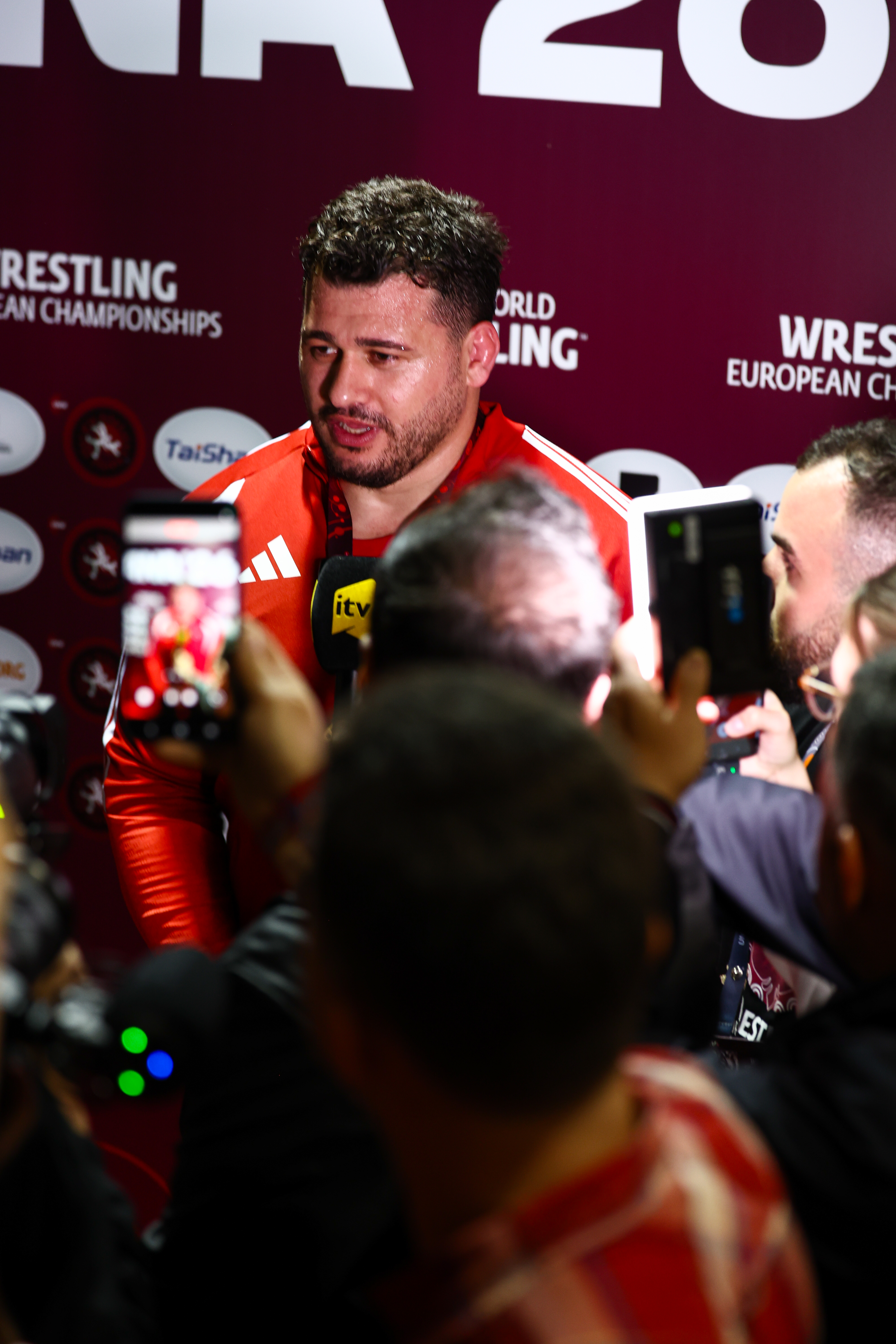 Riza KAYAALP (TUR) speaks to the media after winning the gold medal at the European Championships. (United World Wrestling / Jake Kirkman)
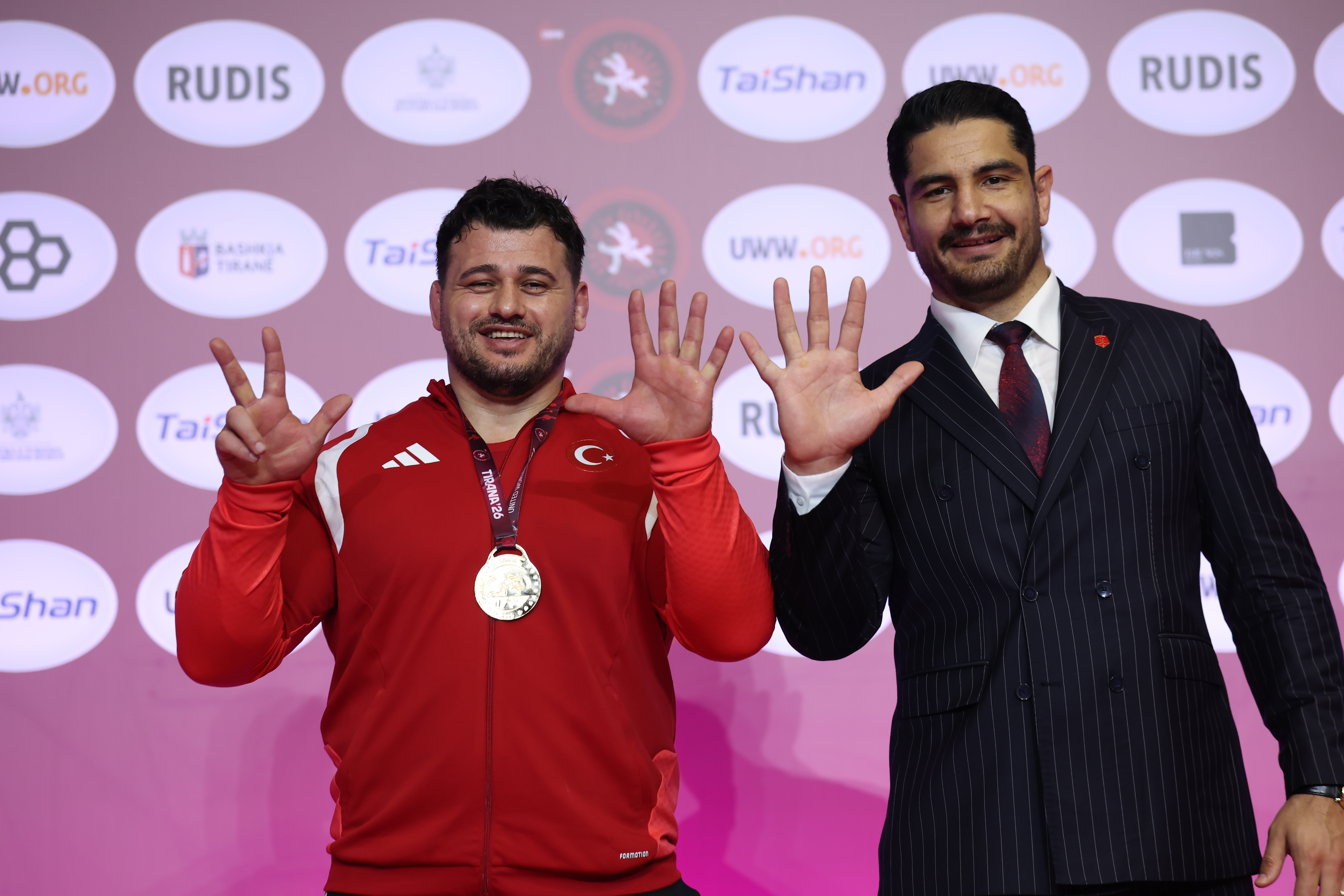 Riza KAYAALP (TUR) with Taha AKGUL (TUR) at the medal ceremony in Tirana. (Photo: United World Wrestling / Kadir Caliskan)
Share your thoughts.
Comments