

Paris 2024: Ramazanov denies Yazdani, Higuchi completes 57kg turnaround
Saturday, August 10, 2024 - 00:42 By Ken Marantz

PARIS (August 9) -- Hassan YAZDANI (IRI) and his aching shoulder missed out on a second Olympic gold medal and was relegated to a second silver instead, and David TAYLOR (USA) was nowhere in sight. Magomed RAMAZANOV (BUL) is the new king of the freestyle 86kg class.
Russian-born Ramazanov outdueled a less-than-100 percent Yazdani in notching a 7-1 victory in the final on Friday at the Paris Olympics, giving Bulgaria its second gold in two nights.
"It was really something for me," said Ramazanov, the 2020 European 79kg silver medalist who began competing for Bulgaria this year. "I come from a little town, and my family worked really hard for me to get here. It is really an honor. I got the gold medal for them."
Japan grabbed the two other gold medals up for grabs at the Champs de Mars Arena, with Rei HIGUCHI (JPN) completing an arduous eight-year journey to an elusive freestyle 57kg gold and two-time reigning world champion Tsugumi SAKURAI (JPN) winning the women's 57kg title in her Olympic debut.
 Magomed RAMAZANOV (BUL) and Hassan YAZDANI (IRI) at the podium of 86kg in Paris. (Photo: United World Wrestling / Kadir Caliskan)
Yazdani, one of the biggest stars of the sport whose many laurels include the 74kg gold from Rio 2016 and a silver at 86kg three years ago in Tokyo, was in obvious discomfort from the get-go of his clash with the 31-year-old Ramazanov.
Almost immediately after the start, the Iranian signaled for a timeout, clutching his upper right arm. While managing to keep the score close, and even tentatively leading at one point, he stopped the match five times for treatment on his shoulder.
"It was hard for him, but he was a great fighter with his other arm," Ramazanov said. "In the Olympics, you don’t get to choose the conditions, you just have to compete, and that’s what makes this sport so hard."
Yazdani gave up an activity point in the first period -- just barely failing to complete a takedown in the process -- but got one himself in the second to lead 1-1 on criteria.
Ramazanov put the pressure on and tripped Yazdani for a takedown while trapping the Iranian's foot underneath him at an odd angle, keeping him in a sitting position. That allowed the Bulgarian to use a crossface to tilt Yazdani backward for two exposures and a 7-1 lead.
With 30 seconds left, Yazdani conceded that it was over. He put his hands on his knees as the seconds ticked down to the inevitable. He gave Ramazanov a hug of respect.
Ramazanov dedicated the gold medal to his father who died when he was still a child.
"It was really hard, I had to fight elite wrestlers, but today it was destiny, and I want to thank god and dedicate this medal to my father, who died a few years ago," Ramazanov said. "I think he would be very proud of me."
He also paid tribute to his adopted country. "Bulgaria is my second home," he said. "This country gave me this amazing opportunity to compete in the Olympics with the best athletes around the world. It’s really hard psychologically because you don’t know if you’ll get to the next Olympics, and it’s so hard to qualify."
 Rei HIGUCHI (JPN) kisses his gold medal at the 57kg medal ceremony. (Photo: United World Wrestling / Kadir Caliskan)
At freestyle 57kg, Higuchi won a showdown with an equally determined Spencer LEE (USA) 4-2 to capture the gold medal that eluded him at the 2016 Rio Olympics and for which he spent the ensuing years on a path of trials and tribulations.
"I was able to have fun wrestling," Higuchi said. "I think that in my career, this was my highest level performance. It was a great tournament."
Higuchi was able to limit Lee's attacks to a pair of stepouts in the first period, the first one while Lee was on the activity clock. In the second period, Higuchi managed to stay grounded so that there would be no points as he went over the edge.
Meanwhile, Higuchi took the initiative himself in the second period, launching a double-leg takedown attempt that Lee tried to counter by rolling over the top. But Higuchi rolled through it and Lee landed on his back, giving Higuchi 2 points and a momentary chance for a fall.
That gave Higuchi the lead 2-2 on criteria, and he managed to hold on, adding a takedown with two seconds left off a desperation throw attempt.
 Rei HIGUCHI (JPN) tackles Spencer LEE (USA) in the 57kg final. (Photo: United World Wrestling / Amirreza Aliasgari)
After Rio, Higuchi moved up to 61kg, winning an Asian title, with an eye on making the Tokyo Olympics at 65kg. He won the world U23 gold at 65kg in 2018, and defeated Takuto OTOGURO (JPN) at one point, but in the end lost out to the eventual Tokyo gold medalist.
The only option for going to his home Olympics was to drop down to 57kg, but he famously failed to make weight at the Asian Olympic Qualifier, a shock only made worse when he later lost a playoff for Japan's Olympic spot to Yuki TAKAHASHI (JPN).
Still in his prime, he spent the next two years at 61kg, winning his first senior world crown in 2022, then made the drop back to 57kg with the aim of being on the mat in Paris.
This time he became more attentive to his nutrition and diet, which got a boost when he got married in May last year. It paid off with a world silver in Belgrade that clinched his ticket to Paris.
"The road to getting the gold medal was not easy at all," said Higuchi, who became a father in February. "I suffered many losses and I had the failure to make weight. I had many setbacks and moments of despair.
"But I was absolutely confident I could win the gold medal. My coaches and teammates supported me and this is a medal I could get because of so many people. I will never think this is
a gold medal that I won by myself."
With Higuchi's win, current students or alumni of his alma mater Nippon Sports Science University now account for four wrestling golds in Paris. He was preceded by Kenichiro FUMITA (JPN) and Nao KUSAKA (JPN) in Greco and Akari FUJINAMI (JPN) in women's wrestling.
 Tsugumi SAKURAI (JPN) celebrates after winning the 57kg final at the Paris Olympics. (Photo: United World Wrestling / Amirreza Aliasgari)
Sakurai later added Japan's fifth gold overall through five days of competition in Paris with a 6-0 victory over Anastasia NICHITA (MDA) in a repeat of the women's 57kg final at last year's World Championships in Belgrade.
"I practiced just for this moment, and I was able to be here because of the support of many people," said Sakurai, who defeated two-time Olympic champion Risako KAWAI (now KINJO) (JPN) in the process of qualifying for Paris. "I'm really glad I won the title."
Sakurai, employing a 2-on-1 while standing that pretty much neutralized Nichita's offense, opened the scoring by shooting for a single-leg takedown, then stepping over for an exposure when Nichita attempted a counter-lift.
Sakurai had the 2-on-1 when the two went to the mat and Nichita tried to go over and hook the far leg. But Sakurai bucked her to the mat and went behind to make it 4-0 at the break. In the second period, Sakurai added a single-leg takedown while conceding nothing to clinch the gold.
After her victory lap, Sakurai went to the stands for a group hug with her father and her coach at Ikuei University, Yoshimaro YANAGAWA, who could have another Olympic champion after Ikuei's Sakura MOTOKI (JPN) made the women's 62kg final earlier in the session.
"He said, 'You did great,'" Sakurai said of Yanagawa. "For this Olympics, he sacrificed so much time for us. He made us train hard and kept pushing us. I'm glad I could get it done. I was able to put out on the mat what I had done up to now."
 Tsugumi SAKURAI (JPN) wrestles Anastasia NICHITA (MDA) in the 57kg final. (Photo: United World Wrestling / Amirreza Aliasgari)
Sakurai suffered a setback in her Olympic preparations when she lost in the final at the Asian Championships in April to Yongxin FENG (CHN), but managed to right the ship in time for Paris. It was her first international loss since the 2019 Asian Junior (U20) Championships.
Despite missing out on the gold, Nichita earned a place in Moldovan history by becoming just its second Olympic wrestling medalist ever and the first woman.
"So many people came today to support me, and I'm really grateful for that," Nichita said. "I'm really sorry that I didn't win the gold medal, but next time I will try my best to win the gold.
"All of my life I dreamed about this, and I went through a lot of pain and trauma, and here I am today, with a medal."
 Helen MAROULIS (USA) celebrates after winning her bronze-medal bout at 57kg in Paris. (Photo: United World Wrestling / Amirreza Aliasgari)
Maroulis quickly bags bronze for 3rd Olympic medal
Helen MAROULIS (USA) needed just 24 seconds to win a third Olympic medal, taking a second straight women's 57kg bronze with victory by fall over Hannah TAYLOR (CAN).
Maroulis hit a textbook-perfect fireman's carry to send Taylor to her back, then clamped down to secure the fall less than a half-minute after the start.
The three-time former world champion added the Paris bronze to the gold she won at Rio 2016 with a historic win over legend Saori YOSHIDA (JPN) and her bronze from Tokyo three years ago.
Kexin HONG (CHN) needed a bit more time to secure the other women's 57kg bronze, rolling to a 10-0 victory over Giullia PENALBER (BRA) in 1:57.
 The two bronze medalists at 86kg -- Aaron BROOKS (USA) and Daruen KURUGLIEV (GRE). (Photo: United World Wrestling / Kadir Caliskan)
World U23 champion Aaron BROOKS (USA), who needed to beat Tokyo Olympic champion David TAYLOR (USA) just to earn his ticket to Paris, defeated Asian silver medalist Javrail SHAPIEV (UZB) 5-0 to take home a freestyle 86kg bronze medal.
Brooks received an activity point in the first period, then added a stepout early in the second. Put on the clock himself, Brooks scored a double-leg takedown to make it 4-0, then added a late stepout to relegate Shapiev to a second straight fifth-place finish at the Olympics.
Asked if the competition in his first major senior event was tougher than he had expected, Brooks replied, "I never try to expect anything. When you are going on the mat with expectations and they are not met, it's where you can have those climaxes and drop-offs.
"It's the Olympics. They are what they are. It's a tough competition."
The other 86kg bronze went to Russian-born Dauren KURUGLIEV (GRE), who survived a valiant late surge by Tokyo bronze medalist Myles AMINE (SMR) in a 5-4 victory that gave Greece its first Olympic wrestling medal since Athens 2000.
Kurugliev appeared to be cruising to a victory on the back of a first-period takedown and 2-point exposure off a second-period scramble. With the clock ticking down, Amine completed a takedown with :07 on the clock, but wasn't done there.
He got behind again, but Kurugliev somehow managed to keep his knees off the mat as they went out of the ring, limiting Amine to a stepout and fleeing point that made it 4-4 but left him on the short end on criteria. An unsuccessful challenge added the final point.
"I would like to thank Greece, this country that gave me this opportunity," Kurugliev said. "Thank you very much to all of you. I'm very happy to have won this medal. Of course, I tried to win gold, but bronze is fine, and I'm quite happy."
 AMAN (IND) became India's youngest Olympic medalist in individual sports. (Photo: United World Wrestling / Kadir Caliskan)
Asian champion Aman SEHRAWAT (IND), the lone Indian male wrestler to qualify for Paris, assured that the country would win a medal for the fifth straight Olympics, winning a takedown-a-thon over Darian CRUZ (PUR) 13-5 to take a bronze at freestyle 57kg.
Sehrawat scored three takedowns in each period, adding a late stepout with a fleeing point tacked on, to deny the U.S.-raised Cruz's bid to become just the second Olympic wrestling medalist for Puerto Rico. Cruz, an NCAA champion at Lehigh University in the U.S., chalked up two takedowns of his own.
Gulomjon ABDULLAEV (UZB), who also did some collegiate wrestling in the U.S., picked up the other 57kg bronze with a 5-1 win over Bekzat ALMAZ UULU (KGZ) that was closer than the score indicates.
Abdullaev got an activity point and stepout in the first period, and led 2-1 in the second after giving up a point on the activity clock. Fighting off everything Almaz Uulu threw at him down the stretch, he got a last-second 2 by stopping a desperation throw attempt, with an unsuccessful challenge point added on.
Day 5 Results
Freestyle
57kg
GOLD: Rei HIGUCHI (JPN) df. Spencer LEE (USA), 4-2
BRONZE: Aman SEHRAWAT (IND) df. Darian CRUZ (PUR), 13-5
BRONZE: Gulomjon ABDULLAEV (UZB) df. Bekzat ALMAZ UULU (KGZ), 5-1
74kg
SF1: Daichi TAKATANI (JPN) df. Kyle DAKE (USA), 20-12
SF2: Razambek JAMALOV (UZB) df. Viktor RASSADIN (TJK), 8-2
86kg
GOLD: Magomed RAMAZANOV (BUL) df. Hassan YAZDANI (IRI), 7-1
BRONZE: Aaron BROOKS (USA) df. Javrail SHAPIEV (UZB), 5-0
BRONZE: Dauren KURUGLIEV (GRE) df. Myles AMINE (SMR), 5-4
125kg
SF1: Amir ZARE (IRI) df. Taha AKGUL (TUR), 2-1
SF2: Geno PETRIASHVILI (GEO) df. Giorgi MESHVILDISHVILI (AZE), 7-0
Women's Wrestling
57kg
GOLD: Tsugumi SAKURAI (JPN) df. Anastasia NICHITA (MDA), 6-0
BRONZE: Helen MAROULIS (USA) df. Hannah TAYLOR (CAN) by Fall, :24 (4-0)
BRONZE: Kexin HONG (CHN) df. Giullia PENALBER (BRA) by TF, 10-0, 1:57
62kg
SF1: Iryna KOLIADENKO (UKR) df. Aisuluu TYNYBEKOVA (KGZ), 9-2
SF2: Sakura MOTOKI (JPN) df. Grace BULLEN (NOR) by Fall, 4:26 (7-7)
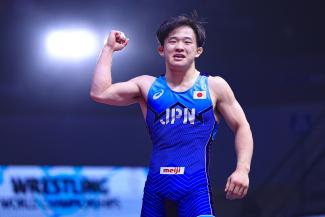

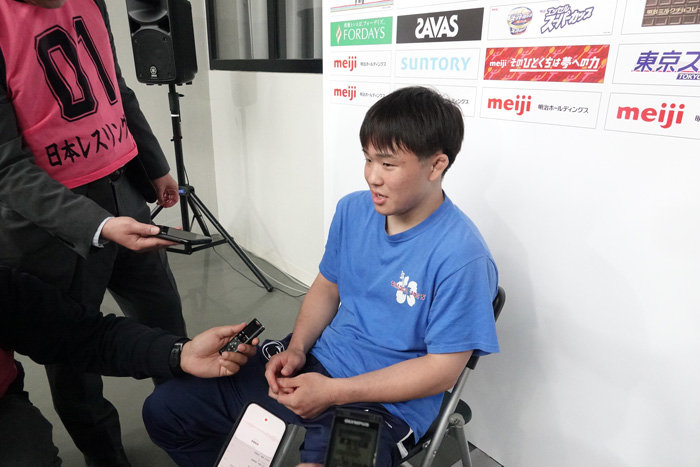 Masanosuke ONO (JPN) giving interview on the sidelines of the Meiji Cup. (Photo: wrestling-spirits.jp / Ikuo Higuchi)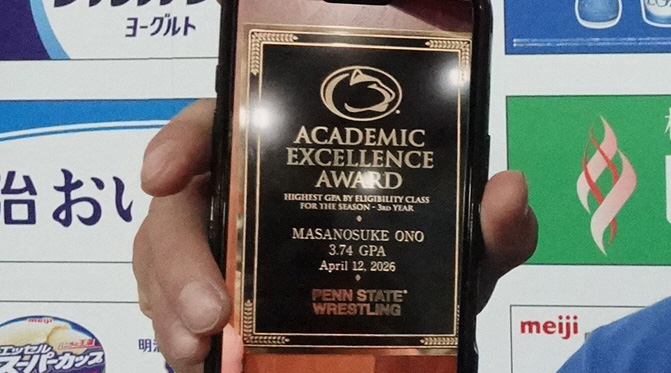
Share your thoughts.
Comments