

Tokyo 2020

Ten Years Later Guenat Still Bringing Energy, New Tech to the Mat 

By Tim Foley

CORSIER-SUR-VEVEY, Switzerland (April 2) – Everything today feels obvious: a livestream to watch, Arena to follow results, and Athena to manage tournament entries. But ten years ago the sport of wrestling had none of these fan-friendly organizational efforts in place.

“We were in a very different time when I arrived in Corsier,” said Sébastien Guenat who arrived in 2010 as a webmaster to what was then FILA. “We were building a new website for each tournament using Joomla.”

While much has changed in recent years, Guenat has remained a constant in Corsier and at events around the world. This week marks his ten year work anniversary and when looking back at what’s changed at the organizational level Guenat has had his hands in many of the sport’s most important innovations, but thinks the driving force has always been one thing.

“Fairness has always been our mission. We wanted to make sure that everything we do makes it easier for the athletes to compete, the national federations to participate, and for fans to follow along,” said Guenat. “I don’t think we are done, but we have made good progress.”


After FILA adopted new leadership in 2013 and changed to United World Wrestling in 2015 Guenat’s first effort was to create a draw system that was totally randomized. “We use to grab balls out of a bag, which is not the right way to do things,” said Guenat.

To make the process fair Guenat created a randomizer which generated numbers between 1-99 and assigned them to the various entrants. Coaches were allowed to press the button to create the number. This year that system was replaced by blockchain technology which provides absolute random assignment and a method by which fans, coaches, and officials could check the blockchain.

“I’m very happy with the progress for our draws,” said Guenat. "Manu (Veyrat) has been a very important part of all our developments, along with and Csaba (Virag) and Youssef (Bouaziz)."

Following the 2016 Rio Games the UWW bureau tasked Guenat to create a system to randomly assign referees using a system of inputs to ensure a fair outcome. The task was difficult, but in 2020 Guenat and Veyrat believe it's been optimized to the benefit of wrestlers, fans, and even referees.

While fairness has always been the aim, the building blocks of the organization also needed improvement. The new website was launched in 2015, which also hosted Arena a results and tournament management software that helped organize information. It was also given out to free to all interested national federations.

When Arena first launched there was a delay in adoption by federations. At one tournament the organizers had no cables with which to connect the computers to the internet. After some jostling the organizers returned the next day with hundreds of feet – everything Guenat and the team needed.

“They robbed a local school,’ Guenat said flatly. “We got great internet but the school probably didn’t have it again for several months.”

Guenat is quick to point out that the IT team's success at implementing Arena, livestreaming and Athena rests on the hard work of a large international team of up to 16 IT externals that travel to every event and help keep the standards established by headquarters.

"They do the most work," said Guenat. Wrestling is very fortunate to have that staff willing to travel and work so hard for the sport."

Arena has been a gift for fans and organizers, but the development of Athena might prove to be Guenat and the IT teams biggest accomplishment to date. The software logs each wrestler, national federation member, and staff member for each tournament and national federation in the world. Federations can purchase licenses, log their flight arrivals, and pay their entry fees right on Athena.

“For a long time you never knew who would show up to a tournament,” said Guenat. “The organizers could have 100 entries, or 1000. Nobody knew. It’s insane to think about!”

To make these improvements has meant that Guenat has needed to travel around the world dozens of times. Using an app called Wipolo, Guenat knows his exact stats: 63 countries, 116 trips, and an incredible 1,468,876 km traveled in the past ten years. And that’s meant a lot fo time away from home, but also some positive experiences on the road.

“I love working in Japan. Everything works the first time and the food is great,” said Guenat. "Nightlife is also good if you have a free moment."

Though he didn’t mention his less-than-favorite trips, Guenat looks more fondly on locations that allow him to finish his work, enjoy good food, and have great local staff. ‘We spend a lot of time on the road. It’s nice to have things be easier sometime.”

Guenat isn’t stopping anytime soon. In addition to advising the IOC’s boxing commission and working within international sports IT-based commissions, he’s also working on getting everything into the cloud. “We can already do more than ever before with our work in the cloud, With COVID-19 it’s been an advantage to have so much available for our international staff,” said Guenat. 

Next up is optimizing 4D Replay (up to 80 cameras around a mat) and maybe further down the road adding some wearable technologies to monitor heart rate of athletes and get better information. IN the immediate future is possibly the biggest project launch of the IT director’s career – a complete, interactive, up-to-date database complete with all videos, photos, and stats of every wrestler in the world.

“We are almost finished,” said Guenat. “This project feels like it’s taken my whole ten years, but I know when it is done we will ask ‘How did we live without this?’”
#WrestleBudapest

Sharshenbekov Cuts Down, Rises to Win Gold in Budapest Ranking Series

By Vinay Siwach

BUDAPEST, Hungary (July 19) -- Zholaman SHARSHENBEKOV (KGZ) appears to be rounding into form just in time for the World Championships.

After almost two years away from the mat, the Paris 2024 bronze medalist won the 63kg title at the Ulaanbaatar Open. On Sunday in Budapest he returned to his original Olympic weight of 60kg and rolled to another gold medal with a dominant run.

"It has been two years since I was at 60kg," Sharshenbekov said. "There was a break after the Olympics. I feel like I am just beginning to feel it again."

Sharshenbekov did not wrestle in the final after his opponent, Yernur FIDAKHMETOV (KAZ), forfeited because of an injury. Before that, however, Sharshenbekov was in dominant form.

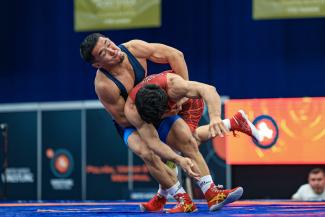
He opened the day against Dalton ROBERTS (USA) and secured a fall in one minute, throwing Roberts on the mat using underhook. It set the tone for the rest of the day.

In his second bout, Elmir ALIYEV (AZE) offered little resistance in a 10-0 loss. Sharshenbekov earned the first par terre opportunity, turned Aliyev for two points and followed with a four-point throw. In the second period, he added a takedown that Azerbaijan challenged. The call stood, and the unsuccessful challenge gave Sharshenbekov another point.

Against Mahmoud SAAD (EGY) in the quarterfinals, Sharshenbekov built a 2-0 lead with a chasing takedown before extending it to 5-0 with a par terre turn. Just before the break, he circled behind Saad for another takedown to make it 7-0.

He needed only 25 seconds of the second period to complete another technical superiority victory and book a semifinal against world silver medalist Alisher GANIEV (UZB).

Asian champion Alisher GANIEV (UZB), wrestling with a heavily taped left knee, came out aggressively from the opening whistle but could not break through Sharshenbekov's defense. Sharshenbekov countered with ease and scored the opening takedown just 15 seconds into the bout.

Ganiev then limited the damage in par terre, defending Sharshenbekov's turn attempts to keep the deficit at 3-0 heading into the break.

The second period opened with both wrestlers battling for position as Ganiev searched for a takedown. But the relentless pace began to take its toll and after a minute of high-intensity wrestling, a tiring Ganiev surrendered a go-behind to fall further behind.

Ganiev threw everything at Sharshenbekov, working from body locks and underhooks to headlocks and two-on-one ties, but he could not move the Kyrgyzstan wrestler. Sharshenbekov eventually pull his arm out of Ganiev's hold and control Ganiev for another takedown to lead 5-0.

During a late scramble, Ganiev managed two exposure points, but Sharshenbekov immediately spun and came on top, brought Ganiev the mat and secured the fall.

As he prepares for the World Championships in Astana, Kazakhstan, in September, Sharshenbekov's dominant return to 60kg sent a message to the rest of the field.

"This isn't my peak," he said. "It is merely the beginning. I have plans and goals to prepare even better for the Asian Games, the World Championships and the Olympics. I need to reach an even higher level of fitness for those events."

Szoke Wins 97kg

Alex SZOKE (HUN) gave the home crowd plenty to cheer about, defeating Ilia ERMOLENKO (RUS), 5-1, in the 97kg final. In one of the standout performances of the tournament, Szoke combined patience, strength and tactical awareness, scoring from par terre before sealing the victory with a counter takedown.

The final began at a high pace, with both wrestlers battling to secure the first par terre advantage. It was the Hungarian who received the activity point in the opening period to take a 1-0 lead. Szoke then capitalized from par terre with a turn to extend the lead to 3-0.

The second period saw Ermolenko on top but Szoke was at his best defense and did not allow the Russian to score any points. But there was a heart stopping moment for Szoke late in the match when Ermolenko locked Szoke and dragged him towards the zone. But Szoke showed exceptional skills and broke the lock.

Ermolenko earned the par terre advantage in the second period, but Szoke's defense held firm, denying the Russian any scoring opportunity. The home crowd was briefly on edge late in the match when Ermolenko locked up Szoke and drove him toward the edge of the mat. Szoke, however, showed exceptional composure, breaking the lock to escape the danger.

Moments later, Szoke circled behind Ermolenko for a takedown to stretch the lead to 5-1, effectively putting the match out of reach. Ermolenko slammed the mat in frustration as the Hungarian closed out the victory.

Russia Wins 3 Golds

It was not all disappointment for Russia, as its experienced wrestlers claimed three of the six Greco-Roman gold medals on offer Sunday.

European champion Sergey EMELIN (RUS) once again showcased the qualities that have made him one of the world's best at 63kg. Whether winning on criteria, scoring when an opening appears or protecting a lead, Emelin has an answer for almost every situation. He displayed all three in a 5-2 victory over Kerem KAMAL (TUR).

Emelin and Kamal were locked in a thrilling contest, with the Russian taking a 2-2 criteria lead. Kamal maintained the pressure and looked set to force a stepout, but Emelin circled behind for a takedown to move ahead 4-2. A stepout in the final minute extended the lead to 5-2, allowing Emelin to close out another Ranking Series title.

The 82kg final was a tactical affair as Gamzat GADZHIEV (RUS) edged Asian champion Shahin BADAGHIMOFRAD (QAT), 1-1 on criteria, to secure Russia's second gold medal.

Russia's third title came at 130kg, where Marat KAMPAROV (RUS) held on for a 1-1 criteria victory over U20 world champion Laszlo DARABOS (HUN), quieting the vocal home crowd.

Asian champion Ikhtiyor BOTIROV (UZB) added a Ranking Series title to his growing résumé with a comfortable 5-1 win over Brady KOONTZ (USA) in the 55kg final. Botirov set the tone from the opening whistle, earning the first par terre opportunity and scoring two gut-wrench turns for a 5-0 lead.

Koontz received the par terre opportunity in the second period, but Botirov defended it comfortably to seal the victory.

RESULTS

55kg
GOLD: Ikhtiyor BOTIROV (UZB) df. Brady KOONTZ (USA), 5-1

BRONZE: Iskhar KURBAYEV (KAZ) df. LALIT (IND), 18-10
BRONZE: Artiom DELEANU (MDA) df. Max NOWRY (USA), 3-0

60kg
GOLD: Zholaman SHARSHENBEKOV (KGZ) df. Yernur FIDAKHMETOV (KAZ), via inj. def.

BRONZE: Alisher GANIEV (UZB) df. Mahmoud SAAD (EGY), 14-2
BRONZE: Anvar ALLAKHIAROV (RUS) df. Yerbol KAMALIYEV (KAZ), 5-3

63kg
GOLD: Sergey EMELIN (RUS) df. Kerem KAMAL (TUR), 5-2

BRONZE: Aref MOHAMMADI (QAT) df. Murad MAMMADOV (AZE), 7-0
BRONZE: Zhambolat LOKYAEV (RUS) df. Sunny KUMAR (IND), 3-1

82kg
GOLD: Gamzat GADZHIEV (RUS) df Shahin BADAGHIMOFRAD (QAT), 1-1

BRONZE: Tornike MIKELADZE (GEO) df. Azimjon SOATULLAEV (UZB), 3-1
BRONZE: Mihail BRADU (MDA) df. Ognjen JAKOVLJEVIC (SRB), 3-1

97kg
GOLD: Alex SZOKE (HUN) df. Ilia ERMOLENKO (RUS), 5-1

BRONZE: Arvi SAVOLAINEN (FIN) df. Arif NIFTULLAYEV (AZE), 1-1
BRONZE: Hayk KHLOYAN (ARM) df. Musa EVLOEV (RUS), via inj. def.

130kg
GOLD: Marat KAMPAROV (RUS) df. Laszlo DARABOS (HUN), 1-1

BRONZE: Wenhao JIANG (CHN) df. Olzhas SYRLYBAY (KAZ), 2-2
BRONZE: Konsta MAEENPAEAE (FIN) df. Aden ATTAO (USA), 3-1