

U23 Worlds 2025: Forrest wins epic final to hand U.S. team title
Tuesday, October 28, 2025 - 00:40 By Vinay Siwach
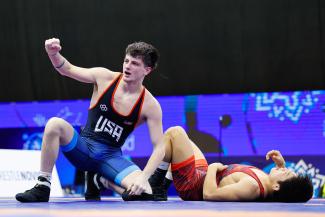
NOVI SAD, Serbia (October 27) — For a second time this year, the United States and Iran were involved in a thrilling team title race in Freestyle at a World Championships with the U.S. eventually winning the title.
After being tied at 102 points each at the U23 World Championships in Novi Sad, the U.S. needed one win and Iran needed to win all three bouts on the final day of the competition.
The U.S. sealed the team title as soon as Jaxen FORREST (USA) won the 61kg final, giving his country an unassailable lead of 137 points over Iran, which finished second with 127 points. Japan was third with 85 points.
With the team title, U.S. won the top spot in Freestyle in all age-group World Championships while Iran won the title in senior Worlds.
Three gold medals already in pocket, the U.S. won a fourth one on Monday through Forrest who had an unforgettable bout against Omurbek ASAN UULU (KGZ).
Both teenagers, U20 world bronze medalist Forrest and U17 world champion Asan Uulu put on a match that will be remembered for ages. Both wrestlers settled in, Forrest came up with an over-underhook for four but Asan Uulu soon fired back with two takedown to make it 4-4. After a back-and-forth scramble, Asan Uulu managed to score a push out for a 5-4 lead.
But Forrest took a big lead when he threw Asan Uulu from quad pod position for four points. Kyrgyzstan’s lost challenge added one more point to make it 9-5.
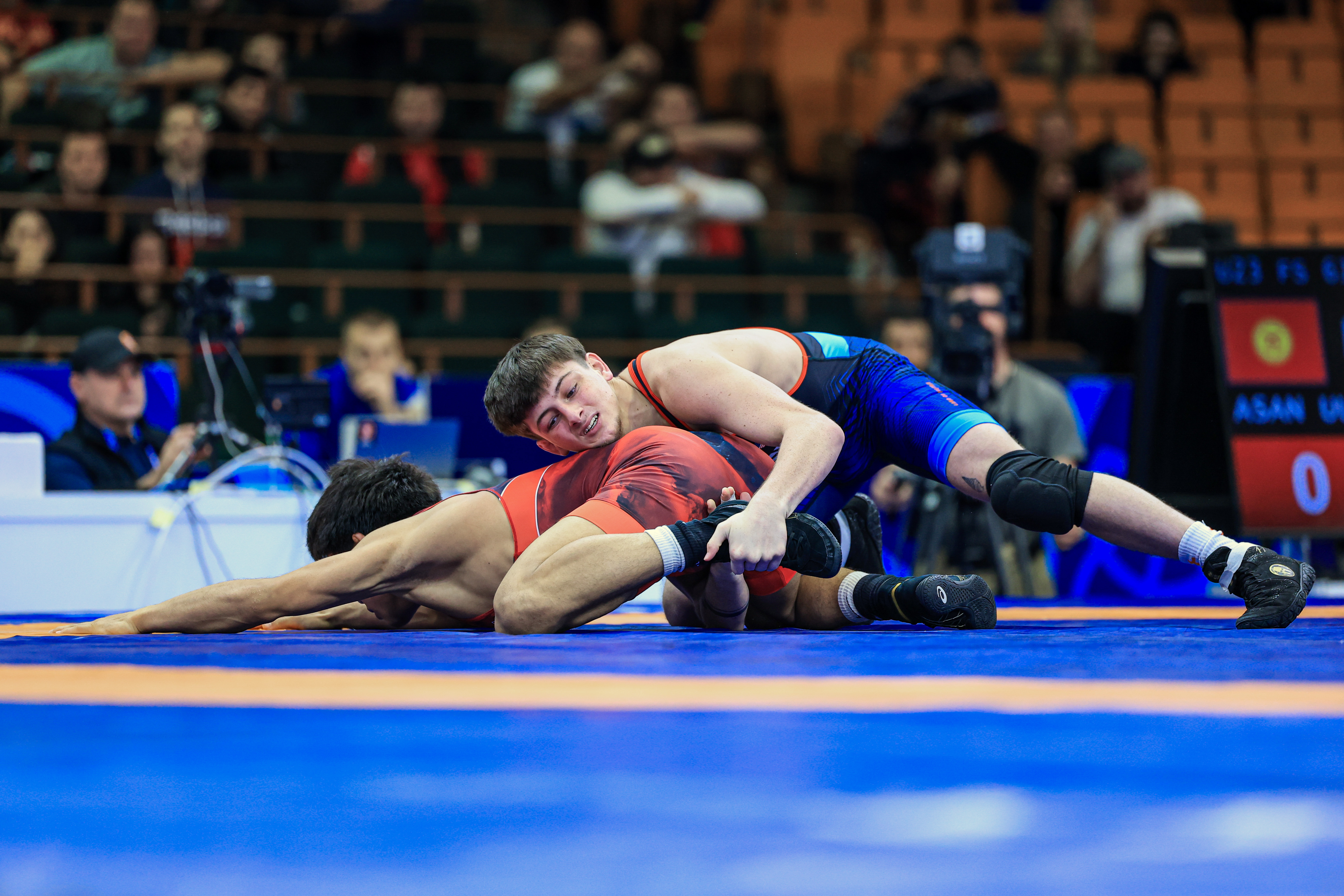 Jaxen FORREST (USA) scores a takedown against Umurbek ASAN UULU (KGZ). (Photo: United World Wrestling / Amirreza Aliasgari)
The two were not done yet. As soon as the second period began, Asan Uulu scored a stepout, Forrest got a takedown to make it 11-6. Asan Uulu managed to get a takedown and score via exposure. He took a 12-11 lead with a takedown on edge with 1:30 left.
There was more left in the match as Forrest got on a low single to get a takedown and as the wrestlers returned to standing, he threw Asan Uulu for a big four, the third of the match to make it 17-12. He was happy to give one takedown to Asan Uulu in the final 10 seconds and win the gold medal 17-14, in what was perhaps the match of the year.
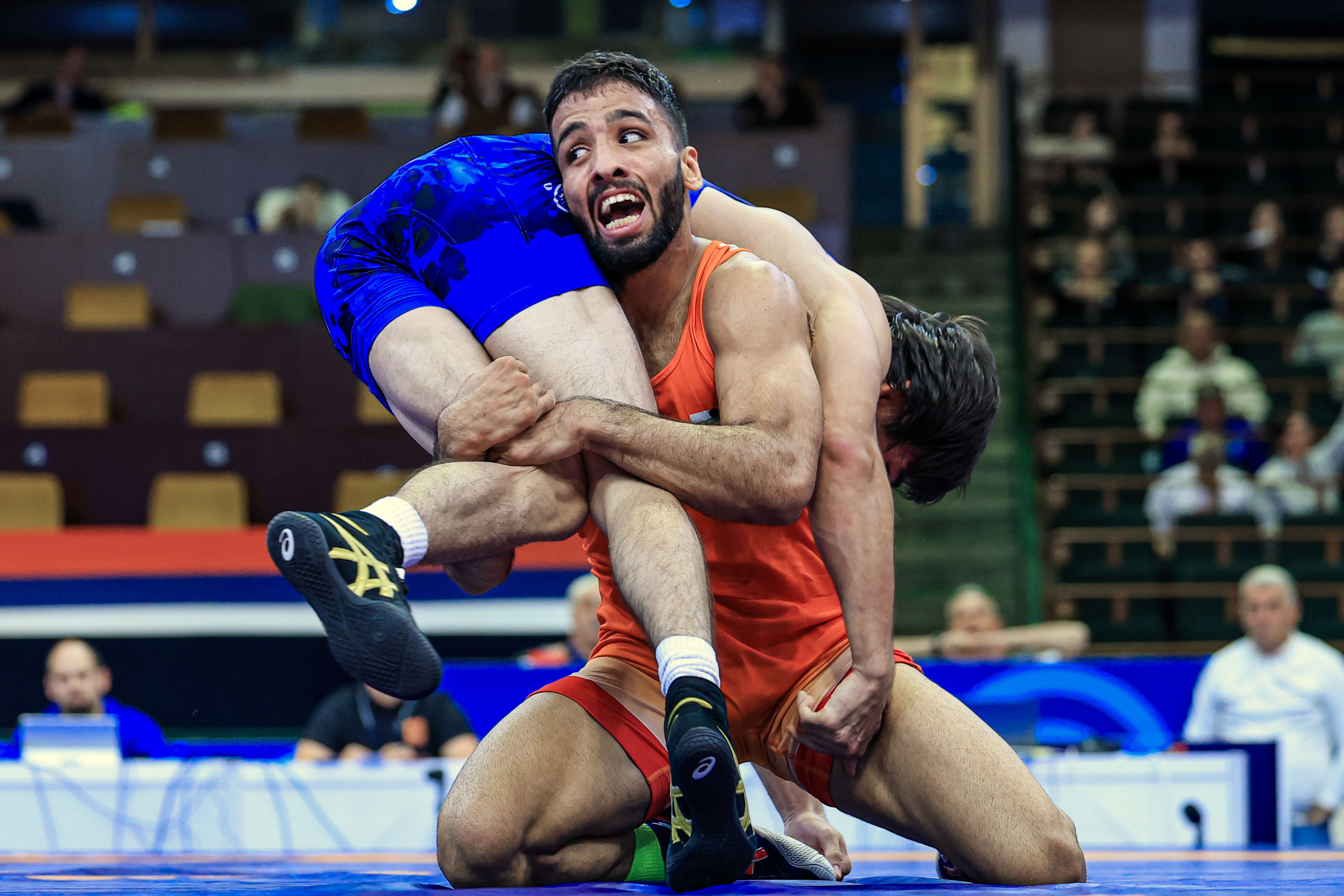 SUJEET (IND) scores the match-winning takedown against Umidjon JALOLOV (UZB). (Photo: United World Wrestling / Amirreza Aliasgari)
At 65kg, SUJEET (IND) upgraded his bronze from last year to gold this year after he blanked world bronze medalist Umidjon JALOLOV (UZB) in the final, his third 10-0 technical superiority over Jalolov this year.
Sujeet began like favorite underhook and snapdowns and Jalolov was put on the clock. Sujeet scored a takedown during that period to lead 3-0 before a stepout made it 4-0, a lead which Sujeet carried into the break.
The second period was no different as Sujeet did not let Jalolov settle down. He scored using a counter takedown to lead 6-0 with 1:52 remaining. Jalolov tried to hit a far reaching leg attack but Sujeet throws thew himself backward before scoring a takedown. A double leg takedown to make it 10-0 with 1:06 remaining.
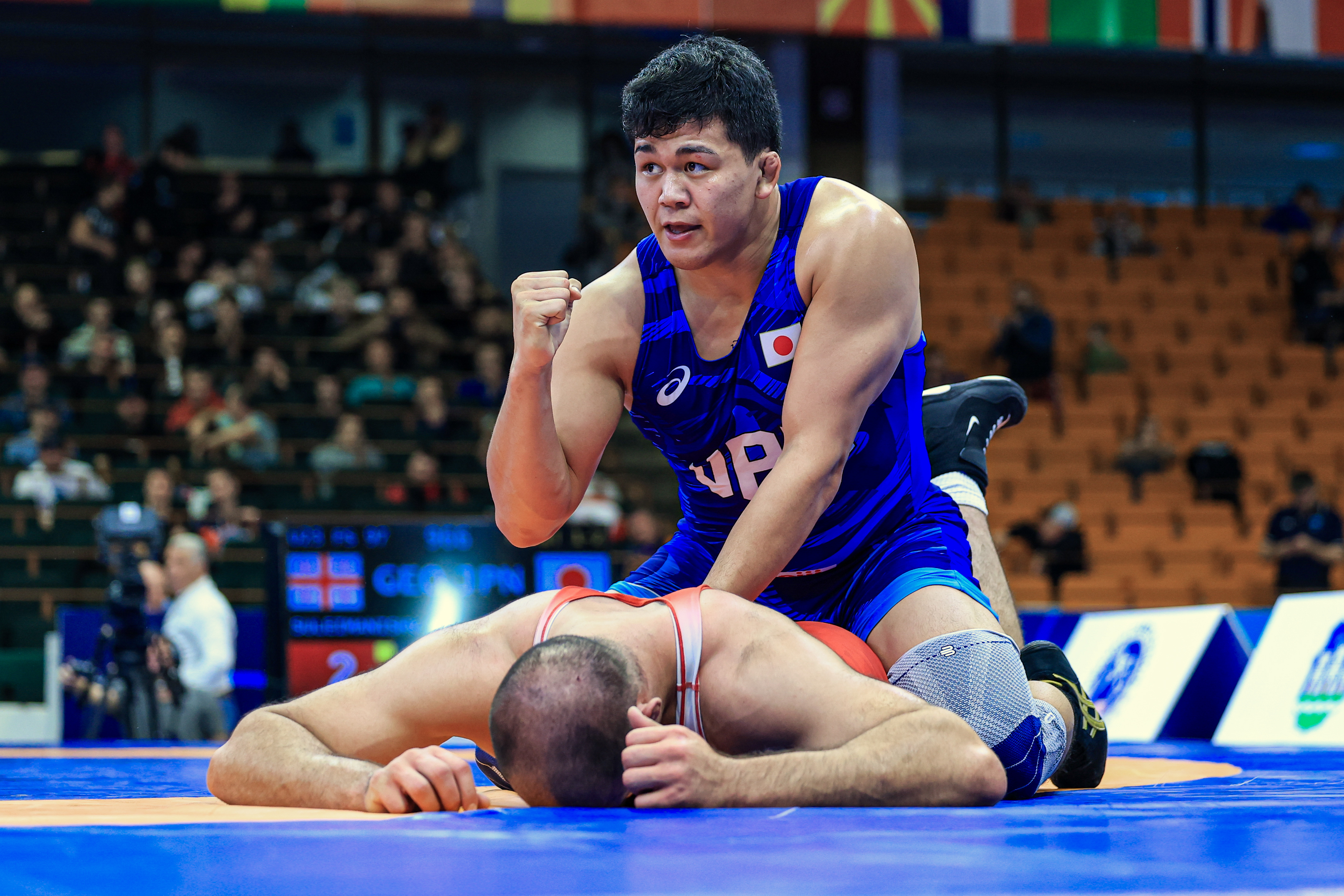 Arash YOSHIDA (JPN) celebrates after beating Merab SULEIMANISHVILI (GEO) in the 97kg final. (Photo: United World Wrestling / Amirreza Aliasgari)
Japan went past Turkiye in the team race by one point, all thanks to Arash YOSHIDA (JPN) winning the gold medal at 97kg by beating Merab SULEIMANISHVILI (GEO), 12-2, in the final.
For a split second Suleimaniashvili was about to pin Yoshida but apart from that, Yoshida never looked in any kind of trouble. His body frame and power were too much for the Georgian who just folded in the battle.
Yoshida managed to score from various position and used the underhook to perfection to earn his first world title.
One of the most dominant wrestlers in this tournament, Arsen BALAIAN (UWW), capped off his incredible run with a 10-0 victory over Eugeniu MIHALCEAN (MDA), 10-0.
RESULTS
61kg
GOLD: Jaxen FORREST (USA) df. Omurbek ASAN UULU (KGZ), 17-14
BRONZE: Akito MUKAIDA (JPN) df. Mykyta ABRAMOV (UKR), 10-0
BRONZE: Tolga OZBEK (TUR) df. Erdal GALIP (BUL), 11-1
65kg
GOLD: SUJEET (IND) df. Umidjon JALOLOV (UZB), 10-0
BRONZE: Bilol SHARIP UULU (KGZ) df. Aykhan ABDULLAZADA (AZE), 10-0
BRONZE: Bashir MAGOMEDOV (UWW) df. Yuto NISHIUCHI (JPN), 7-5
86kg
GOLD: Arsen BALAIAN (UWW) df. Eugeniu MIHALCEAN (MDA), 10-0
BRONZE: Ali TCOKAEV (AZE) df. Tornike SAMKHARADZE (GEO), 13-2
BRONZE: Abolfazl RAHMANI (IRI) df. Rakhim MAGAMADOV (FRA), 7-5
97kg
GOLD: Arash YOSHIDA (JPN) df. Merab SULEIMANISHVILI (GEO), 12-2
BRONZE: Rizabek AITMUKHAN (KAZ) df. Abolfazl BABALOO (IRI), 7-1
BRONZE: Soslan DZHAGAEV (UWW) df. David MCHEDLIDZE (UKR), 4-2

 Over 100 participants competed in the national youth tournament during the
Share your thoughts.
Comments