

Weekly FIVE!

Weekly FIVE! September 10, 2018

By Eric Olanowski

Taking a look at Russia's World Championship team and Hancocks throw heard around the world. Also reviewing Poland Open results and next weeks Junior World Championship schedule. 

1. Russia’s World Team Set After Poland Open 
Four Russian wrestlers headed to Warsaw, Poland with hopes of punching their ticket to Budapest, Hungary, but only two left with a spot on the Russian World Team. 

In the 61kg semifinals, Gadzhimurad RASHIDOV (RUS) beat Magomedrasul IDRISOV (RUS), 2-1 to claim the World Team spot. 

In the finals, Rashidov shutout Kuat AMIRTAYEV (KAZ), 5-0 to claim the Poland Open gold medal. 

Rashidov, the 2017 world runner-up will represent Russia for the second time on the senior-level and for the sixth time overall. 

At 65kg, Akhmed CHAKAEV (RUS) won the ticket to Budapest after European runner-up Ilias BEKBULATOV (RUS) missed weight. 

Chakaev wrestled out the tournament and took first place after Vladimer KHINCHEGASHVILI (GEO) injury defaulted out of the gold-medal bout. 

Russia’s World Team 
57kg - Z. UGUEV 
61kg – G. RASHIDOV 
65kg - A. CHAKAEV 
70kg – M. GAZIMAGOMEDOV 
74kg - Z. SIDAKOV 
79kg -  A. GADZHIMAGOMEDOV
86kg - D. KURUGLIEV 
92kg – B. TSAKULOV 
97kg - A. SADULAEV 
125kg – A. KHIZRIEV 

2. Hancock Sticks Four-time World and Olympic Champion ALEKSANYAN 
Tracy HANCOCK (USA) had the most impressive win of his career in the Poland Open semifinals when he stuck four-time world and Olympic champion, Artur ALEKSANYAN (ARM). 

Hancock, who is wrestling in his first individual international competition since taking tenth place at the U23 World Championships went big in the opening 20 seconds of the semifinal bout and threw the six-time world and Olympic medalist to his back for the fall. 

Hancock went on to score the 7-0 shutout victory over Bulgaria’s Nikolay BAYRYAKOV (BUL) in the 97kg gold-medal bout. 

3. Suchkov defeats Chamzio, Wins #Korkin2018 Gold 
Nikita SUCHKOV (RUS), the Russian Nationals bronze medalist defeated current World No. 1 and two-time world champion, Frank CHAMIZO (ITA), 5-3, claiming the 74kg Dmitri Korkin gold medal. 

Suchkov, who finished behind Zaurbek SIDAKOV (RUS) and Khetik TSBABOLOV (RUS) at Russian Nationals won the Dmitri Korkin for the second year in a row. 

RESULTS 
57kg 
GOLD - Aylar TYUTRIN (RUS) df. Parviz IBRAGIMOV (AZE), 4-1

61kg
GOLD - Akhmednabi GVARZATILOV (AZE) df. TUVSHINTULGA (MGL), 8-4

65kg
Viktor RASSADIN (RUS) df. TULGA (MGL), 4-2 

70kg
GOLD - Evgani ZHERBAEV (RUS) df. BYAMBADORJ Bat-Erdene (MGL), 8-2

74kg 
GOLD - Nikita SUCHKOV (RUS) df. Frank CHAMIZO (ITA), 5-3

79kg
GOLD - Kakhaber KHUBEZHTY (RUS) df. Jumber KYELASHVILI (GEO), 14-4

86kg 
GOLD - Ahmad BAZRIGHOLEI (IRI) df. Arsenali MUSALALIEV (RUS), 4-3

92kg
GOLD - Artur NAIFONOV (RUS) df. Anzor URISHEV (RUS), 3-3

97kg 
GOLD - NURMAGOMED GADZHIEV (AZE) df. ULZISAIKHAN  Batsul (MGL), 10-0

125kg 
GOLD - Komeil GHASEMI (IRI) df. ZOLBOO (MGL), 2-0 
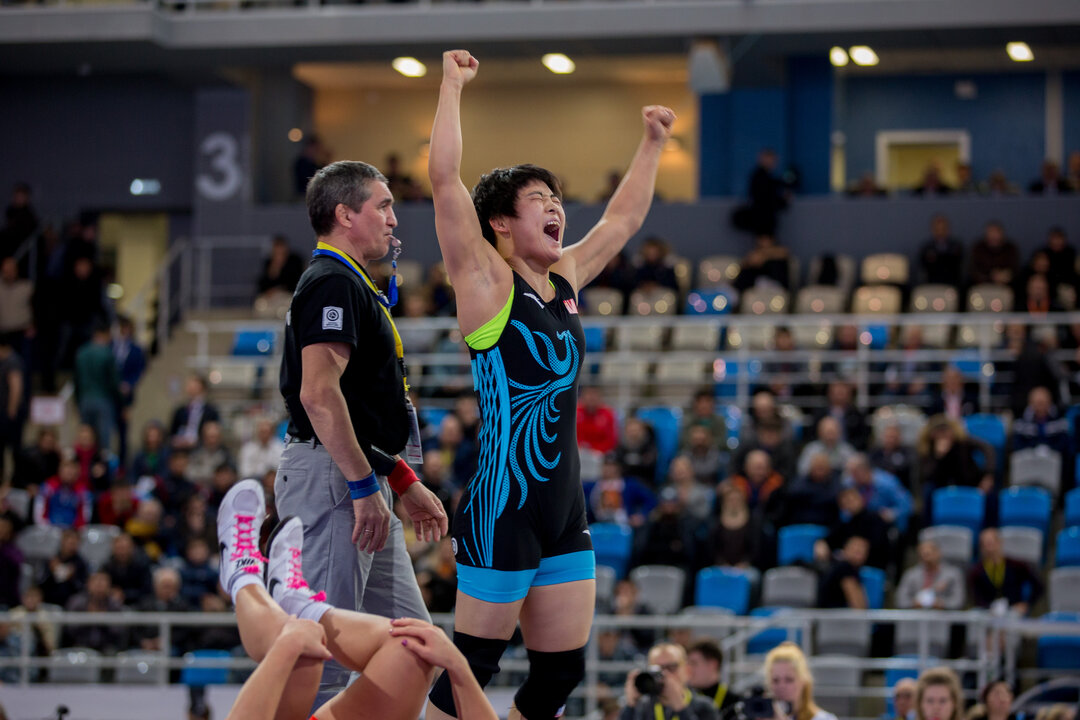
China's RONG Ningning won her fourth gold medal of the year at the Poland Open. (Photo by Max Rose-Fyne) 

4.Rong Wins Second Ranking Series Gold Medal
The final women's wrestling Ranking Series event of the year wrapped up last weekend and China’s RONG Ningning continued her 2018 hot streak and remained undefeated on the year,  winning the 57kg gold medal.

Rong’s win in Warsaw was her second Ranking Series gold medal of the year. She also won the China Open. In addition to her two Ranking Series championships, Rong claimed gold medals at the Ivan Yargin and Asian Championships, while also going undefeated at the World Cup. 

In the 57kg finals, Rong was pitted against Norway’s ninth-ranked Grace BULLEN. Trailing 4-0, the Chinese star went on a 10-0 run and picked up the fall and won her fourth gold medal of the year. 

Women’s Wrestling 
50kg

GOLD -  Mariya STADNIK (AZE) df. Ilona SEMKIV (UKR), 13-2 

53kg
GOLD - Nanami IRIE (JPN) df. Katarzyna KRAWCZYK (POL), 2-2 

55kg
GOLD -  Roksana ZASINA (POL) df. Tetyana KIT (UKR), 6-2 

57kg 
GOLD - Ningning RONG (CHN) df. Grace Jacob BULLEN (NOR), via fall 

59kg
GOLD - Svetlana LIPATOVA (RUS) df. Marwa AMRI (TUN), 3-2  

62kg 
GOLD - Yuliia TKACH OSTAPCHUK (UKR) df. Malin Johanna MATTSSON (SWE), 2-1 

65kg 
GOLD -  Danielle LAPPAGE (CAN) df. Petra Maarit OLLI (FIN), 3-2 

72kg
GOLD -  Agnieszka Jadwiga WIESZCZEK-KORDUS (POL) df. Kunming WANG (CHN), via fall 

68kg 
GOLD - Alla CHERKASOVA (UKR) df. Dalma CANEVA (ITA), 16-5

76kg 
GOLD - Erica WIEBE (CAN) df. Aline FOCKEN (GER), 7-0 
Click HERE for the full recap

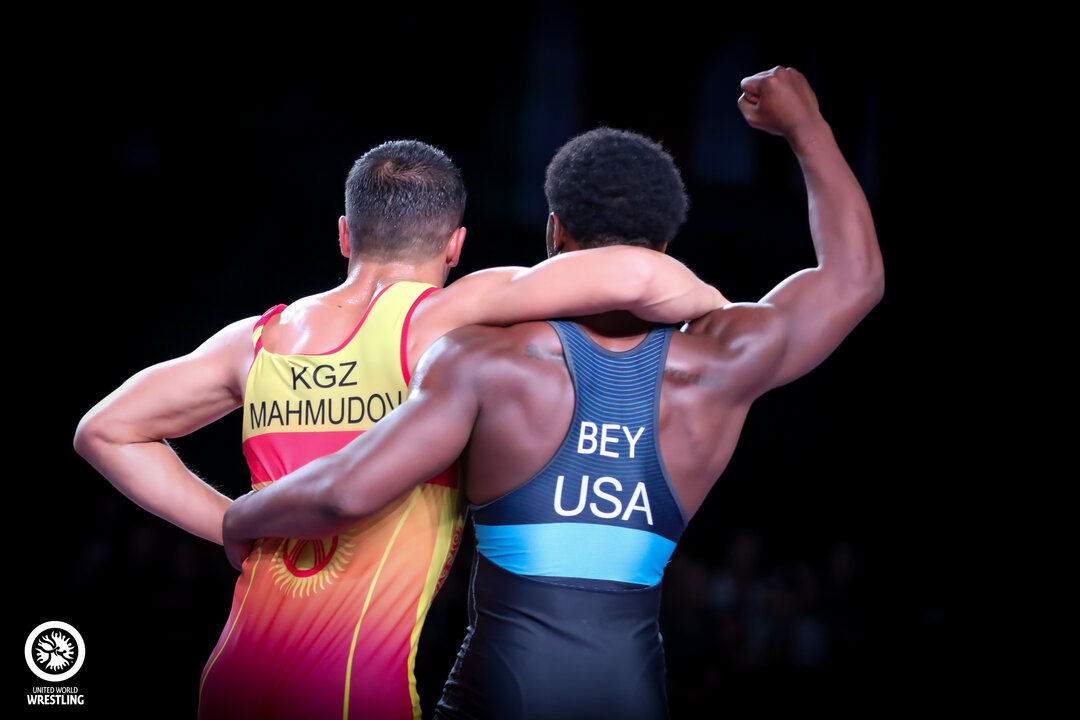
Kamal BEY (USA) and Akzol MAHMUDOV (KGZ) after their epic 2017 finals match-up. (Photo by Marion Stein) 

5. Junior World Championships Are One Week Away 
One week from today, the Junior World Championships will be underway in Trnava, Slovakia. 

Returning Greco-Roman world champions Kamal BEY (USA), Kerem KAMAL (TUR), and Amin KAVIYANINEJAD (IRI) kick off the World Championships on Monday, September 17. 

Reigning women's wrestling world champions, Sae NANJO (JPN) and Khanum VELIEVA (RUS), along with reigning senior-level world champion, Yui SUSAKI (JPN) take the mat on Wednesday, September 19.

Daton FIX (USA) and Gable STEVESON (USA), the duo of American freestyle returning champions will close out the 2018 World Championships beginning on Friday, September 21. 

Click HERE for the full schedule

World Championship Lineups 
Freestyle Lineups
Greco-Roman Lineups 
Women's Wrestling Lineups 

Weekly FIVE! In Social Media 

1. Big Move Monday!

2. Happy Monday, wrestling fans. Have a great week. ?: @mokkdiussh1

3. Great match and amazing action all day in Astana!! @unitedworldgrappling ?? -

4. Superman [wrestling version] ? Супермен [борцовская версия] ? ? @krakatauf #wrestling#superman#борьба#дети

5. Viktor LEBEDEV (RUS) / @lebedev57 and Frank CHAMIZO (ITA) / @frankchamizo92 in Yakutsk, Russia ?? before the Dmitry Korkin (September 6-8). How many world titles are there between these two? (Lebedev is not wrestling)?: @byastin_news . 

Japan Wrestling

Shozo Sasahara, 1956 Olympic champion and former Japan federation president, dies at 93

By Ken Marantz

TOKYO (March 6) --- Hall of Famer Shozo SASAHARA, a gold medalist at the 1956 Melbourne Olympics who went on to become president of the Japan Wrestling Federation and an executive of FILA, the predecessor of UWW, has died of natural causes, the Japan federation announced on Monday. He was 93.

Sasahara, who had suffered a stroke in 2014, won the gold medal in the featherweight class (62kg) of freestyle at the Melbourne Games, where he  served as flag-bearer for Japan in the opening ceremony. Two years earlier, he had won the gold at the World Championships held in Tokyo.

Sasahara became renowned for his pioneering use of legs in what is today referred to as a grapevine, but was reverently termed by the English-speaking press in his prime as "Sasahara's Leg Scissors."

Those would be his lone international triumphs, as he was a late bloomer who only started wrestling after entering Chuo University in Tokyo, having previously competed in judo. He retired after the Melbourne Olympics and would have a long career in business and sports governing.

"He was always a leader in the sports world with ideas and actions that were ahead of the times," current JWF President Hideaki TOMIYAMA said in a statement. "As a wrestler, he was adored by many people from around the world as a pioneer of techniques. It is sad not only for wrestling, but the sports world. I would like to express my sincere condolences."

Sasahara was the national team performance enchancement director when Japan won five gold medals at the 1964 Tokyo Olympics and four at the 1968 Mexico City Olympics. He served as JWF president from 1989 to 2003, and was a director at FILA from 1972 to 1993, during which time he also served as a vice-president.

Sasahara also held the post of vice-president of the Japanese Olympic Committee, and was awarded the Olympic Silver Order by the International Olympic Committee in 1995.

Sasahara was born on July 28, 1929, in Yamagata, the capital city of Yamagata Prefecture in the cold-weather Tohoku region of northern Japan.

According to an account he penned himself in 2005 for a Japan Olympic Committee website series titled "Japanese Olympian Spirits," he said he was in the sixth year of elementary school when World War II broke out, and that inspired him to want a career in international trade, so he enrolled in Yamagata Commercial School for his junior and high school years.

His home was in the north part of the city and the school was four kilometers away in the south. In his third year, he started working at an aircraft factory, which was also four kilometers from his home, so every day for five years until graduation, he had an eight-kilometer round-trip walk. As he needed to learn English, he would carry flash cards and study them as he walked.

At school, judo, kendo (Japanese fencing), and swordsmanship were regular parts of the curriculum, and there was also military training, such as throwing grenades. After the war ended, he would visit a nearby U.S. military base, where he was able to practice his English on a native speaker for the first time, and eventually got a part-time job there.

While at school, Sasahara joined the town's judo club. There, an older teammate said that the university he went to did not have a judo club, so he had switched to wrestling. The friend said Sasahara was perfect for the sport and urged him to try it. Using money he saved from the job on the U.S. base -- and without telling his parents -- he went down to Tokyo to take the entrance exam for Chuo.

As a freshman in the spring of 1950, he started his wrestling career. His first impression of wrestling at Chuo was not good. Blood was splattered on the canvas mat and it smelled of sweat. The mat was hard and wrestlers would sometimes be knocked out. Anyone who skipped practice would be found and beaten. As he had not yet learned the techniques and wasn't physically strong, he thought many times of quitting.

But he didn't give up, and instead drove himself to become better and better. In his second year, he made the finals of several collegiate tournaments, which further encouraged him to  put his full energy into the sport. He would sneak into the other powerhouses of the day, Waseda and Meiji universities, to observe the practices and techniques, and read books written by U.S. coaches. Wrestling became a 24-hour-a-day obsession.

In 1953, he won his first title at the All-Japan Championships, as well as the national collegiate title. After graduating, he captured the world title in May 1954, beating 1952 Helsinki Olympic champion Bayram SIT (TUR), then successfully defended his All-Japan crown.

Sasahara went to Melbourne confident of victory. Japan had only been let back into the Olympics four years earlier in Helsinki, but FILA had been among the first of the individual sports organizations to readmit the nation, in 1949.

International exchanges resumed in 1951. Japanese wrestling was still in the developmental stage, but federation chief Ichiro HATTA saw the exchanges as the optimal path to getting stronger.  Among those who went on a wrestling tour to the United States was Shohachi ISHII, who became Japan's first-ever Olympic wrestling gold medalist in Helsinki. His success, and the speedy moves he brought back from America, served to inspire Sasahara and the others. "If he could do it, we can, too," Sasahara thought.

The team also did tours of the other wrestling powers -- Russia, Iran, Turkey, Bulgaria, Romania -- and Sasahara absorbed it all, which would pay off in gold in Melbourne.

After his triumph, Sasahara, then 27, decided to retire, as he felt he had reached his limit. He noted that it was also a clean way to go out -- from his first All-Japan title to that point, he had won exactly 200 straight matches. He pursued his career in international trade, spending time in America and later importing sporting goods. He was the first to import sports drinks into Japan.

He also got involved in sports organization. He put Japan wrestling's flop at the 1960 Rome Olympics down to poor training and nutrition, which would lead to him to help establish a government-back organization in 1976 to improve the general health and conditioning of athletes.

In one of his last public appearances, Sasahara donated his Olympic gold medal to his high school alma mater in October 2018.