

Top Stories of the Decade

Wrestling Fights its Way Back onto Olympic Programme

By Tim Foley

United World Wrestling President Nenad Lalovic speaks at the 125th IOC Session (AP Photo/Victor R. Caivano)

CORSIER-SUR-VEVEY, Switzerland (January 3) – The news spread quickly. On the morning of February 12, 2013, the International Olympic Committee Executive Board voted that wrestling be eliminated from the Olympic Programme. The 2016 Rio Olympic Games would be the sport’s last as a member of the Olympic family.

By early afternoon stories had run on every major international wire and sports website informing the worldwide wrestling community of the sport’s unlikely elimination from the Olympic Games. With the information came an immediate and worldwide mobilization effort aimed at earning back wrestling’s position on the Olympic programme.

Reacting to the news, the FILA bureau met in Thailand to decide next steps. It was apparent that there had been missed signs and opportunities for organizational improvement and the bureau moved quickly to elect a new president, ultimately choosing Serbian businessman Nenad Lalovic. Two months later Lalovic was elected interim president during an extraordinary Congress in Moscow and set the tone of hard work and cooperation that would ultimately prove successful in helping the sport recapture its spot in the Olympic Games.

“What goes on in this room today and the days that follow will determine if we are an Olympic sport after 2016. We have been given a strong message by the IOC.  How we answer that message will determine if our future includes the Olympic Games.  We need to convince the IOC that we will listen to them.  We are strong enough to change,” said Lalovic.

By June there were promotional events being held around the globe. In Japan a petition was signed with more than 1 million signatures. The United States and Russia raised millions of dollars to ensure additional promotion of values, consultation for a reshaping of the sport, and the creation of marketing and media departments.

In the midst of the upheaval the wrestling community had been given an opportunity. Shortly after the 125th IOC Session in September 2013 -- where members would vote to eliminate wrestling -- there would be a second vote allowing a new sport to earn its place on the programme. Wrestling was eligible for that slot, which allowed Lalovic and the wrestling community to focus its campaign on earning enough votes to win back the sport’s position in the Olympic Games.

The IOC has requests and Lalovic -- along with newly inspired cadre of wrestling leaders -- made the changes required to comply with good governance. One of the most pressing requests was that an effort be made for greater gender equity. Wrestling answered by expanding women’s wrestling to six weight categories to match with both Greco-Roman and men’s freestyle.

Competition rules were deemed too complicated for fans to follow so a new set was developed which simplified and focused action.

Women needed more representation in leadership positions. The referee body was to be separated from bureau control. Anti-doping education and enforcement were increased, and sport presentation was professionalized. As overhauls go, the renovation for wrestling would need to be complete.

On September 8, 2013 the 125th IOC Session took account of wrestling’s myriad initiatives and improvements and voted on whether or not to allow the sport back on to the programme for 2020 and beyond.

Wrestling – who faced competing bids from Squash and Baseball/Softball -- received 49 votes in the first ballot, which was enough to be awarded its position back in the Olympic Games.

"Today is the most important day in the 2,000-year history of our sport," Lalovic told the media in 2013. "We feel the weight of that history. Remaining on the Olympic programme is crucial to wrestling's survival."

From left to right: Jim Scherr, Daniel Igali, Lise Legrand, Carol Huynh and Nenad Lalovic were instrumental in getting wrestling back on the Olympic Programme (AP Photo/Victor R. Caivano)

With the vote wrestling returned to the Olympics, but the energy -- the drive the change --wasn’t to wane.

"With this vote, you have shown that the steps we have taken to improve our sport have made a difference,” Lalovic said in addressing media after the 2013 vote. "I assure each of you that our modernization will not stop now. We will continue to strive to be the best partner to the Olympic movement that we can be."

Since 2013 the sport has continued to improve, develop, and grow. From a modernized development department to the inclusion of more women in leadership positions, and the signing of partnership, sponsor, TV and streaming deals –progress and innovation are at the center of the sport’s future.

FILA is now ‘United World Wrestling’ an organization with fresh branding and worldwide marketing initiatives. Gone are the yellow mats, replaced with eye-friendly deep blue with orange accents. The new rules are still creating some of the most entertaining sporting moments in the world, and more women have become top-of-the-fold superstars both inside the wrestling community and in the wider sports media.

United World Wrestling President Nenad Lalovic was elected to the same IOC executive board that had voted to eliminate the sport only five years before

President Lalovic has increased participation United World Wrestling’s cooperation with the IOC and was added as a member in 2015. In 2018 he was elected to the same IOC executive board that had voted to eliminate the sport only five years before.

“We can never forget the mistakes of our past,” said Lalovic. “But at the end of the decade it’s impossible to not feel optimistic. Our sport is the strongest it’s ever been, and we are excited for the 20’s so we can showcase our wrestlers in Tokyo, Paris, and Los Angeles. Wrestling is now and will always be part of the Olympic programme.”
#Grappling

Poland Steals Grappling Team Title from Russia

By Vinay Siwach

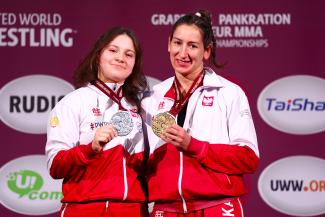
YEREVAN, Armenia (May 28) -- Led by former world medalist Justyna SITKO (POL), Poland pipped Russia by a point to win the the women's Grappling team title at the European Championships in Yerevan, Armenia.

In five weight classes in action, Poland and Russia both won two golds but the former had better results in the weight classes it did not win the gold to score 89 points to Russia's 88 points. The fifth gold went to Spain as world champion Carlota PRENDES (ESP) won at 53kg.

Sitko, in a round-robin bracket with four other grapplers, began with a 9-2 victory over Kseniia BUSHKOVA (RUS) before submitting Sara BORTOLAMIOL (ITA) in Round 2. A 7-3 win over Vlada BOIAKHCHIEVA (RUS) and then a submission of compatriot Maja SALAMON (POL) sealed the gold medal for Sitko at 90kg.

The second gold medal for Poland was won by Martyna KAPUSCINSKA (POL) at 71kg after she secured a victory by decision over Snezhana MORAR (UKR) in the final.

Until the last two weight classes, Russia on a rampage. After dominating through the rounds, Olesia ZHURAVLEVA (RUS) met world champion Daria BRZOZOWSKA (POL) in the semifinals and won 2-1. She defeated Emma ROSINI (ITA), 6-2, in the final to win the 58kg gold medal.

Soon after, Alsu IANSHINA (RUS) worked on a submission on Liudmyla TSALAI (UKR) in the 64kg to win in just over four minutes and claim the second gold medal for Russia.

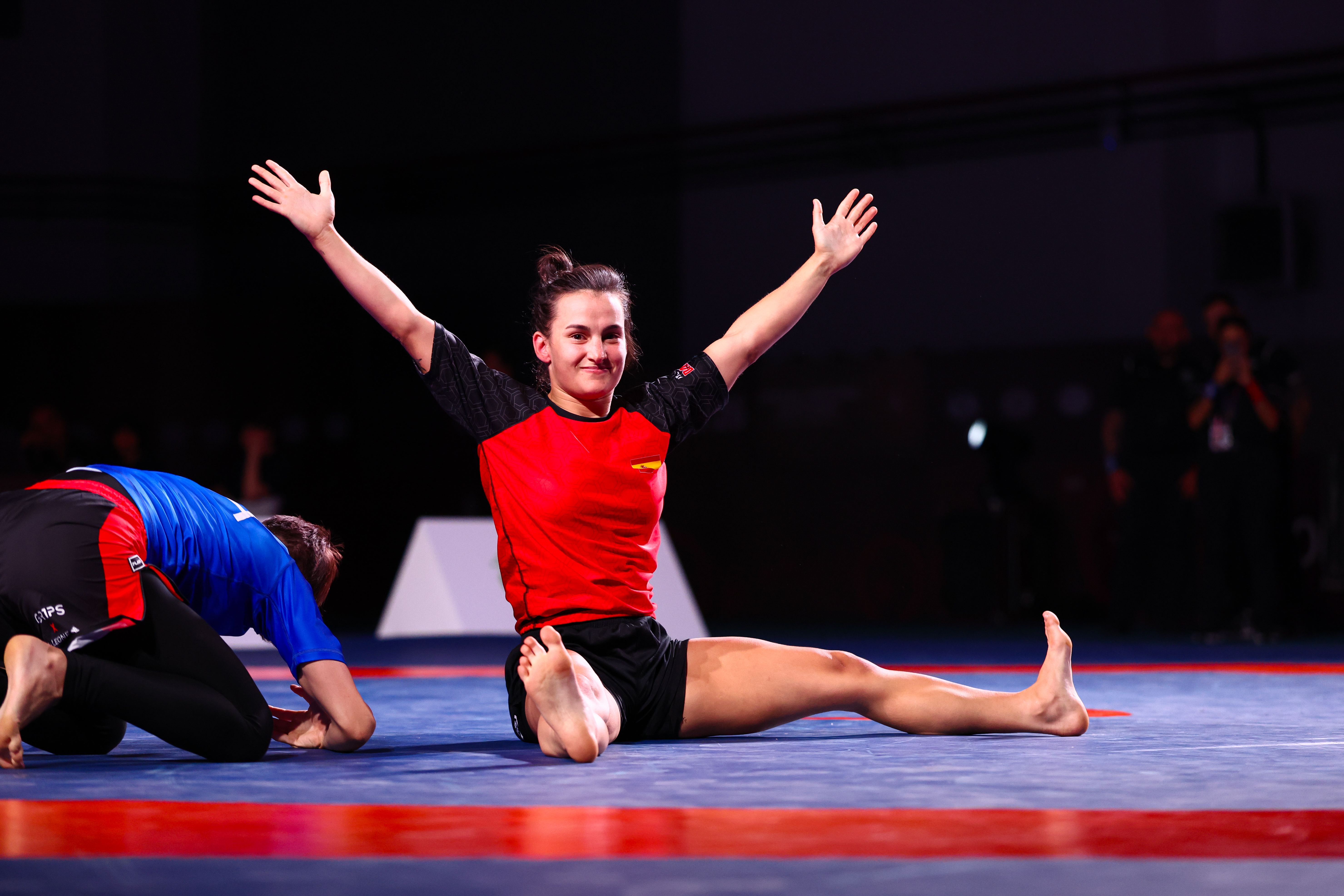
Carlota PRENDES (ESP)World champion Carlota PRENDES (ESP) is now a European champion as well. (Photo: United World Wrestling / Jake Kirkman) 

At 53kg, Prendes once again dominated on the mat, winning yet another gold medal in a United World Wrestling competition. Her loss came in 2023 but since then, she has won four world titles, two each in Grappling and Grappling Gi.

At the European Championships, she won all four of her bouts via submission including a 51-second submission from Giulia ANGIOLINI (ITA) in the final.

Russia Wins Six Golds

In men's Grappling at the European Championships, Russia dominated its way to the team title. It scored 190 points and won six gold medals to finish at the top. Poland was second with 121 points while Spain was third with 86 points.

The Russian team with a mix of experience of youth, ran through its opposition especially two teenagers Shamil GUSEINOV (RUS) at 71kg and Aleksandr KARPENKOV (RUS) at 77kg, both winning gold.

But the gold rush began at 62kg, when Ruslan RADZHABKHANOV (RUS) won gold with a 3-0 decision over compatriot Igor KUZURGASHEV (RUS) in the final. In a low-scoring final, Radzhabkhanov controlled the bout for the entirety of the match.

At 66kg, Magomed SHAKHBANOV (RUS) was up against Yurii CHERKALIUK (UKR) in the final and after getting three points for Cherkaliuk's passivities, Shakhbanov scored a takedown for two points before being awarded three points for control in his 8-0 victory.

Guseinov was facing former world champion Iker CAMARA (ESP) in the final and rocked the arena with a 46-second fall over the Spaniard. He used a front headlock to secure the fall and claim the gold medal at 71kg.

Karpenkov at 77kg had to fight it out against Gazimagomed GAZIEV (RUS) in the final. He opened a 3-0 lead but was penalised twice for stalling as Gaziev closed the gap to 3-2. But as the clock expired, Gaziev challenged for control points but lost it which gave two more points to Karpenkov as he won 5-2.

World champion Mukamed URUSOV (RUS) gave no chance to Aleksandre TEVZADZE (GEO), winning the 100kg final 7-0 with ease. He scored three pushouts in standing to lead 3-0 before score two control takedowns to earn four points and the victory.

A world champion in Grappling Gi, Bilal KURBABAGAMAEV (RUS) earned the title of European champion at 130kg in Grappling after winning gold in Yerevan. After running through the Nordic bracket, he got a walkover from Eldar RAFIGAEV (MDA) in the final.

The remaining three golds were shared by Poland and host Armenia. Former European champion Mateusz MAZUR (POL) won the 92kg title with a 5-2 victory over Alibek SULEIMANOV (RUS) while Sebastian PATYK (POL) won 6-0 against Davud MAGOMEDOV (RUS) in the 84kg weight class.

Armenia's golden grappler was Razmik MISAKYAN (ARM) who held on for a tight 2-0 win over Alejandro REYES RODRIGUEZE (ESP) in the 58kg final.

RESULTS

Men's Grappling

58kg
GOLD: Razmik MISAKYAN (ARM) df. Alejandro REYES RODRIGUEZE (ESP), 2-0

BRONZE: Jakub BARDEN (POL) df. Zakhar DREMLIUHA (UKR), 6-5

62kg
GOLD: Ruslan RADZHABKHANOV (RUS) df. Igor KUZURGASHEV (RUS), 3-0

BRONZE: Mateusz HALAS (POL) df. Andrii TSVYK (UKR), 6-3
BRONZE: Loris ZANOLINI (ITA) df. Dmytro BARANOV (UKR), via submission (7-2)

66kg
GOLD: Magomed SHAKHBANOV (RUS) df. Yurii CHERKALIUK (UKR), 8-0

BRONZE: Mykhailo KAZYMERCHUK (UKR) df. Narek AYVAZYAN (ARM), via decision
BRONZE: Magomed KHIRAMAGOMEDOV (RUS) df. Maximilian REIFF (GER), via submission

71kg
GOLD: Shamil GUSEINOV (RUS) df. Iker CAMARA DOMINGUEZ (ESP), via submission (0-0)

BRONZE: Dzhimsher RAZMADZE (GEO) df. Avelino SANTOS RODRIGUEZ (ESP), via submission (5-3)
BRONZE: Kurban KADIEV (RUS) df. Artur GHERGHILINIC (MDA), 4-0

77kg
GOLD: Aleksandr KARPENKOV (RUS) df. Gazimagomed GAZIEV (RUS), 5-2

BRONZE: Jakub NAJDEK (POL) df. Illia SUKHODIEIEV (UKR), 5-2
BRONZE: Ouassim ADREUACH IDRISSI (ESP) df. Nahapet EKIZYAN (ARM), 7-4

84kg
GOLD: Sebastian PATYK (POL) df. Davud MAGOMEDOV (RUS), 6-0

BRONZE: Cristian TUGULEA (MDA) df. Suren KHURDAYAN (ARM), via submission
BRONZE: Christian FRILLICI (ITA) df. Roger DOMINGUEZ LOPEZ (ESP), 2-1

92kg
GOLD: Mateusz MAZUR (POL) df. Alibek SULEIMANOV (RUS), 5-2

BRONZE: Muslim MALSAGOV (RUS) df. Amirani SVIMONISHVILI (GEO), 8-0
BRONZE: Pablo ESTEPA NIETO (ESP) df. Joris ROOKHUIJZEN (NED), 4-2

100kg
GOLD: Mukhamed URUSOV (RUS) df. Aleksandre TEVZADZE (GEO), 7-0

BRONZE: Antonio SALTUPS CARETTO (ITA) df. Misha DILANYAN (ARM), via submission (6-0)

130kg
GOLD: Bilal KURBABAGAMAEV (RUS) df. Eldar RAFIGAEV (MDA), via decision

BRONZE: Aleksander KOLDOVSKI (UKR) df. Liviu MALUDA (MDA), 5-3

Women's Grappling

53kg
GOLD: Carlota PRENDES LARIOS (ESP) df. Giulia ANGIOLINI (ITA), via submission (2-0)

BRONZE: Natalia JAKUBOWICZ (POL) df. Sylwia WELC (POL), via submission (7-0)
BRONZE: Viktoriia ISAIEVA (UKR) df. Evelina FLORIAK (UKR), via submission (6-2)

58kg
GOLD: Olesia ZHURAVLEVA (RUS) df. Emma ROSINI (ITA), 6-2

BRONZE: Daria BRZOZOWSKA (POL) df. Alicja STYPULKOWSKA (POL), via submission (10-0)

64kg
GOLD: Alsu IANSHINA (RUS) df. Liudmyla TSALAI (UKR), via submission (5-1)

BRONZE: Raluca ROSCA (ITA) df. Mendy MACATIS (GER), 6-2

71kg
GOLD: Martyna KAPUSCINSKA (POL) df. Snezhana MORAR (UKR), via decision

BRONZE: Anna REMNEVA (RUS) df. Valentina PAVLOVA (RUS), 3-2

90kg
GOLD: Justyna SITKO (POL)
SILVER: Maja SALAMON (POL)
BRONZE: Vlada BOIAKHCHIEVA (RUS)