

Top Stories of the Decade

Wrestling Fights its Way Back onto Olympic Programme

By Tim Foley

United World Wrestling President Nenad Lalovic speaks at the 125th IOC Session (AP Photo/Victor R. Caivano)

CORSIER-SUR-VEVEY, Switzerland (January 3) – The news spread quickly. On the morning of February 12, 2013, the International Olympic Committee Executive Board voted that wrestling be eliminated from the Olympic Programme. The 2016 Rio Olympic Games would be the sport’s last as a member of the Olympic family.

By early afternoon stories had run on every major international wire and sports website informing the worldwide wrestling community of the sport’s unlikely elimination from the Olympic Games. With the information came an immediate and worldwide mobilization effort aimed at earning back wrestling’s position on the Olympic programme.

Reacting to the news, the FILA bureau met in Thailand to decide next steps. It was apparent that there had been missed signs and opportunities for organizational improvement and the bureau moved quickly to elect a new president, ultimately choosing Serbian businessman Nenad Lalovic. Two months later Lalovic was elected interim president during an extraordinary Congress in Moscow and set the tone of hard work and cooperation that would ultimately prove successful in helping the sport recapture its spot in the Olympic Games.

“What goes on in this room today and the days that follow will determine if we are an Olympic sport after 2016. We have been given a strong message by the IOC.  How we answer that message will determine if our future includes the Olympic Games.  We need to convince the IOC that we will listen to them.  We are strong enough to change,” said Lalovic.

By June there were promotional events being held around the globe. In Japan a petition was signed with more than 1 million signatures. The United States and Russia raised millions of dollars to ensure additional promotion of values, consultation for a reshaping of the sport, and the creation of marketing and media departments.

In the midst of the upheaval the wrestling community had been given an opportunity. Shortly after the 125th IOC Session in September 2013 -- where members would vote to eliminate wrestling -- there would be a second vote allowing a new sport to earn its place on the programme. Wrestling was eligible for that slot, which allowed Lalovic and the wrestling community to focus its campaign on earning enough votes to win back the sport’s position in the Olympic Games.

The IOC has requests and Lalovic -- along with newly inspired cadre of wrestling leaders -- made the changes required to comply with good governance. One of the most pressing requests was that an effort be made for greater gender equity. Wrestling answered by expanding women’s wrestling to six weight categories to match with both Greco-Roman and men’s freestyle.

Competition rules were deemed too complicated for fans to follow so a new set was developed which simplified and focused action.

Women needed more representation in leadership positions. The referee body was to be separated from bureau control. Anti-doping education and enforcement were increased, and sport presentation was professionalized. As overhauls go, the renovation for wrestling would need to be complete.

On September 8, 2013 the 125th IOC Session took account of wrestling’s myriad initiatives and improvements and voted on whether or not to allow the sport back on to the programme for 2020 and beyond.

Wrestling – who faced competing bids from Squash and Baseball/Softball -- received 49 votes in the first ballot, which was enough to be awarded its position back in the Olympic Games.

"Today is the most important day in the 2,000-year history of our sport," Lalovic told the media in 2013. "We feel the weight of that history. Remaining on the Olympic programme is crucial to wrestling's survival."

From left to right: Jim Scherr, Daniel Igali, Lise Legrand, Carol Huynh and Nenad Lalovic were instrumental in getting wrestling back on the Olympic Programme (AP Photo/Victor R. Caivano)

With the vote wrestling returned to the Olympics, but the energy -- the drive the change --wasn’t to wane.

"With this vote, you have shown that the steps we have taken to improve our sport have made a difference,” Lalovic said in addressing media after the 2013 vote. "I assure each of you that our modernization will not stop now. We will continue to strive to be the best partner to the Olympic movement that we can be."

Since 2013 the sport has continued to improve, develop, and grow. From a modernized development department to the inclusion of more women in leadership positions, and the signing of partnership, sponsor, TV and streaming deals –progress and innovation are at the center of the sport’s future.

FILA is now ‘United World Wrestling’ an organization with fresh branding and worldwide marketing initiatives. Gone are the yellow mats, replaced with eye-friendly deep blue with orange accents. The new rules are still creating some of the most entertaining sporting moments in the world, and more women have become top-of-the-fold superstars both inside the wrestling community and in the wider sports media.

United World Wrestling President Nenad Lalovic was elected to the same IOC executive board that had voted to eliminate the sport only five years before

President Lalovic has increased participation United World Wrestling’s cooperation with the IOC and was added as a member in 2015. In 2018 he was elected to the same IOC executive board that had voted to eliminate the sport only five years before.

“We can never forget the mistakes of our past,” said Lalovic. “But at the end of the decade it’s impossible to not feel optimistic. Our sport is the strongest it’s ever been, and we are excited for the 20’s so we can showcase our wrestlers in Tokyo, Paris, and Los Angeles. Wrestling is now and will always be part of the Olympic programme.”

#WrestleBudapest

Ranking Series: Double delight for Japan, Sujeet gives India gold

By Vinay Siwach

BUDAPEST, Hungary (July 17) -- Asian champion Takara SUDA (JPN) and world silver medalist Yoshinosuke AOYAGI (JPN) showed on Thursday why they will be prime contenders for gold medal at the World Championships in Zagreb in September.

Suda and Aoyagi earned two gold medals at 61kg and 70kg respectively, and reminded the world about Freestyle powerhouse Yamanashi Gakuin University in Japan.

Suda, who has not lost a match this year, won his second Ranking Series gold medal in 2025, adding to his gold from Tirana. But he needed a big comeback in the 61kg final against Taiyrbek ZHUMASHBEK UULU (KGZ) in the dying seconds, winning 5-3.

Zhumashbek Uulu led 3-1 with 13 seconds remaining in the match when Suda used a snap to off balance Zhumashbek Uulu and go behind. He tried a takedown but then switches the direction and brings Zhumashbek Uulu to the mat, back first.

Zhumashbek Uulu tried to defend it with a whizzer but failed and Suda turned on his head without any danger to get the two points and win 3-3 on criteria. Kyrgyzstan challenged the call but on review, Suda was awarded four points and the scored changed to a 5-3 win for the Japanese.

In February, Suda won the gold medal in Tirana after an 8-8 victory over Nachyn MONGUSH (UWW) and then won the Asian Championships gold medal over UDIT (IND) 6-4 in March.

Zhumashbek Uulu, who won Mongolian Open in June at 65kg, returned to 61kg after an year of competing at 65kg. He defeated Udit earlier in the day and reached the final but failed to cross the final hurdle.

With the win, Suda has clearly shown signs that he will be a gold-medal threat in Zagreb at 61kg, a weight class won by his high school and university teammate Masanosuke ONO (JPN) in 2024.

Aoyagi, who had also won gold medal in Tirana, was more dominant in his gold medal run. In Tirana, European silver medalist Arman ANDREASYAN (ARM) had pulled out injured in the final.

Incidentally, he made the final against Aoyagi in Budapest on Thursday and this time he decided to wrestler. However, the winner was the same.

Aoyagi used a head-in-the-hole move to score four points in his 8-0 victory in the final of the 70kg weight class. Andreasyan had no answer to Aoyagi's attack despite being in advantageous positions during the final.

The Armenian was put on the activity clock during which he failed to score and gave up four points. Aoyagi, leading 5-0, won a challenge when Andreasyan was awarded two points for a takedown but on review, it was clear that Andreasyan had both his feet outside before completing a takedown.

With a 6-0 lead, Aoyagi scored a beautiful duck-under for two points and lead 8-0, the final score for the winner.

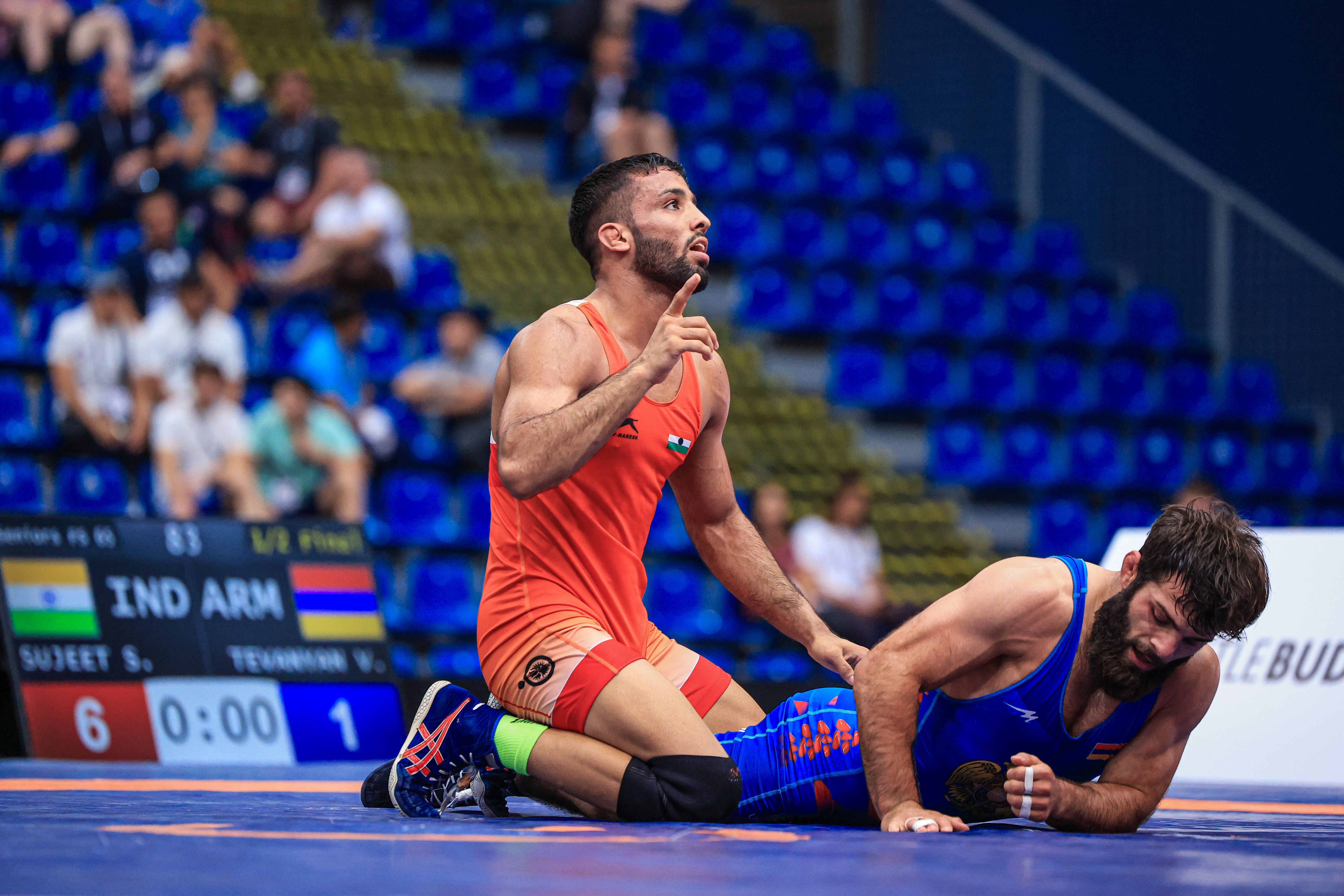
SUJEET (IND)SUJEET (IND) celebrates after beating Vazgen TEVANYAN (ARM) in the 65kg semifinal. (Photo: United World Wrestling / Amirreza Aliasgari)

Sujeet ends Indian drought

India failed to win any gold medals at the senior level in 2025 as it drew blank at the Asian Championships in March and Mongolian Open in June. However, Asian U23 champion SUJEET (IND) ended that curse for India by winning the 65kg gold medal in Budapest.

While he has age-group world and continental medals, Sujeet's run in Budapest and gold medal can be considered his biggest medal yet as he defeated Paris bronze medalist Islam DUDAEV (ALB) in the first bout, European U23 silver medalist Khamzat ARSAMERZOUEV (FRA) in the quarterfinal and world medalist Vazgen TEVANYAN (ARM) in the semifinal.

Ali RAHIMZADE (AZE) was up in the final and Sujeet, who showed glimpses of Tokyo bronze medalist Bajrang PUNIA (IND), made sure he doesn't let his guard down in the last match.

Sujeet conceded an activity point in the first period and was down 1-0 at the break against Rahimzade. But as soon as the second period began, Sujeet put pressure on Rahimzade, who kept dropping on his knees in the zone to avoid the pushout.

But Sujeet did not back down and scored a takedown when Rahimzade was on the activity clock. Leading 3-1, Sujeet added another takedown and completed a 5-1 victory over Rahimzade and captured the gold medal, his first of Ranking Series events.

At 57kg, world U20 champion Luke LILLEDAHL (USA) needed three straight comebacks to win the gold medal. He defeated Islam BAZARGANOV (AZE) 3-1 in the final to capture his first gold at the senior level.

Lilledahl scored a takedown using a reattack with 20 seconds remaining in the match against Bazarganov to clinch a 3-1 win. His semifinal victory over RAHUL (IND) was even more dramatic as he managed to come back from 6-2.

Rahul used a leg-turk to score six point and lead 6-2 but Lilledahl scored a stepout and then blocked an attempted duck-under and put Rahul's back on the mat for two points. In the final 20 seconds, he threw off Rahul when the Indian was trying to hit a double-leg attack and won 7-6. In his first bout of the day, he scored a pushout with just 0.01 seconds left on the clock and dashed the dreams of Niklas STECHELE (GER).

World silver medalist Vladimeri GAMKRELIDZE (GEO) returned to 79kg from 86kg and instantly showed results, winning the gold medal in Budapest. He blanked Magomet EVLOEV (TJK), 5-0, in the final

At 125kg, Bahrain won its second gold of the tournament as Shamil SHARIPOV (BRN) defeated Dzianis KHRAMIANKOU (UWW), 5-3.

Photo

RESULTS

57kg
GOLD: Luke LILLEDAHL (USA) df. Islam BAZARGANOV (AZE), 3-1

BRONZE: RAHUL (IND) df. Niklas STECHELE (GER), 4-0
BRONZE: Aryan TSIUTRYN (UWW) df. Roberti DINGASHVILI (GEO), 10-0

61kg
GOLD: Takara SUDA (JPN) df. Taiyrbek ZHUMASHBEK UULU (KGZ), 5-3

BRONZE: Bekzat ALMAZ UULU (KGZ) df. Emrah ORMANOGLU (TUR), 4-3
BRONZE: Assylzhan YESSENGELDI (KAZ) df. Giorgi GONIASHVILI (GEO), 10-0

65kg
GOLD: SUJEET (IND) df. Ali RAHIMZADE (AZE), 5-1

BRONZE: Goderdzi DZEBISASHVILI (GEO) df. Alibeg ALIBEGOV (BRN), 7-7
BRONZE: Vazgen TEVANYAN (ARM) df. Khamzat ARSAMERZOUEV (FRA), 9-0

70kg
GOLD: Yoshinosuke AOYAGI (JPN) df. Arman ANDREASYAN (ARM), 8-0

BRONZE: Sina KHALILI (IRI) df. Austin GOMEZ (MEX), via inj. def.
BRONZE: Akaki KEMERTELIDZE (GEO) df. Abbas EBRAHIM (IRI), 11-4

79kg
GOLD: Vladimeri GAMKRELIDZE (GEO) df. Magomet EVLOEV (TJK), 5-0

BRONZE: Georgios KOUGIOUMTSIDIS (GRE) df. Lucas KAHNT (GER), 10-0
BRONZE: Fariborz BABAEI (IRI) df. Bolat SAKAYEV (KAZ), 2-0

97kg
GOLD: Akhmed TAZHUDINOV (BRN) df. Zbigniew BARANOWSKI (POL), 11-0

BRONZE: Jonathan AIELLO (USA) df. Juhwan SEO (KOR), 10-0
BRONZE: Adlan VISKHANOV (FRA) df. Merab SULEIMANISHVILI (GEO), 9-4

125kg
GOLD: Shamil SHARIPOV (BRN) df. Dzianis KHRAMIANKOU (UWW), 5-3

BRONZE: Robert BARAN (POL) df. Demetrius THOMAS (USA), 6-0
BRONZE: Alen KHUBULOV (BUL) df. Vladislav BAJCAJEV (HUN), 3-0