

Yazdani Interview: 'Changing Weight Classes Difficult, But Ready for 97kg Challenge'
Saturday, June 20, 2026 - 06:27 By
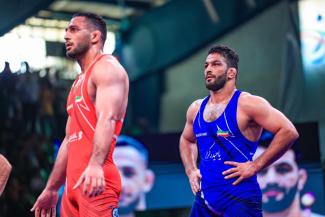
- By Amirreza ALIASGARI
KEMRAN, Iran (July 19) -- Hassan YAZDANI (IRI) made his eighth World Championships for Iran on Friday after beating Amirali AZARPIRA (IRI), 4-2 and 5-3, in two straight matches at 97kg.
In 2015, Yazdani was at 70kg and won a silver medal at his debut World Championships. For a decade, he spent his wrestling career at 86kg, winning two Olympic silver medals, three world titles, two world silver and one bronze medal.
Now at 97kg after two shoulder surgeries, a 31-year-old Yazdani is adjusting to the new weight class. As he returns to the World Championships after three years, Yazdani will be chasing his eighth medal and fourth title.
After making the Iran team for the World Championships, to be held in Astana from October 24 to November 1, Yazdani spoke to United World Wrestling about the challenges of 97kg, returning to the World Championships and how his body is holding up.
Excerpts:
- How are you feeling physically after the two tough matches?
Yazdani: I’ve improved in some areas, especially when it comes to my breathing and conditioning. But we didn’t really have enough time to focus on strength training, so we worked on that a bit less than we wanted to. With the time that’s left until the World Championships, I’m going to do everything I can to get myself in the best shape possible and be even better prepared.
- How prepared were you for the wrestle-off against Amirali AZARPIRA (IRI)?
Yazdani: For these competitions, I’d say I was about 70 percent ready. It’s hard to be 100 precent prepared for a tournament like this, but by the time the World Championships come around, I’ll definitely be in better shape and more prepared.
- What are your thoughts on competing at 97kg, a weight class that may have four Olympic champions in Astana?
Yazdani: The 97kg weight class is new for me, and of course I have new opponents now. It’s quite different from 86kg. I hope I can put on a good performance in this weight class as well. There are a lot of great champions here, and I hope I get the chance to wrestle against them, challenge myself, and show my best wrestling at the World Championships.
- But will it be challenging for your to be at the top at this weight class?
Yazdani: I already knew how many top wrestlers compete in this weight class. Considering my physical condition, I decided last year to move up to 97kg. Since it’s also an Olympic weight class, I wanted to make the move early so I’d have enough time to fix any weaknesses and adapt before the Olympics. My goal is to be at my very best for both the Olympics and the World Championships, which are just as important.
I wanted to move up sooner so I could get comfortable in this weight class as quickly as possible. Once you get to around 30 years old, things naturally become a little more difficult, and changing weight classes isn’t as easy as it used to be. There are definitely challenges at 97kg, and I’ve thought about all of them. Hopefully, I’ll be able to put on my best performance and come away with a great result.
Share your thoughts.
Comments