

#WrestleZagreb

Zagreb Open Best Move: Blades Suplex

By Vinay Siwach

ZAGREB, Croatia (February 14) -- Kennedy BLADES (USA) is making the suplex her own. After thrilling a packed Champs de Mars Arena with a majestic suplex at the Paris Olympics, the 21-year-old star began her 2025 season with two of them at the Zagreb Open last week.

"When I get behind, in my mind, I am like I have to execute this because it's so rare to hit a suplex," Blades said in Zagreb. "So every time I get behind in matches or big stages, I try to hit the suplex. I want to do it at the world stage because I know it will be on the highlights."

At the Zagreb Open, Blades was at 68kg, two weight classes down from 76kg, in which she won the silver medal at the Paris Games. She debuted at 68kg with a fall over Kendra DACHER (FRA) and another fall over world bronze medalist Adela HANZLICKOVA (CZE).

The first glimpse of her suplex in the match against Noémi SZABADOS (HUN). Close to a minute had gone in the bout when Blades used her reach for a outside single-leg. Instead of going for a takedown, she stood up and locked Szabados from behind and out came the throw.

However, the perfect arch was missing and it was awarded four points.

Blades wasn't satisfied. In Round 5 and leading 7-0, Blades countered Karolina POK (HUN) in a perfect set up for a suplex. Pok made a half-hearted attempt for a headlock but Blades snuck out and moved behind.

Pok knew it was coming. She did not resist and Blades did not relent. A picture-perfect arch, a beautiful throw, safe landing and a cheeky smile at the end. Blades was content.

"I just feel like when someone gets a headlock, they probably have to throw it really hard because growing up, I used to wrestle Greco in the summer," she said. "So my coach always taught us how to set up the suplex if they grab your head for a headlock and they don't go. When someone gets in a headlock position and they don't go super hard, then the suplex is there. If I would ever be in that position, I just go flat because I know that they can probably throw me. "

While it has become relatively easy for Blades to throw her opponents at 68kg, she still needs to tackle their speed and movement.

"I think at 68kg, the girls just feel lighter and that's what makes it a tiny bit easier," she said. "The difference though is that they wrestle a little bit more so my conditioning and footwork needs to be better. Whereas at 76kg, they're kind of hand fighting. It's more like strength. But at 68kg, it's speed and technique. It's hard to distinguish if it's easier or not, but I think the fact that I was able to lift the girls up easy was the best thing ever."

The suplex isn't new to Blades. She performed one at the U20 World Championships back in 2021, then at the Olympics and now in Zagreb. However, Blades picks the one in Paris as the best one so far.

"The best suplex is probably my Olympic one because that was straight back on her neck, on the Olympic stage, first match." she said. "I was on fire. I kind of want to see that the suplex I just hit because I think it was pretty nice. But the Olympic one is so hard to beat and I was in a pink singlet."
Five-Time Olympic Champ Lopez Joins China as Greco Coach

By United World Wrestling Press

By Yang Boyi and Wang Chujie for Xinhua News

BEIJING, China (March 30) -- 18 years ago, Mijain LOPEZ (CUB) claimed his first Olympic gold medal in Beijing, launching an unprecedented reign of five consecutive Olympic titles, a feat unmatched in Olympic wrestling history.

Now the 42-year-old Cuban legend has returned to the Chinese capital, not as a competitor, but as a specially recruited foreign coach for China's national Greco-Roman team.

He arrived alongside Raul DIAZ, the lifelong mentor who guided him through the most dominant stretch of his historic career. Both now serve as United World Wrestling (UWW) Development Ambassadors, making this far more than a routine visit.

It is a homecoming to the city where Lopez's legend was forged, and a full-circle moment for two men whose fates have intertwined with Beijing and each other for nearly two decades.

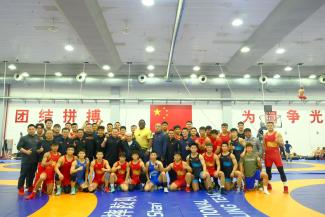
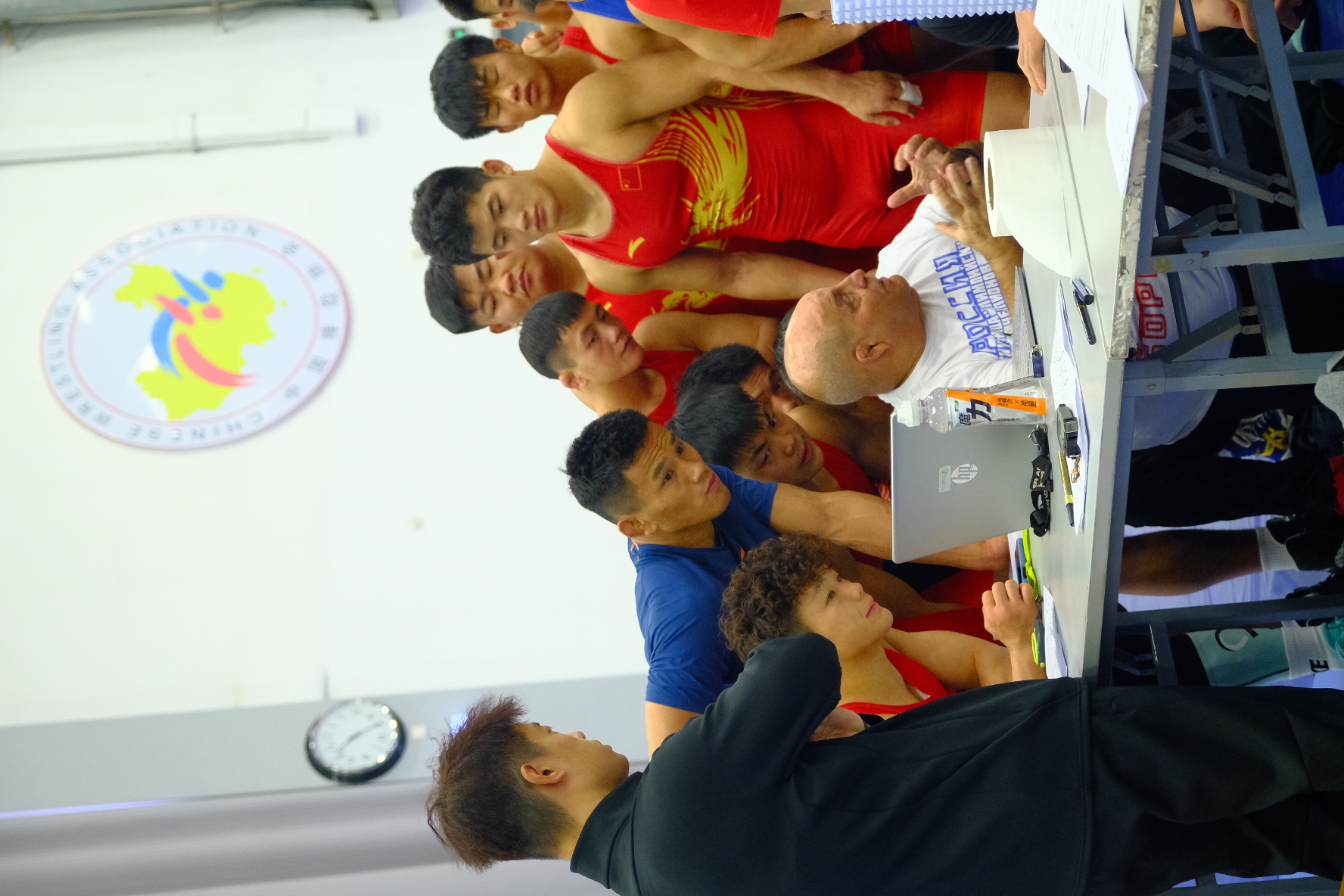
Ruis DIAZRaul DIAZ (CUB) with the Chinese Greco-Roman national team. (Photo: Xinhua News)
Although Diaz and Lopez first bonded in 1999, their fates did not officially intertwine until after Lopez claimed his maiden Olympic gold at the 2008 Beijing Olympics, with Diaz then serving as a coach for the Portuguese national team.

In 2010, Diaz returned as Lopez's full-time head coach, guiding him through the next 14 years and four more consecutive Olympic gold medals from London 2012 to Paris 2024, cementing his status as the greatest Greco-Roman wrestler of all time.

The 2024 Paris Olympics marked the final chapter of Lopez's storied career. After clinching his historic fifth title, he knelt to kiss the mat and left his shoes on the canvas - the universal ritual of retirement in wrestling.

"That moment was full of mixed emotions. I was overjoyed with the result, but also overwhelmed with sadness, because I had decided to close the book on my career," Lopez told Xinhua through an interpreter.

"I kissed the wrestling mat to express my gratitude for all the achievements in my wrestling career. This mat and my coach made me the champion I am today. I am thankful for all those days and nights we spent training together."

When asked whether Lopez would have won four more Olympic golds and completed the five-peat without his coaching, Diaz is quick to deflect the credit to his pupil's innate talent and unshakable character.

"Lopez is an exceptional athlete, one of a kind. What makes him great is not just his physical strength, but his mental fortitude," said Diaz. "He competes not for money or fame, but for his love for the Cuban people, wrestling and his family."

"He is family to me," Lopez said of his mentor. "A coach is more than an instructor; he is a guide who walks with you through every critical moment. I hope every athlete can experience this kind of profound connection."

Diaz recalled the words Lopez's father said to him on his deathbed: "Please, be a father to Lopez from now on." Over years of close companionship, the pair have become inseparable.

"I can no longer imagine my life without him," Diaz said.

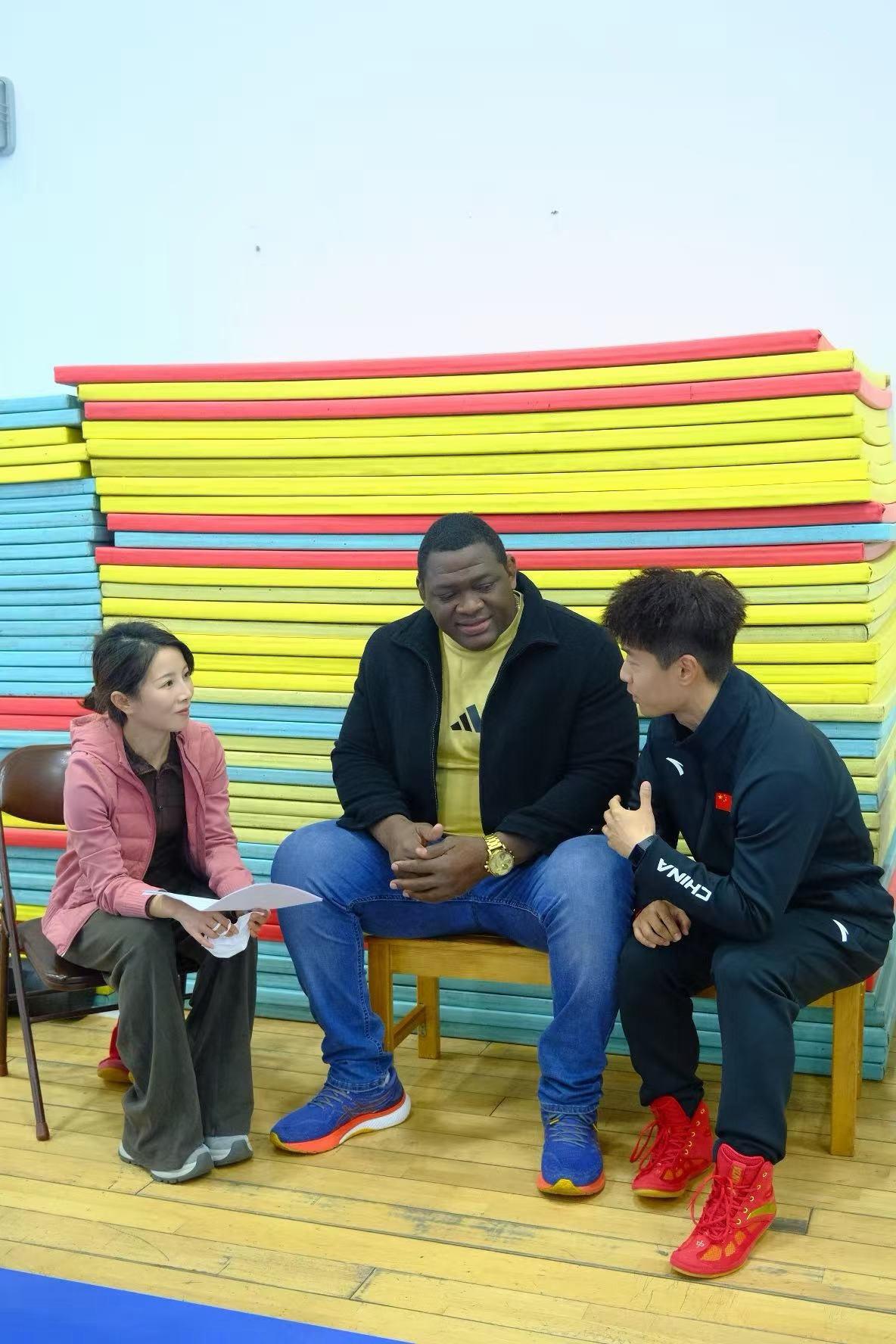
Mijain LOPEZ (CUB)Reporter interviewing Mijain LOPEZ (center) and Shen SHIYAN (right), Spanish interpreter for the Chinese Greco-Roman team. (Photo: Xinhua News)

Lifetime to Understand China

For both men, China has never been a distant country. For Lopez, Beijing will always be the starting point of his legend. "I have an immense affection for China. It was here that I won my first Olympic gold, the medal that broke the ice and opened a whole new chapter of my career," he said.

Diaz's connection to China stretches back to childhood, with Chinese classmates and family friends. He still remembers the Chinese couple in Havana's Chinatown who always kept a meal warm for him.

"Those simple acts of kindness made me feel a deep closeness to Chinese people from the very beginning," Diaz recalled.

When Lopez stepped onto the mat in Beijing in 2008, Diaz watched with special pride - not just for his former pupil, but for a country he had long felt a bond with.

"The more you learn about China, the more you realize it may take a whole lifetime to truly understand this country," Diaz observed. "Chinese people are kind, honest and down-to-earth. Some countries refuse to see the real China out of prejudice, but there is no better way to know this country than to come here, to see it with your own eyes."

Passing the Torch

Diaz and Lopez have come to Beijing with a clear mission: to pass on decades of experience and training philosophy to help nurture China's next generation of wrestlers.

Zheng PAN (CHN), head coach of China's Greco-Roman team, noted that Diaz prioritizes efficiency in training. "We have more sessions now, but each is shorter. Raul always emphasizes that athletes must give their absolute all in every minute."

Diaz is full of praise for China's young wrestlers, citing their strength, speed, discipline, intelligence and work ethic. "The most important thing is to train with purpose and focus. Chinese wrestlers have every ability to compete with the top athletes in the world."

Lopez echoed his coach's optimism. "These young wrestlers have a bright future. We are here to give them that extra push, to help them stand firm on the world stage."

18 years ago, Lopez arrived in Beijing as a rising talent and left as an Olympic champion. Now they have returned together as legends, ready to pass on the torch and write a new chapter in the decades-long friendship between Cuban and Chinese wrestling.

In November 2025, Diaz received the International Olympic Committee (IOC) Coaches Lifetime Achievement Award. Standing beside him to share the honor was his star pupil. "That moment felt like a dream," Diaz said. "I want to give all my love for wrestling, my knowledge, and everything I have to this sport."