

Bolat Turlykhanov Cup weight-to-watch: 130kg
Monday, May 30, 2022 - 13:28 By Eric Olanowski

ALMATY, Kazakhstan (May 30) -- The depth of the 10-man 130kg field at the upcoming Bolat Turlykhanov Cup Ranking Series event (June 2-5) will feature the reigning Olympic silver medalist, senior world champion, U23 world gold-medal holder, Asian championship winner and five of the top-20 ranked wrestlers in the world.
The must-watch weight will be headlined by top-ranked Iakobi KAJAIA (GEO), but Iran is bringing two young guns who are battling for a potential place on the Belgrade world championship team.
Kajaia enters the second Ranking Series event in Almaty ranked first in the world with 76, 200 points, commanding a 20,800-point lead over Riza KAYAALP (TUR). The Tokyo Olympic runner-up is on the verge of locking up the No. 1 seed for the Belgrade World Championships with a gold-medal finish. A win in Kazakhstan would give Kajaia 8,000 points, bringing his overall total to 84, 200 points. The magic number he needs to cement that top spot is 84, 000 points.
130kg Ranking Series points up for grab in Almaty:
1st - 8000
2nd - 6400
3rd - 5200
5th - 4000
7th - 3520
8th - 3200
9th - 2800
10th - 2480
With three Ranking Series events left, and without the second through fourth-ranked wrestlers -- No. 2 Kayaalp, No. 3 Yasmani ACOSTA (CHI) and No. 4 Mijain LOPEZ (CUB) -- in Kazakhstan, Aliakbar YOUSOFIA (IRI) is the only other wrestler who can halt the Georgian big man’s quest from locking up that top seed.
Yousofia, the reigning 130kg world champion, is ranked fifth in the world with 45,000 points. He would need to earn 31,300 points over the next three Ranking Series tournaments to sit atop the bracket in Belgrade. Although it’s a long shot and the scenario is very unlikely to happen, the Iranian super heavyweight could steal the top spot if Kajaia missed reaching that 84,000-point mark and elected to sit out of the final two Ranking Series competitions. The Iranian also needs to win gold in Rome and Tunisia with more than 16 wrestlers entered at 130kg.
Yousofia will certainly be hunting down that top seed, but he’ll also be in a battle for Iran’s world team spot with No. 14 Amin MIRZAZADEH (IRI). The winner will likely represent Iran at the World Championships later this year.
The last time the two met was at the 2021 Poland Open Ranking Series event, which determined Iran’s 130kg Tokyo Olympic spot. Mirzazadeh defeated Yousofia, 3-1, in the finals and punched his ticket to the Tokyo Games. He ultimately finished fifth in Tokyo, only falling to Lopez and Kayaalp.
Two months later, he was scheduled to compete in Oslo but tested positive for COVID and was forced to sit out of the '21 World Championships.
In Mirzazadeh’s absence, Yousofia received the nod and ran with his chance. He won all four of his Oslo matches, capping off an unthinkable run to the 130kg world title with a 3-1 win over Zurabi GEDEKHAURI (RWF).
After recovering from COVID, Mirzazadeh returned to the mat at the U23 World Championships, dominating his bouts en route to winning his second world title and first since the 2018 U20 world gold.
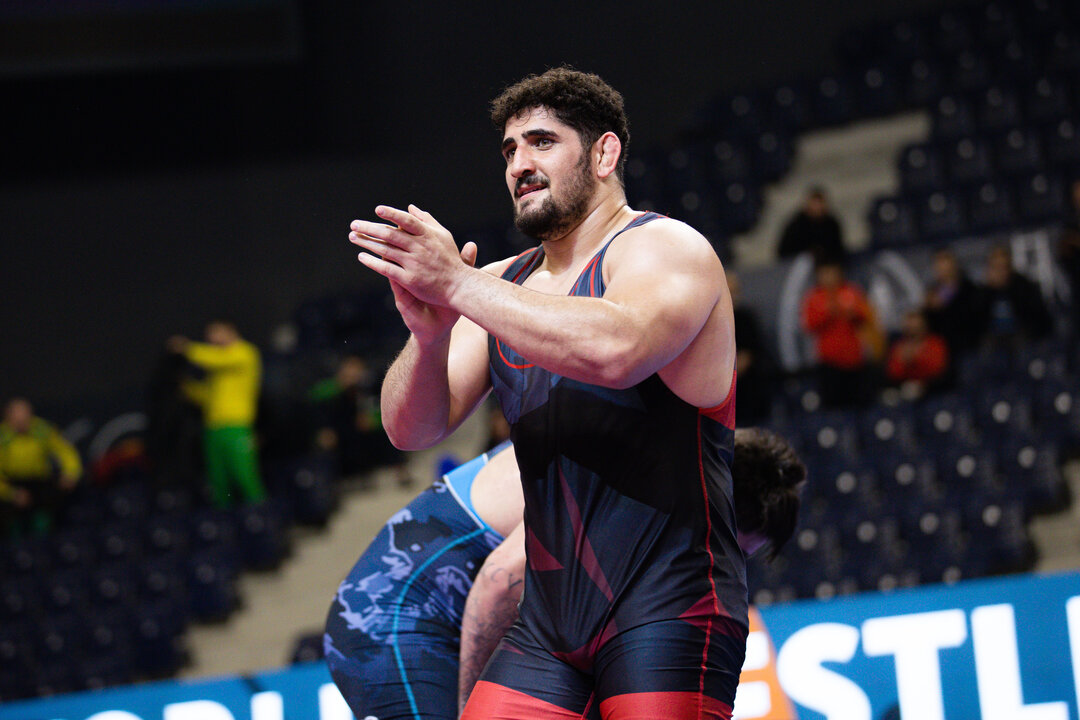
Osman YILDIRIM (TUR) will look to try to win a second consecutive Ranking Series event. (Photo: Kadir Caliskan)
Another guy looking to make some noise at 130kg is No. 7 Osman YILDIRIM (TUR). With Kayaalp being sidelined by personal matters, Turkey will rely on Yildirim to replace the four-time world champion for the foreseeable future.
Yildirim proved that he has the caliber to compete with the best at 130kg with a fifth-place finish at last year's World Championships and by winning gold earlier this year at the Yasar Dogu Ranking Series event.
In Oslo, he reached the bronze-medal bout but fell one point shy of winning a world medal. Then in January, he scored wins over Asian champions Muminjon ABDULLAEV (UZB) and No. 16 Alimkhan SYZDYKOV (KAZ) before grabbing gold with a 3-1 win over Beka KANDELAKI (AZE) in Istanbul.
Kazakhstan’s reigning Asian champion Syzdykov is also entered at 130kg. He’s fresh off one of the best three-match stretches of his career. At the Asian Championships, the Kazakh won by technical superiority over Roman KIM (KGZ) and Arata SONODA (JPN) before pinning world bronze medalist Minseok KIM (KOR) to win continental gold.
All the action from Kazakhstan starts on Thursday and can be followed live on uww.org.
130kg (10 entries)
No. 1 Iakobi KAJAIA (GEO)
No. 5 Aliakbar YOUSOFIAHMADCHALI (IRI)
No. 7 Osman YILDIRIM (TUR)
No. 14 Amin MIRZAZADEH (IRI)
No. 16 Alimkhan SYZDYKOV (KAZ)
Sulkhan BUIDZE (GEO)
SATISH (IND)
Mansur SHADUKAYEV (KAZ)
Anton SAVENKO (KAZ)
Murat RAMONOV (KGZ)

 Iran's national Greco-Roman coach Hassan RANGRAZ during the 2024 Paris Olympics. (Photo: United World Wrestling / Jake Kirkman)
Share your thoughts.
Comments