BAKU, Azerbaijan (July 28) -- Shamil LABAZANOV (RUS) shocked Ibrahim NASIBOV (UKR) and the Ukrainian could never recover from that.
The two clashed in the 65kg final of the U17 World Championships final in Baku on Tuesday. Nasibov had looked in top form coming into the final and Labazanov had scored a 29-seocnd win in the semifinal using a deadly front headlock.
Nasibov must have watched Labazanov's semifinal and thought that the front headlock will come. Yet, he was not able to stop it.
When Labazanov was awarded the par terre in the first period, he did not go for the traditional gut-wrench as Nasibov was prepared to defend it. But he went for the front headlock which Nasibov failed to defend.
Labazanov scored the first turn as Nasibov was still trying to stable himself to defend. But then he did it again with brute force and then again to lead 7-0. Nasibov was left playing catch from there on.
Nasibov managed to cut the lead to 7-2 before the break and despite the par terre in the second period, it was never enough as Labazanov won 7-5 to capture the 65kg title.
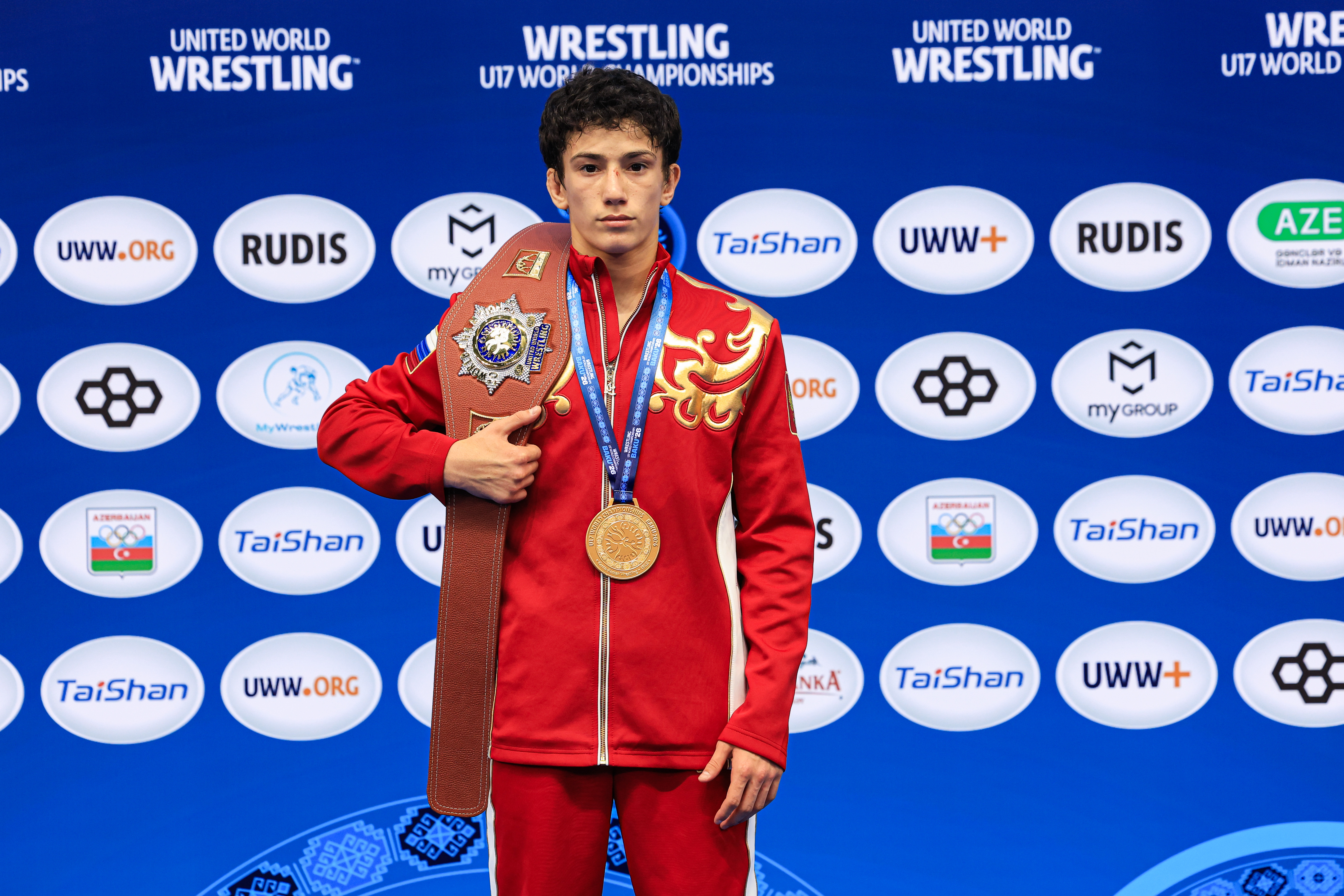 Soltan IUSUPOV (RUS) with the world champion belt at the podium. (Photo: United World Wrestling / Amirreza Aliasgari)
This was the second gold medal for Russia on Tuesday, coming after Soltan IUSUPOV's (RUS) dominant win at 48kg. In the first final of the night, Iusupov and Ali ALMAS (KAZ) clashed and when the Kazakhstan wrestler got the par terre in the first period, it seemed that it will an even contest.
However, Iusupov did not think so. He first defended that position and then scored a takedown and turn in the first period to lead 4-1 at the break. He was not done yet as he began the second period also with a takedown, and then used a slideby to make it 8-1. He turned Almas in the same sequence to earn a 10-1 win. Kazakhstan challenged the last call and it was changed to one takedown and scored returned to 8-1.
Almas managed to bring him down in the final 20 seconds to cut the lead to 8-3 but that was all he managed despite getting the only par terer of the final.
Kazakhstan's moment of glory came at 55kg when Diyar AMANALI (KAZ) won the gold medal at 55kg after beating Keve KOVACS (HUN), 1-1 in the final. The two traded passivity but it was the Kazakhstan wrestler who kept the criteria as he got the par terre first.
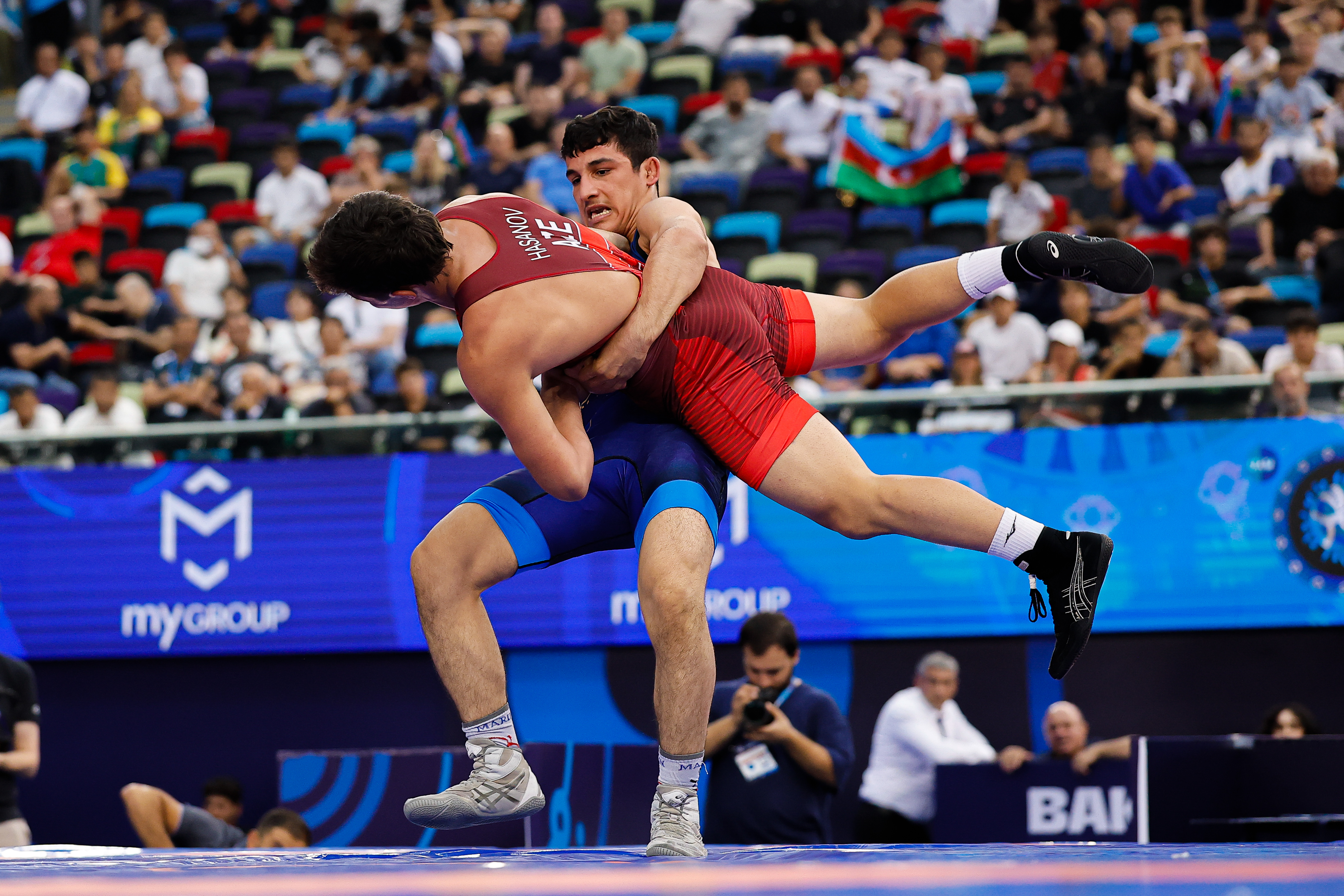 Alireza REZAEI (IRI) loads to launch Isfahan HASANOV (AZE) for a throw during the 80kg final in Baku. (Photo: United World Wrestling / Kadir Caliskan)
Rezaei Gives Iran Gold
Iran's campaign got a breather after Alireza REZAEI (IRI) grabbed the 80kg gold medal by upsetting Isfahan HASANOV (AZE), 2-1, in the final and the home crowd. In the low scoring final, Rezaei was put in par terre first but he defended the position to keep Hasanov's lead to 1-0.
In the second period, Rezaei got his chance from par terre and while he could not perform a big move, he lifted and threw Hasanov out of bounds for a step out point to lead 2-1. This left Hasanov needing at least one point to win but the Iranian evaded any such situation to claim gold, the first medal for Iran in Baku.
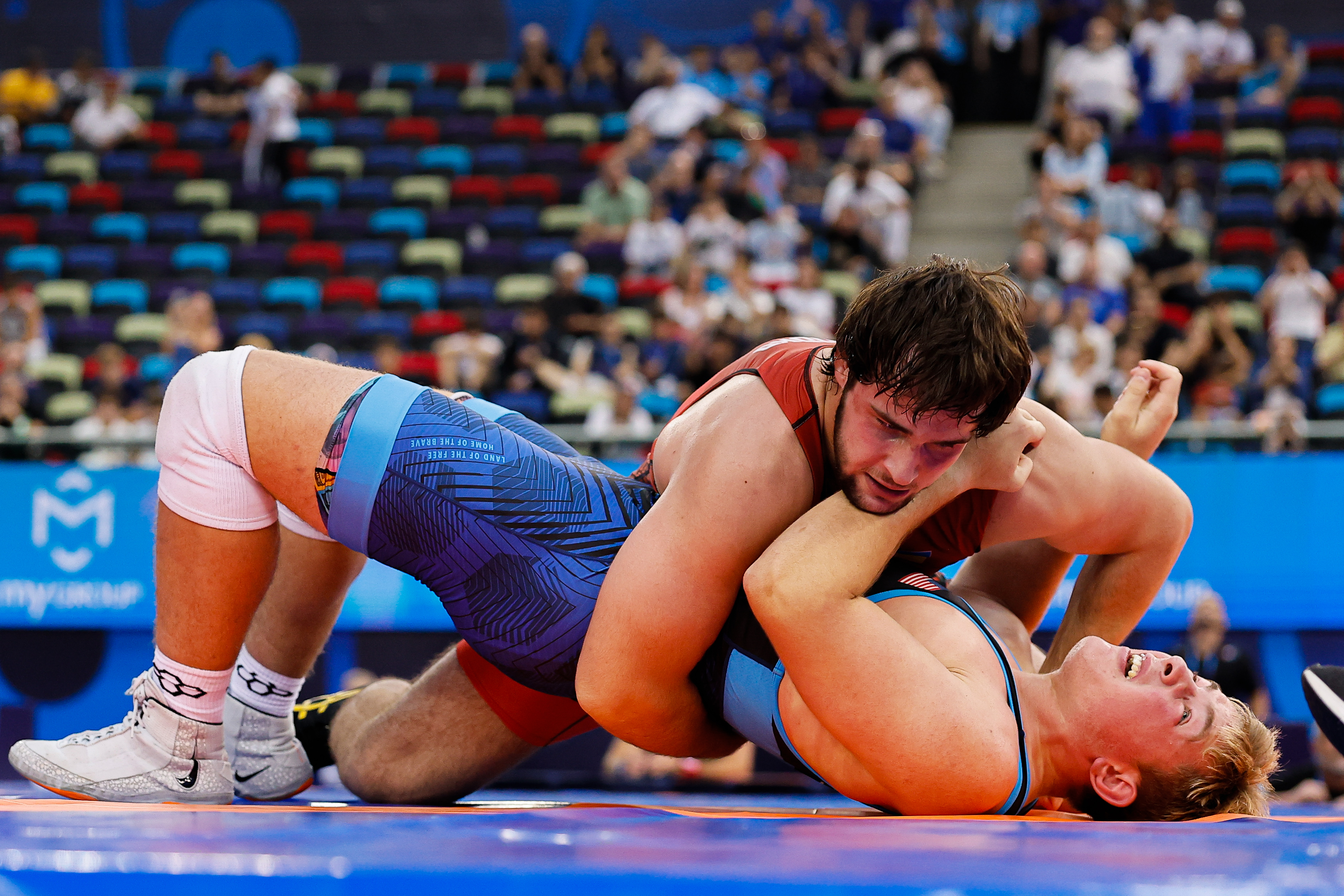 Tymofii PRYKHODKO (UKR) tries to pin Bruno PALLONE (USA) during the 110kg final at the U17 World Championships. (Photo: United World Wrestling / Kadir Caliskan)
Prykhodko's Golden Throws
Ukraine also went home with a gold medal as Tymofii PRYKHODKO (UKR) clinched the 110kg title after a big-throwing show in the final against Bruno PALLONE (USA). Both wrestler went all out and complete four-point throws with ease. However, Prykhodko never gave up the lead and eventually won 14-5.
Prykhodko began with an arm-spin which resulted in a takedown for two points. He then completed his first big throw for four points and had Pallone in danger for fall but the U.S. wrestler managed to escape the position. A stepout before the break gave Pallone a point which cut the lead to 6-1.
Instead of playing the waiting game, Pallone hit a four-pointer at the start of the second period and came within one point distance, 6-5, of Prykhodko. At one point, both wrestlers bear-hugged each other but it was the Ukrainian who risked a headlock and once again threw Pallone for four points.
Pallone had no choice but go for the big throw himself as Prykhodko kept the pressure. But when he did, it was in a bad position and he tamely fell on his own back, giving Prykhodko four points, the win and the gold medal.

RESULTS
48kg
GOLD: Soltan IUSUPOV (RUS) df. Ali ALMAS (KAZ), 8-3
BRONZE: Ararat AVETISYAN (ARM) df. Benedek TOMBOR (HUN), 8-0
BRONZE: Omar SALMANOV (AZE) df. Giorgi CHKHIKVADZE (GEO), 7-1
55kg
GOLD: Diyar AMANALI (KAZ) df. Keve KOVACS (HUN), 1-1
BRONZE: Edem PAIZIEV (RUS) df. Danimir YORDANOV (BUL), 8-0
BRONZE: Vlad TRIP (ROU) df. Tsimafei SEMIANENKA (BLR), 6-2
65kg
GOLD: Shamil LABAZANOV (RUS) df. Ibrahim NASIBOV (UKR), 7-5
BRONZE: Imre JUHASZ (HUN) df. Vazgen MNATSAKANYAN (ARM), 3-2
BRONZE: Orkhan HABIBLI (AZE) df. Kunal DAGAR (IND), 7-5
80kg
GOLD: Alireza REZAEI (IRI) df. Isfahan HASANOV (AZE), 2-1
BRONZE: Abdulaziz KHOLMIRZAEV (UZB) df. Ivan IVANOV (USA), 12-4
BRONZE: Benediktas BUBELEVICIUS (LTU) df. Abdulhalik BAL (TUR), 5-2
110kg
GOLD: Tymofii PRYKHODKO (UKR) df. Bruno PALLONE (USA), 14-5
BRONZE: Andrej SIMIC (SRB) df. Yahor SAVICH (BLR), 5-1
BRONZE: Aliakbar AKOO (IRI) df. Fedor SUKHAREV (RUS), 1-1
Semifinals
45kg
SF 1: Rylen WAX (USA) df. Afruzbek IBRAGIMOV (UZB), 2-1
SF 2: Ali JAVADLI (AZE) df. Armin ESMAEILI (IRI), via forfeit
51kg
SF 1: Bunyod HASANOV (UZB) df. Vadim TARELUNGA (MDA), 10-0
SF 2: Abdurrahman HUSEYNLI (AZE) df. Saba ABASHIDZE (GEO), 9-3
60kg
SF 1: Makhdi BAROTOV (TJK) df. Alexandru LUNGU (ROU), 2-1
SF 2: Amirreza TAHMASBPOUR (IRI) df. Elmir CHARKAZOV (AZE), 5-4
71kg
SF 1: Janes NAZARYAN (ARM) df. Kristiyan KRASTEV (BUL), 8-0
SF 2: Aslan DZUEV (RUS) df. Esmaeil ZAHERDOUST (IRI), 10-1
92kg
SF 1: Tomasz MITAL (POL) df. Yusuf AKSU (TUR), via fall (7-3)
SF 2: Hlib YEVSIEIEV (UKR) df. Mirjalol SHOVKATOV (UZB), 8-0



 Participants look on doing the education courses held in Croaita during the final week of May. (Photo: United World Wrestling)
Share your thoughts.
Comments