

#WrestleTirana

Interview: Iran Greco-Roman coach Hassan Rangraz

By Vinay Siwach

ZAGREB, Croatia (February 14) -- Iran won its first Olympic gold medal in Greco-Roman at the 2012 London Games. Rio 2016 was a blank but Mohammadreza GERAEI (IRI) won at the Tokyo Olympics. Soon, Iran changed the coaching staff and brought in Hassan RANGRAZ to lead the Iran team.

Rangraz enjoyed success at various levels but the 2024 Paris Olympics was one of the best that Iran had. Two gold medals, one silver and one bronze made it the most successful Olympics for Iran.

The 44-year-old soft-spoken former world champ has a different personality while coaching. He rarely takes the role of first coach during the bouts. But he is always animated in the corner, shouting instructions to his wrestlers and sometimes reacting to the referee's decisions.

As the new Olympic cycle for the 2028 Los Angeles Games begins, United World Wrestling caught up with Rangraz at the season opening Zagreb Open Ranking Series. Rangraz explained the success of Iran's Greco-Roman team, training in Tehran, defended the selection process and the fans who have a say on everything in Iran wrestling.

Hassan RANGRAZ (IRI)Iran's national Greco-Roman coach Hassan RANGRAZ during the 2024 Paris Olympics. (Photo: United World Wrestling / Jake Kirkman)

Excerpts:

- How do you see the success of Iran Greco-Roman team at the Paris Olympics?

Rangraz: In my opinion, the result of the Paris Olympics, with four medals, two of them gold, was a remarkable achievement in the history of Greco-Roman wrestling for Iran. This success was primarily due to the six years of planning by the federation, the efforts of former head coaches and previous coaches. I played a very small part in this journey.

- What is it like in the national camp for Iran?

Rangraz: Right after the Olympics, with a very short break, we began our planning. From the Olympics to the 2025 World Championships, we will have 22 training camps, totaling 220 days. We will also be competing for nearly 80 days. Out of the 365 days in a year, our wrestlers will be under direct supervision of the coaching staff for about 300 days. They will follow intense training programs and preparation matches. Even during the remaining 60 days, they will still be monitored indirectly through technical and strength training programs provided by the coaching staff.

- Iran's selection process often comes under scrutiny. Despite that, it keeps producing results. What are you thoughts on the current selection process in Iran?

Rangraz: We have a process and young wrestlers can enter this cycle to compete and prove their worth. The prime examples of this process are Esmaeili and Mohammadi. They shone in domestic and international tournaments, competed with top wrestlers in their weight classes. They performed and won Olympic medals. We are committed to implementing the national team’s selection process and giving talented young wrestlers the opportunity to prove themselves. This way, we can execute the talent identification process in the best possible way.

- What are the responsibilities and challenges as the national coach?

Rangraz: Wrestling is the number one sport in Iran and our national, patriotic, and traditional sport. Wrestling is part of Iran’s culture. Therefore, taking on the technical responsibility as the head coach primarily brings stress, anxiety, and immense pressure. On top of that, you have to be accountable for the results and take responsibility for the team’s performance. In terms of difficulty, I can confidently say that considering the intense scrutiny, being the head coach of the national team is so challenging it’s like working in a mine.

- The fans of Iranian wrestling are always involved. How do you see this and does it affect you in any way?

Rangraz: As I mentioned earlier, 80 million Iranians have a deep love for wrestling. Perhaps that’s why a tournament that may not hold much significance for people from other countries is so important to our people. They follow it closely, they care about it, they rejoice in victories and worry about defeats. This immense passion and support from fans is the greatest strength and asset for wrestling in our country.

- What is the roadmap for the 2028 Los Angeles Olympics?

Rangraz: We believe that the Olympic Games are just around the corner. Four years go by very quickly. To succeed in the Olympics, you need to work hard, but also work smart. You can’t afford to miss a single training session or day. With this mindset and determination and knowing how high and legitimate the expectations are, we continue on our path with great strength, despite all the pressures we feel in every competition.

I believe the future of Iranian wrestling is very bright. Iran is passionate about wrestling. One of my dreams is that, just like in 1998 and 2002, we can once again host the World Wrestling Championships in Iran. The main reason for this is that nowhere else in the world will you find such passionate and numerous fans. These fans are the greatest asset of world wrestling, not just Iranian wrestling, and their expectation is to host a World Championship event.
#WrestleSamokov

Iliasov levels up to win 130kg gold; Iran Greco champ again

By Vinay Siwach

SAMOKOV, Bulgaria (August 24) -- Ali ILIASOV (UWW) made his international wrestling debut at the European U20 Championships in July and won a silver medal. Two months later, the 18-year-old is a world champion.

Wrestling at his career first World U20 Championships on Sunday, Iliasov emerged at the champion in the 130kg weight with victories over rivals more experienced and heavier, literally, than him.

Weighing only 115kg for the 130kg final, Iliasov defeated returning silver medalist Abolfazl FATHITAZANGI (IRI) in the semifinals and on Sunday, he managed to humble two-time world U17 champion Yusuf BAKIR (TUR) in the final and win the gold medal.

"I’m underweight for the class but I feel a kind of relief," Iliasov said. "I’ve fulfilled a small dream of mine. I still haven’t fully realized that I’ve become a world champion."

Overall, Iran became the team champions with 117 points. Armenia managed second-place finish with 98 points and Azerbaijan was third with 90 points. This was Iran's fourth straight team win in Greco at the World U20 Championships.

Ali ILIASOV (UWW)Ali ILIASOV (UWW) turns Yusuf BAKIR (TUR) for two points during the 130kg final at the World U20 Championships. (Photo: United World Wrestling / Kadir Caliskan)

Iliasov was only 10 seconds into the final against Bakir when he used an arm-drag and had Bakir in trouble. Bakir managed to stop the takedown but he stepped out and was cautioned for fleeing as well. Iliasov led 2-0 after this sequence.

A similar arm drag brought down Bakir to the mat and Iliasov scored his first takedown. A stepout made the score 5-0. Iliasov remained relesntless in his attacks and a snapdown helped him score another takedown on Bakir. He then turned Bakir for the match-winning gut-wrench.

"I managed to beat my opponent so decisively was because I was extremely confident in myself, even more confident than he was," he said.

While he blanked Bakir in the final, Iliasov did have his share of close bout in Samokov. In his opening bout, Iliasov had a close 7-6 victory over Viachaslau FEDARYNA (UWW). He scored a technical superiority win over Leonhard JUNGER (AUT) in the second match before facing Fathitanzangi in the semifinals.

"I would say I was warming up, a little nervous [in the first bout]," he said. "After that first match I completely opened up."

In the semifinals, Iliasov led 3-0 when Fathitanzangi went for a pushout. Iliasov tried to stop it by throwing Fathitanzangi but he landed on his back and the Iranian wrestler was given two points.

As Fathitanzangi was awarded par terre position in the second period, he also got the 3-3 criteria lead over Iliasov. The Iranian tried defending his lead for the win but Iliasov managed to circle around and bring him down for two points. Fathitanzangi pulled one back with a stepout but that was all as Iliasov entered the gold-medal bout with a 5-4 win.

"My performance can be rated 9 out of 10," he said. "Because in the semifinal I strayed a bit from my tactics, lost focus, and almost gave away points."

With experience from this World U20 Championships, Iliasov now wants to switch to senior level as early as next year.

"I’ll try at the senior level," he said. "Of course, that’s another level, wrestler with much more experience. But I’ll do my best to test myself."

Georgia double

Georgia earned two gold medals on the final day of the World U20 Championships, a feat the country has not achieved since 2016.

Anri PUTKARADZE (GEO) and Luka KOCHALIDZE (GEO) came out with dominant performances in the 77kg and 87kg finals respectively to bring home two golds for Georgia.

Anri PUTKARADZE (GEO)Anri PUTKARADZE (GEO) hits a counter attack against Ahoura BOUVEIRI (IRI) during the 77kg final. (Photo: United World Wrestling / Kadir Caliskan)

At 77kg, Putkaradze was up against Ahoura BOUVEIRI (IRI) in the final and got the par terre position. He managed to turn Bouveiri two times for a 5-0 lead. In the second period Bouveiri had the chance to turn it around when he the top position in par terre.

Things, however, did not go that way. As Bouveiri was trying lift Putkaradze, the Georgian countered with a bodylock and then slammed him for two-point takedown. He then turned the Iranian for two more points and won the gold medal, 9-1. Iran challenged for a foul but there was none and one more point was added to his score to make it 10-1.

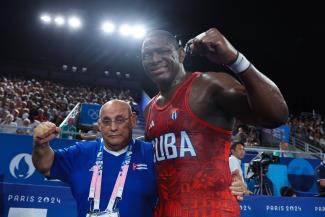
Luka KOCHALIDZE (GEO)Luka KOCHALIDZE (GEO) celebrates with his coach after winning the 87kg final. (Photo: United World Wrestling / Amirreza Aliasgari)

The second gold came from Kochalidze as he pinned Abdurakhman ABDULKADYROV (UWW) in the 87kg final. In a rematch of the European U20 Championships final at 87kg, Abdulkadyrov was hoping to avenge his loss from Carole, Italy.

He was given the par terre advantage in the first period and he tried turning Kochalidze, who blocked the turn but lost his grip as well and the turns were called neutral. As Abdulkadyrov was back on top, he again tried to turn Kochalidze who managed stop Abdulkadyrov and kept him on the mat till the fall was called.

Georgia was the only country to win two gold medals in this competition in Greco-Roman.

At 63kg, senior Asian champion Aytjan KHALMAKHANOV (UZB) proved why he will be medal threat in Zagreb with a dominant run to gold-medal. He defeated Aleks MARGARYAN (ARM), 12-2, with two big four-point throws.

Khalmakhanov began with a underhook throw for a takedown in the first 20 seconds. He tried the same move again but Margaryan blocked and scored a takedown for a 2-2 criteria lead. Late in the first period, Khalmakhanov was awarded the par terre position for one point but he failed to score and led 3-2 at the break.

If Margaryan hoped for a better second period, Khalmakhanov had no such idea. He slammed Margaryan from standing using the underhook for four points. He continued the sequence and lifted Margaryan and slammed him forward for four more points.

The two big throws for Khalmakhanov were enough for him for the win despite a challenge from Armenia. The lost challenged made his score 12-2.

RESULTS

63kg
GOLD: Aytjan KHALMAKHANOV (UZB) df. Aleks MARGARYAN (ARM), 12-2

BRONZE: Mohammad ABOUTALEBI (IRI) df. Kristiyan MILENKOV (BUL), 9-0
BRONZE: Igor PUNCHENKO (UWW) df. Damir IBRASHOV (KAZ), 5-1

77kg
GOLD: Anri PUTKARADZE (GEO) df. Ahoura BOUVEIRI (IRI), 10-1

BRONZE: Zaur BESLEKOEV (UWW) df. Raatbek PAIAZBEKOV (KGZ), 8-0
BRONZE: Kiryl VALEUSKI (UWW) df. Leister BOWLING (USA), 9-0

87kg
GOLD: Luka KOCHALIDZE (GEO) df. Abdurakhman ABDULKADYROV (UWW), via fall

BRONZE: Erik TER MATEVOSYAN ( ARM) df. Elias LYYSKI (FIN), 1-1
BRONZE: Temirlan TURDAKYN (KAZ) df. Orkhan HAJIYEV (AZE), 4-4

130kg
GOLD: Ali ILIASOV (UWW) df. Yusuf BAKIR (TUR), 9-0

BRONZE: Ivan YANKOVSKYI (UKR) df. Mazaim MARDANOV (AZE), 8-0
BRONZE: Abolfazl FATHITAZANGI (IRI) df. Viachaslau FEDARYNA (UWW), 5-1