IOC

Lalovic Re-Elected to IOC Executive Board

By United World Wrestling Press

CORSIER-SUR-VEVEY (February 19) -- United World Wrestling president Nenad LALOVIC was re-elected to the International Olympic Committee Executive Board (EB) for an additional four-year term. The IOC Session confirmed his election this morning in Beijing.

He will continue to represent the Association of Summer Olympic Federation (ASOIF) on the IOC EB.

Lalovic remains the first EB member from the sport of wrestling.

“To be re-elected as a member of the IOC Executive Committee is the ultimate honor and I thank all IOC members for their continued support,” said Lalovic. “I remain humbled to be a part of the EB and resume my desire to contribute to its mission and goals."

Recently re-elected as United World Wrestling president, Lalovic has overseen several dramatic and popular changes to one of the Olympic Games’ oldest sports.

Lalovic was named the president of United World Wrestling in February 2013 and appointed as IOC member in August of 2015. He currently also serves on the WADA Executive Committee and Foundation Board and GAISF Council.

The EB consists of the IOC President, four Vice-Presidents and ten other members. Among its many concerns, the EB assumes the overall responsibility for the administration of the IOC, approves the IOC's internal organization and is responsible for the management of the IOC's finances and prepares an annual report. The EB also conducts the procedure for acceptance and selection of candidatures for the organization of the Olympic Games and establishes the agenda for the IOC Sessions.

Click Here to learn more about the IOC Executive Board.        (https://www.olympic.org/executive-board)
#development

South Africa Advances National Wrestling System with DNSS Phase 2

By United World Wrestling Press

PRETORIA, South Africa (April 8) -- South Africa has reached a decisive milestone in its long-term wrestling development strategy with the successful implementation of Phase 2 of the Development of National Sport System (DNSS) programme, delivered in collaboration with United World Wrestling (UWW) and supported by Olympic Solidarity.

Following the diagnostic and mapping phase conducted earlier, Phase 2 marks a clear transition from analysis to structured implementation, laying the foundation for a sustainable and internationally aligned wrestling system.

Led by UWW Development Officer Vincent AKA, in close cooperation with the South African Wrestling Federation (SAWF), the National Head Coach, Markus DEKKER and Provincial Coordinators, the programme was deployed across multiple provinces through a structured 10-day intervention from March 2 to 13. 

Activities were conducted in key locations including:

· LPWA (Ion Bachu)
· CGWA (Ruiter)
· NGWA (Menlo Park Hall)
· Frank Joubert Tournament (Menlo Park Hall)

This nationwide approach ensured direct engagement with provincial structures, strengthening alignment between national leadership and local associations while promoting inclusive development across the country.

From Talent Identification to System Building

Unlike traditional training camps, DNSS Phase 2 focused on identifying talent and building long-term development systems. Wrestlers and coaches from all age categories -- U13, U15, U17, U20, and Senior -- were actively involved, ensuring a complete pathway approach.

Provincial visits and stakeholder meetings played a key role in assessing facilities and operational structures, strengthening coordination between SAWF and provinces, and identifying emerging wrestlers.

Building Athlete Pipeline

A training camp for different provinces brought together wrestler to consolidate talent identified during Phase 1 and introduce standardized training methodologies.

The training camp included technical sessions, physical conditioning, match simulations and wrestling. The initiative contributed to the creation of an updated national prospect and the foundation of a structured athlete monitoring system.

South Africa

Beach Wrestling Gains Momentum

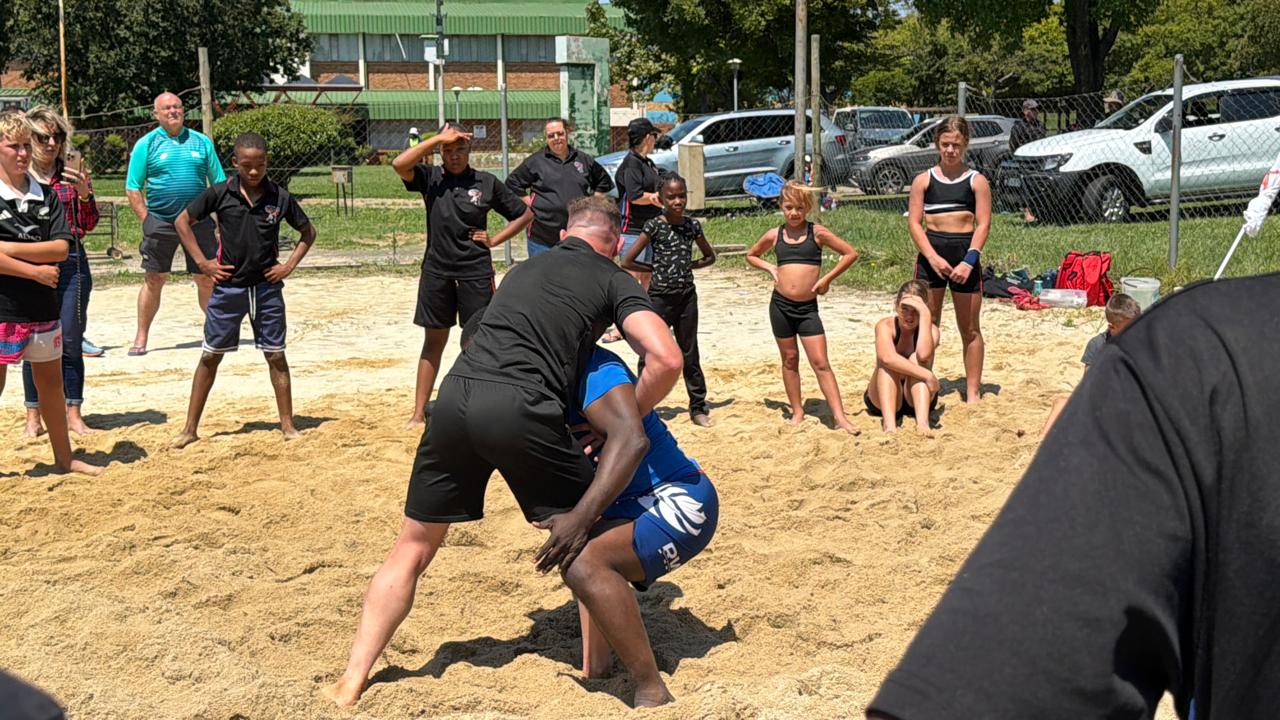
As part of the DNSS activities, a Beach Wrestling training session in Roodepoort highlighted the programme’s expanding impact.

During the visit, Aka led a specialized session, sharing advanced technical insights adapted to beach wrestling. It included stance and balance adjustments, grip and control techniques, and movement adaptation on sand.

The training programme comes at a crucial time, as South African athletes prepare for African Beach Wrestling Championships in Alexandria, Egypt and other international tournaments.