

Women's World Cup

Susaki, Mukaida Lead Japan at Women's World Cup

By Andrew Hipps

CHEBOKSARY, Russia - Women's wrestling power Japan looks to claim its third straight title at the Women's World Cup.  The two-day event gets underway on Friday in Cheboksary, Russia.

The competition is comprised of eight of the top women's wrestling nations, divided into two pools of four. Nations will compete in dual meets against other nations within their pool, followed by placement matches paring teams from different pools.  

Group A includes Japan, host Russia, USA and Sweden. 

Eight-time Women's World Cup winner Japan is led by world champions Yui SUSAKI (48kg) and Mayu MUKAIDA (53kg). Susaki captured her first senior world title this year after winning three straight world titles at the cadet level. Mukaida was a world silver medalist this year in Paris, a year after winning world titles at both the senior and junior levels in 2016. Japan's roster also includes three-time cadet world champion Masako FURUICHI (75kg) and junior world champion Yurika ITO (63kg). 

Mayu MUKAIDA (53kg)

Russia's roster is headlined by three-time world finalist Irina OLOGONOVA (55kg). She won gold medals this year in Alexander Medved Prizes and Alrosa Cup events. Also competing for Russia is two-time world bronze medalist Elena PEREPELKINA (75kg). This year she was a bronze medalist at the Ivan Yarygin Grand Prix. Other notable wrestlers on Russia's team include junior world champions Valeriya CHEPSARAKOVA (48kg) and Natalia MALYSHEVA (53kg), European champion Anastasia BRATCHIKOVA and Klippan Lady Open champion Yulia PRONTSEVICH (60kg). 

Irina OLOGONOVA (55kg)

USA brings a strong team to the World Cup that includes three-time world champion Adeline GRAY (75kg) and two-time world silver medalist Alli RAGAN (60kg). Gray won world titles in 2012, 2014 and 2015. She took 2017 off.  Ragan's world silver medals have come in each of the last two years.

Adeline GRAY (75kg)

Sweden's roster includes a pair of bronze medalists from last week's U23 World Championships, Elin NILSSON (58kg) and Moa NYGREN (63kg). 

Group B features China, Azerbaijan, Mongolia and Ukraine.

China has won this event six times, with five coming in a row (2007-2011). Olympic champion Jiao WANG (69kg) will lead a talented team. Wang won Olympic gold in 2008 and placed fifth at the 2012 Olympic Games in London. Another star competing for China is Yanan SUN, a 2016 Olympic bronze medalist and 2013 world champion. Qian ZHOU (75kg) is a multiple-time world medalist competing for China. Rui XU (63kg) was a 2016 Olympian. 

Yanan SUN (CHN)

Mariya STADNYK (48kg) will lead Azerbaijan at the World Cup. She is a three-time Olympic medalist, world champion and four-time world medalist. Also competing in the same weight class (48kg) for Azerbaijan is Turkan NASIROVA, who wrestled at three world championships this year.  She was a bronze medalist last week at the U23 World Championships last week. Azerbaijan's roster also includes junior and cadet world champion Leyla GURBANOVA (53kg), as well as U23 world bronze medalist Tetiana OMELCHENKO (60kg).
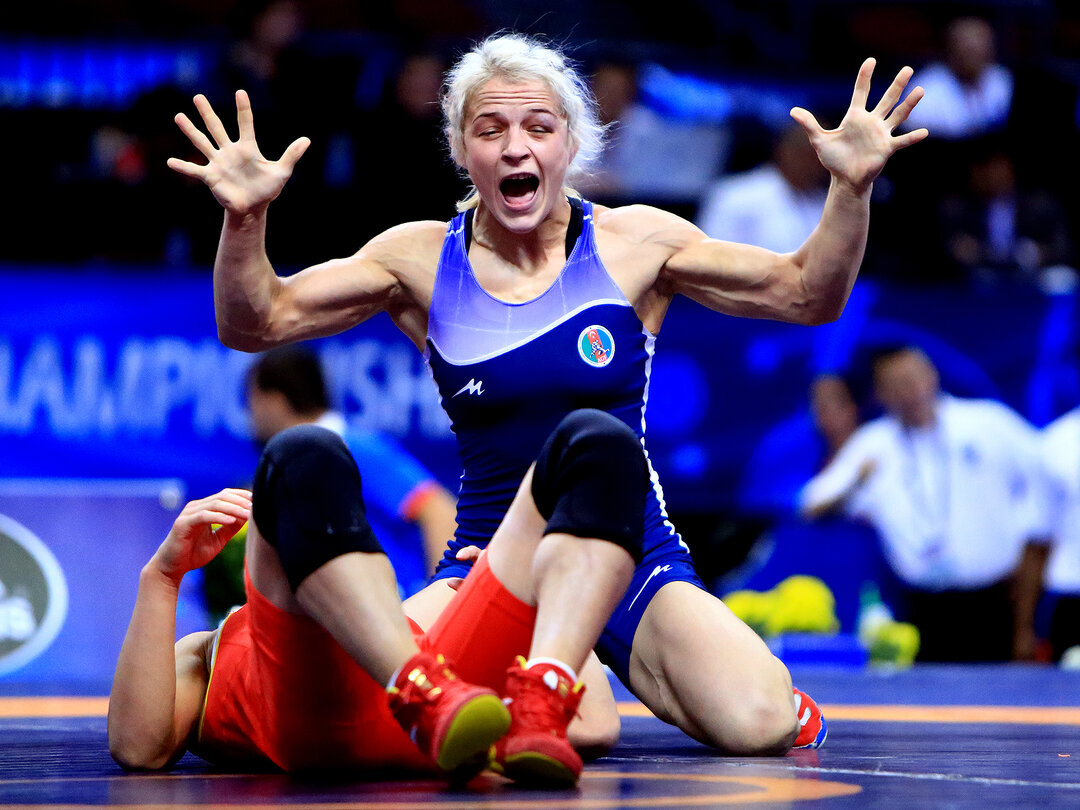
Mariya STADNYK (48kg)

Mongolia will look to make noise with a roster that includes multiple medalists from the recent U23 World Championships, led by junior world champion Battsetseg ALTANTSETSEG (58kg). Otgonjargal GANBAATAR (53kg), Gantuya ENKHBAT (60kg) were bronze medalists at the U23 World Championships. 

Ukraine brings a team that includes two-time cadet world champion Olena KREMZER (55kg), 2014 world bronze medalist Irina CHYKHRADZE (58kg) and world military champion Alla BELINSKAYA (69kg). 

Day ONE (Friday, December 1)

Round 1

Group A: Sweden vs. Japan || 10am/2am ET
Group A: USA vs. Russia || 11am/3am ET

Group B: Ukraine vs. China || 10am/2am ET
Group B: Mongolia vs. Azerbaijan || 11am/3am ET

Round 2 (Friday)

Group A: Russia vs. Japan || 12:30pm/430am ET
Group A: USA vs. Sweden || 1:30pm/530am ET

Group B: Azerbaijan vs. China || 12:30pm/430am ET
Group B: Mongolia vs. Ukraine || 1:30pm/530am ET

Round 3 (Friday)

Group A: USA vs. Japan || 5:30pm/930am ET
Group A: Sweden vs. Russia || 6:30pm/1030am ET

Group B: Mongolia vs. China || 5:30pm/930am ET
Group B: Ukraine vs. Azerbaijan || 6:30pm/1030am ET

Day TWO (Saturday, December 2)

7th Place: Group A (4) v. Group B (4) || 1pm/5am ET
5th Place: Group A (3) v. Group B (3) || 1pm/5am ET

3rd Place: Group A (2) v. Group B (2) || 2pm/6am ET

1st Place: Group A (1) v. Group B (1) ||  3pm/7am ET
#WrestleTirana

Interview: Iran Greco-Roman coach Hassan Rangraz

By Vinay Siwach

ZAGREB, Croatia (February 14) -- Iran won its first Olympic gold medal in Greco-Roman at the 2012 London Games. Rio 2016 was a blank but Mohammadreza GERAEI (IRI) won at the Tokyo Olympics. Soon, Iran changed the coaching staff and brought in Hassan RANGRAZ to lead the Iran team.

Rangraz enjoyed success at various levels but the 2024 Paris Olympics was one of the best that Iran had. Two gold medals, one silver and one bronze made it the most successful Olympics for Iran.

The 44-year-old soft-spoken former world champ has a different personality while coaching. He rarely takes the role of first coach during the bouts. But he is always animated in the corner, shouting instructions to his wrestlers and sometimes reacting to the referee's decisions.

As the new Olympic cycle for the 2028 Los Angeles Games begins, United World Wrestling caught up with Rangraz at the season opening Zagreb Open Ranking Series. Rangraz explained the success of Iran's Greco-Roman team, training in Tehran, defended the selection process and the fans who have a say on everything in Iran wrestling.

Hassan RANGRAZ (IRI)Iran's national Greco-Roman coach Hassan RANGRAZ during the 2024 Paris Olympics. (Photo: United World Wrestling / Jake Kirkman)

Excerpts:

- How do you see the success of Iran Greco-Roman team at the Paris Olympics?

Rangraz: In my opinion, the result of the Paris Olympics, with four medals, two of them gold, was a remarkable achievement in the history of Greco-Roman wrestling for Iran. This success was primarily due to the six years of planning by the federation, the efforts of former head coaches and previous coaches. I played a very small part in this journey.

- What is it like in the national camp for Iran?

Rangraz: Right after the Olympics, with a very short break, we began our planning. From the Olympics to the 2025 World Championships, we will have 22 training camps, totaling 220 days. We will also be competing for nearly 80 days. Out of the 365 days in a year, our wrestlers will be under direct supervision of the coaching staff for about 300 days. They will follow intense training programs and preparation matches. Even during the remaining 60 days, they will still be monitored indirectly through technical and strength training programs provided by the coaching staff.

- Iran's selection process often comes under scrutiny. Despite that, it keeps producing results. What are you thoughts on the current selection process in Iran?

Rangraz: We have a process and young wrestlers can enter this cycle to compete and prove their worth. The prime examples of this process are Esmaeili and Mohammadi. They shone in domestic and international tournaments, competed with top wrestlers in their weight classes. They performed and won Olympic medals. We are committed to implementing the national team’s selection process and giving talented young wrestlers the opportunity to prove themselves. This way, we can execute the talent identification process in the best possible way.

- What are the responsibilities and challenges as the national coach?

Rangraz: Wrestling is the number one sport in Iran and our national, patriotic, and traditional sport. Wrestling is part of Iran’s culture. Therefore, taking on the technical responsibility as the head coach primarily brings stress, anxiety, and immense pressure. On top of that, you have to be accountable for the results and take responsibility for the team’s performance. In terms of difficulty, I can confidently say that considering the intense scrutiny, being the head coach of the national team is so challenging it’s like working in a mine.

- The fans of Iranian wrestling are always involved. How do you see this and does it affect you in any way?

Rangraz: As I mentioned earlier, 80 million Iranians have a deep love for wrestling. Perhaps that’s why a tournament that may not hold much significance for people from other countries is so important to our people. They follow it closely, they care about it, they rejoice in victories and worry about defeats. This immense passion and support from fans is the greatest strength and asset for wrestling in our country.

- What is the roadmap for the 2028 Los Angeles Olympics?

Rangraz: We believe that the Olympic Games are just around the corner. Four years go by very quickly. To succeed in the Olympics, you need to work hard, but also work smart. You can’t afford to miss a single training session or day. With this mindset and determination and knowing how high and legitimate the expectations are, we continue on our path with great strength, despite all the pressures we feel in every competition.

I believe the future of Iranian wrestling is very bright. Iran is passionate about wrestling. One of my dreams is that, just like in 1998 and 2002, we can once again host the World Wrestling Championships in Iran. The main reason for this is that nowhere else in the world will you find such passionate and numerous fans. These fans are the greatest asset of world wrestling, not just Iranian wrestling, and their expectation is to host a World Championship event.