

Szel scripts comeback to win U23 European gold
Friday, March 17, 2023 - 19:36 By Vinay Siwach
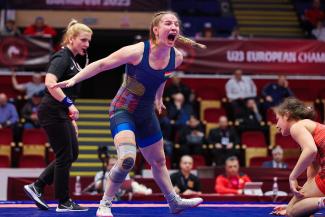
BUCHAREST, Romania (March 17) -- Perhaps the most amateurish move Oleksandra KHOMENETS (UKR) has performed in her career. With little control over Anna SZEL (HUN), she tried an arm spin, only to suffer a heartbreaking loss. After the final whistle blew, Khomenets realized her mistake, smashing her hand on the head.
An incredible comeback and Khomenets brain-fade moment gave Szel a thrilling 6-6 win and the 57kg gold medal at the U23 European Championships on Friday. This was Szel's first gold at a championship in five years.
 Oleksandra KHOMENETS (UKR) tried the arm spin on Anna SZEL (HUN) which proved costly. (Photo: UWW / Kadir Caliskan)
Szel has shown sparks of brilliance before, like when she won a silver medal at the U20 European Championships in 2021 or when she claimed bronze at the U23 Worlds in 2021. Or when she finished with silver at the 2018 Youth Olympic Games.
But for the major part of her career, Szel has been jumping around weight classes. In 2018, she wrestled at 57kg. A year later, she remained at 55kg but till 2021, she wrestled in four competitions at 62kg without much success at the top level. In 2021 and 2022, she wrested at 59kg and 62kg with a single appearance at 57kg as well.
With the start of the new season, Szel decided to stay at 57kg. She finished 14th at the Zagreb Open Ranking Series event in February. But she did not lose heart and decided to enter the U23 Europeans at the same weight and what a decision that has turned out to be.
"I was injured at the last U23 Europeans," Szel said. "I had to take off for six months for surgery and rehab. Even today I was wrestling with pain in my right knee. A ligament injury took time to heal and that is why I kept wrestling in different weight classes."
Wrestling against world silver medalist Khomenets, Szel never felt out of place, sticking to her defense even when Khomenets was close to scoring. She even trailed early and survived a barrage of double-leg attacks. But in the end, she came out all clear and with the gold medal around her neck.
Khomenets, like Szel, has been juggling between 55kg and 57kg. She has had success at 57kg before as she won the U20 European title and a bronze medal at the U20 World Championships last year.
She was hoping to achieve her biggest win at 57kg on Friday until the brain fade in the last 30 seconds of the final.
The bout began with Khomenets' back-to-back attacks, unsettling Szel at first. The aggression bore fruit as she managed to score a takedown with a double-leg to lead 2-0 at the break.
Szel had not taken a real shot so far in the bout and did not look for any chances in the second as well. So Khomenets got going and once again managed to hit a double leg. However, this time Szel was alert and did not give up a takedown, thanks to a crucial challenge from the Hungary corner. Szel had locked her hands around Khomenets to defend the attack but the referee had awarded two points to Khomenets which were removed after the challenge.
"I followed a tactic in the final to wait till the last minute," Szel said. "We knew that she will get tired and I can score and win then. I definitely had more power than her. I had a better chance to win in the final minute because the score could be close."
Khomenets stayed low and tried the double leg again. Szel kept splitting her legs and putting her arms around Khomenets waist. In one such sequence, Szel managed to lift Khomenets for exposure and get the two points to take a 2-2 criteria lead.
But Khomenets kept coming back and got Szel in danger. She tried pinning the Hungarian for 30 seconds but could not. In that sequence, she scored two rolls. However, the referee only scored one.
With 20 seconds left, Khomnenets, leading 4-2, looked at the scoreboard and tried to score two more points. The lapse in concentration cost her as Szel put her right leg over Khomenets and got two points to lead 4-4 on criteria.
It was then that Khomenets tried that arm spin which proved disastrous. She only managed to put her own back in danger which gave Szel two more points to win 6-4.
"I did not know what I will do but I knew that I can win this match," she said. "I was not sure what was happening in the final 30 seconds. When the challenge was going on, I knew that the last point is mine so even if she gets two more, I will win."
Ukraine had already challenged, asking for two points in the earlier sequence. Khomenets was awarded two points on review but Szel had scored the last points and hence declared the winner, 6-6, on criteria.
Khomenets was heartbroken as she lay on the mat even as Szel jumped around in excitement, hugged her coach and screamed before the nerves settled. During her victory lap, Szel took the flag and just jumped, letting the moment sink in, something she had waited for since that U17 Euro title in 2018.
With Szel cutting down and Khomenets moving up, there was a clear difference in strength between the two wrestlers which made Szel follow the game plan to tire her out.
"I felt that 62kg is not for me as I was not feeling strong enough," Szel said. "I could not wrestle like myself. I am stronger and faster at 57kg and I felt that in the final today. I could feel that she is not the same as me."
In a month's time, Szel will be at the European Championships in Zagreb, Croatia and the gold in Bucharest could not have come at a better time to boost her confidence before the senior tournament.
Despite Khomenets' loss, Ukraine won the team title with 158 points. Turkiye finished second with 129 points and the host country finished with 123 points for third place.
 Iryna BONDAR (UKR) won the 62kg gold medal in Bucharest. (Photo: UWW / Kadir Caliskan)
Iryna BONDAR (UKR) won the gold medal for Ukraine at 62kg to go with the gold medals won by Solomiia VYNNYK (UKR) and Anastasiya ALPYEYEVA (UKR) on Thursday. Apart from three golds, it also won three silvers and a bronze medal.
Bondar's gold at 62kg came as she defeated Ameline DOUARRE (FRA) 5-1 in the final. All the points by Bondar were scored in the first period and Douarre had to endure a frustrating second period as Bondar decided to not engage.
Douarre was called passive in the first period and during the activity time, Bondar jumped behind Douarre, caught both arms and slammed her on the mat for four points.
Douarre did get on a couple of single-leg attacks in the second period but Bondar always pressured Douarre's head to keep her from elevating her legs. Bondar gave up one point for passivity which did not cause her much damage as she won the final 5-1.
Two more Ukrainians were in the finals but both fell short at the final hurdle.
 Zeynep YETGIL (TUR) scores a four-pointer on Liliia MALANCHUK (UKR) in the 53kg final. (Photo: UWW / Kadir Caliskan)
At 53kg, Zeynep YETGIL (TUR) defeated Liliia MALANCHUK (UKR) and Wiktoria CHOLUJ (POL) denied Iryna ZABLOTSKA (UKR) in the 72kg final.
Yetgil has been long overdue for a big win and that came in the form of the U23 European gold medal at 53kg. This was her second U23 European title as she won her first back in 2018.
In her three bouts prior to the final, Yetgil won with scores of 10-0, 10-0 and a victory via fall. In the final, she had to work a little harder but was never in extreme trouble.
She shot a double-leg on Malanchuk to score her first takedown and exposed her for two points more. Malanchuk got out of the grip and scored a roll for two points but Yetgil ultimately finished on top to lead 5-2.
Just before the break, Yetgil hit a huge four to extend her lead to 9-2, enough for her to take a step back in the second period. Malanchuk managed to score a takedown after the break but that was all as Yetgil won the gold 9-4.
Yetgil will now hope to end the medal drought at the senior European Championships as her best finish at that competition is fifth, a result she achieved last year.
 Wiktoria CHOLUJ (POL) became a three-time U23 European champion. (Photo: UWW / Kadir Caliskan)
U23 world silver medalist Choluj became a three-time U23 European champion as she defeated Zablotska 11-0 in the gold medal bout.
Choluj began with a snapdown and added a gut-wrench to lead 4-0 inside the first minute of the final. A go-behind made it 6-0 before she forced a stepout against Zablotska. As Zablotska tried attacking Choluj, she kept giving up points on the counter.
Choluj scored two more points via go behind and the final move was a double-leg blast for which she got two more points for an 11-0 win and her third straight U23 Euro title.
With medals at all age-group World and European Championships, Choluj will like to complete the set by winning medals at the senior level of both tournaments.
 An emotional Amina CAPEZAN (ROU) after winning the 65kg gold at home. (Photo: UWW / Kadir Caliskan)
At 65kg, Amina CAPEZAN (ROU) gave the home crowd something to cheer about she won the gold medal after beating Birgul SOLTANOVA (AZE), 6-5, in a nail-biting final.
Capezan had suffered a heartbreaking loss in the final of the same tournament last year but kept her nerves to win her first international gold medal.
Soltanova, a U20 European champion at 62kg, lead 1-1 at the break after scoring a stepout after giving up a point for passivity. In the second period, Capezan was hit with the passivity call and she attacked Soltanova who scored with a lift for exposure before giving up a reversal.
Trailing 3-2, Capezan scored a takedown and transitioned into a gut wrench to lead 6-3 with a minute left. Soltanova managed to score two points for a double-leg but Capezan held off, barely, to win the gold in front of a loud home crowd.

RESULTS
53kg
GOLD: Zeynep YETGIL (TUR) df. Liliia MALANCHUK (UKR), 9-4
BRONZE: Mariana DRAGUTAN (MDA) df. Gultakin SHIRINOVA (AZE), 10-0
BRONZE: Anastasia BLAYVAS (GER) df. Beatrice FERENT (ROU), 5-2
57kg
GOLD: Anna SZEL (HUN) df. Oleksandra KHOMENETS (UKR), 6-6
BRONZE: Naemi LEISTNER (GER) df. Celeste SION (FRA), 4-1
BRONZE: Zhala ALIYEVA (AZE) df. Aurora RUSSO (ITA), 6-2
62kg
GOLD: Iryna BONDAR (UKR) df. Ameline DOUARRE (FRA), 5-1
BRONZE: Viktoria VESSO (EST) df. Gabriela CUC (ROU), via fall
BRONZE: Elena ESPOSITO (ITA) df. Luisa SCHEEL (GER), 5-2
65kg
GOLD: Amina CAPEZAN (ROU) df. Birgul SOLTANOVA (AZE), 6-5
BRONZE: Iris THIEBAUX (FRA) df. Gergana STOYANOVA (BUL), 4-1
BRONZE: Elma ZEIDLERE (LAT) df. Busra EFE (TUR), 4-3
72kg
GOLD: Wiktoria CHOLUJ (POL) df. Iryna ZABLOTSKA (UKR), 11-0
BRONZE: Noemi SZABADOS (HUN) df. Paula ROTARU (ROU), 10-0
BRONZE: Tindra SJOEBERG (SWE) df. Lilly SCHNEIDER (GER), via fall

 Iran's national Greco-Roman coach Hassan RANGRAZ during the 2024 Paris Olympics. (Photo: United World Wrestling / Jake Kirkman)
Share your thoughts.
Comments