

U23 Worlds: Motivated Hlinchuk makes golden return
Saturday, October 28, 2023 - 22:24 By Vinay Siwach

TIRANA, Albania (October 28) -- The last two years have been extremely difficult for Pavel HLINCHUK (AIN). With no international wrestling for him, the 21-year-old felt like moving away from the sport. The death of his first coach six months ago and then the passing of his uncle troubled Hlinchuk emotionally.
"These have been the toughest two years of my whole life," Hlinchuk says. "After being away from international competitions for two years, as well as not being able to train at all for about 8-9 months, I wanted to return. These reasons gave me motivation."
Making a return to international wrestling at the U23 World Championships, Hlinchuk made it golden by capturing the U23 world title in Tirana, Albania on Saturday.
A U20 world champion from 2021, Hlinchuk looked like he was never away from the mat, beating Mustafa OLGUN (TUR) 4-3 in the 97kg final. Despite a few aggressive moments in towards the end of the final, Hlinchuk kept his cool to deny Olgun.
"Many people will agree, that it's difficult to describe this feeling," he said. "These are probably the best emotions that the athlete could ever experience, especially after the long training. I want to dedicate my win to my coach and uncle."
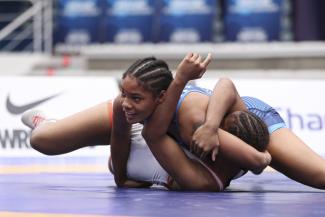
 Pavel HLINCHUK (AIN) defends the par terre position against Mustafa OLGUN (TUR). (Photo: UWW / Ulug Bugra Han Degirmenci)
The final may have been a close battle but Hlinchuk's previous bouts in Tirana were completely one-sided. He outscored his opponents 29-5 before Olgun checked his dominant run.
Olgun got the first point for par terre and though he could not score any points, he managed to score a stepout from neutral to lead 2-0. Hlinchuk turned the tables in the second period by scoring a turn from par terre to lead 3-2.
With around a minute left, Olgun managed to lock Hlinchuk and bring him down on his back. It was ultimately given a fall but Hlinchuk's corner challenged for a leg foul. On review, the fall was reversed as Olgun had in fact brought Hlinchuk down using his leg.
A few moments later, the two got warned by the referee for aggressive wrestling. Olgun again came close to winning as he brought Hlinchuk towards the zone, scoring a stepout with Hlinchuk falling. The referee awarded caution two points to Hlinchuk for a singlet-grab from Olgun. But the judge and mat chairman gave one point to Olgun for stepout. Hlinchuk now led 3-3 on criteria as he had a two-point turn while Olgun had three one-point scores.
Turkiye challenged the decision but on review, it was only given one point to Olgun. A point was added to Hlinchuk's score for Turkiye's lost challenge. In the final eight seconds, Hlinchuk kept Olgun at a distance and won 4-3.
"From outside it might have been seen as if I gave up," he said referring to the fall. "People might have thought that I gave it up and got pinned. But in reality, I immediately felt his leg foul. This still didn't give me the right to give up and secondly, I thought that my head was outside when he was pinning me, so I was relaxed, which is also not an excuse."
 Pavel HLINCHUK (AIN) celebrates after winning the 97kg gold in Tirana. (Photo: UWW / Kadir Caliskan)
Hlinchuk burst into prolonged celebrations, including a somersault, after the win. Comparing his 2021 campaign in which he won the silver medal to Saturday's gold, Hlinchuk said he has adopted a more risk-free game plan.
"Back in 2021, I was not completely ready even though I won U20 gold and U23 silver," he said. "I was different back then. Now I've grown up, I try to think more, analyze more and be riskless. Back then I only wanted to win as fast as possible. And if I wasn't winning the match, I would lose concentration. Now I don't do that anymore. Even though the final match didn't go as planned, I wrestled with a clear mind."
After the medal ceremony, Hlinchuk also revealed that he was motivated by reading about last year's champion Alex SZOKE (HUN) returning but also his own name in an article. [Szoke lost 4-4 to Lucas LAZOGIANIS (GER) in the quarterfinals and the German lost to Hlinchuk in the semifinals.]
"I was motivated by the article that I read before this championship," he said. "It was written that last year's champion Alex Szoke is coming. But at the same time, Pavel Hlinchuk is coming as well, trying to change the color of his medal. I had this on my mind and that motivated me a lot."
Indeed, Hlinchuk will return home after upgrading his 2021 U23 world silver to gold this year in Tirana.
Share your thoughts.
Comments