

#WrestleBelgrade

World Champ Tynybekova Captures Title in Dominant Fashion

By Andrew Hipps

Links:
Day 4 Photos
Interview with Maria PREVOLARAKI (GRE)
Interview with Iryna KURACHKINA (BLR)

BELGRADE, Serbia (December 15) -- World champion Aisuluu TYNYBEKOVA (KGZ) made it look easy in Belgrade, Serbia, winning the gold medal at the Individual World Cup with four consecutive dominant victories over two days, outscoring her opponents 47-2, capped off by a 14-0 technical superiority in the 62kg final on Tuesday night.

Tynybekova wasted little time scoring in her final against three-time European champion Anastasija GRIGORJEVA (LAT). The 27-year-old Kyrgyzstani women's wrestler shot a double leg and scored four points early in the match to go up 4-0. She built her lead to 9-0 after two more takedowns and a step out. Needing just one point to finish the match, Tynybekova shot a double leg and lifted Grigorjeva off her feet before bringing her to the mat for a five-point move to put an exclamation point on the match. 

All five women's wrestling champions crowned Tuesday came from different nations. 
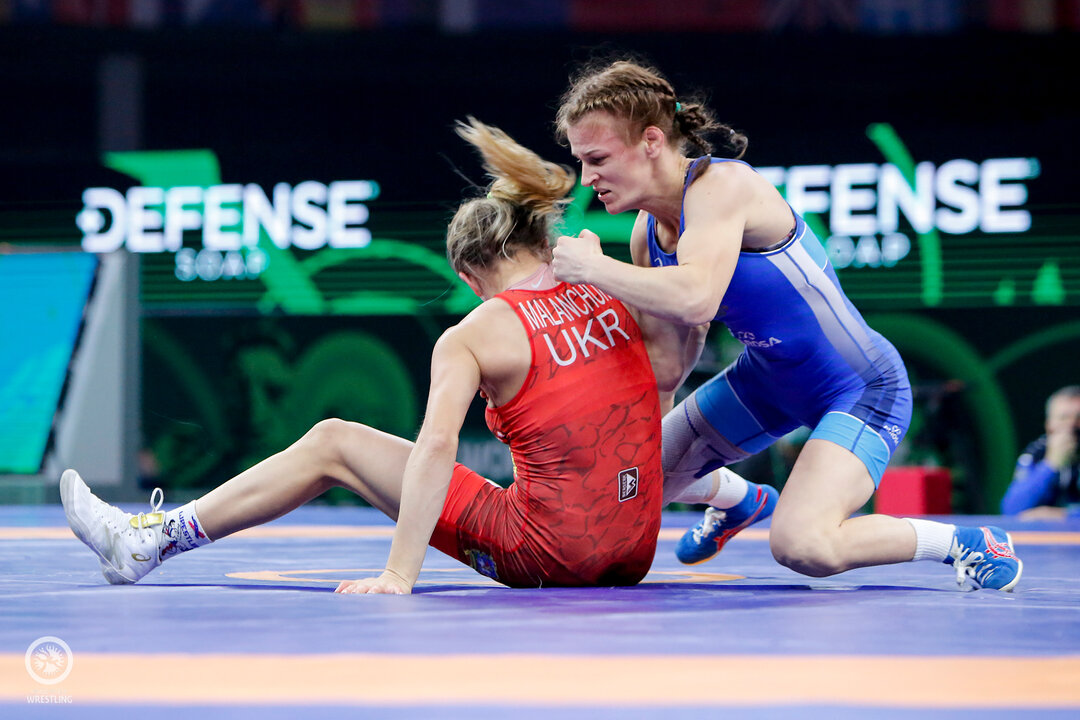
Ekaterina POLESHCHUK (RUS) won by technical superiority in the 50kg final (Photo: Gabor MARTIN, UWW)

World bronze medalist Ekaterina POLESHCHUK (RUS) claimed the gold medal at 50kg with a 10-0 technical superiority over Liliia MALANCHUK (UKR). Poleshchuk picked up an early takedown before locking up a gut wrench and turning the Ukrainian four times to finish the match in the first period. 
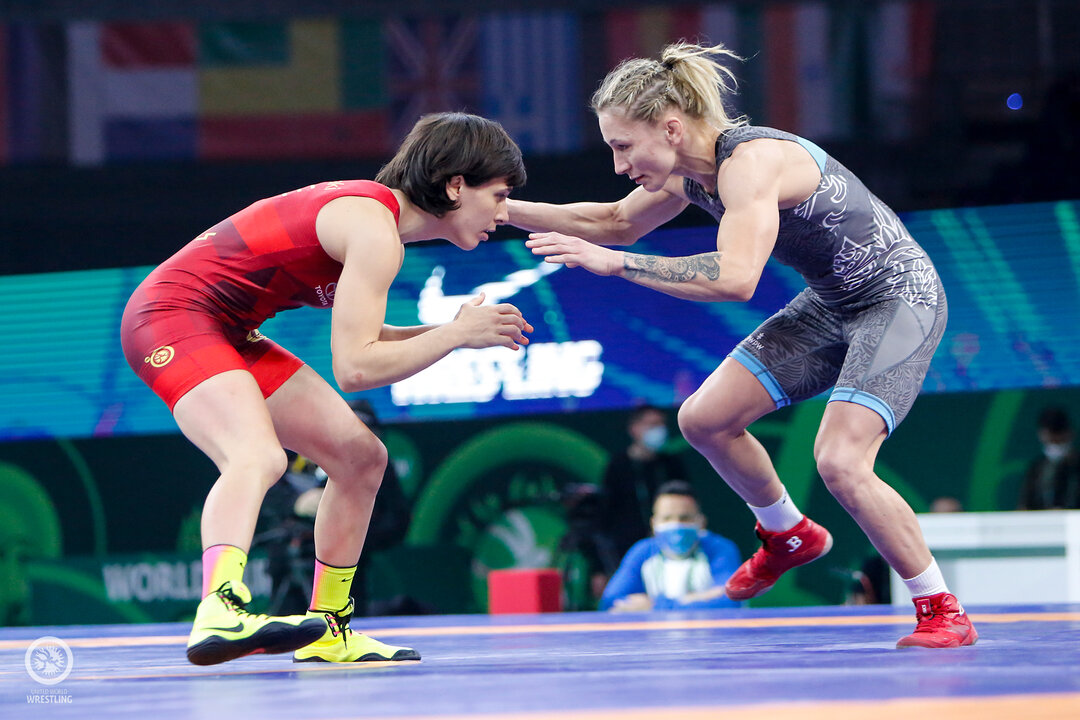
Maria PREVOLARAKI (GRE) took the title at 53kg with a 5-1 victory (Photo: Gabor MARTIN, UWW)

Maria PREVOLARAKI (GRE) used a big second period to help her earn a 5-1 win over Roksana ZASINA (POL) in the 53kg final. The two wrestlers traded passivity points, with Zasina scoring the second one in the final period to take the criteria lead. Midway through the second period, Prevolaraki hit a four-point throw to go up by four, which was enough to earn the victory.
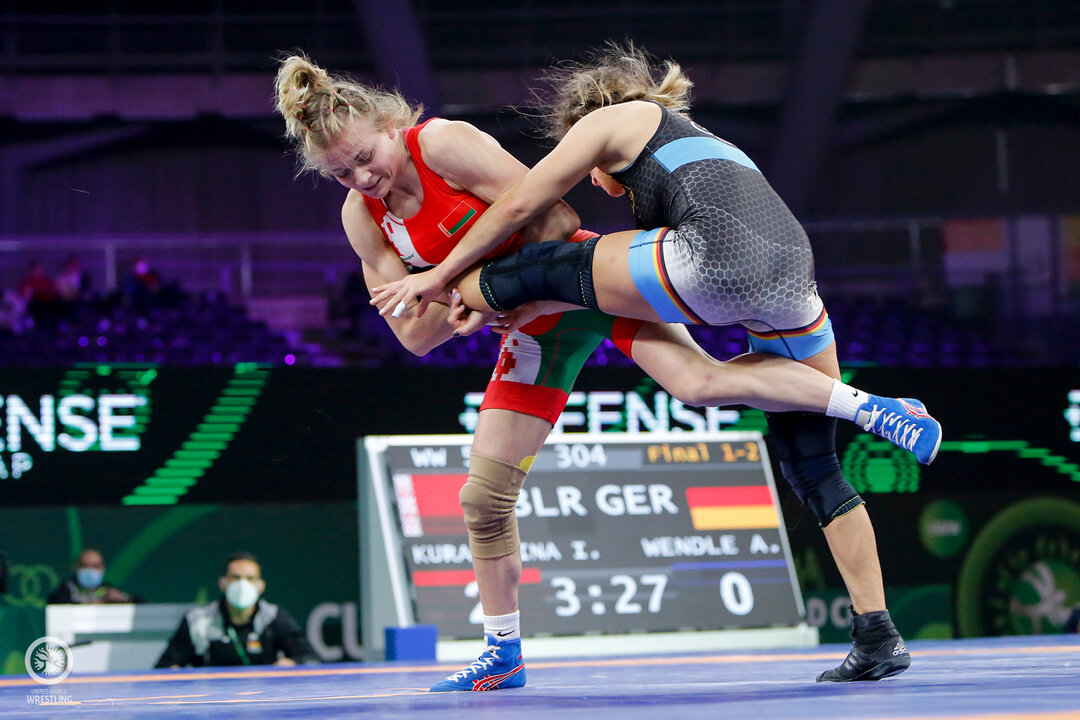
Iryna KURACHKINA (BLR) shut out Annika WENDLE (GER) in the 55kg final (Photo: Gabor MARTIN, UWW)

Iryna KURACHKINA (BLR) cruised to a decisive 9-0 shutout over Annika WENDLE (GER) to claim gold at 55kg. Kurachkina scored two takedowns in the first period to lead 4-0 at the break. She added a third takedown early in the second period before countering an attack from Wendle for a two-point exposure and adding a point off a step out. 
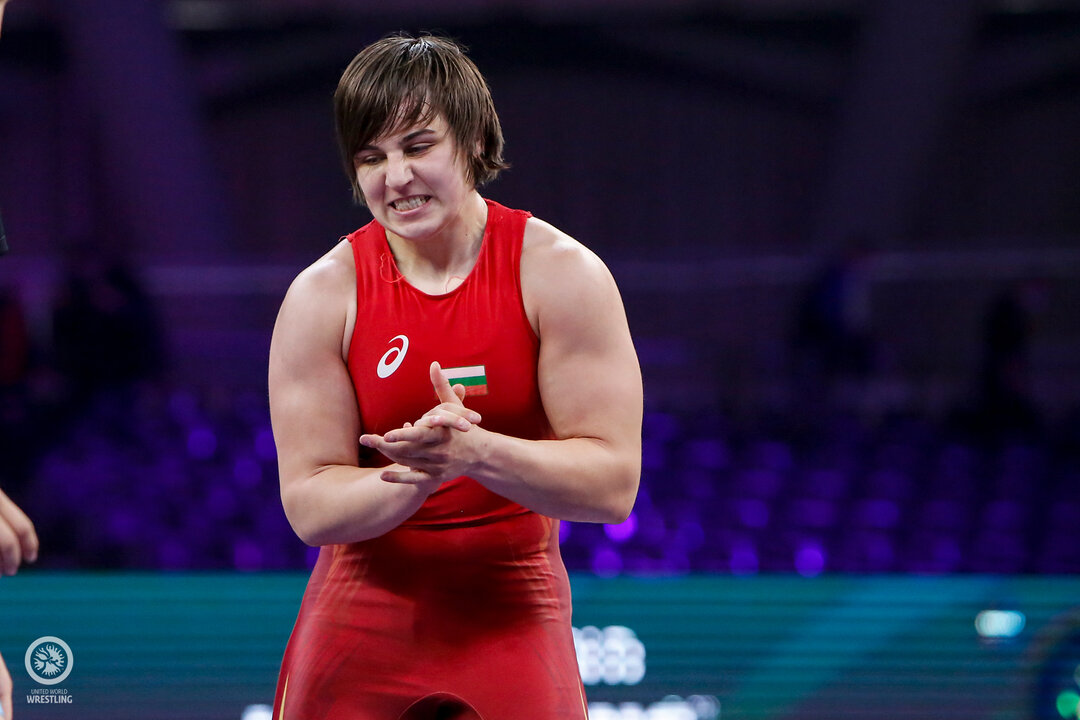
Yuliana YANEVA (BUL) celebrates after earning the title at 72kg (Photo: Gabor MARTIN, UWW)

Yuliana YANEVA (BUL) won the gold medal at 72kg with a 5-2 victory over Buse TOSUN (TUR). Yaneva scored her first point off the activity clock before picking up two takedowns to lead 5-0 at the break. Tousun would get on the scoreboard in the second period with two step outs, but the Bulgarian would earn the victory. 

Russia finished with four medals on Tuesday. In addition to Poleshchuk's gold at 50kg, three Russian women earned bronze medals: Anzhelika VETOSHKINA (53kg), Olga KHOROSHAVTSEVA (55kg) and Liubov OVCHAROVA (62kg).

Ukraine earned a pair of bronze medals from Ilona PROKOPEVNIUK (62kg) and Alla BELINSKA (72kg). 

Miglena SELISHKA (BUL) and Lisa ERSEL (GER) won the bronze medals at 50kg.

Also winning bronze medals on Tuesday were Zalina SIDAKOVA (BLR) at 53kg, Katarzyna KRAWCZYK (POL) at 55kg and Zsuzsanna MOLNAR (SVK) at 72kg.

Women's Wrestling Medal Match Results

50kg
GOLD: Ekaterina POLESHCHUK (RUS) df. Liliia MALANCHUK (UKR) by VSU, 10-0
BRONZE: Miglena SELISHKA (BUL) df. Evin DEMIRHAN (TUR) by VSU1, 13-2
BRONZE: Lisa ERSEL (GER) df. Gloria Estefanny ASCA VILCAPOMA (PER) by VSU, 10-0

53kg
GOLD: Maria PREVOLARAKI (GRE) df. Roksana Marta ZASINA (POL) by VPO1, 5-1
BRONZE: Anzhelika VETOSHKINA (RUS) df. Nina HEMMER (GER) by VPO1, 12-4
BRONZE: Zalina SIDAKOVA (BLR) df. Zeynep YETGIL (TUR) by VPO, 3-0

55kg
GOLD: Iryna KURACHKINA (BLR) df. Annika WENDLE (GER) by VPO, 9-0
BRONZE: Katarzyna KRAWCZYK (POL) df. Mariana DRAGUTAN (MDA) by VPO, 7-0
BRONZE: Olga KHOROSHAVTSEVA (RUS) df. Pinki PINKI (IND) by VSU, 10-0

62kg
GOLD: Aisuluu TYNYBEKOVA (KGZ) df. Anastasija GRIGORJEVA (LAT) by VFA, 14-0
BRONZE: Liubov OVCHAROVA (RUS) df. Kriszta Tunde INCZE (ROU) by VPO1, 1-1
BRONZE: Ilona PROKOPEVNIUK (UKR) df. Luisa Helga Gerda NIEMESCH (GER) by VPO1, 3-1

72kg
GOLD: Yuliana Vasileva YANEVA (BUL) df. Buse TOSUN (TUR) by VPO1, 5-2
BRONZE: Alla BELINSKA (UKR) df. Evgeniia ZAKHARCHENKO (RUS) by VFA, 6-2
BRONZE: Zsuzsanna MOLNAR (SVK) df. Luz Clara VAZQUEZ (ARG) by VFA, 2-2
 

#WrestleTirana

Interview: Iran Greco-Roman coach Hassan Rangraz

By Vinay Siwach

ZAGREB, Croatia (February 14) -- Iran won its first Olympic gold medal in Greco-Roman at the 2012 London Games. Rio 2016 was a blank but Mohammadreza GERAEI (IRI) won at the Tokyo Olympics. Soon, Iran changed the coaching staff and brought in Hassan RANGRAZ to lead the Iran team.

Rangraz enjoyed success at various levels but the 2024 Paris Olympics was one of the best that Iran had. Two gold medals, one silver and one bronze made it the most successful Olympics for Iran.

The 44-year-old soft-spoken former world champ has a different personality while coaching. He rarely takes the role of first coach during the bouts. But he is always animated in the corner, shouting instructions to his wrestlers and sometimes reacting to the referee's decisions.

As the new Olympic cycle for the 2028 Los Angeles Games begins, United World Wrestling caught up with Rangraz at the season opening Zagreb Open Ranking Series. Rangraz explained the success of Iran's Greco-Roman team, training in Tehran, defended the selection process and the fans who have a say on everything in Iran wrestling.

Hassan RANGRAZ (IRI)Iran's national Greco-Roman coach Hassan RANGRAZ during the 2024 Paris Olympics. (Photo: United World Wrestling / Jake Kirkman)

Excerpts:

- How do you see the success of Iran Greco-Roman team at the Paris Olympics?

Rangraz: In my opinion, the result of the Paris Olympics, with four medals, two of them gold, was a remarkable achievement in the history of Greco-Roman wrestling for Iran. This success was primarily due to the six years of planning by the federation, the efforts of former head coaches and previous coaches. I played a very small part in this journey.

- What is it like in the national camp for Iran?

Rangraz: Right after the Olympics, with a very short break, we began our planning. From the Olympics to the 2025 World Championships, we will have 22 training camps, totaling 220 days. We will also be competing for nearly 80 days. Out of the 365 days in a year, our wrestlers will be under direct supervision of the coaching staff for about 300 days. They will follow intense training programs and preparation matches. Even during the remaining 60 days, they will still be monitored indirectly through technical and strength training programs provided by the coaching staff.

- Iran's selection process often comes under scrutiny. Despite that, it keeps producing results. What are you thoughts on the current selection process in Iran?

Rangraz: We have a process and young wrestlers can enter this cycle to compete and prove their worth. The prime examples of this process are Esmaeili and Mohammadi. They shone in domestic and international tournaments, competed with top wrestlers in their weight classes. They performed and won Olympic medals. We are committed to implementing the national team’s selection process and giving talented young wrestlers the opportunity to prove themselves. This way, we can execute the talent identification process in the best possible way.

- What are the responsibilities and challenges as the national coach?

Rangraz: Wrestling is the number one sport in Iran and our national, patriotic, and traditional sport. Wrestling is part of Iran’s culture. Therefore, taking on the technical responsibility as the head coach primarily brings stress, anxiety, and immense pressure. On top of that, you have to be accountable for the results and take responsibility for the team’s performance. In terms of difficulty, I can confidently say that considering the intense scrutiny, being the head coach of the national team is so challenging it’s like working in a mine.

- The fans of Iranian wrestling are always involved. How do you see this and does it affect you in any way?

Rangraz: As I mentioned earlier, 80 million Iranians have a deep love for wrestling. Perhaps that’s why a tournament that may not hold much significance for people from other countries is so important to our people. They follow it closely, they care about it, they rejoice in victories and worry about defeats. This immense passion and support from fans is the greatest strength and asset for wrestling in our country.

- What is the roadmap for the 2028 Los Angeles Olympics?

Rangraz: We believe that the Olympic Games are just around the corner. Four years go by very quickly. To succeed in the Olympics, you need to work hard, but also work smart. You can’t afford to miss a single training session or day. With this mindset and determination and knowing how high and legitimate the expectations are, we continue on our path with great strength, despite all the pressures we feel in every competition.

I believe the future of Iranian wrestling is very bright. Iran is passionate about wrestling. One of my dreams is that, just like in 1998 and 2002, we can once again host the World Wrestling Championships in Iran. The main reason for this is that nowhere else in the world will you find such passionate and numerous fans. These fans are the greatest asset of world wrestling, not just Iranian wrestling, and their expectation is to host a World Championship event.