#Grappling

World Combat Games Qualifiers: 16 earn quotas

By Vinay Siwach

TASHKENT, Uzbekistan (April 30) -- The World Combat Games Qualifiers offering 40 quotas got underway in Tashkent, Uzbekistan on Sunday in Grappling and Grappling Gi.

The first phase of the qualification was held in 2022 in Pontevedra, Spain which also offered 40 quotas. The four highest-placed grapplers in each of the Combat Games approved senior weight categories qualified for the World Combat Games in Saudi Arabia in October 2023.

In Tashkent, the process will be the same and the first four highest-placed athletes in each of the weight categories will each qualify for one quota place for their national federation.

If in a weight category, more than one athlete from the same country is ranked in the first four highest places, only one quota will be allocated to the country. The remaining quota(s) will be reallocated in the same weight category to the national federation of the next best-ranked athlete, not yet qualified, in the qualification event where the quota place was obtained.

Men's Grappling

66kg
Mayis NERSESYAN (ARM)
Renzo MARTINEZ (VEN)
Avzal AKHMETOV (UZB)
Syimyk MAKHMEDOV (KGZ)

84kg
Nadir IMAMALIYEV (AZE)
Ulugbek RAKHMONOV (UZB)
Nurbek TALBUDIN (KAZ)
Amirhossein JINOUR (IRI)

92kg
Hajimurad PURTIYEV (AZE)
Eldar RAFIGAEV (MDA)
Mantas DAUBLYS (LTU)
Ramazan KUSSAINOV (KAZ)

Women's Grappling

58kg
Viktoriia SYNIAVINA (UKR)
Zhenishgul ABDYRAKHMAN KYZY (KGZ)
Zilolakhon MUHAMMADOVA (UZB)

90kg
Madinabonu SALOKHIDDINOVA (UZB)
 

#development

South Africa Advances National Wrestling System with DNSS Phase 2

By United World Wrestling Press

PRETORIA, South Africa (April 8) -- South Africa has reached a decisive milestone in its long-term wrestling development strategy with the successful implementation of Phase 2 of the Development of National Sport System (DNSS) programme, delivered in collaboration with United World Wrestling (UWW) and supported by Olympic Solidarity.

Following the diagnostic and mapping phase conducted earlier, Phase 2 marks a clear transition from analysis to structured implementation, laying the foundation for a sustainable and internationally aligned wrestling system.

Led by UWW Development Officer Vincent AKA, in close cooperation with the South African Wrestling Federation (SAWF), the National Head Coach, Markus DEKKER and Provincial Coordinators, the programme was deployed across multiple provinces through a structured 10-day intervention from March 2 to 13. 

Activities were conducted in key locations including:

· LPWA (Ion Bachu)
· CGWA (Ruiter)
· NGWA (Menlo Park Hall)
· Frank Joubert Tournament (Menlo Park Hall)

This nationwide approach ensured direct engagement with provincial structures, strengthening alignment between national leadership and local associations while promoting inclusive development across the country.

From Talent Identification to System Building

Unlike traditional training camps, DNSS Phase 2 focused on identifying talent and building long-term development systems. Wrestlers and coaches from all age categories -- U13, U15, U17, U20, and Senior -- were actively involved, ensuring a complete pathway approach.

Provincial visits and stakeholder meetings played a key role in assessing facilities and operational structures, strengthening coordination between SAWF and provinces, and identifying emerging wrestlers.

Building Athlete Pipeline

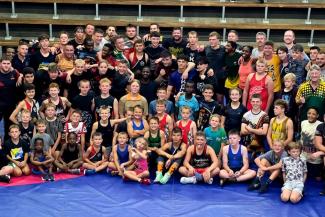
A training camp for different provinces brought together wrestler to consolidate talent identified during Phase 1 and introduce standardized training methodologies.

The training camp included technical sessions, physical conditioning, match simulations and wrestling. The initiative contributed to the creation of an updated national prospect and the foundation of a structured athlete monitoring system.

South Africa

Beach Wrestling Gains Momentum

As part of the DNSS activities, a Beach Wrestling training session in Roodepoort highlighted the programme’s expanding impact.

During the visit, Aka led a specialized session, sharing advanced technical insights adapted to beach wrestling. It included stance and balance adjustments, grip and control techniques, and movement adaptation on sand.

The training programme comes at a crucial time, as South African athletes prepare for African Beach Wrestling Championships in Alexandria, Egypt and other international tournaments.