

Gomi Takes Big Strides as Japan’s Next Greco-Roman Hope
Wednesday, February 18, 2026 - 13:33 By Vinay Siwach
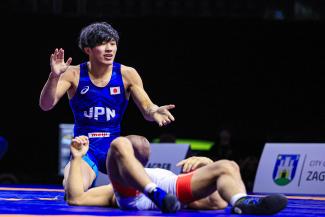
JAPAN (February 18) -- Koto GOMI (JPN) has been racking up titles in recent times. Last year, he won the U23 world title, the first for Japan in six years. He then won the All-Japan Championships gold in December for the first time.
Making his senior debut in 2026, the 21-year-old had an extraordinary run at the Zagreb Open Ranking Series event, winning the 60kg gold medal and giving up only three points in four bouts. In the final, Gomi defeated world silver medalist Alisher GANIEV (UZB), 10-0, using three arm-throws to secure the victory inside the first period.
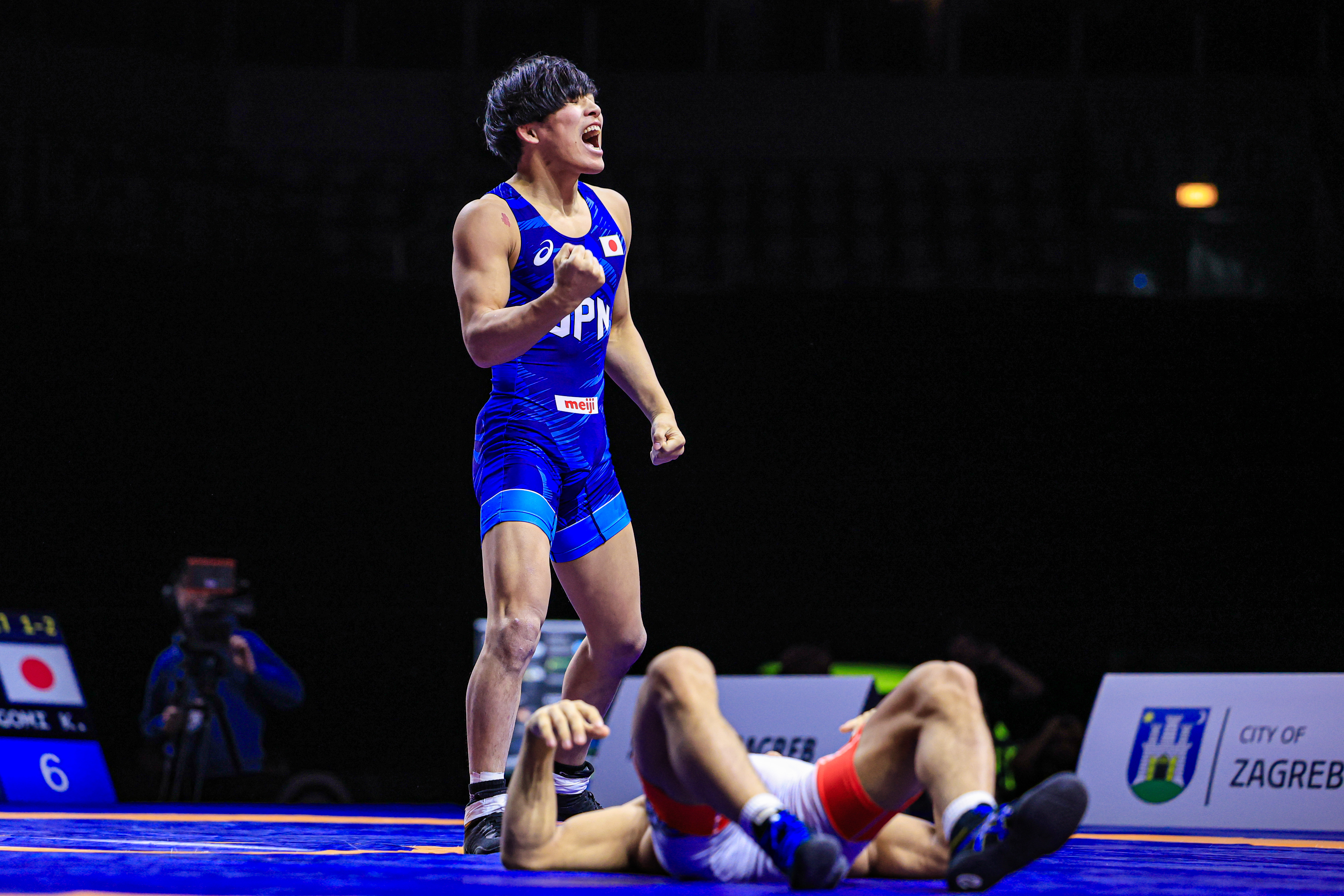 Koto GOMI (JPN) defeated Alisher GANIEV (UZB) in the Zagreb Open final. (Photo: United World Wrestling / Amirreza Aliasgari)
While it may be too early to call Gomi a protégé, he may have already ended Japan's search for a new star at 60kg and a replacement for Olympic champion Kenichiro FUMITA (JPN).
The 30-year-old Fumita is a two-time world champion and won silver at the 2023 World Championships. A silver medalist from the Tokyo Olympics, he turned it into gold at Paris 2024.
But Fumita has not stepped on the mat since. He took time off and was entered in the All-Japan Championships at 63kg, but later pulled out. Though he did not mention it, most in Japan cite weight-cut issues for his delayed return.
That leaves Yu SHIOTANI (JPN), Kaito INABA (JPN) and Gomi as the front-runners for the spot if Fumita cannot make it. Gomi pinned Shiotani and then beat Inaba via technical superiority at the National Sports Festival in October.
Two months later in December, he again beat Shiotani to earn a spot on Japan’s Asian Championships team.
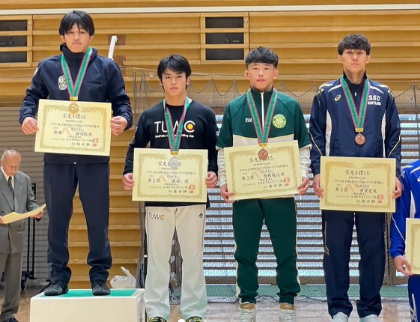
Koto GOMI (JPN), left, after winning the All-Japan University Championships. (Photo: Koto Gomi / Instagram)
Early start
Gomi was born in the Yamanashi Prefecture, west of Tokyo. The prefecture has given wrestling some of its biggest stars including Olympic champions Takuto OTOGURO (JPN) and Tatsuhiro YONEMITSU (JPN).
He was introduced to wrestling by his father Joe, a kickboxer. Joe would take his eldest son Koto to far away tournaments to compete. Though the results were not always satisfying, Shiro wanted his son to face high-level competition every year.
"Wrestling has few injuries," he was quoted as saying by Japan Wrestling Federation in 2010. "It's a sport that develops physical ability and trains both the body and mind. I think it's the perfect martial art for children.
"It's a sport where older students take care of younger students. They naturally take care of you without you having to teach them."
It's true in Gomi's case. Like Gomi, both Fumita and Inaba hail from the same prefecture and attended the same high school.
Fumita's father, Toshiro, introduced most wrestlers to Greco in their high school. While Fumita and Inaba moved to Nippon Sports Science University, Gomi is at the Ikuei University, same as the world and Olympic champions in women's Sakura MOTOKI (JPN) and Tsugumi SAKURAI (JPN).
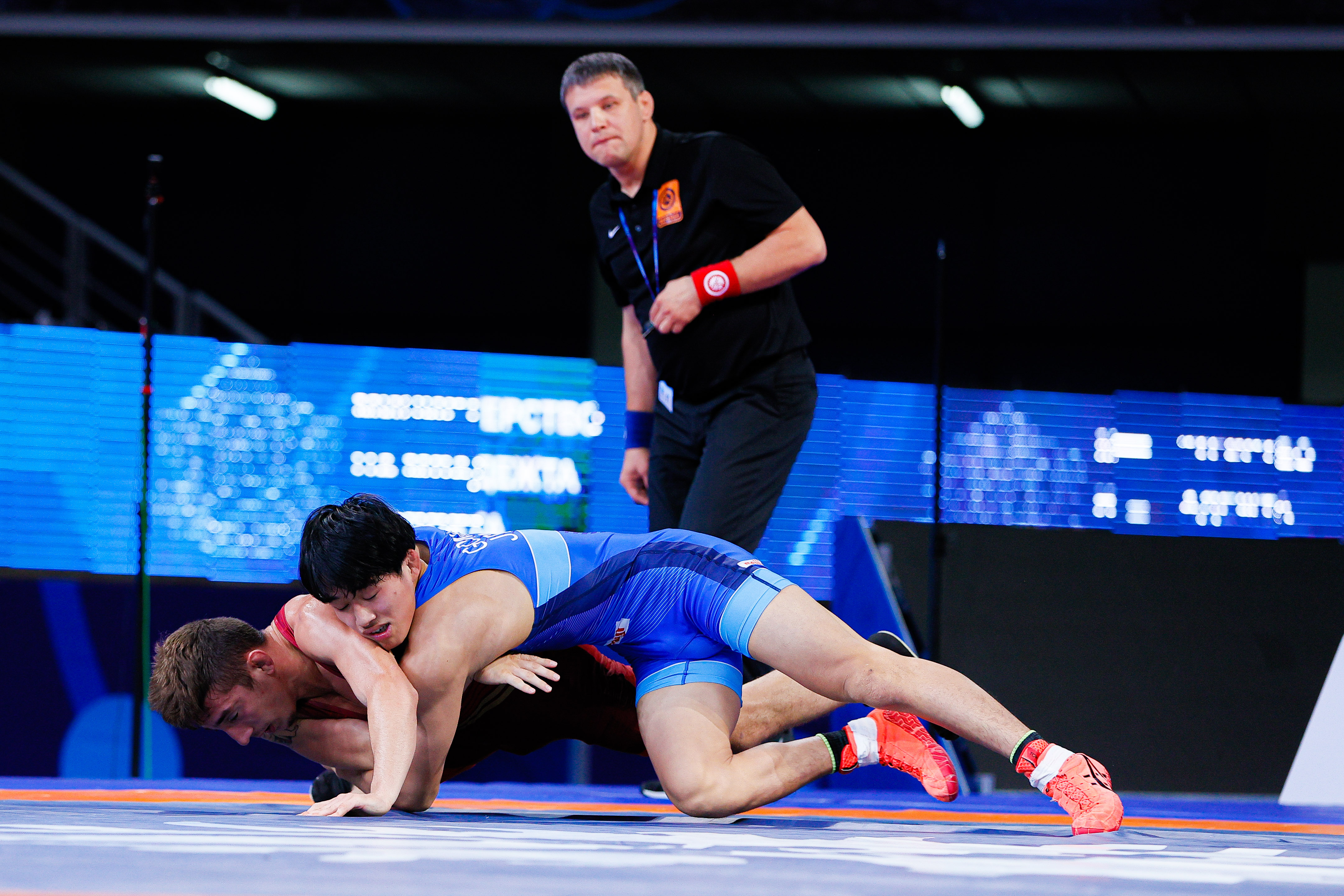 Koto GOMI (JPN), blue, at the 2022 U20 World Championships. (Photo: United World Wrestling / Kostadin Andonov)
Gomi began competing exclusively in Greco-Roman around 2022 but did not get satisfactory results internationally, finishing fifth and ninth at the two U20 World Championships.
In one of the memorable matches early in his career, Gomi had troubled the now Olympic Saied ESMAEILI (IRI). At the 2022 U20 Worlds, he was led 6-4 and then 9-4 at one point in the match against the Iranian but he lost it 13-9.
Two years later, Gomi emerged as a dominant force. He won the gold medal at the U20 Asian Championships and all age-group domestic competitions. His only losses came at the senior All-Japan Championships, winning bronze at three of them.
Gomi said his recent success was the result of years of hard work, particularly at university.
"I don't seem to be the athletic type, but rather a refreshing liberal arts type, and that's how I'm often seen," Gomi said. "I'm competitive. I get really annoyed and frustrated when I lose in practice. The hard work I've put in over the past four years at university is starting to show in the past year."
Domestic challenges
In 2025, Gomi suffered only one loss in five tournaments -- a 10-0 humiliation to Shiotani in May. But in December, he avenged that loss in the final of the All-Japan Championships and earned a chance to represent Japan at the 2026 Asian Championships in Bishkek, Kyrgyzstan in April.
The December win also put Gomi a step closer to the 2026 World Championships and Asian Games. He now has to win the Japan National Championships in May to qualify for both. If he fails to win, he will have a wrestle-off with the winner on the same day.
Both the U23 World Championships and the Zagreb Open showcased Gomi's technical excellence. He often uses a two-on-one to set up his arm-throws and arm-drags. It is his swiftness, rather than brute force, that allows him to complete his attacks.
In par terre, Gomi has an excellent high gut-wrench, which he used effectively against Sajjad ABBASPOUR (IRI) in Zagreb and Maxwell BLACK (USA) at the U23 Worlds.
"I'm starting to find my strengths, like in terms of technique, so I think that's a good thing," he said.
Despite his rapid rise, Gomi is cautious about calling himself the best yet. He knows he still needs to get past several domestic rivals before becoming Japan’s first-choice wrestler at 60kg.
"It's not like that, but I was conscious of focusing on my strengths and techniques and taking the initiative to attack," he said. "But, there are many other players in Japan, like Fumita and Inaba, and I don't think I can beat them yet, so I'll continue to practice hard."
But if Zagreb was any indication, it may not take long.

 Over 100 participants competed in the national youth tournament during the
Share your thoughts.
Comments