

Host Japan Holds Off China for 4th Straight Women's World Cup Title
Sunday, March 18, 2018 - 23:20 By Ken Marantz
Missing one of its world and Olympic champions from the lineup, Japan needed someone among its less heralded members to step up and notch a pivotal win.
Enter Ayana GEMPEI (JPN), whose come-from-behind victory at 65kg clinched host Japan's 6-4 victory over China in the final of the Women's World Cup, giving the host country its fourth consecutive title and 10th overall.
"I was so focused, I didn't really think about that," Gempei said of being in position to give Japan an insurmountable lead. "Anyway, I went out there absolutely determined to win."
Facing TANG Chuying (CHN), Gempei was trailing 3-2 when she scored a takedown and roll in the final 12 seconds to notch a 6-3 victory.
"I was losing, but I thought I could definitely get something somewhere. I believed in what I brought [to the mat]. I went for it with confidence."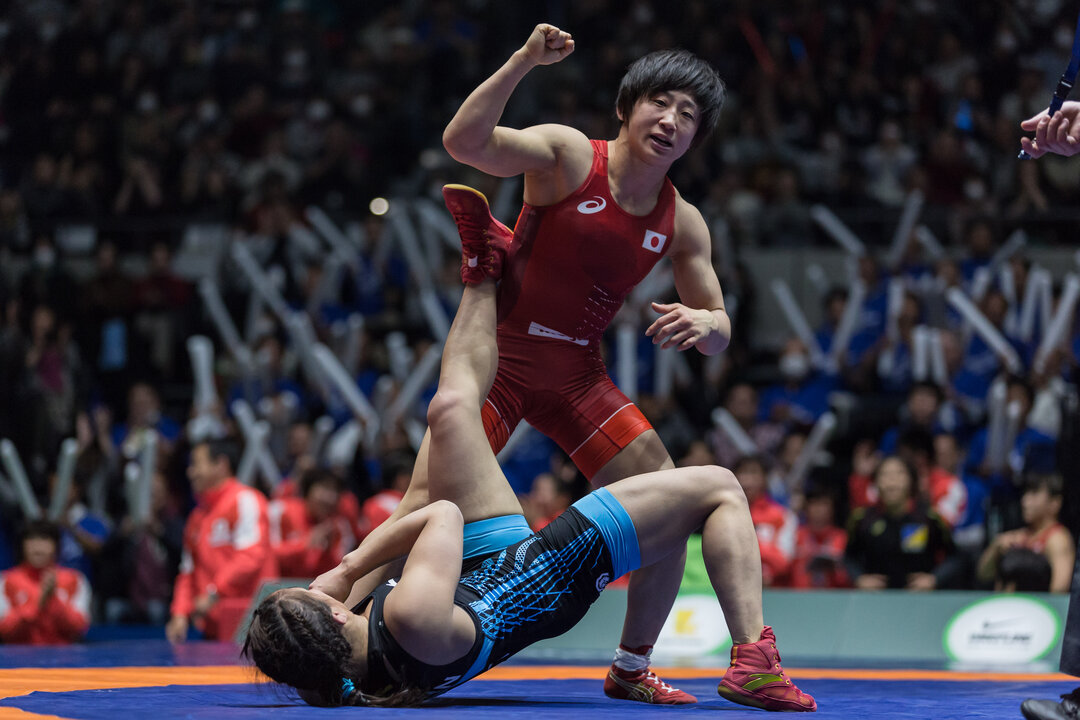 df. Yanan SUN (CHN) -by VFA, 10-0--3.jpg) Yuki IRIE (JPN) celebrates her 10- technical fall over Olympic bronze medalist SUN Yanan of China (Photo: Max Rose-Fyne).
Yuki IRIE (JPN) celebrates her 10- technical fall over Olympic bronze medalist SUN Yanan of China (Photo: Max Rose-Fyne).
Yuki IRIE (JPN) got the host country off to a perfect start when she overwhelmed Rio 2016 Olympic bronze medalist SUN Yanan (CHN), building up a 10-0 lead before scoring a fall with :46 remaining.
Irie, who had beaten world champion Yui SUSAKI at the Japan championships in December, was coming off a disappointing showing at the recent Asian Championships in Bishkek, where she had to settle for a bronze medal in a tournament dominated by China.
But before the packed house of 2,000 at Takasaki Arena and national TV audience, Irie showed what makes her a force to be reckoned with.
"At the start, I was wondering about Irie," Japan head coach Hideo SASAYAMA said. "If we lose there, it could be a problem. But if we win the opener, it gets things rolling. She came up with a fantastic victory and that got the momentum going for Japan."
Paris 2017 world champion Haruna OKUNO (JPN) followed with a victory at 53kg by fall over OUYANG Junling (CHN), in contrast to her labored 7-6 victory the day before over Sarah HILDEBRANDT (USA).
"In yesterday's match, I allowed the opponent to work her strategy," Okuno said. "Today, I was able to do what I wanted to do."
Paris 2017 silver medalist Mayu MUKAIDA (JPN) kept the ball rolling with a 10-0 technical fall victory in 1:27 over XIE Mengyu (CHN) at 55kg.
While those three victories could be expected, the next few matches would be decisive for China, which was relying on setting the stage for its highly touted trio of heavyweights.
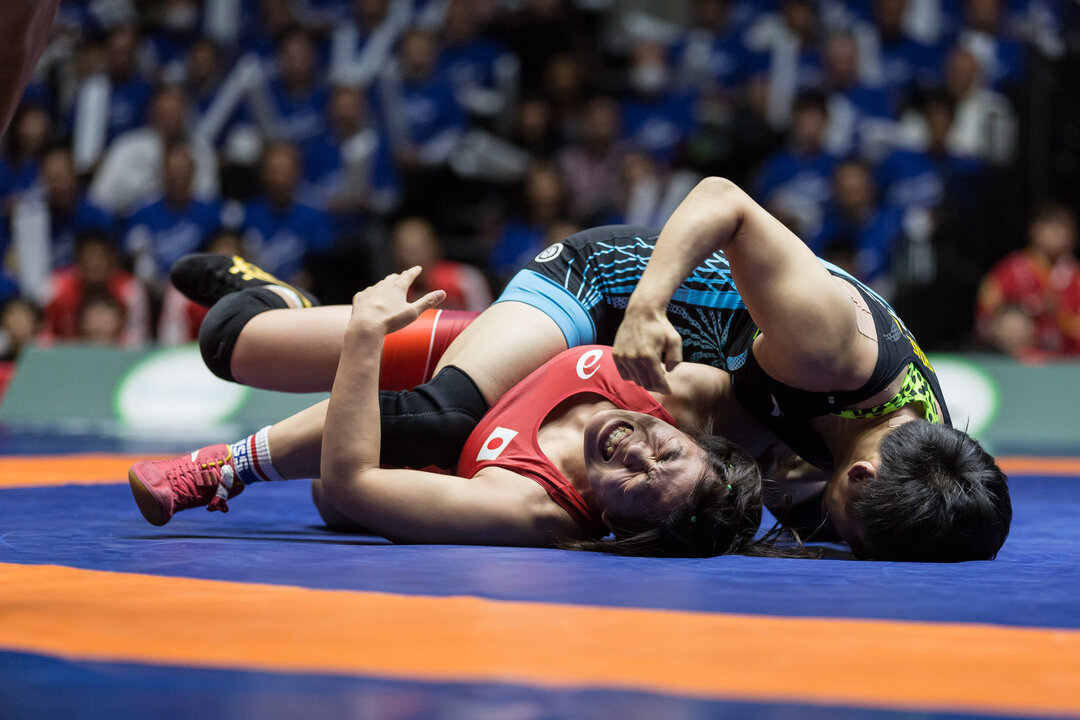 df. Katsuki SAKAGAMI (JPN) -by VSU1, 15-4-5.jpg) RONG Ningning (CHN) looks for the fall in the finals of the Women's World Cup (Photo: Max Rose-Fyne)
RONG Ningning (CHN) looks for the fall in the finals of the Women's World Cup (Photo: Max Rose-Fyne)
Next up for China was Bishkek 2018 gold medalist RONG Ningning at 57 kg, and it was a surprise to many when Katsuki SAKAGAMI jumped out to a 4-0 lead. But Rong stuffed Sakagami on a double-leg tackle attempt, sending her to her back before ripping off five consecutive rolls---the last of which just beat the first-period buzzer for a 15-4 technical fall.
At 59kg, Yukako KAWAI (JPN) pulled off a key win when she scored a second-period takedown for a 3-1 victory over PEI Xingru (CHN), who, like Rong, was one of five newly crowned Asian champions who took the mat for China on Sunday.
Kawai's older sister, Rio 2016 Olympic and Paris 2017 world champion Risako KAWAI (JPN) lived up to expectations by forging a 10-4 victory over Bishkek 2018 silver medalist LUO Xiaojuan, putting Japan up 5-1.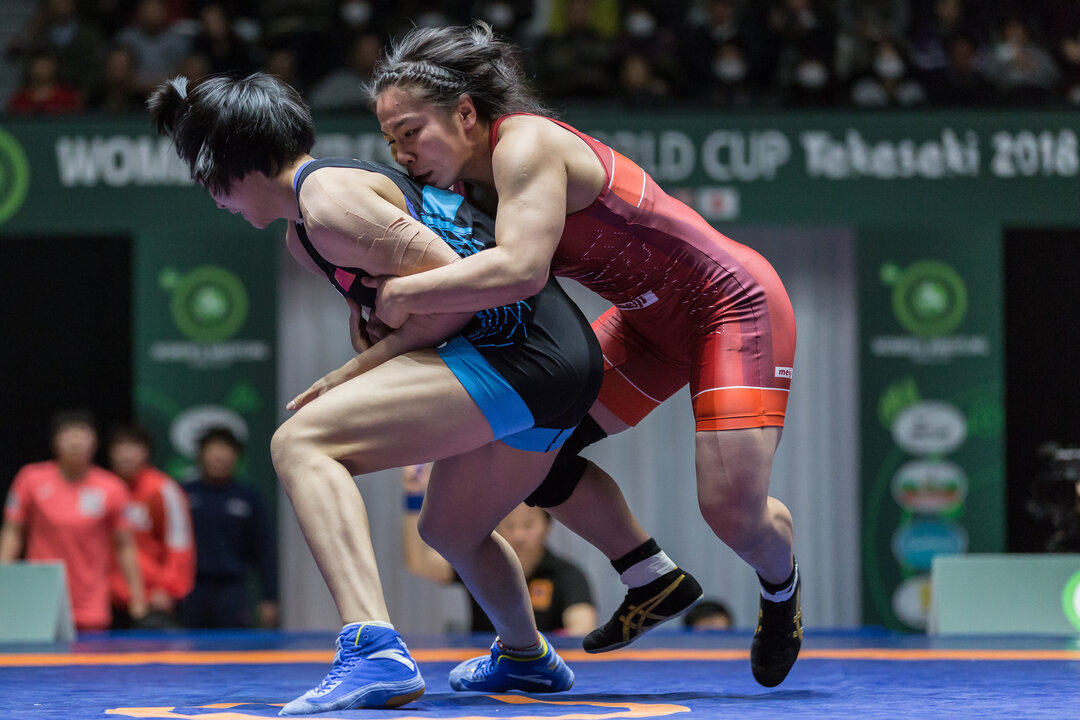 df. Chuying TANG (CHN) -by VPO1, 6-3-2.jpg) Ayana GEMPEI (JPN) battles for control in Sunday night's final (Photo: Max Rose-Fyne)
Ayana GEMPEI (JPN) battles for control in Sunday night's final (Photo: Max Rose-Fyne)
Gempei, a world under-23 champion, scored her decisive victory over the lanky Tang, who was a head taller than the stocky Japanese.
"Whoever the opponent, whatever their body type, I only think about having to fight by using the moves that I know," Gempei said. "So I don't think about that."
With Rio 2016 Olympic and Paris 2017 world champion Sara DOSHO (JPN) skipping the final due to a shoulder injury suffered during the preliminary round, Miwa MORIKAWA (JPN) proved no match at 68kg for Bishkek 2018 champion ZHOU Feng, going down to defeat 9-0.
China's two other Asian champions, Yue HAN (CHN) at 72kg and ZHOU Qian (CHN) at 76kg, finished up with wins that only served to slim Japan's margin of victory.
Han, a Paris 2017 bronze medalist, was pushed to the limit by Masako FURUICHI (JPN) and needed two second-period takedowns to notch a 10-7 victory, while Zhou followed by topping Paris 2017 bronze medalist Hiroe SUZUKI (JPN) 7-1.
Mongolia takes bronze for 3rd straight year
In a thrilling third-place playoff that featured a number of late, come-from-behind wins, Tumentsetseg SHARKHUU (MGL) provided the shocker that helped clinch Mongolia's 6-4 victory over the United States for a third consecutive bronze medal.
The U.S. had cut Mongolia's lead to 4-3 with victories over two of its top wrestlers when Bishkek 2018 silver medalist Sharkhuu faced Tamrya MENSAH (USA) in a pivotal bout at 68kg.
Mensah stormed to a 5-0 lead, but in the second period, Sharkhuu used an inside trip to send the American to her back, then finished off the match with a fall with 1:56 left.
"Our team, we all supported each other and were saying, 'You can do it,'" Sharkhuu said. "I was just thinking about the team and thinking 'I have to win.'"
Regarding her winning move, Sharkhuu said, "That technique is not my technique, but for the last month I have been trying it."
After Davaachimeg ERKHEMBAYAR (MGL) at 55kg and Shoovdor BAATARJAV (MGL) at 59kg pulled off last-second victories, the U.S. got back into the match with two big wins.
Mallory VELTE (USA) held on for an 11-9 victory at 62kg over Paris 2017 world champion Orkhon PUREVDORJ (MGL), who was not at 100 percent and had defaulted two group stage matches.
Then, Forrest MOLINARI (USA) ended a close battle at 65kg with former world champion Battsetseg SORONZONBOLD (MGL) with a first-period fall.
"Orkhon was injured, but she tried her best," Sharkhuu said. "I really appreciate her [effort]. We are all one team."
Mongolia coach Byambajov BATTULGA said the team is improving as younger wrestlers start to step up.
"We have a good mix with young wrestlers getting better," Battulga said. "We're more confident. Two champions lost, we were shocked. But Sharkhuu came up with a big win."
High drama for the lower places
Meanwhile, there was drama in the morning as both of the playoffs for lower places were split evenly 5-5 between the competing teams, and had to be decided on classification points.
Canada held on to edge Belarus 24-21, with the main difference coming from the fact that Belarus had one more victory by default or forfeit than Canada.
The outcome was not decided until the final match at 76kg, when Vasilisa MARZALIUK (BLR), needing to win by fall, could only manage a 6-4 victory over Justina DI STASIO (CAN).
With the score 2-2 and less than minute left, Marzaliuk pressed to lock up di Stasio's arms to set up a throw. The Canadian resisted but was flipped over as they went out of bounds for a 4-point move.
"I think I was trying so hard to not step out of bounds that I overcompensated and drove so hard," di Stasio said. "I don't know how I got flipped over."
Adding to the drama, di Stasio was injured on the play and needed medical attention. "I've got a little neck thing going on," she said. "I don't know why I landed on my head in the last two matches."
A default would have given Belarus the victory---a detail that the Canadian said she was not aware of.
"No, I had no idea---which I'm happy about," said di Stasio, who added she never thought about stopping the match.
For Sweden, splitting the matches with Romania in the seventh-place playoff but losing on classification points 24-22 was a moral victory of sorts, given the young squad's bleak results in the group stage when it won just two matches overall.
"Yesterday was really tough for the whole team," said veteran Jenny FRANSSON (SWE), the Rio 2016 bronze medalist who beat Catalina AXENTE (ROU) by technical fall at 72kg. "When I was almost the last match, I could feel everyone was so sad. It was hard. But it's a good experience."
Final Day Results
1st-2nd Place
JAPAN 6 CHINA 4
50 kg: Yuki IRIE (JPN) df. SUN Yanan (CHN) by Fall, 0:46 (10-0)
53 kg: Haruna OKUNO (JPN) df. OUYANG Junling (CHN) by Fall, 4:33 (4-0)
55 kg: Mayu MUKAIDA (JPN) df. XIE Mengyu (CHN) by TF, 10-0, 1:15
57 kg: RONG Ningning (CHN) df. Katsuki SAKAGAMI (JPN) by TF, 15-4, 3:00
59 kg: Yukako KAWAI (JPN) df. PEI Xingru (CHN), 3-1
62 kg: Risako KAWAI (JPN) df. LUO Xiaojuan (CHN), 10-4
65 kg: Ayana GEMPEI (JPN) df. TANG Chuying (CHN), 6-3
68 kg: ZHOU Feng (CHN) df. Miwa MORIKAWA (JPN), 9-0
72 kg: HAN Yue (CHN) df. Masako FURUICHI (JPN), 10-7
76 kg: ZHOU Qian (CHN) df. Hiroe MINAGAWA (JPN), 7-1
3rd-4th Place
MONGOLIA 6 UNITED STATES 4
50 kg: Victoria ANTHONY (USA) df. Narangerel ERDENESUKH (MGL) by Fall, 3:49 (8-2)
53 kg: Sumiya ERDENECHIMEG (MGL) df. Sarah HILDEBRANDT (USA), 10-6
55 kg: Davaachimeg ERKHEMBAYAR (MGL) df. Jacarra WINCHESTER (USA), 9-6
57 kg: Battsetseg ALTANTSETSEG (MGL) df. Allison RAGAN (USA) by TF, 10-0, 1:38
59 kg: Shoovdor BAATARJAV (MGL) df. Kayla MIRACLE (USA), 5-4
62 kg: Mallory VELTE (USA) df. Orkhon PUREVDORJ (MGL), 11-9
65 kg: Forrest MOLINARI (USA) df. Battsetseg SORONZONBOLD (MGL) by Fall, 3:22 (4-4)
68 kg: Tumentsetseg SHARKHUU (MGL) df. Tamyra MENSAH (USA) by Fall, 1:56 (4-5)
72 kg: Nasanburmaa OCHIRBAT (MGL) df. Victoria FRANCIS (USA), 11-3
76 kg: Adeline GRAY (USA) df. Chantsalnyamaa AMGALANBAATAR (MGL) by TF, 10-0, 3:59
5th-6th Place
CANADA 5 BELARUS 5
(Canada won 24-21 on classification points)
50 kg: Jessica MACDONALD (CAN) df. Kseniya STANKEVICH (BLR) by Fall, 3:12 (6-2)
53 kg: Diana WEICKER (CAN) df. Vanesa KALADZINSKAYA (BLR) by Default
55 kg: Iryna KURACHKINA (BLR) df. Jade PARSONS (CAN), 10-4
57 kg: Samantha STEWART (CAN) df. Zalina SIDAKOVA (BLR), 7-0
59 kg: Katsiaryna HANCHAR YANUSHKEVICH (BLR) df. Emily SCHAEFER (CAN) by TF, 12-2,2:15
62 kg: Veranika IVANOVA (BLR) df. Jessica BROUILLETTE (CAN) by Fall, 5:34 (4-0)
65 kg: Krystsina FEDARASHKA (BLR) df. Braxton STONE (CAN) by Default
68 kg: Olivia DI BACCO (CAN) df. Hanna SADCHANKA (BLR), 5-2
72 kg: Erica WIEBE (CAN) by Forfeit
76 kg: Vasilisa MARZALIUK (BLR) df. Justina DI STASIO (CAN), 6-4
7th-8th Place
ROMANIA 5 SWEDEN 5
(Romania won 24-22 on classification points)
50 kg: Alina VUC (ROU) df. Malin LJUNGSTROEM (SWE) by Fall, 3:56 (8-0)
53 kg: Estera TAMADUIANU DOBRE (ROU) df. Linn LUNDSTROEM (SWE) by TF, 10-0, 1:37
55 kg: Simona PRICOB (ROU) df. Liliana JUAREZ ANDINO (SWE) by TF, 10-0, 2:15
57 kg: Kateryna ZHYDACHEVSKA (ROU) df. Sara LINDBORG (SWE) by Fall, 2:23 (10-3)
59 kg: Emma JOHANSSON (SWE) by Forfeit
62 kg: Kriszta INCZE (ROU) df. Therese PERSSON (SWE) by Default
65 kg: Moa NYGREN (SWE) df. Adina POPESCU (ROU) by Fall, 1:35 (6-2)
68 kg: Alexandra SANDAHL (SWE) df. Alexandra ANGHEL (ROU), 9-2
72 kg: Jenny FRANSSON (SWE) df. Catalina AXENTE (ROU) by TF, 10-0, 1:17
76 kg: Denise MAKOTA STROEM (SWE) by Forfeit

Share your thoughts.
Comments