

Weekly FIVE! March 19, 2018
Monday, March 19, 2018 - 11:51 By Eric Olanowski

Reviewing the Women's World Cup, Snyder's three-peat and the return of Mijain LOPEZ (CUB).
1.Japan’s Women's World Cup Four-Peat
For the fourth year in a row and the tenth time overall, the Japanese women captured the Women’s World Cup title. They did so by picking up wins over Canada, Sweden, the United States and China, who they beat in the gold-medal bout, 6-4.
On the heels of come-from-behind wins from SHARKHUU Tumentsetseg (MGL), ERKHEMBAYAR Davaachimeg (MGL), and BAATARJAV Shoovdor (MGL), Mongolia defeated the United States, 6-4 in the bronze-medal bout for the third year in a row.
In the fifth-place bout, Canada edged Belarus, 24-21 on classification points after splitting the dual five matches apiece.
The seventh-place match was determined on criteria as well, with Romania picking up the victory, 24-22 on classification points.
2. Snyder Ends College Career Winning Third NCAA Title
Kyle SNYDER (USA), the two-time world and Olympic champion snagged his third NCAA title by outlasting two-time junior world bronze medalist Adam COON (USA), 3-2 in front of 19, 778 fans at the NCAA Championships.
In their third meeting of the year, Snyder used a slide-by to pick up the late takedown with 13 seconds left, giving him the 3-1 lead, ultimately winning the match, 3-2.
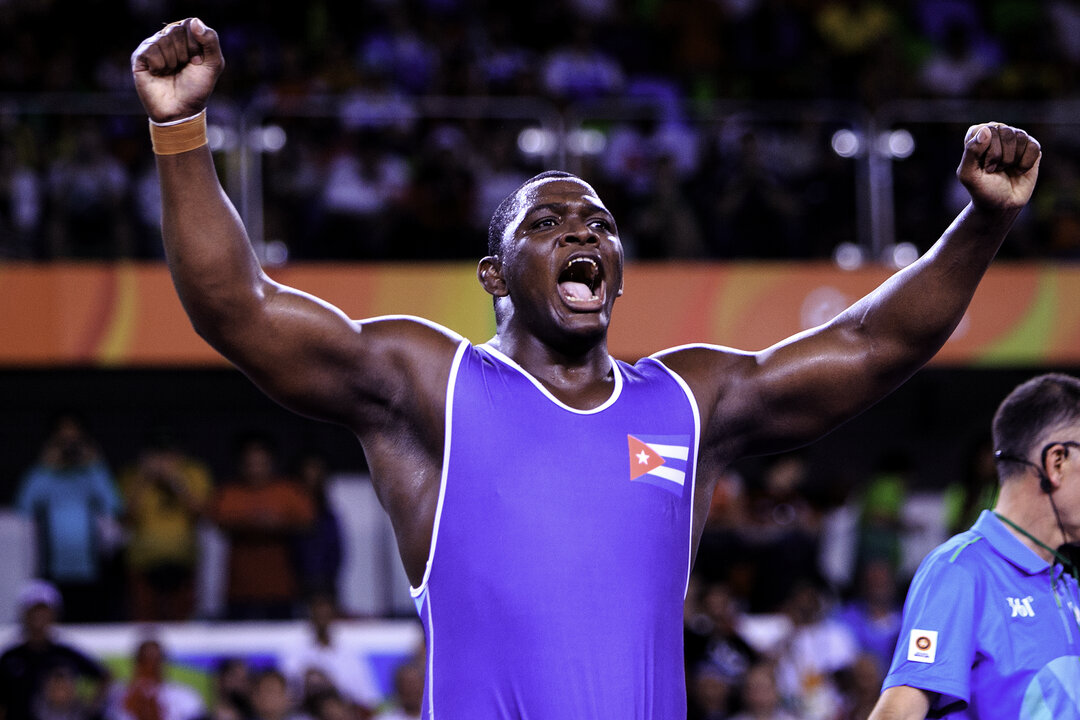-1.jpg) (Mijain LOPEZ (CUB) after winning his third Olympic gold medal.)
(Mijain LOPEZ (CUB) after winning his third Olympic gold medal.)
3. The Return of Mijain Lopez
Mijain LOPEZ (CUB), the three-time Olympic champion is slated to make his return at this week's Central American and Caribbean Championships in La Havana, Cuba. This will be Lopez’ first competition since winning his third Olympic gold medal at the 2016 Olympic Games.
Due to his age, the enormous Cuban is expected to limit his competitions until the 2020 Olympic Games in Tokyo, Japan. Aside from this week's Central American and Caribbean Championship, Lopez is only scheduled to compete at the 2018 World Championships in Budapest, Hungry.
4. Weibe Tops Fransson in the Battle of Olympic Medalists
In a showdown of Canada’s Olympic gold medalist Erica WIEBE (CAN) and Sweden’s Olympic bronze medalist, Jenny FRANSSON (SWE), Weibe used a pair of takedowns in the second period to steal the match, 4-4 on criteria.
It was Fransson who entered the second period with a 3-0 lead after a takedown and shot-clock point in the first period. Wiebe stormed back in the second period by going on a 4-0 run, clinching the match with a late takedown.
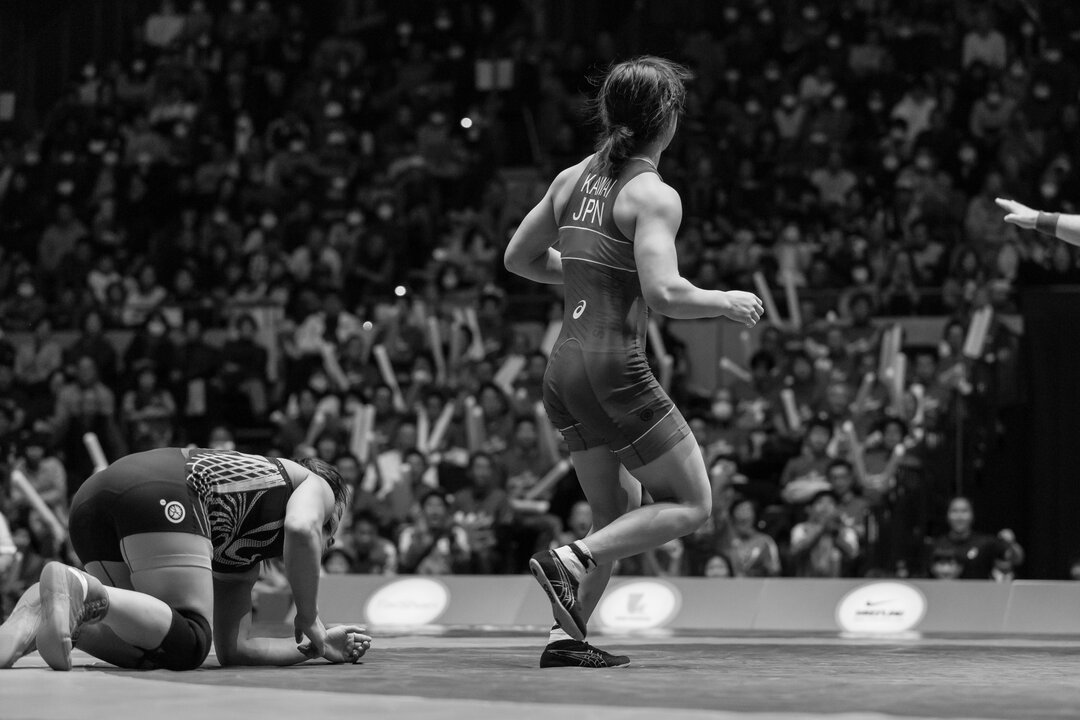 df. Xingru PEI (CHN) -by VPO1, 3-1--4.jpg) (Photo: Kawai celebrates her victory over China in the Women's World Cup finals, by Max Rose-Fyne.)
(Photo: Kawai celebrates her victory over China in the Women's World Cup finals, by Max Rose-Fyne.)
5. Sisters Kawai
In December, Risako KAWAI (JPN) and Yukako KAWAI (JPN) became the first sisters to win gold medals at the same Japan championships since the ICHO (JPN) sisters did so eleven years ago.
Their plan coming into this weekend was to have more success than they did at the 2017 World Championships. Risako, the world and Olympic gold medalist said before the tournament "I went to the world championships with my sister, but she didn't do well. This time, we want to do well together."
The pair did just that, going undefeated on the weekend, outscoring their opponents 40-5, including picking up two wins by technical superiority victories and one win by fall.
Weekly FIVE In Social Media
1. Big Move Monday!
2. Sounds of Wrestling // Behind the scenes moments as Japan defeated China in the finals of the Women's World Cup.
3. Big Move From Day 2 Of The Women's World Cup | #takasaki2018
4. Video of the Zahid VALENCIA (USA) v. Mark HALL (USA) match is circulating on Iran wrestling Instagram pages and the Iranian fans are asking why didn't Valencia get four on this takedown?
5. Erica Wiebe leads the team warm up before they step on the mat to face Belarus //

 Sarah HILDEBRANDT (USA) is the Olympic champion at 50kg. (Photo: United World Wrestling / Kadir Caliskan)
 Zaineb SGHAIER (TUN) is a two-time Olympian from Tunisia. (Photo: United World Wrestling /Amirreza Aliasgari)
 Paris Olympic silver medalist at 57kg Anastasia NICHITA (MDA). (Photo: United World Wrestling / Kadir Caliskan)
Share your thoughts.
Comments