

Top Stories of the Decade

Wrestling Fights its Way Back onto Olympic Programme

By Tim Foley

United World Wrestling President Nenad Lalovic speaks at the 125th IOC Session (AP Photo/Victor R. Caivano)

CORSIER-SUR-VEVEY, Switzerland (January 3) – The news spread quickly. On the morning of February 12, 2013, the International Olympic Committee Executive Board voted that wrestling be eliminated from the Olympic Programme. The 2016 Rio Olympic Games would be the sport’s last as a member of the Olympic family.

By early afternoon stories had run on every major international wire and sports website informing the worldwide wrestling community of the sport’s unlikely elimination from the Olympic Games. With the information came an immediate and worldwide mobilization effort aimed at earning back wrestling’s position on the Olympic programme.

Reacting to the news, the FILA bureau met in Thailand to decide next steps. It was apparent that there had been missed signs and opportunities for organizational improvement and the bureau moved quickly to elect a new president, ultimately choosing Serbian businessman Nenad Lalovic. Two months later Lalovic was elected interim president during an extraordinary Congress in Moscow and set the tone of hard work and cooperation that would ultimately prove successful in helping the sport recapture its spot in the Olympic Games.

“What goes on in this room today and the days that follow will determine if we are an Olympic sport after 2016. We have been given a strong message by the IOC.  How we answer that message will determine if our future includes the Olympic Games.  We need to convince the IOC that we will listen to them.  We are strong enough to change,” said Lalovic.

By June there were promotional events being held around the globe. In Japan a petition was signed with more than 1 million signatures. The United States and Russia raised millions of dollars to ensure additional promotion of values, consultation for a reshaping of the sport, and the creation of marketing and media departments.

In the midst of the upheaval the wrestling community had been given an opportunity. Shortly after the 125th IOC Session in September 2013 -- where members would vote to eliminate wrestling -- there would be a second vote allowing a new sport to earn its place on the programme. Wrestling was eligible for that slot, which allowed Lalovic and the wrestling community to focus its campaign on earning enough votes to win back the sport’s position in the Olympic Games.

The IOC has requests and Lalovic -- along with newly inspired cadre of wrestling leaders -- made the changes required to comply with good governance. One of the most pressing requests was that an effort be made for greater gender equity. Wrestling answered by expanding women’s wrestling to six weight categories to match with both Greco-Roman and men’s freestyle.

Competition rules were deemed too complicated for fans to follow so a new set was developed which simplified and focused action.

Women needed more representation in leadership positions. The referee body was to be separated from bureau control. Anti-doping education and enforcement were increased, and sport presentation was professionalized. As overhauls go, the renovation for wrestling would need to be complete.

On September 8, 2013 the 125th IOC Session took account of wrestling’s myriad initiatives and improvements and voted on whether or not to allow the sport back on to the programme for 2020 and beyond.

Wrestling – who faced competing bids from Squash and Baseball/Softball -- received 49 votes in the first ballot, which was enough to be awarded its position back in the Olympic Games.

"Today is the most important day in the 2,000-year history of our sport," Lalovic told the media in 2013. "We feel the weight of that history. Remaining on the Olympic programme is crucial to wrestling's survival."

From left to right: Jim Scherr, Daniel Igali, Lise Legrand, Carol Huynh and Nenad Lalovic were instrumental in getting wrestling back on the Olympic Programme (AP Photo/Victor R. Caivano)

With the vote wrestling returned to the Olympics, but the energy -- the drive the change --wasn’t to wane.

"With this vote, you have shown that the steps we have taken to improve our sport have made a difference,” Lalovic said in addressing media after the 2013 vote. "I assure each of you that our modernization will not stop now. We will continue to strive to be the best partner to the Olympic movement that we can be."

Since 2013 the sport has continued to improve, develop, and grow. From a modernized development department to the inclusion of more women in leadership positions, and the signing of partnership, sponsor, TV and streaming deals –progress and innovation are at the center of the sport’s future.

FILA is now ‘United World Wrestling’ an organization with fresh branding and worldwide marketing initiatives. Gone are the yellow mats, replaced with eye-friendly deep blue with orange accents. The new rules are still creating some of the most entertaining sporting moments in the world, and more women have become top-of-the-fold superstars both inside the wrestling community and in the wider sports media.

United World Wrestling President Nenad Lalovic was elected to the same IOC executive board that had voted to eliminate the sport only five years before

President Lalovic has increased participation United World Wrestling’s cooperation with the IOC and was added as a member in 2015. In 2018 he was elected to the same IOC executive board that had voted to eliminate the sport only five years before.

“We can never forget the mistakes of our past,” said Lalovic. “But at the end of the decade it’s impossible to not feel optimistic. Our sport is the strongest it’s ever been, and we are excited for the 20’s so we can showcase our wrestlers in Tokyo, Paris, and Los Angeles. Wrestling is now and will always be part of the Olympic programme.”
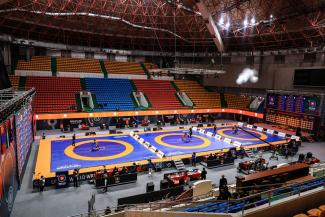

#wrestlebishkek

Asian Championships: Iran Puts Four into Greco-Roman Finals

By Ken Marantz

BISHKEK, Kyrgyzstan (April 6) – On an opening day bereft of big surprises, the Iranians were their usual dominant selves, while local hero Azkhol MAKHMUDOV (KGZ) sent the partisan crowd into a frenzy by doing what he does best.

Amin MIRZAZADEH (IRI) and fellow reigning world champion Gholamreza FAROKHI (IRI) were among four Iranians who qualified for the finals in the five Greco-Roman weight classes in action on the first day of the Asian Championships on Monday in Bishkek.

For the first time, the two-day format for all weight classes is being used at the Asian Championships, so that the five divisions on the first day were competed only through the semifinals.

Amin MIRZAZADEH (IRI)Amin MIRZAZADEH (IRI) turns Minseok KIM (KOR) during the 130kg semifinal at the Asian Championships. (Photo: United World Wrestling / Kostadin Andonov)

Mirzazadeh’s march toward a fourth Asian gold at 130kg over a seven-year span could not be regarded as unscathed – he was on the receiving end of a painful head butt in his 8-0 semifinal victory over Minseok KIM (KOR).

Other than that, it was smooth sailing as the Paris Olympic bronze medalist and two-time world champion advanced with a pair of wins by technical superiority.

Mirzazadeh and Farokhi were joined in the finals by Erfan JARKANI (IRI) and Ali OSKOU (IRI) as Iran looks on track to surpass its 2025 gold medal tally of five in Amman, Jordan.

“We were expecting Farokhi and Mirzazadeh to reach the final, but over the last two years, both Jarkani and Oksou have improved a lot and good results were expected from them and they showed that,” Iran head coach Hassan RANGRAZ said. “Hopefully, tomorrow also our wrestlers will achieve good results.”

Against Kim, Mirzazadeh jumped out to a 5-0 lead with a pair of gut wrenches in par terre. In the second period, Kim rose his head as Mirzazadeh approached, causing a collision that left both rubbing their wounds.

Kim was assessed a 2-point penalty, and when a Korean challenge of the call was denied, that gave the Iranian his eighth and decisive point.

In the final, Mirzazadeh will face a newcomer to the Asian scene, former Russian national champion Rafael TSITSUASHVILI (UZB), who advanced with a 7-2 victory over two-time bronze medalist Yuta NARA (JPN).

Gholamreza FAROKHI (IRI)Gholamreza FAROKHI (IRI), the world champion at 82kg, defeated Sunil KUMAR (IND) in 87kg semifinals at the Asian Championships. (Photo: United World Wrestling / Kostadin Andonov)

In one of those blink-and-you-missed-it dominant victories, Farokhi swiftly powered to an 8-0 victory over three-time Asian medalist Sunil KUMAR (IND) to advance to the 87kg final.

Farokhi, last year’s world champion at 82kg who has not lost an international match since 2022, shrugged Kumar by to get behind, then used an arm lock for four quicksilver back-and-forth exposures to end the match in 37 seconds.

In the final, Farokhi will take on world bronze medalist Asan ZHANYSHOV (KGZ), who put together a slightly less dominant 8-0 victory over Nursultan TURSYNOV (KAZ) to become one of three wrestlers from the host country to make the finals.

Zhanyshov, a two-time Asian U23 champion, finished up the win with a go-behind takedown to top Tursynov, who has three Asian medals over a 10-year span – from a gold in 2014 to silvers in 2015 and 2023.

Akzhol MAKHMUDOV (KGZ)Akzhol MAKHMUDOV (KGZ) launches Doniyorkhon NAKIBOV (UZB) for four points during the 77kg semifinals in Bishkek. (Photo: United World Wrestling / Kostadin Andonov)

The biggest cheers of the night at the new Zhastyk Arena came in response to the exploits at 77kg of Makhmudov, who first stole the spotlight when he won the first of his three Asian golds in 2018 across the street at the Soviet-era Kojomkul Sports Palace.

Facing 2024 Asian bronze medalist Doniyorkhon NAKIBOV (UZB), Makhmudov got the first shot at par terre and took full advantage, thrilling the crowd with not one but two powerful reverse body lifts in which he flipped his opponent over like a pancake on the griddle.

Makhmudov, a two-time world champion and two-time Olympic medalist, began the year on a sluggish note, falling in the 82kg quarterfinals of the Tirana Ranking Series tournament in February to Tunjay VAZIRZADE (AZE).

But back at his usual weight, Makhmudov is looking more like his old self – and he’ll need to be in that form in a challenging final against Iran’s Oskou, this year’s Zagreb Ranking Series champion and a 2024 world U23 bronze medalist.

Oskou had a pair of four-point throws and, while having to fight off his back when one roll attempt was stopped, still managed to forge a solid 13-3 victory over AMAN (IND) in the other semifinal.

Erfan JARKANI (IRI)Erfan JARKANI (IRI) battles it out with Islomjon BAKHRAMOV (UZB) in the 63kg semifinal. (Photo: United World Wrestling / Kostadin Andonov)

At 63kg, Zagreb Open champion and 2024 world U23 and U20 bronze medalist Jarkani held off former Asian champion Islomjon BAKHRAMOV (UZB) in a 5-3 win to advance to the final in his senior Asian debut.

Jarkani opened with a takedown, then quickly went up 5-0 when he received single points for passivity, fleeing and an unsuccessful challenge.

In the second period, Bakhramov showed the fight that led him to the 60kg gold in 2019, but could only manage a single gut wrench from par terre to fall short of victory.

Bakhramov, a world bronze medalist in 2023, still has a chance for his fourth career Asian medal and third bronze.

Jarkani will battle for the gold against Aftandil TAALAIBEK UULU (KGZ), who become the first wrestler from the home team to make the finals when he bulldozed his way to a 10-0 victory over Azatjan ACHILOV (TKM) in the other semifinal.

Taalaibek Uulu started the rout with a four-point arm throw onto which a challenge point was added. A passivity call put Taalaibek Uulu on top in par terre, and he hit his second four-pointer of the match to end it at 2:05.

Ikhtiyor BOTIROV (UZB)Ikhtiyor BOTIROV (UZB) raises the hand of Ulan MURATBEK UULU (KGZ) after beating the home wrestler in the 55kg semifinal. (Photo: United World Wrestling / Kostadin Andonov) 

At 55kg, two-time bronze medalist Ikhtiyor BOTIROV (UZB) shrugged off the vocal partisan crowd and a potentially costly penalty against 2024 bronze medalist Ulan MURATBEK UULU (KGZ), riding a five-point first period to a 5-3 victory and a place in tomorrow’s final.

Botirov, the silver medalist in Zagreb, reeled off a pair of gut wrenches from par terre for a 5-0 lead. In the second period, Muratbek Uulu was put on top and before the action even started, Botirov was assessed a two-point penalty for moving too soon.

Despite the crowd’s efforts to spur their wrestler on, Botirov withstood Muratbek Uulu’s late attacks and assured he will improve on the bronze medals he won last year and in 2023 by making the final, where he will face LALIT (IND).

Botirov earlier defeated the only Iranian to not make the final on the day, Hajiali HOSSEINVAND (IRI), in the quarterfinals.

“Hosseinvand, too, should have been in the final given his recent performances, but it was unfortunate that he lost 8-0 [officially 10-0] against the Uzbekistan wrestler,” Rangraz added. “He beat him in February and he deserved to reach the final.”

LALIT (IND)LALIT (IND) reached the 55kg final after beating Houying SHI (CHN), 11-3. (Photo: United World Wrestling / Amirreza Aliasgari)

Lalit put himself in position to become just the fourth Asian champion from India in Greco and first since 2020 when he battled back after losing the lead to defeat world bronze medalist Huoying SHI (CHN) 11-3.

Lalit, who likes to use a standing roll through from par terre, hit the move to take a 3-1 lead in the second period, but got stuck when he tried it again and Shi got around front, clamped on a front headlock and bulled Lalit over to go ahead 3-3 on criteria.

But Lalit struck back right away with a slick duck under for a takedown, then went to the roll through for two more, with an unsuccessful challenge point tacked on. A stepout and a defensive takedown gave Lalit the win by technical superiority as time ran out.

Photo

RESULTS

55kg
GOLDLALIT (IND) vs. Ikhtiyor BOTIROV (UZB)

SF 1: Ikhtiyor BOTIROV (UZB) df. Ulan MURATBEK UULU (KGZ), 5-3
SF 2: LALIT (IND) df. Huoying SHI (CHN), 11-3

63kg
GOLD: Aftandil TAALAIBEK UULU (KGZ) vs. Erfan Behnam JARKANI (IRI) 

SF 1: Erfan JARKANI (IRI) df. Islomjon BAKHRAMOV (UZB), 5-3
SF 2: Aftandil TAALAIBEK UULU (KGZ) df. Azatjan ACHILOV (TKM), 10-0

77kg
GOLD: Ali OSKOU (IRI) vs. Akzhol MAKHMUDOV (KGZ) 

SF 1: Akzhol MAKHMUDOV (KGZ) df. Doniyorkhon NAKIBOV (UZB), 9-0
SF 2: Ali OSKOU (IRI) df. AMAN (IND), 13-3

87kg
GOLD: Asan ZHANYSHOV (KGZ) vs. Gholamreza FAROKHI (IRI)

SF 1: Gholamreza FAROKHI (IRI) df. Suni KUMAR (IND), 8-0
SF 2: Asan ZHANYSHOV (KGZ) df. Nursultan TURSYNOV (KAZ), 8-0

130kg
GOLD: Amin MIRZAZADEH (IRI) vs. Rafael TSITSUASHVILI (UZB) 

SF 1: Rafael TSITSUASHVILI (UZB) df. Yuta NARA (JPN), 7-2
SF 2: Amin MIRZAZADEH (IRI) df. Minseok KIM (KOR), 8-0