#development

Jordan hosts coaching and referee courses

By United World Wrestling Press

AMMAN, Jordan (August 29) -- Jordan Wrestling Federation hosted a series of education courses for their coaches and referees between August 5-17 in Amman. These courses were conducted in conjunction with United World Wrestling, Olympic Solidarity, and the Jordan Wrestling Federation.

The coaching courses were led by Ahmed KHEDHRI (TUN) while the referee course was led by UWW Referee Commission vice-president Kamel BOUAZIZ (TUN).

The first course conducted was the Introduction to Referee Course from August 5-7. Forty participants participated in the course which included six women referees. The participants learned the foundations of what it takes to be a successful referee.

The areas covered during the course included: the safety of the athletes, evaluation of holds, referee mechanics, positioning, and controlling the bout. The participants were active during the course and were able to practice their skills through practical evaluations.

JordanThe coach's course in Amman. (Photo: United World Wrestling)

“It was an excellent training course as all the participants are happy with it and wish to repeat such courses," Bouaziz said. "Members of the Jordan Federation and Olympic Committee expressed their thanks to the International Olympic Committee, UWW and the IF's development department for their great contribution and keenness to develop wrestling in the Kingdom of Jordan.”

Following the referee course, Khedri led 40 participants in the Introduction to Coaching and Safety Course (Level 1). The course included nine women [coaches and athletes] and 31 men [coaches, PE teachers, and athletes].

All participants learned the foundations of being a successful coach. They focused on the following areas: discovery games, introducing a new technique, coaching skills, giving feedback, risk management, age and developmental stage characteristics. During the course, the coaches actively practiced and developed their skills through practical evaluations.

“The atmosphere was distinguished, based mainly on teamwork, involvement and practice of all participants individually and by group system,” Khedhri said.

JordanA competition was held after the completition of both the courses. (Photo: United World Wrestling)

Following the completion of the two courses, the Jordan Wrestling Federation hosted a competition that allowed the referees and coaches to practice the skills that they learned. This competition had 80 boys and 16 girls participating which allowed 87 bouts to be wrestled.

After the competition, Khedhri conducted the Introduction to Practice Planning Course (Level 2). This course had 45 coaches participating [nine women and 36 men].

During this course, the participants learned the foundations of planning effective training sessions. They discussed the general framework for practice plans, risk management strategies in planning, creating activities during practice, video analysis, and effective time management. The participants were able to create practice plans that they could use in upcoming training.

“They were outstanding courses and a convincing performance from all the participants," Khedhri said. "The participants expressed the improvement of their knowledge and their desire to continue to participate in such courses and along with a commitment of the Jordan Federation, which expressed their complete satisfaction and thanks to Olympic Solidarity, the Jordanian Olympic Committee, and the UWW Development department, confirming their continued hard work for the benefit of Jordanian wrestling."


#JapanWrestling

Ono Interview: On Comeback, Penn State, Folkstyle, 2028 LA Olympics

By Vinay Siwach

TOKYO (May 24) -- Where is Masanosuke ONO (JPN)?

A question that has intrigued both fans and wrestlers alike as Ono continues to missing from international wrestling since he became the world champion at 61kg in 2024.

Ono watched the Meiji Cup 2026 in Tokyo as he was in Japan to change his United States visa. Since he did not participate in the 2025 Emperor's Cup, Ono was ineligible to participate in the Meiji Cup.

 United World Wrestling caught up with Ono on the sidelines of the Meiji Cup in Tokyo. Ono talks about his comeback, plan for 2028 Los Angeles Olympics, life at Penn State and more:

UWW Plus

Excerpts:

- Why did you not participate in the Meiji Cup

Ono: I suppose it’s only natural that I can’t play because I don’t have the right to do so. That’s just the way things are in Japan. I’m aiming to make a comeback so that I can play in the next Emperor’s Cup and Meiji Cup. This has been a good period of preparation for that.

- How are your preparation for the comeback?

Ono: I’m feeling pretty much back to normal now, so I’m absolutely fine. It’s just that I haven’t competed much since the World Championships ended about two years ago, and there’s a part of me that simply can’t suppress the urge to get back out there. So I’m really looking forward to getting back into competition soon and giving it my all.

- When will you compete next?

Ono: I’ll be aiming to qualify [for Emperor's Cup]. As for the weight class, I’m thinking of competing in the 61kg category at the Shakaijin Championships. [The Shakaijin Championships will be held on July 11]. Once I’ve qualified, I’m not quite sure yet whether I’ll move down a weight class, stay in the same one, or move up, but I’m planning to set myself some clear goals.

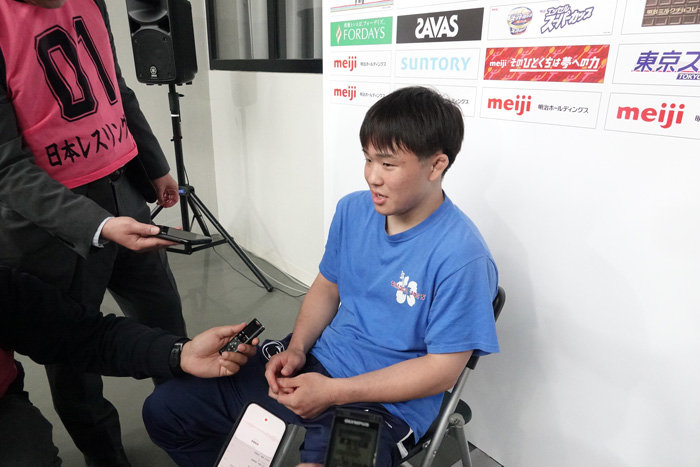
Masanosuke ONO (JPN)Masanosuke ONO (JPN) giving interview on the sidelines of the Meiji Cup. (Photo: wrestling-spirits.jp / Ikuo Higuchi)
- How challenging life is at Penn State in the United States?

Ono: I imagine there are plenty of challenges. The rules of wrestling are different there, so there’s a lot to learn. I’m always being taught and helped by others. When it comes to what I’ve actually taken on board, it’s obviously wrestling. As for other aspects of school life, I wasn’t really the type who was naturally good at studying. I’m currently studying philosophy at a university in the United States, and whilst it’s a bit tricky, I’m doing my best in my own way.

- What is your daily routine?

Ono: I have practice in the morning, then I go to lessons, then there’s another practice session around midday, and then in the evening - or rather, in the late afternoon - I study with the translator.

- How's your experience at Penn State and Folkstyle?

Ono: I do a lot of Folkstyle, and I do a bit of Freestyle as well, but there’s so much to learn that I’m still very much a novice. When it comes to training, coach Cael SANDERSON, and his brother Cody, who’s also a coach, as well as Casey CUNNINGHAM and Nick LEE. Everyone, both the students and my flat mates, are really strong, so I’m learning a hell of a lot from them.

There really are so many movements that are unique to Folkstyle, I still feel a bit of a gap there. But once I’ve got the hang of it, I reckon I’ll be able to grow even more myself without losing sight of the good bits. If I just focus on that one thing, it’ll disappear, so I’m thinking I’ll keep 95 per cent of my style exactly as it is and just add a few bits here and there.

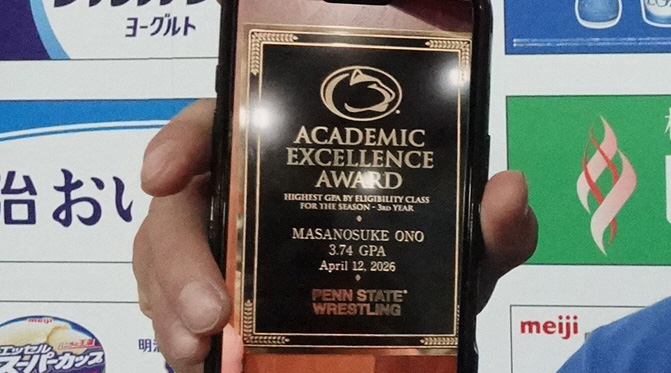
Masanosuke ONO (JPN)

Masanosuke ONO (JPN) showing his grades.

- Do you like studying Philosophy? 

Ono: Philosophy. No, I don’t really get it. (Ono scored a remarkable 3.74 CGPA in his last semester).

- Why did you decide to wrestle Folkstyle?

Ono: I want to do Folkstyle more because I like Folkstyle more than Freestyle right now. I was world champ maybe two years ago, but I know Freestyle like 95 percent but Folkstyle, that I don't know. So I mean, I just I'm excited compete Folkstyle more than Freestyle right now. 

- When will you compete for Penn State and why have you not yet?

Ono: I don't know why. If the coaches say you go, I go. I am learning for maybe just one year. It's kind of hard.

- Marcus BLAZE (USA) is your roommate. What you learn from him?

Ono: He's my roommate and in my weight. He's great guy. He's my weight maybe. I learn a lot from him. He likes pickleball. He likes something like outside. I cannot drive. I don't have license. So he drive me around there.

- If you want to go to 2028 LA Olympics, what is the path for you? If it's at 57kg, will you take inspiration from Rei HIGUCHI (JPN) who made it at 57kg for Paris?

Ono: I compete at December competition because of 2028 Olympics trial. I have to. I mean my weight like around 64kg so maybe this difficult. Living in America, when the Olympics are held here, you can’t exactly just give up on the idea of competing, you can’t just walk away from it. But when it comes to the Olympics, at 57 or 65kg, with the 8kgs mark being a key hurdle, it’s certainly a challenge. So I thought I’d just have to take it step by step, listening to my body as I go along. I’m not really that bothered about winning or losing. I just want to wrestle, so to be honest, it doesn’t really matter.

Higuchi is amazing. I am sure he is mentally tough. I like to eat and I like chipotle.

- Which weight class are you aiming for?

Ono: If [Rei] Higuchi were to join us at 57kg, I’d be absolutely chuffed. I’d be just as chuffed if we played with Higuchi at 65kg, or with [Kotaro] Kiyooka at 65kg. I’m not sure about [Toshihiro] Hasegawa, but I reckon [Rin] Sakamoto would be there. Wouldn’t it be brilliant if they all got together?